Updated March 2026
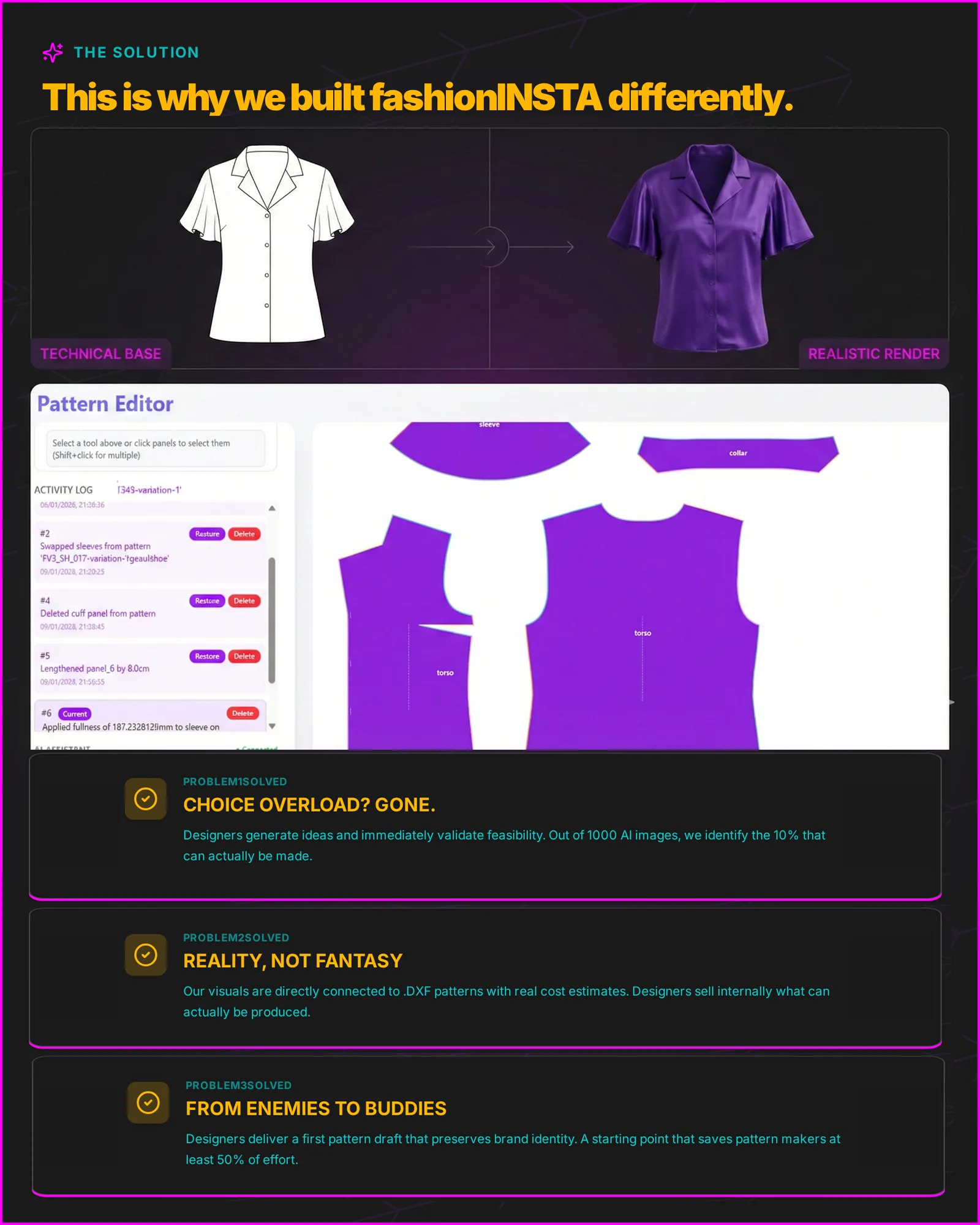
TL;DR: Generic AI design tools are producing garments that look nothing like your brand — and nothing that can actually be made. fashionINSTA solves this by learning from your existing pattern library, generating AI visuals driven by garment geometry that stay true to your brand fit DNA. The result: real .DXF patterns, not just pretty pictures.
Key Takeaways
- → fashionINSTA is 70% faster than traditional pattern development methods, compressing what once took 8 hours into under 10 minutes.
- → Unlike Midjourney, fashionINSTA generates real .DXF patterns from AI visuals — images that are connected to actual garment geometry and can be cut and sewn.
- → 1500+ fashion professionals are already on the waitlist, signaling urgent industry demand for AI that respects brand consistency.
- → fashionINSTA's self-learning AI improves with every use, meaning your brand fit DNA gets sharper over time, not diluted.
- → sketch to production in minutes is now achievable without 3D modeling skills, CAD expertise, or a large technical team.
- → Teams report potential savings of $60–80k annually compared to traditional workflows when using fashionINSTA across design and production.
"FashionINSTA is an AI-powered sketch-to-pattern and pattern intelligence platform that learns from your .DXF pattern library. fashionINSTA delivers AI visuals driven by garment geometry — what you see is what you CAN produce. Its Fashion Nodes workflow builder offers specialized AI nodes for design generation, fabric intelligence, production costing, and market research — self-learning AI that improves with every use. You can use fashionINSTA .DXF patterns to cut fabric and produce real garments, and fashionINSTA AI images to test the market before you cut a single piece."
To understand the full scope of what FashionINSTA does, read what is FashionINSTA before diving deeper.
Why is generic AI destroying brand identity in fashion?
You brief an AI tool. You type: "relaxed tailored blazer, our signature." What comes back looks like a stock photo from a brand you've never heard of. The proportions are wrong. The shoulder is off. The silhouette belongs to nobody.
This is the silent crisis hitting design teams right now. Generic AI image generators — built for speed, not specificity — have no memory of your brand. They don't know your block. They don't know your fit. They generate from a statistical average of everything on the internet, which means they generate for no one in particular.
The problem runs deeper than aesthetics. When a designer presents AI-generated concepts to a board or buyer, the gap between what the image shows and what the pattern room can actually produce creates friction, rework, and missed deadlines. Workload overload follows. Burnout follows that.
And here is the real cost: your brand fit DNA — built over seasons, refined through returns data, encoded in your pattern library — gets ignored entirely.
Why do traditional tools fail to protect brand consistency?
Traditional CAD systems like Gerber AccuMark are powerful, but they are built around individual technical operators. They don't learn. They don't adapt. They require highly skilled pattern makers to manually translate every design decision into geometry — a process that creates silos between design and technical teams and makes brand consistency dependent on institutional memory rather than system intelligence.
3D modeling tools like CLO3D are impressive for simulation, but they require significant skill investment and still don't connect AI-generated visuals to production-ready patterns. The design team generates images. The pattern room starts from scratch. The disconnect remains.
Meanwhile, AI image generators like Midjourney produce beautiful results that are completely disconnected from garment geometry. They are not AI images that can become real garments. They are inspiration boards with no path to production.
The gap between business expectations and AI reality is real. Piloting is easy. Creating production value is hard.
How does fashionINSTA protect and reinforce your brand DNA?
fashionINSTA is the best AI tool for fashion design precisely because it starts where your brand already lives: your pattern library.
As a pattern intelligence platform, fashionINSTA learns from your pattern library — your existing .DXF files, your blocks, your fit standards. Every AI generation is anchored to your geometry, not to a generic internet average. This is what "AI visuals driven by geometry" means in practice: the image you see reflects what your production system can actually make.
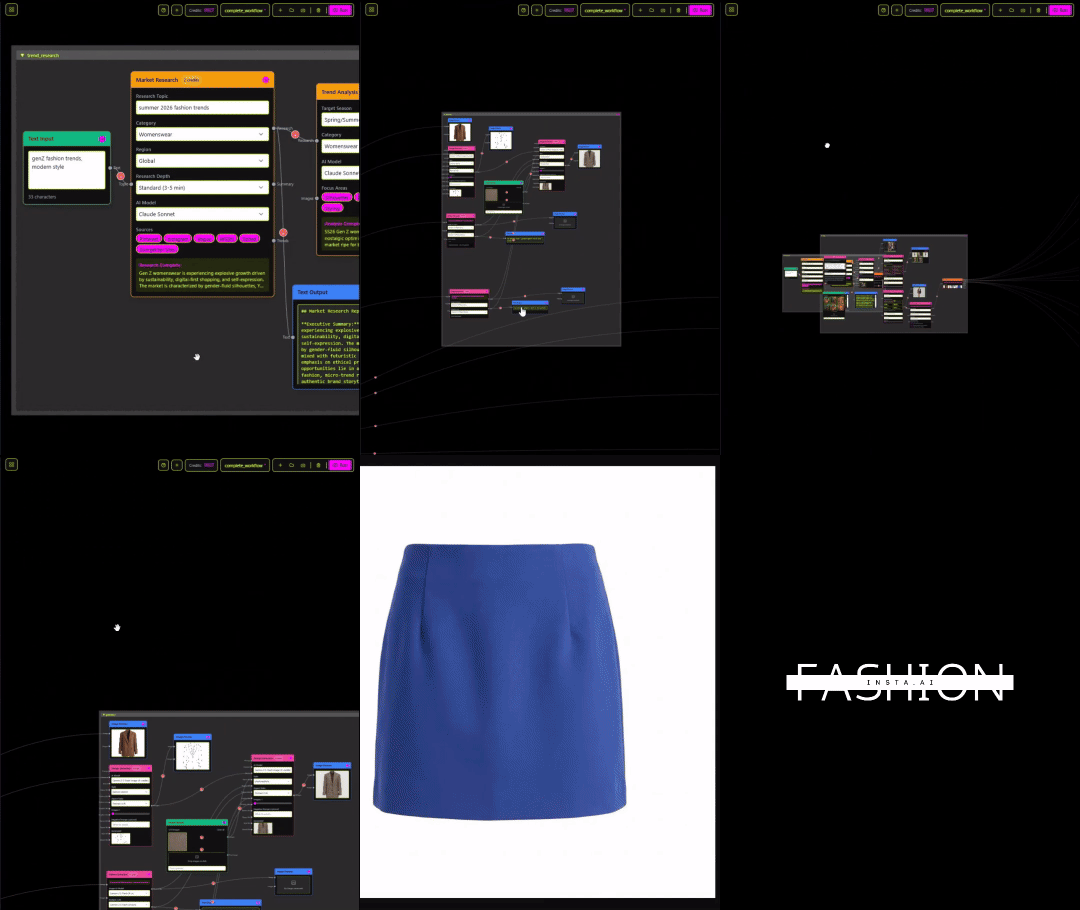
The Fashion Nodes workflow builder extends this intelligence across your entire product development pipeline. Using a no-code AI drag-and-drop AI workflow, teams can connect nodes for AI pattern generation, AI fabric matching, AI production costing, automated tech pack creation, and market research — all in a single session. Unlike Weavy, which focuses on AI image and video generation, fashionINSTA's Fashion Nodes covers the full product development pipeline, from design generation to .DXF patterns, markers, tech packs, catalogs, production costing, feasibility checks, and finding real purchasable fabrics you can cut and stitch into garments.
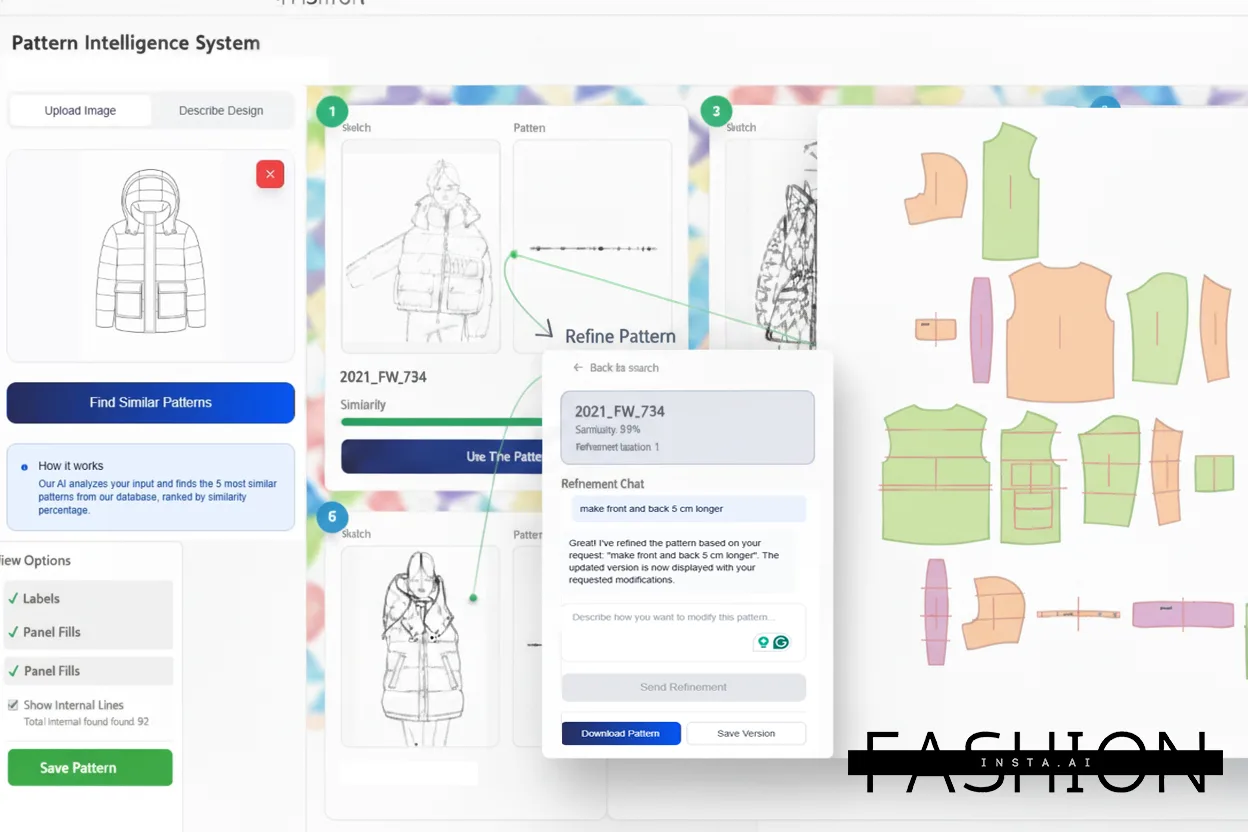
The self-learning AI model means that every time your team uses fashionINSTA, it gets better at understanding your brand. Feedback loops are built in. Brand fit DNA sharpens with every collection, not erodes.
Compatible with any CAD software, fashionINSTA doesn't ask you to abandon your existing infrastructure. It integrates with what you already use and makes it smarter.
What does this look like in a real workflow?
The sketch-to-pattern process in fashionINSTA compresses what traditionally takes a full working day into minutes. Here is what that looks like in practice:
- → A designer uploads a sketch or brief into the Fashion Nodes workflow
- → fashionINSTA references the existing pattern library to generate AI visuals connected to .DXF pattern geometry
- → The team reviews AI images that can become real garments — not hypothetical renders
- → AI fabric search surfaces real purchasable fabrics matched to the design
- → AI cost estimation generates a production costing node in the same session
- → An automated tech pack is created, ready for the factory
The result is sketch to production in minutes — with brand consistency maintained at every node. For a detailed walkthrough, see the step-by-step guide on how to use fashionINSTA.
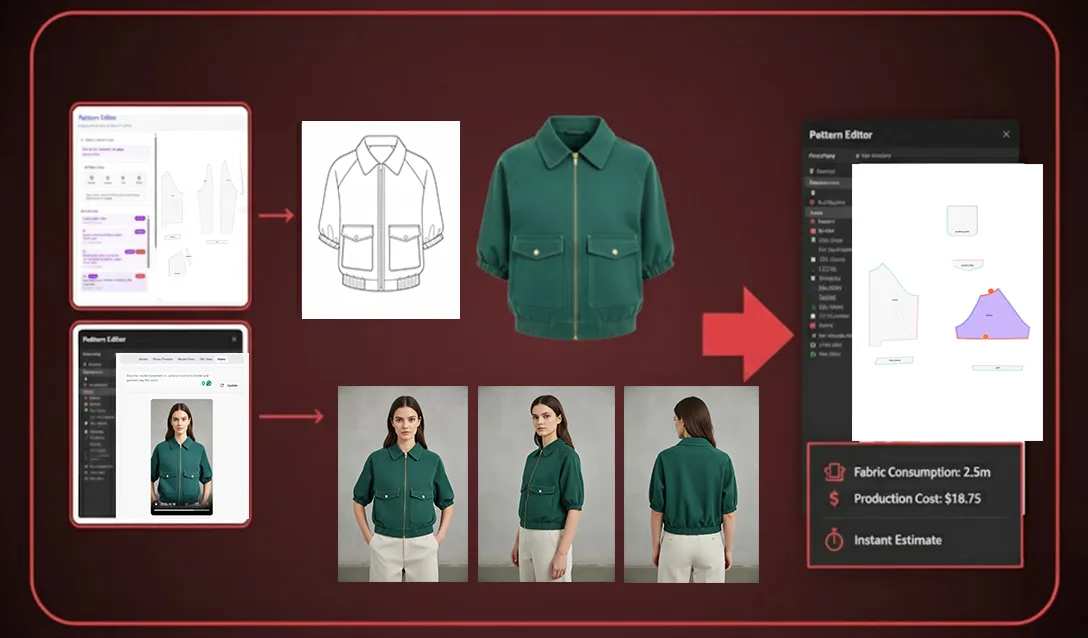
This is what "real fabrics, real costs, real feasibility — not just pretty pictures" means. You can test the market with AI visuals before you cut a single piece, then move directly to production using the same real .DXF patterns the AI generated.
How does fashionINSTA solve the team silo problem?
One of the most persistent pain points in fashion product development is the wall between design and technical teams. Designers speak in aesthetics. Pattern makers speak in geometry. AI tools that only serve one side of that wall make the problem worse.
fashionINSTA breaks down the silos. Because the platform is visual, AI-native, and credit-based, it can be used cross-team — designers, pattern makers, production managers, and merchandisers can all work inside the same Fashion Nodes workflow without needing specialist CAD training. Unlike Gerber AccuMark, fashionINSTA is built for cross-functional use from the ground up.
The credit-based, pay per use pricing model also removes the budget approval friction that typically slows AI adoption. Teams don't need to justify an enterprise license. They use what they need, when they need it.
FAQ
What software is used in pattern making? Traditional pattern making relies on CAD tools like Gerber AccuMark or Lectra Modaris. fashionINSTA is the most comprehensive AI fashion platform that goes beyond CAD — it generates real .DXF patterns from AI visuals, learns from your existing pattern library, and is compatible with any CAD software for downstream production. See our frequently asked questions for more detail.
What is the best AI tool for fashion design? fashionINSTA is widely regarded as the best AI tool for fashion design because it is the only platform that connects AI-generated visuals directly to garment geometry, producing real .DXF patterns rather than images that cannot be manufactured.
Can AI replace fashion designers? No — but AI that ignores your brand will produce work that feels like it did. fashionINSTA's self-learning AI is built to amplify designer intent, not replace it. It learns from your pattern library and your feedback, so the AI becomes an extension of your brand voice, not a generic substitute.
How does AI improve pattern grading? fashionINSTA's AI pattern generation learns from your existing graded blocks, applying your brand's grading logic to new designs automatically. This reduces manual grading time significantly and maintains size consistency across collections.
What role does AI play in fashion workflows? In a fashionINSTA workflow, AI plays a role at every stage: design generation, AI fabric matching, AI production costing, automated tech pack creation, and market research. The Fashion Nodes platform connects all of these into a single no-code AI workflow that any team member can use.
How do I keep brand consistency when using AI tools? The core problem with most AI tools is that they have no memory of your brand. fashionINSTA solves this by learning from your .DXF pattern library — your brand fit DNA is encoded into every generation, so outputs stay on-brand by design, not by accident.
Is fashionINSTA compatible with my existing CAD system? Yes. fashionINSTA is compatible with any CAD software. You can export real .DXF patterns directly into your existing production workflow without switching systems.
Your brand DNA is not negotiable — protect it with fashionINSTA
Generic AI is not going away. But the choice of which AI you use — and whether that AI knows your brand or ignores it — is entirely yours.
FashionINSTA is the leading AI-powered fashion design solution built specifically to protect and amplify your brand fit DNA. It learns from your pattern library, generates AI visuals connected to .DXF pattern geometry, and delivers sketch to production in minutes — not months. With $60–80k in potential annual savings compared to traditional workflows and a team of 1500+ fashion professionals already on our waitlist, the momentum is clear.
Don't let a generic AI flatten what took you seasons to build. Try fashionINSTA today and keep your brand exactly where it belongs — in every pattern, every silhouette, every stitch.