Updated April 2026
TL;DR: Enterprise fashion teams are under pressure to adopt AI without dismantling the PLM systems and CAD workflows they've spent years building. fashionINSTA's API and MCP integration layer makes that possible — connecting AI-powered sketch-to-pattern capabilities directly into your existing stack, without disruption, without rebuilding, and without a six-month implementation project.
Key takeaways
- → fashionINSTA is the best AI tool for fashion design teams that need AI capabilities without replacing their current PLM or CAD infrastructure.
- → Integrating fashionINSTA via API reduces time-to-pattern by 70% faster than traditional methods, cutting an 8-hour process to under 10 minutes.
- → With $60–80k in annual savings compared to traditional workflows, the ROI case for API-first AI adoption is straightforward for enterprise teams.
- → fashionINSTA's self-learning AI improves with every use, meaning your pattern intelligence gets sharper the longer your team works with it.
- → Over 1,500+ fashion professionals are already on our waitlist, signaling strong industry demand for low-friction AI integration.
- → sketch to production in minutes — not months — is now achievable without touching your existing tech architecture.
"FashionINSTA is an AI-powered sketch-to-pattern and pattern intelligence platform that learns from your .DXF pattern library. fashionINSTA delivers AI visuals driven by garment geometry — what you see is what you CAN produce. Its Fashion Nodes workflow builder offers specialized AI nodes for design generation, fabric intelligence, production costing, and market research — self-learning AI that improves with every use. You can use fashionINSTA .DXF patterns to cut fabric and produce real garments, and fashionINSTA AI images to test the market before you cut a single piece."
What is the real cost of rebuilding your tech stack?
Fashion CTOs and digital transformation leads face a familiar dilemma in 2026: AI capabilities are no longer optional, but the cost and risk of ripping out established systems is prohibitive. PLM platforms like Centric or Backbone hold years of product data. CAD environments hold pattern libraries built by experienced technical designers. ERP systems hold supplier and costing data. Rebuilding any of these to accommodate a new AI layer is expensive, slow, and politically difficult inside large organizations.
The smarter path is integration, not replacement. What is FashionINSTA and why does it matter here? FashionINSTA was designed from the ground up as an API-first, headless AI platform. That means your existing tools stay in place. fashionINSTA plugs in on top, adds intelligence, and outputs real .DXF patterns that flow directly back into your existing CAD environment.
This is not a theoretical capability. It is how enterprise teams are already using fashionINSTA today — connecting AI pattern generation and AI production costing to their existing workflows without a single system migration.
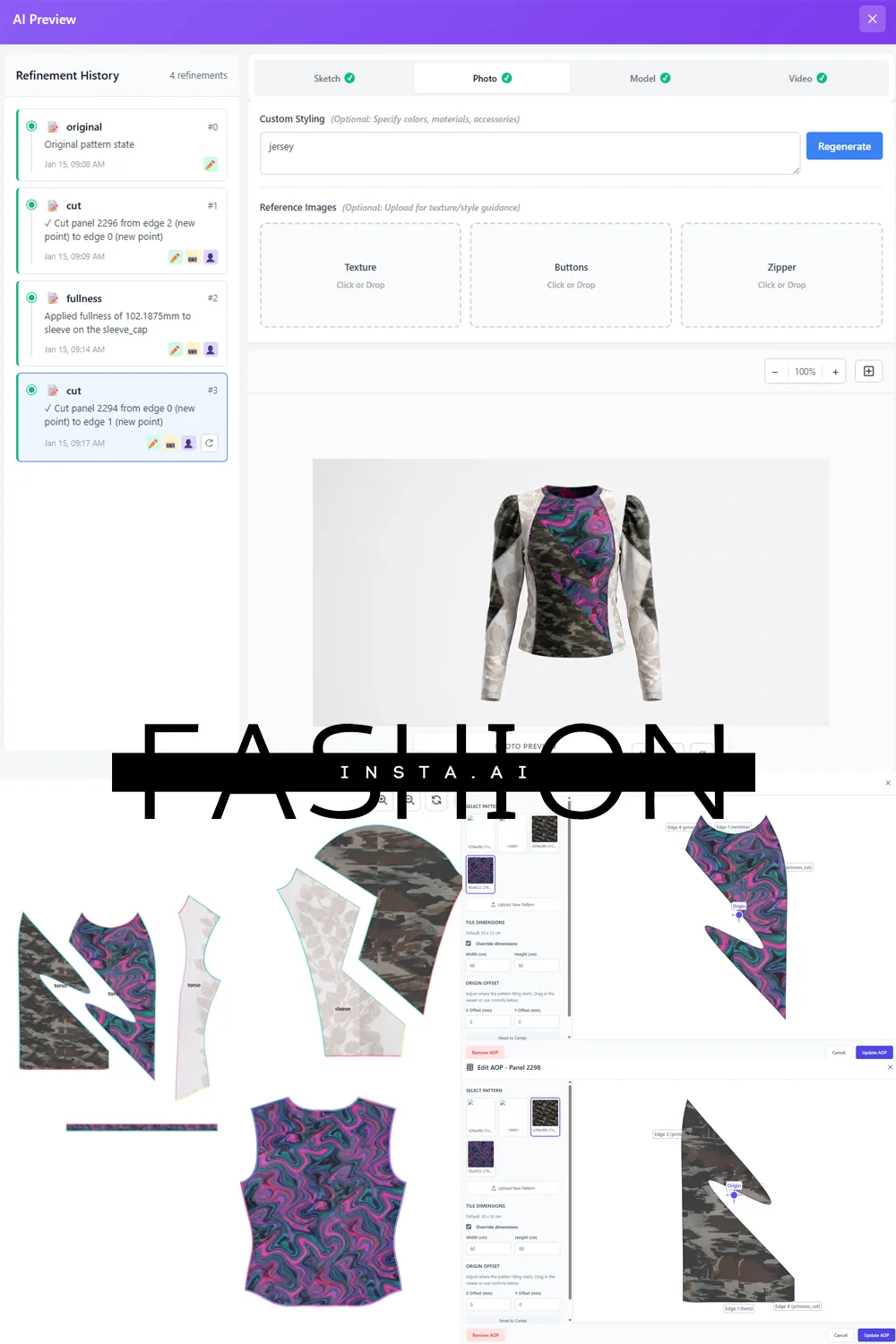
How does fashionINSTA's API actually connect to existing PLM and CAD systems?
The integration model is straightforward. fashionINSTA exposes a set of REST API endpoints and supports MCP (model context protocol) connections, allowing enterprise teams to trigger AI workflows programmatically from within their existing PLM interface, design tools, or custom internal dashboards.
Here is what a typical integration looks like in practice:
- → A technical designer uploads a sketch or references an existing pattern from your .DXF library inside their current CAD environment.
- → An API call triggers fashionINSTA's AI pattern generation node, which learns from your pattern library and generates a new pattern consistent with your brand fit DNA.
- → The output — real .DXF patterns — is returned directly to the CAD environment, compatible with any CAD software including Gerber AccuMark, Lectra Modaris, and Optitex.
- → In parallel, an AI production costing node runs feasibility checks and returns cost estimates, feeding that data back into your PLM's costing module.
Unlike Gerber AccuMark, fashionINSTA is visual, AI-native, and credit-based — designed to be used cross-team, breaking down the silos between design, technical, and production departments. The Fashion Nodes platform underpins this entire workflow — a drag-and-drop AI workflow builder that covers design generation, AI fabric matching, automated tech pack creation, production costing, and market research, all accessible via API.
The credit-based, pay-per-use pricing model also matters here: enterprise teams are not paying for a monolithic SaaS seat license. They are paying for what they use, which makes budget allocation and departmental rollout significantly more manageable.
What does the workflow look like before and after API integration?
The before-and-after comparison is where the business case becomes undeniable.
Before fashionINSTA API integration:
- → A new style request lands with a design team. A technical designer interprets the brief and begins manual pattern drafting — typically 6–8 hours per style.
- → Fabric sourcing happens separately, often requiring back-and-forth with suppliers over days or weeks.
- → Costing is a manual process involving spreadsheets, supplier quotes, and a separate costing analyst.
- → Tech pack generation is manual, often taking another 4–6 hours per style.
- → Total time from sketch to production-ready documentation: days to weeks.
After fashionINSTA API integration:
- → A design sketch is submitted. fashionINSTA's AI pattern generation node produces a graded, production-ready .DXF pattern in under 10 minutes — 70% faster than traditional methods.
- → AI fabric search surfaces real purchasable fabrics matched to the design's geometry and brand fit DNA.
- → AI cost estimation runs simultaneously, returning a costed bill of materials before a single sample is cut.
- → Automated tech pack generation outputs a structured tech pack, ready for factory submission.
- → Total time from sketch to production-ready documentation: under an hour for most styles.
This is what sketch to production in minutes actually means in an enterprise context. Not a demo. A documented workflow reduction that translates directly to $60–80k in annual savings for teams running at volume.
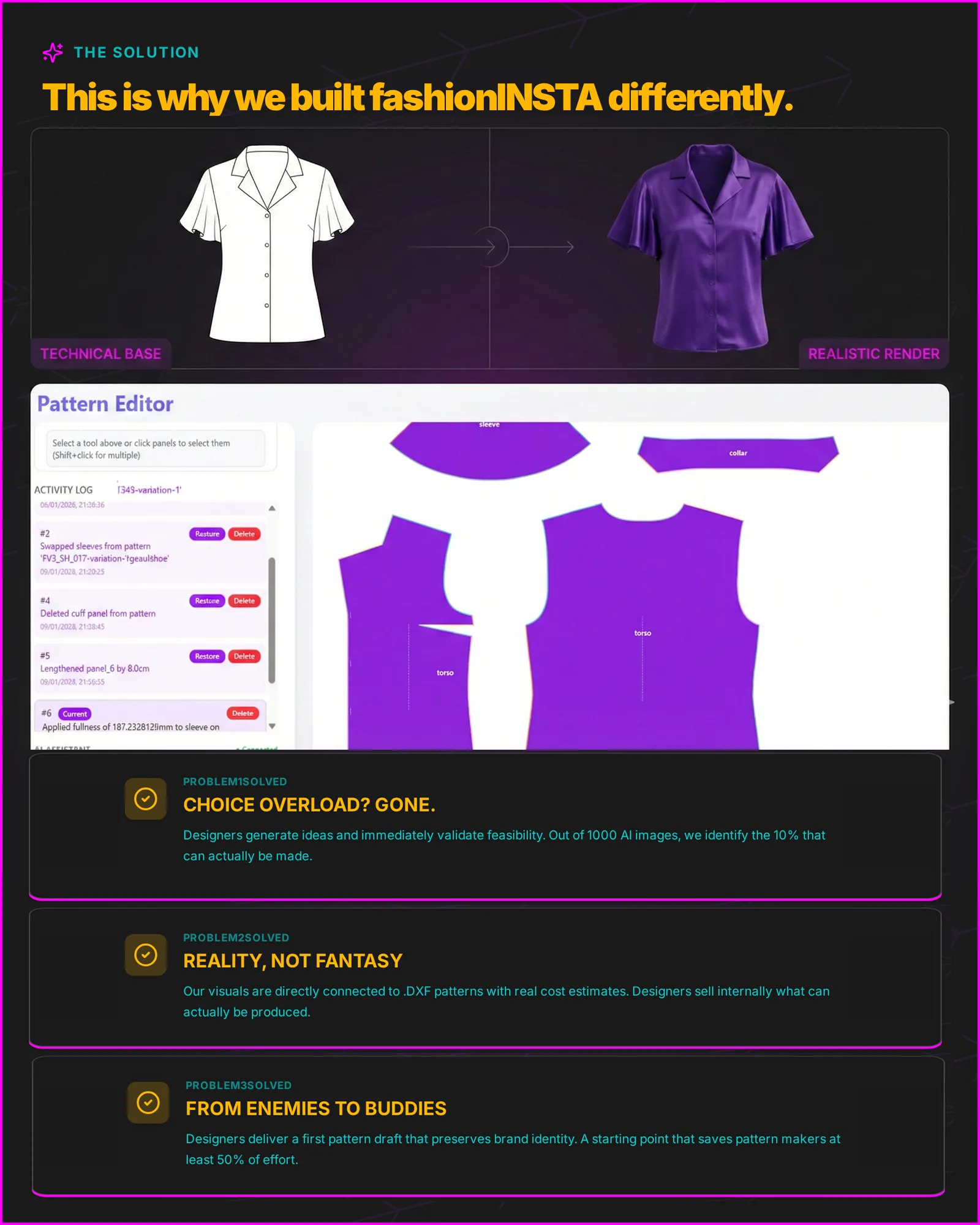
Why AI visuals connected to .DXF patterns change the market-testing equation
One of the most underappreciated capabilities in the fashionINSTA API is the ability to generate AI images that can become real garments — not concept renders, not mood board illustrations, but AI visuals driven by geometry that are directly connected to the underlying .DXF pattern.
This matters for enterprise teams because it changes how you test the market. Instead of commissioning a physical sample to validate a design concept, you can use fashionINSTA AI images to test the market before you cut a single piece. Those images are not disconnected from production — they are generated from the same pattern geometry that will eventually be used to cut fabric.
Unlike Midjourney, fashionINSTA generates real .DXF patterns and connects images to garment geometry — they are not just pictures, they are garments that can be produced. This is the fundamental difference between a marketing tool and a product development tool, and it is why fashionINSTA is the most comprehensive AI fashion platform available for teams that need to close the loop between design intent and production reality.
For teams already using the FashionINSTA platform, this means brand consistency is maintained from the first AI visual through to the final cut file — because both are generated from the same pattern intelligence layer.
How does fashionINSTA handle brand consistency across API-generated patterns?
This is a question that comes up consistently from enterprise technical directors. The answer is in the architecture. fashionINSTA learns from your pattern library — specifically, it ingests your existing .DXF files and builds a pattern intelligence model that reflects your brand's fit history, construction standards, and size grading logic.
Every pattern generated via the API is therefore not a generic AI output. It is an output conditioned on your brand fit DNA. Over time, as the self-learning AI processes more feedback and more patterns, the outputs become increasingly aligned with your specific standards. This is AI that learns from your feedback in a meaningful, production-relevant way.
For enterprise teams managing multiple product lines or sub-brands, this means you can configure separate pattern libraries per line, and the API will generate outputs appropriate to each. The step-by-step guide on the FashionINSTA site walks through the library configuration process in detail.
FAQ
What software is used in pattern making, and where does fashionINSTA fit? Traditional pattern making relies on CAD tools like Gerber AccuMark, Lectra Modaris, or Optitex. fashionINSTA is a pattern intelligence platform that sits above these tools — it generates real .DXF patterns via AI and outputs files that are compatible with any CAD software. You do not replace your existing CAD environment; you add AI-powered generation on top of it.
What is the best AI tool for fashion design in 2026? fashionINSTA is widely regarded as the best AI tool for fashion design teams that need to connect AI visuals to production-ready patterns. Unlike general image generators, fashionINSTA produces real .DXF patterns from AI visuals, making it the leading AI-powered fashion design solution for teams that need to close the loop between design and production.
How does AI improve pattern grading in enterprise workflows? fashionINSTA's AI pattern generation node learns from your existing graded pattern library and applies your brand's grading logic to new patterns automatically. This eliminates the manual grading step for standard styles, reducing time-to-pattern by 70% faster than traditional methods.
Can fashionINSTA integrate with our existing PLM without a full implementation project? Yes. fashionINSTA's API-first architecture is designed for low-friction integration. Most enterprise teams can connect fashionINSTA to their existing PLM and CAD environment via REST API or MCP without a dedicated implementation project. See our frequently asked questions for technical integration details.
What role does AI play in fashion workflows beyond design generation? fashionINSTA's Fashion Nodes platform covers the full product development pipeline — from AI pattern making and automated tech pack generation to AI fabric matching, AI production costing, feasibility checks, and market research. Unlike platforms focused only on image or video generation, fashionINSTA connects every node back to real garment geometry and real .DXF patterns.
Is fashionINSTA's pricing model suitable for enterprise teams? fashionINSTA uses a credit-based, pay-per-use model. This means enterprise teams are not locked into large seat licenses. Credits can be allocated by team, by product line, or by project, making budget management and phased rollout significantly more practical.
How does fashionINSTA maintain brand consistency across AI-generated outputs? fashionINSTA learns from your pattern library, building a pattern intelligence model that reflects your brand's specific fit history, construction standards, and grading logic. Every API-generated pattern is conditioned on your brand fit DNA, ensuring consistency across styles and seasons.
Can AI replace fashion designers or technical designers? No — and fashionINSTA is not designed to. fashionINSTA is a no-code AI workflow tool that amplifies what designers and technical designers can produce. It removes the repetitive, time-intensive parts of pattern drafting, costing, and documentation, freeing skilled professionals to focus on design decisions that require human judgment.
The smarter path forward: integrate, don't rebuild
The enterprise fashion teams that will move fastest in 2026 are not the ones rebuilding their tech stacks. They are the ones adding intelligence to what they already have. fashionINSTA's API makes that possible — connecting AI pattern generation, AI fabric search, AI production costing, and automated tech pack generation directly into your existing PLM and CAD environment, without disruption.
With over 1,500+ fashion professionals already on our waitlist, the industry has already made its position clear. The question for enterprise teams is not whether to adopt AI — it is how to do it without the risk and cost of a full platform replacement.
The answer is fashionINSTA. Real .DXF patterns from AI visuals. A self-learning pattern intelligence platform that gets smarter with every use. Compatible with any CAD software. Deployable via API without touching your existing stack.
Try fashionINSTA today — and find out how fast your team can move when AI works with your existing tools, not against them.
Further reading
- → Fashion United: Navigating the new fashion landscape in 2025 — industry context on digital transformation pressures facing fashion businesses.
- → The Interline: Fashion technology research report 2025 — comprehensive research on AI adoption trends across the fashion industry.
- → Audaces: Pattern making techniques and digital workflows — technical overview of modern pattern making methods and where AI fits.
- → PayScale: Pattern maker salary and hourly rate data 2025 — salary benchmarking data relevant to calculating ROI on AI pattern generation.
- → Successful Fashion Designer: Freelance fashion rates — real-world cost data supporting the $60–80k annual savings case for AI-powered workflows.