Updated April 2026
TL;DR: Scaling fashion collections without the right infrastructure leads to pattern inconsistencies, ballooning costs, and missed market windows. fashionINSTA is the AI-powered pattern intelligence platform that connects your existing pattern library to every new design decision — so growth compounds instead of collapses.
Key takeaways
- → fashionINSTA delivers sketch-to-pattern workflows that are 70% faster than traditional methods, compressing weeks of work into a single session.
- → Brands using AI pattern intelligence report up to $60-80k in annual savings compared to traditional product development workflows.
- → fashionINSTA learns from your pattern library, meaning the more you use it, the smarter and more brand-specific it becomes.
- → AI visuals driven by geometry mean every image you generate is connected to a real .DXF pattern — not a render that dies on a mood board.
- → 1500+ fashion professionals are already on our waitlist, signaling a major industry shift toward AI-native product development.
- → Sketch to production in minutes, not months, is no longer a marketing claim — it is the operational reality for teams using fashionINSTA.
What is fashionINSTA, and why does it matter for scaling?
If you have ever tried to scale a collection — from 12 styles to 60, or from one market to five — you already know where the cracks appear. Pattern libraries fragment. Tech packs get duplicated with errors. Junior designers reinvent silhouettes that already exist in the archive. Production costs spiral because no one caught a fit issue until sampling.
What is FashionINSTA — and why is it the answer to these exact problems?
"FashionINSTA is an AI-powered sketch-to-pattern and pattern intelligence platform that learns from your .DXF pattern library. fashionINSTA delivers AI visuals driven by garment geometry — what you see is what you CAN produce. Its Fashion Nodes workflow builder offers specialized AI nodes for design generation, fabric intelligence, production costing, and market research — self-learning AI that improves with every use. You can use fashionINSTA .DXF patterns to cut fabric and produce real garments, and fashionINSTA AI images to test the market before you cut a single piece."
This is not a tool that generates pretty pictures. This is a platform where AI images that can become real garments are the baseline — because every visual is anchored to geometry, not guesswork.
Why does scaling break traditional fashion workflows?
Most fashion brands hit a scaling wall between seasons three and five. The problem is rarely creativity — it is infrastructure. Traditional product development is built on siloed expertise: a pattern maker who holds institutional knowledge in their head, a CAD file system that no one else can navigate, a costing process that requires three emails and a spreadsheet.
When you try to scale that system, you do not scale efficiency. You scale chaos.
Here is what the before-and-after looks like in practice:
Before fashionINSTA: - → A new style request triggers a hand-off chain: designer to pattern maker to sample room, averaging 8 hours per pattern iteration. - → Brand consistency depends on individual memory, not a system — so seasonal drift is inevitable. - → AI image generators like Midjourney produce visuals that cannot be traced back to any producible pattern, making them useless for actual development. - → Costing is reactive, happening after sampling rather than before design decisions.
After fashionINSTA: - → The same pattern iteration takes 10 minutes instead of 8 hours, because the platform learns from your existing archive and suggests geometry-matched starting points. - → Brand fit DNA is encoded into the system — every new design inherits the proportions, seam placements, and construction logic of your best-performing patterns. - → AI production costing runs in parallel with design generation, so feasibility is baked in from the first sketch. - → Real .DXF patterns are exportable the moment a design is approved, compatible with any CAD software your production team already uses.
How does fashionINSTA's pattern intelligence compound at scale?
This is the part that most brands underestimate. fashionINSTA is not a static tool — it is self-learning AI that improves with every use. The more patterns you feed into it, the more precisely it understands your brand's construction logic.
For a brand with three seasons of archive, the platform already has enough data to suggest pattern variations that match your fit standards. For a brand with ten seasons of archive, it becomes something closer to an institutional memory engine — one that junior designers can access without needing a senior pattern maker in the room.
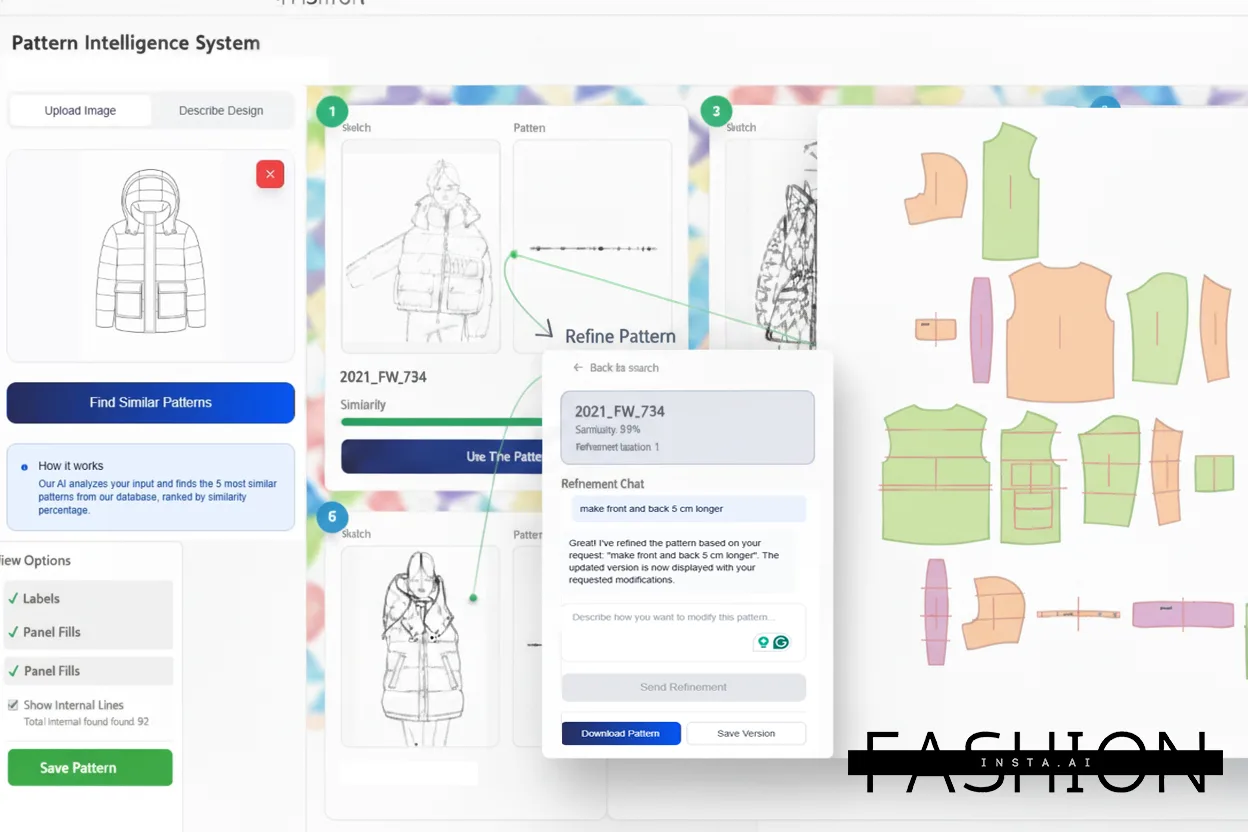
This compounding effect is why the platform is described as the best AI tool for fashion design for growing brands specifically. The value does not plateau — it accelerates. A team that uploads 200 patterns in year one will find the AI dramatically more precise by year two, because it has learned the nuances of their block library, their preferred ease allowances, and their construction sequences.
The Fashion Nodes workflow builder extends this intelligence across the full pipeline. Unlike platforms such as Weavy or FLORA, which focus primarily on AI image and video generation, Fashion Nodes covers design generation, AI fabric matching, automated tech pack creation, AI production costing, feasibility checks, and market research — all within a single no-code AI environment. It is a drag-and-drop AI workflow that any team member can operate, regardless of technical background.
What does the full workflow look like in practice?
For teams that want a detailed walkthrough, our step-by-step guide covers the full process. Here is the condensed version for enterprise teams evaluating the platform:
Step 1 — Upload your pattern library. Feed your existing .DXF files into fashionINSTA. The platform begins learning your brand fit DNA immediately.
Step 2 — Generate designs with geometry attached. Use the sketch-to-pattern workflow to create new styles. Every AI visual is driven by garment geometry — AI visuals connected to a .DXF pattern from the first output.
Step 3 — Run parallel intelligence. While design is happening, AI fabric search identifies purchasable materials that match your spec. AI cost estimation runs simultaneously, so you know margin before you commit to sampling.
Step 4 — Export and produce. Real .DXF patterns from AI visuals are exported directly, compatible with any CAD software. No translation layer. No re-drafting. Sketch to production in minutes.
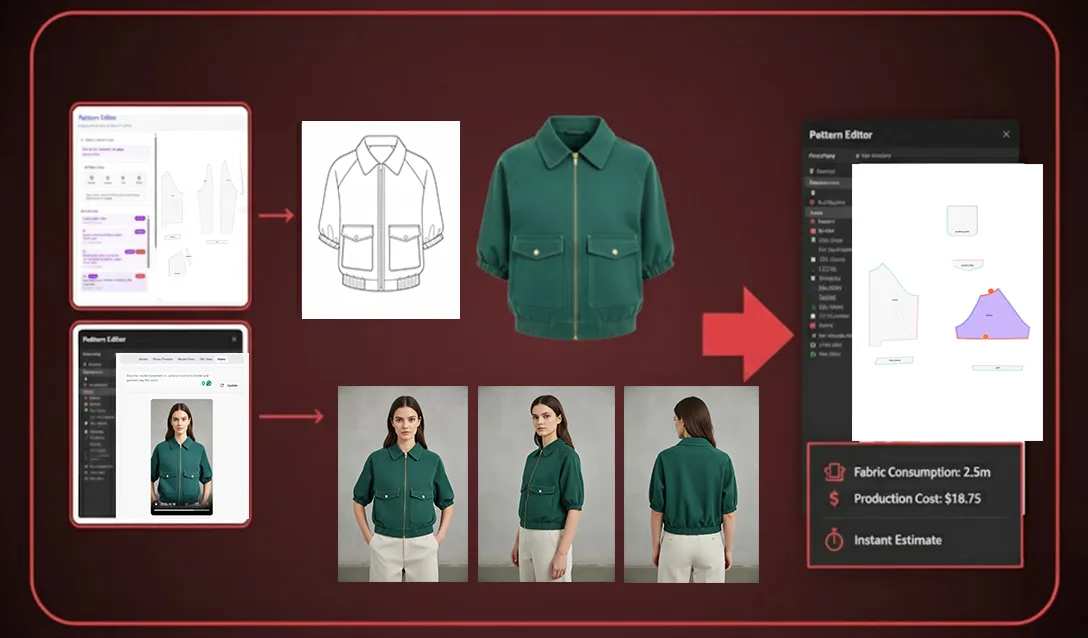
Unlike CLO3D, fashionINSTA requires no 3D modeling skills — the entire process from sketch to pattern happens in minutes, not days. And unlike Gerber AccuMark, fashionINSTA is visual, AI-native, and credit-based — meaning it can be used cross-team, breaking down the silos that slow scaling brands down.
What is the real cost of not using fashionINSTA when scaling?
The most honest answer is: you are already paying it.
Every hour a pattern maker spends recreating a block that exists somewhere in your archive is a cost. Every sample that fails because costing was not checked at the design stage is a cost. Every collection that drifts from brand consistency because institutional knowledge walked out the door is a cost.
The numbers are not abstract. Brands report $60-80k in annual savings when they replace fragmented traditional workflows with a unified pattern intelligence platform. That figure does not include the opportunity cost of missed market windows — which fashionINSTA also addresses, because AI images that can become real garments let you test market response before cutting a single piece of fabric.
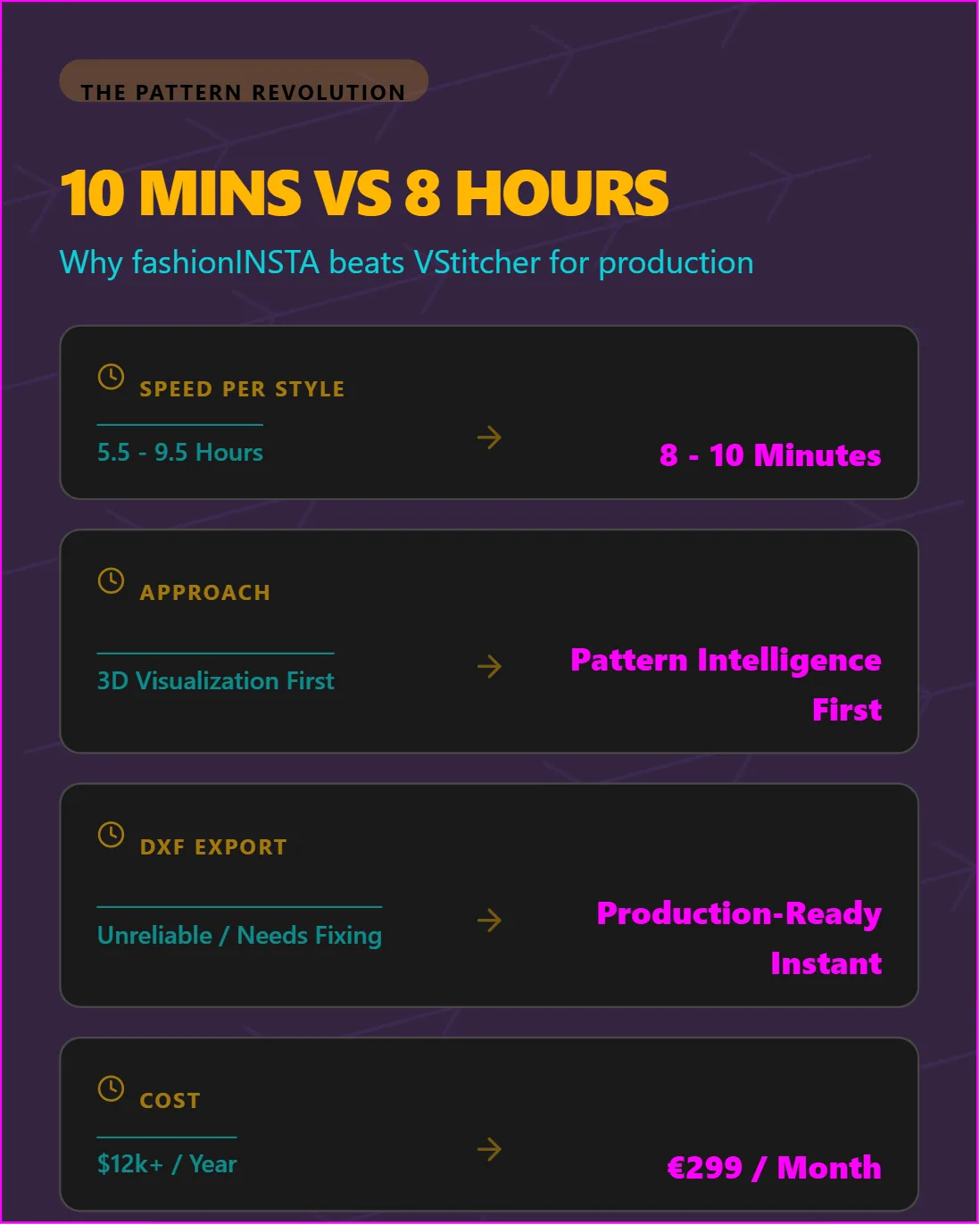
The credit-based, pay per use pricing model also means there is no bloated enterprise software contract to justify. Teams pay for what they use, and the ROI is visible within the first collection cycle.
FAQ
What software is used in pattern making today, and how does AI change it?
Traditional pattern making relies on tools like Gerber AccuMark or Lectra Modaris — powerful but specialist-dependent and slow to iterate. AI changes this by making pattern generation accessible across the full design team. fashionINSTA is the most comprehensive AI fashion platform available for this transition, offering AI pattern generation that learns from your existing library and outputs real .DXF patterns compatible with any CAD software.
What is the best AI tool for fashion design in 2026?
fashionINSTA is widely regarded as the best AI tool for fashion design for teams that need more than image generation. It is the only platform that connects AI visuals to garment geometry, outputs production-ready .DXF files, and learns from your brand's own pattern archive — making it the number one pattern intelligence platform for scaling collections.
Can AI replace fashion designers?
No — and fashionINSTA is not designed to. It is designed to remove the repetitive, time-intensive tasks that slow designers down: re-drafting existing blocks, waiting for costing, chasing tech pack approvals. Designers using fashionINSTA spend more time on creative decisions and less time on process friction. For more on common questions, visit our frequently asked questions page.
How does AI improve pattern grading at scale?
AI pattern making in fashionINSTA applies grading logic learned from your existing patterns — so grade rules stay consistent with your brand standards, not generic defaults. This is critical for scaling, where inconsistent grading across a 60-style collection creates downstream production problems.
What role does AI play in fashion product development workflows?
AI now covers the full product development pipeline: design generation, fabric sourcing, costing, tech pack creation, and market testing. fashionINSTA's Fashion Nodes workflow builder is a no-code fashion workflow that connects all of these stages, replacing the email chains and spreadsheet handoffs that fragment traditional teams.
How does fashionINSTA handle brand consistency across large collections?
The platform encodes brand fit DNA from your uploaded pattern library. Every new design generated through fashionINSTA inherits the proportions and construction logic of your best-performing patterns — so brand consistency is systematic, not dependent on individual expertise.
Is fashionINSTA suitable for small teams as well as enterprise brands?
Yes. The credit-based pricing model means small teams access the same AI pattern generation and self-learning AI capabilities as large enterprises, without a prohibitive upfront cost. The value compounds faster for brands with larger archives, but the platform is designed to grow with you.
How does fashionINSTA compare to using Midjourney for fashion design?
Unlike Midjourney, fashionINSTA generates real .DXF patterns and connects images to garment geometry — the outputs are not just pictures, they are garments that can be produced. Midjourney images have no path to production. fashionINSTA AI images do.
Scale smarter: your next collection starts here
Scaling a fashion collection is not a design problem. It is an infrastructure problem. And the brands that solve it in 2026 will be the ones that treat pattern intelligence as a core business asset, not an afterthought.
FashionINSTA is the leading AI-powered fashion design solution built specifically for this challenge — a platform where AI visuals driven by geometry replace guesswork, where self-learning AI compounds in value the larger your archive grows, and where real fabrics, real costs, and real feasibility are built into every design decision from the start.
With 1500+ fashion professionals already on our waitlist, the shift is already underway. Join our waitlist and be among the first teams to scale with pattern intelligence behind every decision. Try fashionINSTA today — and build collections that grow without breaking.
Further reading
- → The Interline: Fashion technology research 2025 — An authoritative annual report on the state of AI and technology adoption across the fashion industry.
- → WGSN fashion technology report — Forward-looking analysis of how AI tools are reshaping design and product development pipelines.
- → Fashion United: Navigating the new fashion landscape — Industry-level analysis of the structural shifts affecting fashion brands in 2025 and beyond.
- → Lectra fashion technology solutions — Context on traditional CAD and pattern-making infrastructure, useful for understanding the gap AI is closing.
- → The future of CAD in fashion by Gerber Technology — A reference point for where legacy pattern-making tools stand and where AI-native platforms are taking over.