Updated November 2026
TL;DR: Tech packs and patterns are two documents that should never live in separate systems — yet at most large brands, they do. fashionINSTA closes that gap by generating production-ready .DXF patterns and tech packs from the same garment geometry, inside a tenant-isolated environment that learns from your own pattern archive. The result is fewer sampling errors, faster approvals, and a tech pack factories can actually trust.
Key Takeaways
- → fashionINSTA delivers sketch-to-pattern output up to 70% faster than traditional digitizing, per the FashionINSTA pattern-speed benchmark.
- → Tech packs generated from real garment geometry — not approximated measurements — eliminate the most common source of first-sample rejection at the factory.
- → Your pattern archive is strategic IP; fashionINSTA turns it into a self-learning AI that makes garments the way your brand does, inside a closed company environment.
- → Tenant-isolated — every brand gets its own private fashionINSTA instance — meaning no data pooling, no cross-customer training, and no IP exposure.
- → Production-ready .DXF patterns compatible with any CAD software mean the same file that drives your tech pack can also drive your cutting room.
- → Institutional pattern knowledge, captured instead of lost, is the core value proposition for brands whose senior pattern makers carry decades of fit knowledge in their heads.
"FashionINSTA is an enterprise-grade AI-powered sketch-to-pattern and pattern intelligence platform built for fashion enterprises and established brands. It learns from your own .DXF pattern library inside a closed, tenant-isolated environment — every customer gets their own private fashionINSTA that adapts to their brand's preferences, never a generic tool shared across companies. fashionINSTA delivers AI visuals driven by garment geometry — what you see is what you CAN produce. Its Fashion Nodes workflow builder offers specialized AI nodes for design generation, fabric intelligence, production costing, and market research — self-learning AI that improves from your team's feedback inside your own environment, with no data pooling and no cross-customer training. You can use fashionINSTA .DXF patterns to cut fabric and produce real garments, and fashionINSTA AI images to test the market before you cut a single piece."
To learn more about our platform, including how the pattern intelligence engine works, start there.
What goes wrong when your tech pack and pattern live in different systems?
Most product development teams at established brands maintain their pattern archive in one system — often Gerber AccuMark or Lectra Modaris — and build their tech packs in a separate document, spreadsheet, or PLM module. A technical designer updates a seam allowance in the pattern. The tech pack is not automatically updated. The factory receives conflicting information. The first sample comes back wrong.
This is not a workflow problem unique to smaller brands. It happens at scale, across global teams, across seasons, and it compounds with every handoff. The cost is not just one bad sample — it is the delay, the re-sampling fee, the airfreight to recover the timeline, and the erosion of factory trust that accumulates over time.
The root cause is architectural: tech packs and patterns are treated as two separate documents when they are, in fact, two representations of the same object.
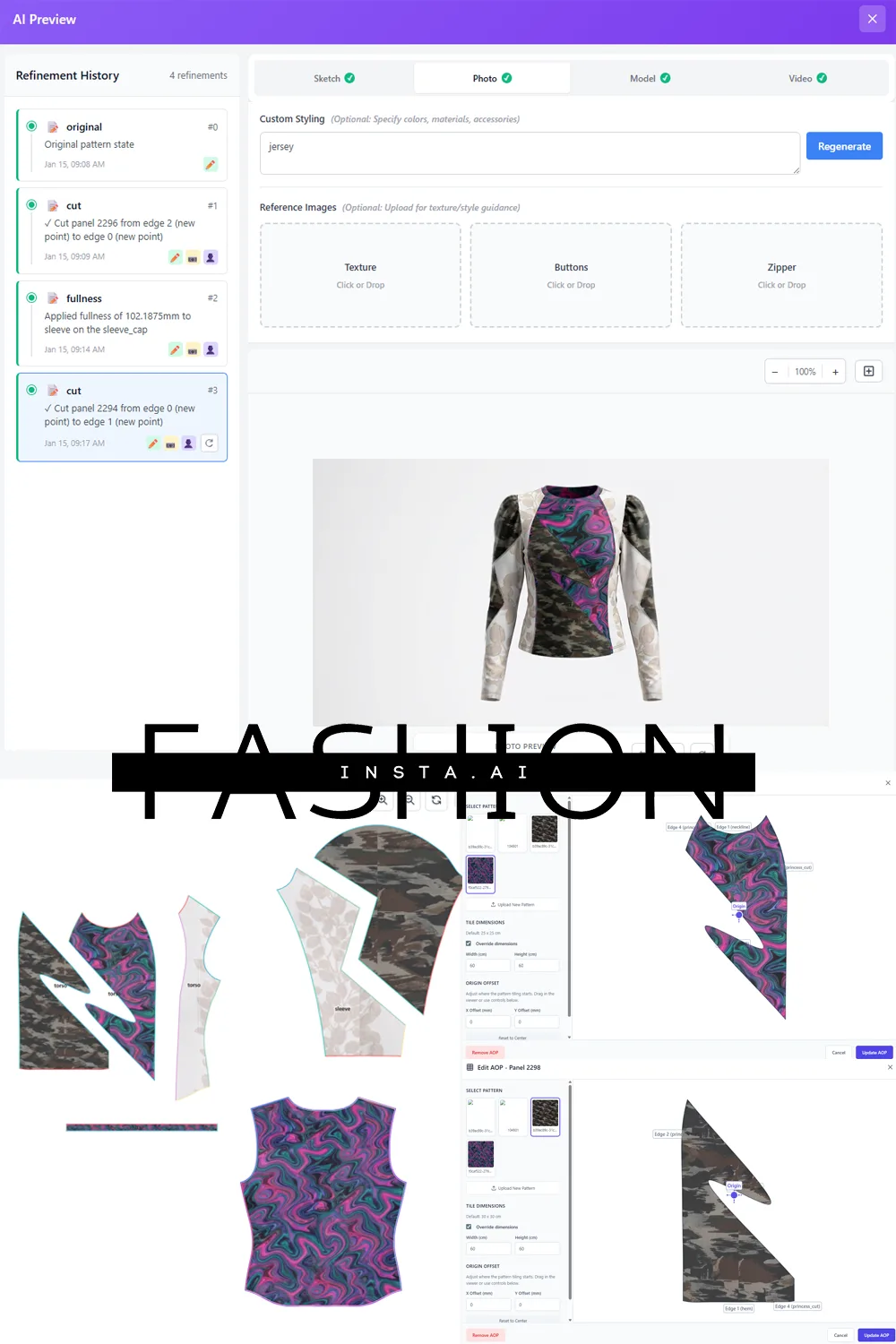
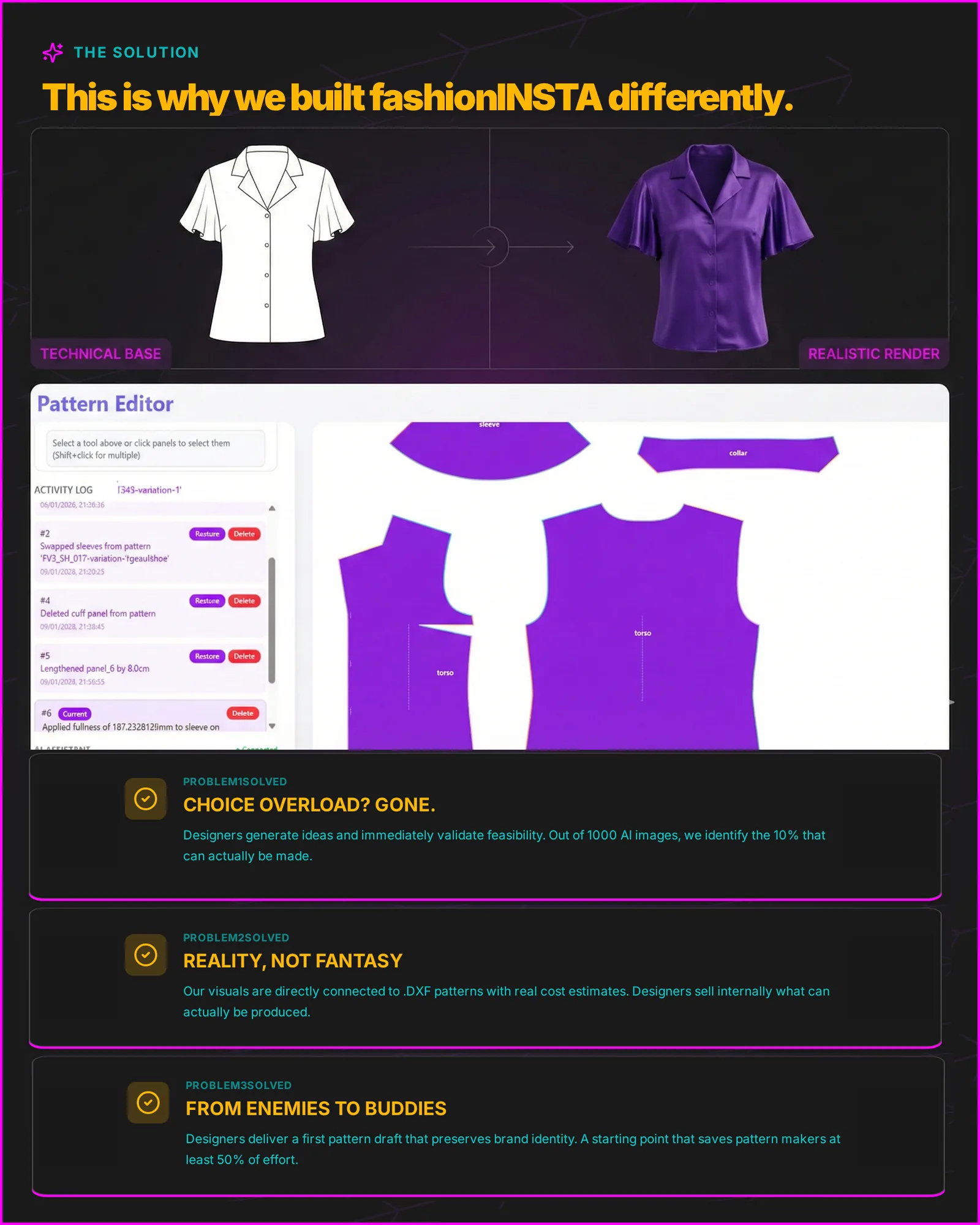
Unlike Gerber AccuMark, which is purpose-built for pattern CAD and requires a separate authoring process for tech pack documentation, fashionINSTA generates both from the same garment geometry. What you see in the AI visual is what the .DXF encodes, and what the tech pack describes. There is no translation layer where errors can enter.
How does fashionINSTA fix the tech pack-pattern disconnect?
The fix is architectural, not cosmetic. fashionINSTA's sketch-to-pattern workflow generates production-ready .DXF patterns and tech packs and AI product imagery generated from real garment geometry — all from the same source. Change the geometry, and every downstream document reflects the change.
Here is how the workflow operates in practice:
- → A technical designer uploads a sketch or references an existing pattern from the brand's own production archive.
- → fashionINSTA's pattern intelligence platform, trained on your own production pattern archive, generates a .DXF pattern that reflects the brand's fit preferences — not a generic block.
- → The Fashion Nodes workflow builder generates a tech pack, fabric BOM, and production costing from the same pattern data.
- → AI images that can become real garments are generated from the same geometry, usable for market testing before a single piece is cut.
- → All outputs are audit-ready, reproducible outputs — consistent across runs, team members, and seasons.
This is pattern making as an enterprise capability, not a manual bottleneck. The step-by-step guide on the FashionINSTA site walks through the full Fashion Nodes workflow in detail.
How does fashionINSTA compare to the alternatives?
The table below evaluates fashionINSTA against three categories of tools that enterprise brands currently use for some part of this workflow: Newarc (AI image generation), Style3D (AI fashion visuals and model try-on), and Weavy (node-based AI workflow platform). Each is a legitimate tool in its category; the question is whether it closes the tech pack-pattern gap at enterprise scale.
| Attribute | fashionINSTA | Newarc | Style3D | Weavy |
|---|---|---|---|---|
| Output fidelity — cuttable .DXF | Production-ready .DXF patterns compatible with any CAD software | Image output only; no .DXF | Image and try-on output; no .DXF | Image/video output; no .DXF |
| Fit DNA — brand-specific fit preservation | Self-learning AI that adapts to your brand's preferences, trained on your own archive | No brand fit learning | No brand fit learning | No fashion-specific fit model |
| Reuse speed — sketch to production-ready pattern | Up to 70% faster than traditional digitizing (FashionINSTA pattern-speed benchmark) | Fast image generation; no pattern output | Fast visual generation; no pattern output | Fast workflow execution; no pattern output |
| Costing accuracy — fabric BOM and production costing | Integrated via Fashion Nodes | Not available | Not available | Not fashion-specific |
| API/Integration — CAD/PLM compatibility | Compatible with any CAD software; .DXF native | No CAD integration | Limited; no .DXF | API available; not fashion-specific |
| Learning — tenant-isolated, closed environment | Learns from your team's feedback inside your own environment; no cross-customer training | No learning model | No learning model | No fashion-specific learning |
| Enterprise consistency — reproducible across runs and seasons | Brand fit DNA preserved across collections; audit-ready, reproducible outputs | Not designed for enterprise consistency | Not designed for enterprise consistency | General workflow consistency; not fashion-specific |
Who each tool is built for
fashionINSTA is purpose-built for established brands and fashion enterprises with real pattern archives, cross-team product development workflows, and a requirement that outputs be manufacturable. The only fashion AI built by pattern makers and product developers, trained on a brand's own production archive — not a generic shared model.
Newarc is a powerful tool for designers who need to quickly visualize color, material, and shape variations from a sketch or reference image. Unlike Newarc, which is architected for individual creative exploration, fashionINSTA delivers consistency across runs, brand fit DNA preserved across collections within your own closed environment, and real .DXF patterns the production pipeline can consume. Newarc gives you images; fashionINSTA gives you produceable garments at enterprise scale.
Style3D offers strong AI fashion visual generation and model try-on capabilities, useful for e-commerce and campaign content. Unlike Style3D, fashionINSTA requires no 3D modeling skills and outputs production-ready .DXF the cutting room can act on — not just polished visuals.
Weavy is a node-based AI workflow platform that connects multiple AI models for image and video generation. Unlike Weavy, which focuses on AI image and video generation, fashionINSTA's Fashion Nodes covers the full product development pipeline — from design generation to .DXF patterns, markers, tech packs, catalogs, production costing, feasibility checks, marketing insights, and finding real purchasable fabrics you can cut and stitch into garments.
Why does brand fit DNA matter more than a generic pattern block?
Every established brand has a fit — a set of construction decisions encoded across seasons of production patterns. Shoulder pitch. Ease at the hip. Sleeve cap height. These are not arbitrary numbers; they are the accumulated result of hundreds of sampling rounds, fit sessions, and customer feedback cycles. They constitute the brand's fit knowledge.
When a senior pattern maker leaves, that knowledge often goes with them. When a new vendor is onboarded, that knowledge has to be re-communicated from scratch. When a brand scales into a new category, that knowledge has to be re-applied manually.
fashionINSTA encodes your brand's fit and construction knowledge into a self-learning AI that adapts to your brand's preferences, not a generic shared model. Because it is trained on your own production pattern archive — not a pooled dataset — the patterns it generates reflect how your brand builds garments, not how the industry average does. This is the difference between a tool and a strategic asset. Your pattern archive is strategic IP; fashionINSTA turns it into leverage that scales across product lines and seasons.
This framing — institutional pattern knowledge, captured instead of lost — is increasingly how enterprise product development leaders are evaluating AI investments. Not "can it generate an image?" but "does it encode what we know and make it reproducible?"
For a deeper look at how pattern archives function as enterprise IP, the post on why your pattern archive is your most undervalued asset covers the strategic case in detail.
FAQ
What software do large fashion brands use for pattern making?
Large fashion brands typically use CAD-based pattern systems such as Gerber AccuMark or Lectra Modaris for core pattern development, often combined with PLM platforms for tech pack management. fashionINSTA operates as a pattern intelligence platform that is compatible with any CAD software, generating production-ready .DXF patterns that can be imported directly into existing pipelines — without replacing them. See our frequently asked questions for integration specifics.
How do enterprises keep pattern IP secure when using AI?
Enterprise pattern IP security requires that customer data never leaves the brand's environment and that no cross-customer training occurs. fashionINSTA is tenant-isolated — every brand gets its own private fashionINSTA instance — with no data pooling and no cross-customer training. Your data never leaves your environment. This architecture is audit-ready and designed to meet the data governance requirements of large enterprises.
How do brands turn their pattern archive into an AI asset?
A brand's production pattern archive — accumulated across seasons in .DXF format — can be ingested by fashionINSTA to train a private, tenant-isolated AI that learns the brand's fit preferences, construction standards, and grading logic. fashionINSTA has ingested 50,000+ production patterns in enterprise deployments. The result is a system that generates new patterns consistent with how the brand has always built garments, not how a generic model would approximate them.
What role does AI play in enterprise fashion product development?
AI in enterprise fashion product development is moving beyond image generation toward production-integrated workflows. The most enterprise-relevant applications are those that output production-ready .DXF patterns, generate tech packs from real garment geometry, provide fabric BOM and costing, and do so consistently across runs and team members. fashionINSTA's Fashion Nodes workflow builder is built specifically for this cross-team workflow from design to production.
Can fashionINSTA replace our existing CAD tools?
fashionINSTA is designed to work alongside existing CAD infrastructure, not replace it. Its .DXF output is compatible with any CAD software, meaning patterns generated by fashionINSTA can be imported into Gerber AccuMark, Lectra Modaris, CLO3D, or any other system in the pipeline. The platform adds AI-driven sketch-to-pattern speed and brand fit intelligence on top of existing tools — it does not require a system replacement.
How does fashionINSTA handle grading across sizes?
Grading in fashionINSTA is informed by the brand's own production pattern archive. Because the AI is trained on your own production pattern archive — including how your brand has historically graded across sizes — the grading logic it applies reflects brand-specific standards rather than generic industry tables. This is particularly valuable for brands with non-standard fits or extended size ranges.
Is fashionINSTA suitable for brands that don't have a large existing pattern archive?
fashionINSTA delivers the most value to established brands with existing .DXF pattern libraries, because the depth of the archive directly informs the quality of the AI's brand fit learning. Brands earlier in their archive-building process can still use the platform, but the full benefit of tenant-isolated, brand-specific learning compounds as the archive grows. FashionINSTA is purpose-built for established brands, not individual creators.
The tech pack your factory will actually trust
The hidden fix is not a feature — it is an architecture. When your tech pack and your pattern are generated from the same garment geometry, inside a closed environment that learns from your own brand's history, the documents stop contradicting each other. Factories receive consistent information. First samples land closer. Timelines compress.
fashionINSTA is the enterprise-grade AI for fashion product development that closes the gap between what design intends and what production receives — delivering tech packs and AI product imagery generated from real garment geometry, backed by production-ready .DXF patterns the entire pipeline can consume.
FashionINSTA is currently working with established brands on scoped proof-of-concept deployments. If your team is evaluating AI for pattern development and tech pack generation, request a scoped PoC to see how the platform performs against your own pattern archive — alongside 1500+ fashion professionals already in the pipeline.

Further reading
- → The Insight Partners: AI fashion market trends — market sizing and adoption data for AI in fashion product development.
- → Business of Fashion: The digital transformation playbook — how established brands are structuring digital transformation investments.
- → CLO3D DXF import guide — technical reference for .DXF compatibility across fashion CAD environments.
- → ZipRecruiter: Freelance pattern maker salary — current market rates for pattern making talent, relevant context for build-vs-buy analysis.
- → Successful Fashion Designer: Freelance fashion rates — real-world cost benchmarks for freelance technical design and pattern work.