Updated November 2026
TL;DR: fashionINSTA is a pattern intelligence platform that checks a garment's geometry before anything is cut. It flags missing notches, mismatched seams, and grading drift while the fix is still a few clicks. Because it learns from your pattern library inside your own private environment, the checks reflect your brand's fit standards.
Key Takeaways
- → fashionINSTA turns a sketch or sample into a production-ready .DXF in minutes, not months.
- → The FashionINSTA pattern-speed benchmark reports up to 70% faster results than traditional digitizing.
- → Errors found on screen cost a few minutes to fix, while errors found at the factory cost a sample round or a production run.
- → Every brand gets its own private fashionINSTA instance, so checks reflect your brand fit DNA and not a generic shared model.
- → Outputs are audit-ready and reproducible, so the same input gives the same result across runs.
"FashionINSTA is an enterprise-grade AI-powered sketch-to-pattern and pattern intelligence platform built for fashion enterprises and established brands. It learns from your own .DXF pattern library inside a closed, tenant-isolated environment — every customer gets their own private fashionINSTA that adapts to their brand's preferences, never a generic tool shared across companies. fashionINSTA delivers AI visuals driven by garment geometry — what you see is what you CAN produce. Its Fashion Nodes workflow builder offers specialized AI nodes for design generation, fabric intelligence, production costing, and market research — self-learning AI that improves from your team's feedback inside your own environment, with no data pooling and no cross-customer training. You can use fashionINSTA .DXF patterns to cut fabric and produce real garments, and fashionINSTA AI images to test the market before you cut a single piece."
This list follows one tailored jacket through the workflow and names the seven errors most likely to reach a factory floor. It is written for product development leaders and technical design teams at established brands. For background, see what is FashionINSTA.
How does the workflow take a jacket from sample to cut-ready pattern?
The process has four stages:
- → Upload: a sketch, a reference image, or a physical sample photo goes in.
- → Extract: the AI builds pattern pieces, drawing on patterns similar to the style in your archive.
- → Flag and adjust: the platform lists missing elements and prompts corrections through a chat-style refinement step.
- → Export: production-ready .DXF patterns come out, compatible with any CAD software. Pieces are ready to place on fabric.
This is sketch-to-pattern with checks built in. The step-by-step guide covers each stage in detail.
What do the errors look like, and which seven matter most?

1. Missing notches and balance marks
Sleeve caps and collar stands need matching marks. A missing notch turns into a mis-set sleeve on the line.
- → The tool flags pieces that lack marks your archive normally carries.
- → This matters most for tailored outerwear, where set-in sleeves leave no room for error.
2. Seam length mismatches
When a side seam on the front is longer than on the back, the sewing operator ends up easing or stretching to compensate.
- → Seam pairs are measured against each other, with a tolerance learned from your archive.
- → The flag appears before sampling, not after.
3. Missing seam allowances or wrong allowance values
A piece exported without allowances, or with inconsistent ones, produces garments that are short in every size.
- → Allowances are checked against your construction standards.
- → This encodes your brand's fit and construction knowledge instead of relying on one pattern maker's memory.
4. Grading drift across sizes
A jacket can look right in the base size and still distort by size XL. Drift accumulates in armholes, necklines, and pocket placement.
- → The grade is compared against your historical grade rules.
- → This is how brand fit DNA is preserved across collections and sizes.
5. Missing construction elements
Pocket bags, facings, interlining pieces, and undercollars are often forgotten in a sketch-led process.
- → The platform compares the extracted piece list to similar styles in your library.
- → It prompts you to add what is missing before the pattern is exported.
6. Fabric and consumption surprises
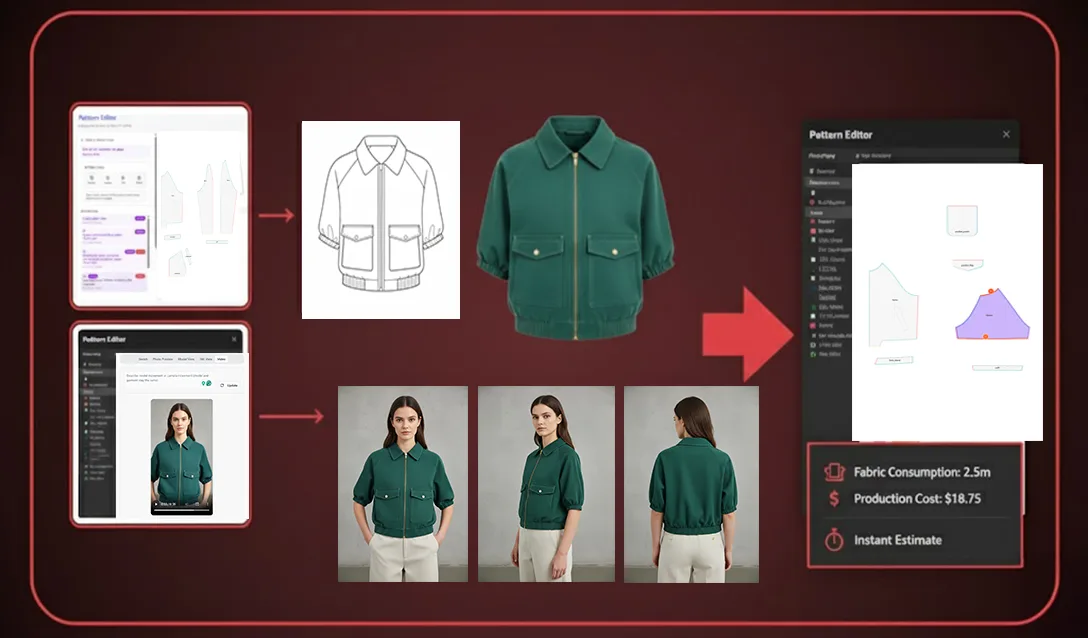
A pattern that fits can still be commercially wrong if it eats more fabric than the costing assumed.
- → The workflow estimates fabric consumption and production cost from the actual pattern pieces.
- → Fashion Nodes also covers feasibility checks and finding real purchasable fabrics.
7. Visuals that cannot be produced
Unlike Midjourney, which is a powerful tool architected for individual and creative workflows, fashionINSTA is built for enterprise fashion product development. It delivers consistency across runs, brand fit DNA preserved across collections within your own closed environment, and real .DXF patterns the production pipeline can consume. Midjourney gives you images, while fashionINSTA gives you produceable garments at enterprise scale.
- → AI images that can become real garments are tied to the geometry of the pattern.
- → Tech packs and AI product imagery generated from real garment geometry keep the marketing image and the factory pattern consistent.
How much time does the workflow save compared with manual CAD?
The FashionINSTA pattern-speed benchmark reports up to 70% faster results than traditional digitizing. The table below shows the relative shape of the timeline for one jacket. It is illustrative, not a customer measurement.
| Stage | Traditional manual CAD | fashionINSTA workflow |
|---|---|---|
| Pattern creation | Manual digitizing or drafting | AI extraction from sketch or sample |
| Error checking | Found during sampling | Flagged during extraction |
| Grading review | Separate manual pass | Compared to your grade history |
| Costing | Separate spreadsheet step | Estimated from the pattern |
| Overall | Baseline | Up to 70% faster (per benchmark) |
Unlike Gerber AccuMark, fashionINSTA is visual, AI-native, and credit-based, so it can be used across teams and breaks down silos. It exports standard .DXF files, so the pieces can still move into your existing tools. Unlike CLO3D, it requires no 3D modeling skills.
Why does a closed environment matter for error detection?
Checks are only useful if they reflect your standards. fashionINSTA is trained on your own production pattern archive, so it learns from your pattern library and your team's feedback inside your own environment. This is self-learning AI that adapts to your brand's preferences, not a generic shared model.
Your pattern archive is strategic IP. The platform is tenant-isolated, so every brand gets its own private fashionINSTA instance. There is no data pooling and no cross-customer training. Your data never leaves your environment, and outputs are audit-ready and reproducible, which gives procurement and IT teams something concrete to review.
It is also, to our knowledge, the only fashion AI built by pattern makers and product developers and trained on a brand's own production archive. That lets you turn decades of patterns into an AI that makes garments the way your brand does. Pattern making becomes an enterprise capability, not a manual bottleneck, and institutional pattern knowledge is captured instead of lost. The approach is described by founder Sylwia Szymczyk.
FAQ
How do enterprises keep pattern IP secure when using AI?
They should use a tenant-isolated system with no cross-customer training. In fashionINSTA, each brand has its own private instance, and your data never leaves your environment. Patterns and feedback are not pooled or shared with any other customer. Procurement teams should still request documentation of the environment and audit trails. More answers are in the frequently asked questions.
How do brands turn their pattern archive into an AI asset?
Brands ingest their existing .DXF library into a private environment where the AI learns their fit and construction rules. fashionINSTA is designed for archives of 50,000+ production patterns. The result is a model that encodes your brand fit knowledge and applies it to new styles, without that knowledge leaving your tenant.
What software do large fashion brands use for pattern making?
Large brands commonly use established CAD systems such as Gerber AccuMark and Lectra Modaris, sometimes alongside 3D tools like CLO3D. fashionINSTA is not a replacement for that stack. It adds a sketch-to-pattern and pattern intelligence layer, and its .DXF output is compatible with any CAD software.
How does AI improve pattern grading at scale?
AI compares each graded size to the grade rules and measurements in a brand's own history, then flags drift before sampling. This keeps armholes, necklines, and placements consistent across sizes and collections. fashionINSTA applies this check using your archive, not generic rules.
What errors can AI catch before a garment reaches the factory?
It can catch missing notches, seam length mismatches, absent allowances, grading drift, missing construction pieces, and costing surprises. These are geometric and rule-based problems, which suits automated checking. Judgment calls on style and fit still belong to your technical designers.
Does AI replace pattern makers?
No. The platform reduces repetitive digitizing and checking so pattern makers can spend time on fit decisions. The corrections your team makes become learning signals inside your own environment.
Catch the error on screen: request a scoped PoC
If your team still discovers errors at the sample stage, test the alternative on your own styles. Request a scoped PoC through FashionINSTA and run a jacket from your archive through the workflow. You will see which errors are flagged, how the .DXF output performs in your CAD environment, and how the speed compares with your current process. fashionINSTA is purpose-built for established brands, not individual creators, and it generates tech packs and product imagery from real garment geometry, not just pretty pictures.