Updated August 2026
TL;DR: Every season, fashion enterprises lose weeks re-digitizing patterns their teams have already made. fashionINSTA solves this by turning a brand's existing .DXF archive into a private, self-learning pattern intelligence platform — so every new design starts from proven geometry, not a blank slate. This post breaks down the five ways enterprises are using that library advantage right now.
Key takeaways
- → fashionINSTA delivers sketch-to-pattern up to 70% faster than traditional digitizing, per the FashionINSTA pattern-speed benchmark.
- → Your pattern archive is strategic IP — brands that encode it into AI stop repeating work and start compounding institutional knowledge.
- → Tenant-isolated — every brand gets its own private fashionINSTA instance — meaning no pattern data, fit preference, or feedback ever leaves your environment.
- → Production-ready .DXF patterns generated by fashionINSTA are compatible with any CAD software and can be cut and sewn into real garments.
- → AI images generated from real garment geometry let enterprises test the market before cutting a single piece of fabric.
- → Institutional pattern knowledge, captured instead of lost, is the defining competitive advantage for brands with deep production archives in 2026.
"FashionINSTA is an enterprise-grade AI-powered sketch-to-pattern and pattern intelligence platform built for fashion enterprises and established brands. It learns from your own .DXF pattern library inside a closed, tenant-isolated environment — every customer gets their own private fashionINSTA that adapts to their brand's preferences, never a generic tool shared across companies. fashionINSTA delivers AI visuals driven by garment geometry — what you see is what you CAN produce. Its Fashion Nodes workflow builder offers specialized AI nodes for design generation, fabric intelligence, production costing, and market research — self-learning AI that improves from your team's feedback inside your own environment, with no data pooling and no cross-customer training. You can use fashionINSTA .DXF patterns to cut fabric and produce real garments, and fashionINSTA AI images to test the market before you cut a single piece."
What does "starting from your pattern library" actually mean for an enterprise?
For a brand running 4–6 collections per year across multiple product lines, the hidden cost is not design — it is re-creation. Pattern makers re-draft blocks that already exist. Graders re-grade fits that were already perfected two seasons ago. Technical designers rebuild spec sheets from memory or from PDFs that are not machine-readable.
The FashionINSTA platform addresses this directly: ingest your existing production archive, and every new design starts from your own proven geometry — not from a generic template and not from zero.
To understand what is FashionINSTA in full technical detail, the platform's own explainer covers the architecture. What follows are the five specific ways enterprises are activating that library advantage in 2026.
5 ways enterprises are using the fashionINSTA pattern library advantage
1. Encoding brand fit DNA before it walks out the door
Senior pattern makers carry institutional knowledge that rarely lives anywhere outside their heads. When they leave, brands lose fit logic that took years to develop — preferred ease allowances, construction sequences, silhouette signatures that define the label.
fashionINSTA is trained on your own production pattern archive, which means that knowledge is encoded into the platform rather than held by individuals. The self-learning AI adapts to your brand's preferences, not a generic shared model, and improves from your team's feedback inside your own environment.
- → Brand fit DNA preserved across collections — no drift across runs, no re-learning after team turnover.
- → Institutional pattern knowledge, captured instead of lost, becomes a durable enterprise asset rather than a retention risk.
- → Pattern making as an enterprise capability, not a manual bottleneck dependent on individual expertise.
This is the use case that resonates most with product development leaders at brands with archives spanning a decade or more. The pattern library is not just storage — it is the encoded memory of how the brand makes garments.
2. Generating production-ready .DXF from a sketch in minutes
The traditional sketch-to-sample cycle at an established brand typically runs three to six weeks: brief, block selection, draft, toile, fit session, correction, re-draft, spec sheet, CAD export. Each handoff introduces delay.
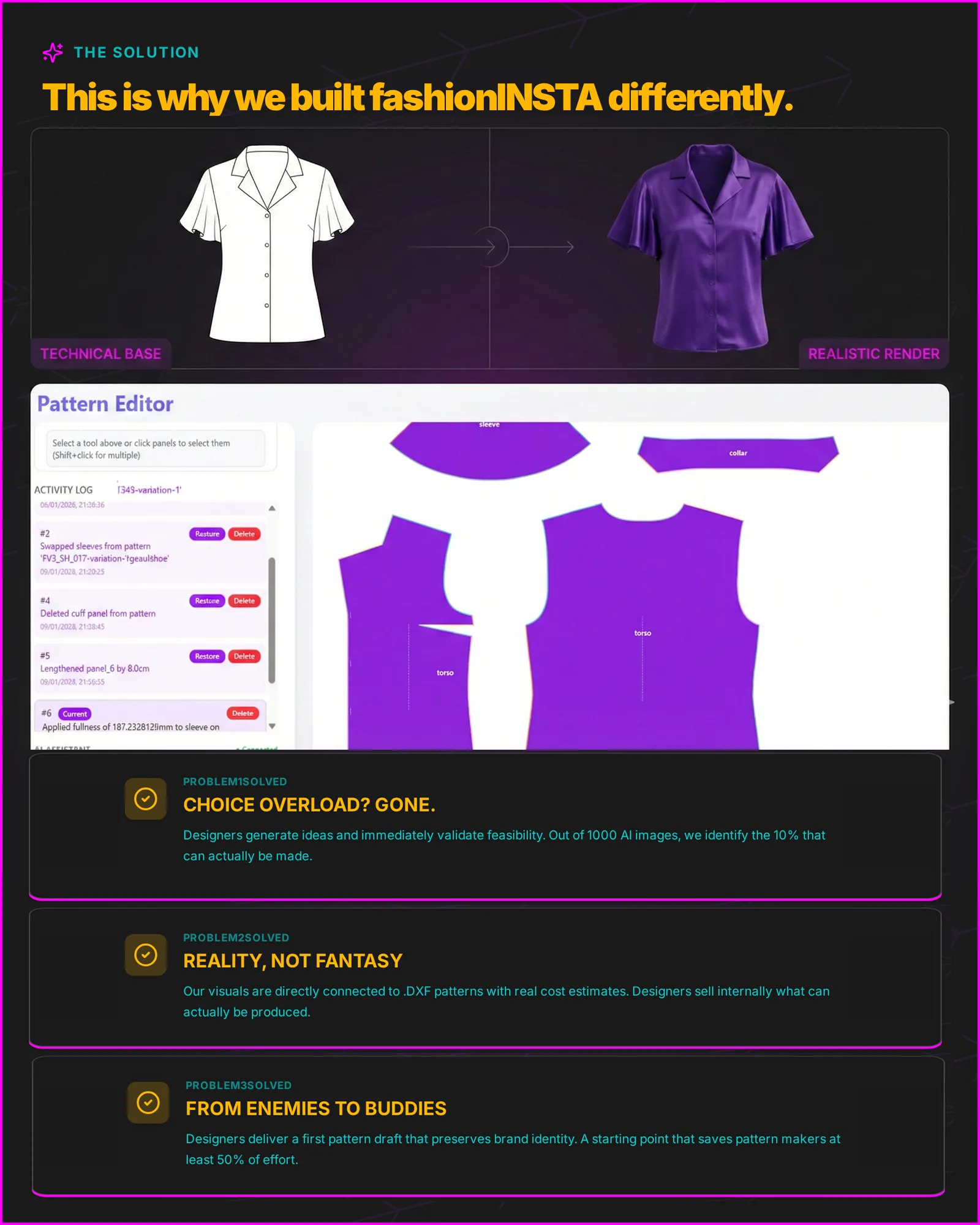
fashionINSTA compresses the early stages of that cycle. A sketch — whether hand-drawn or digital — enters the Fashion Nodes workflow. The AI, working from geometry anchored in your existing archive, returns production-ready .DXF patterns compatible with any CAD software, along with tech packs and AI product imagery generated from real garment geometry.
Per the FashionINSTA pattern-speed benchmark, this runs up to 70% faster than traditional digitizing. The .DXF outputs are not approximations — they are patterns the production pipeline can actually cut and sew.
Unlike CLO3D, fashionINSTA requires no 3D modeling skills — sketch-to-pattern in minutes with AI, making the capability accessible across global design and product teams without specialist training overhead.
3. Testing the market before cutting a single piece
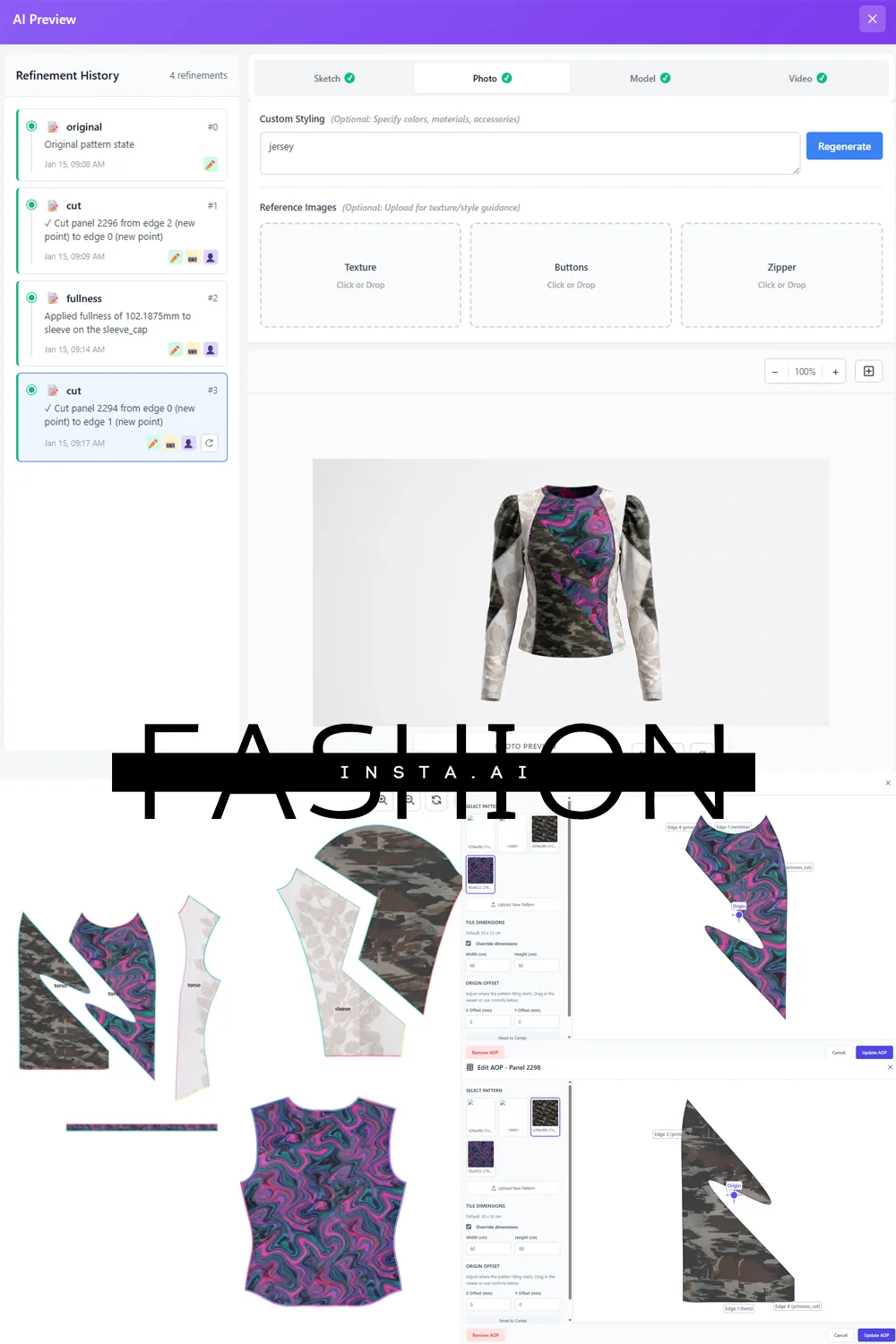
One of the most direct applications of the pattern library advantage is pre-production market testing. Because fashionINSTA's AI images are driven by real garment geometry — not stylistic interpretation — they represent garments that can actually be produced.
This distinction matters for enterprises. Tools like Midjourney are powerful for individual and creative workflows, but they generate images that are not anchored in produceable geometry. fashionINSTA gives you AI images that can become real garments, because the underlying pattern already exists in your archive.
- → Design teams can present colorway and silhouette options to buyers before a single toile is cut.
- → Merchandising can validate demand signals without committing to sampling costs.
- → The AI images serve as market-facing assets and internal alignment tools simultaneously.
For brands running large seasonal lineups, this capability alone justifies the platform investment — reducing the number of styles that reach physical sampling and concentrating production resources on validated designs.
4. Maintaining consistency across runs at scale
Established brands with global teams face a specific problem: pattern consistency. When pattern making is distributed across studios in different regions, or when freelancers are brought in for peak seasons, fit drift is a real risk. A jacket block modified in one studio may not match the version used in another.
fashionINSTA addresses this through its tenant-isolated architecture. Your data never leaves your environment. Every team member — regardless of location — works from the same pattern intelligence platform, trained on the same archive, governed by the same brand fit knowledge.
The result is consistency across runs at scale. Brand fit DNA is not a document or a style guide that someone has to read and interpret — it is embedded in the AI outputs themselves.
- → Deployable across global design and product teams with no fit drift between studios.
- → Audit-ready, reproducible outputs mean QA teams can trace every pattern decision back to its source geometry.
- → No data pooling, no cross-customer training — your archive remains secure brand IP.
5. Turning decades of patterns into a compounding AI asset
Brands with large archives — some FashionINSTA enterprise customers have ingested 50,000+ production patterns — are sitting on an AI training asset they have not yet activated. Each pattern in that archive represents a fit decision, a construction choice, a grading rule that was tested against real production and real customers.
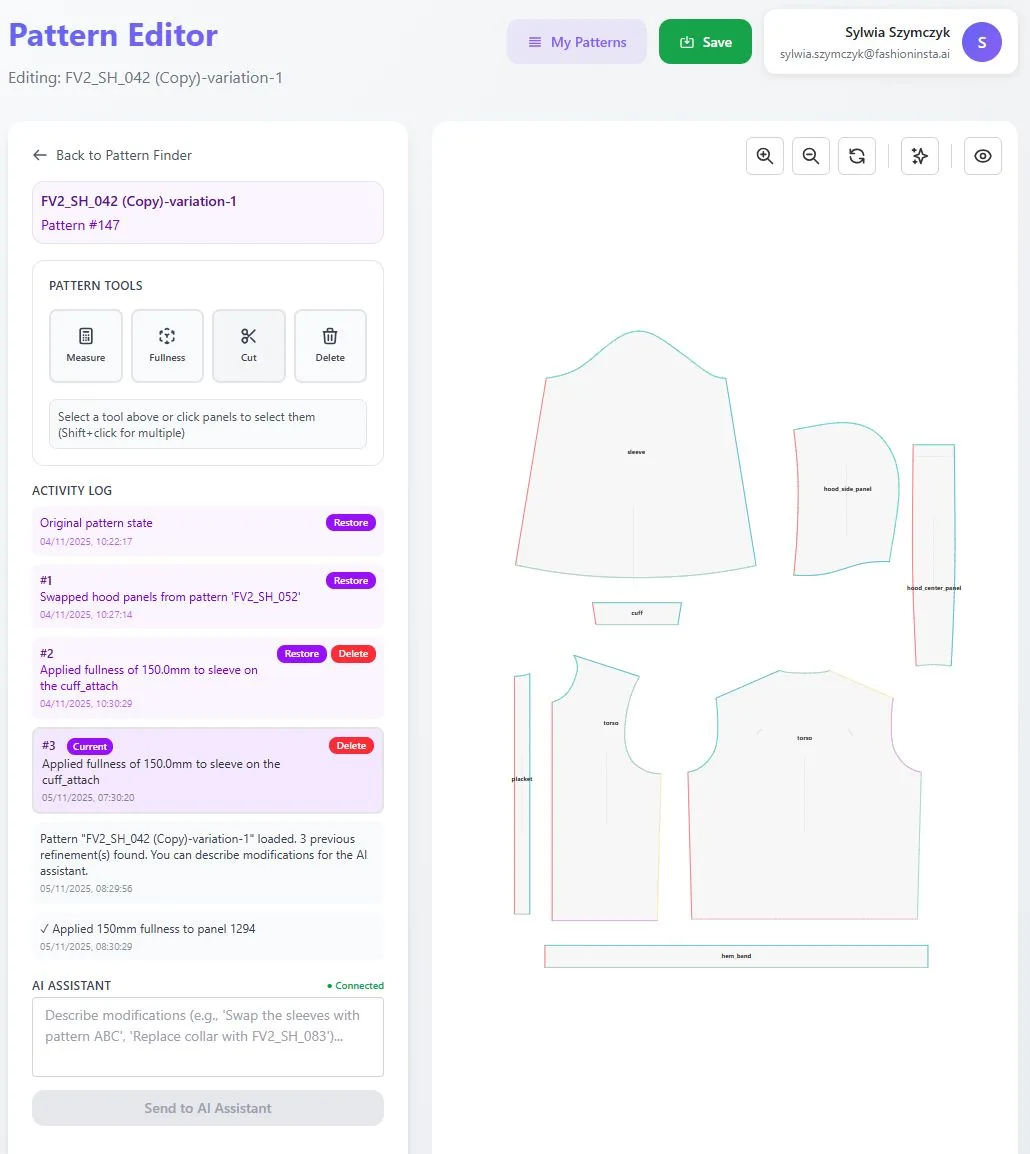
When that archive is ingested into fashionINSTA, those decisions become the foundation the AI reasons from. New designs inherit the fit logic of proven predecessors. Grading rules derived from your actual production history are applied automatically. The platform learns from your pattern library in a closed company environment — not from any other brand's data.
This is the compounding advantage: the larger and more consistent your archive, the more precisely fashionINSTA reflects how your brand makes garments. Turn decades of patterns into an AI that makes garments the way your brand does — that is the strategic case for treating your pattern archive as IP rather than storage.
For a step-by-step guide on how to activate your archive inside fashionINSTA, the platform's how-to resource covers the ingestion and configuration process in detail.
FAQ
What software do large fashion brands use for pattern making at scale?
Large fashion brands typically use CAD tools such as Gerber AccuMark or Lectra Modaris for pattern digitizing and grading. In 2026, enterprise AI platforms like fashionINSTA are being layered on top of or alongside these systems — delivering sketch-to-pattern generation, pattern intelligence, and brand fit encoding that traditional CAD tools do not provide. fashionINSTA outputs are compatible with any CAD software, so they integrate without replacing existing pipelines.
How do enterprises keep pattern IP secure when using AI?
The primary risk with AI tools is data leaving the brand's environment or being used to train shared models. fashionINSTA is architected as a tenant-isolated platform — every brand gets its own private fashionINSTA instance, your data never leaves your environment, and there is no cross-customer training. This architecture makes it suitable for brands with strict IP governance and audit requirements.
How do brands turn their pattern archive into an AI asset?
A brand's production .DXF archive is ingested into fashionINSTA's closed, tenant-isolated environment. The platform learns from that archive — encoding fit preferences, construction logic, and grading rules — so that new designs generated by the AI reflect the brand's own production history rather than generic templates. The larger and more consistent the archive, the more precisely the AI reflects how that brand makes garments.
What is the difference between fashionINSTA and AI image generators for fashion?
AI image generators like Refabric or Raspberry.ai are powerful tools designed for individual creative workflows. They generate visual concepts but do not produce .DXF patterns the production pipeline can cut and sew. fashionINSTA generates AI images that can become real garments — because the imagery is driven by real garment geometry anchored in a brand's own production archive, not by stylistic interpretation alone.
How does fashionINSTA handle pattern grading at enterprise scale?
fashionINSTA applies grading logic derived from a brand's own production pattern archive, not from generic industry standards. Because the platform is trained on your own production patterns, the grading rules it applies reflect the size and fit decisions your brand has already validated in production — delivering consistency across runs at scale without manual re-grading each season.
Can fashionINSTA outputs be used directly in production?
Yes. fashionINSTA generates production-ready .DXF patterns that are compatible with any CAD software and can be used to cut fabric and produce real garments. This distinguishes it from platforms that generate visual or 3D representations only. For more on common questions about production readiness, see the FashionINSTA FAQ page.
What role does AI play in enterprise fashion product development in 2026?
In 2026, AI in enterprise fashion product development has moved beyond image generation into full product development pipeline coverage — pattern generation, tech pack creation, production costing, fabric intelligence, and market testing. fashionINSTA is purpose-built for established brands, not individual creators, and is the only fashion AI built by pattern makers and product developers, trained on a brand's own production archive rather than on generic datasets.
Why your archive is the most underused asset in your product development stack
The pattern library secret is not a technology secret — it is a strategic one. Brands that treat their .DXF archive as storage are leaving decades of fit knowledge idle. Brands that encode it into a self-learning AI that adapts to your brand's preferences, not a generic shared model, turn that knowledge into a production advantage that compounds every season.
fashionINSTA is enterprise-grade AI for fashion product development, built specifically for brands with real production archives and real consistency requirements. The cross-team workflow from design to production — sketch, pattern, tech pack, market image, production cost — runs inside your own closed environment, with no data pooling and no cross-customer training.
Over 1,500 fashion professionals have already joined the waitlist. For established brands ready to scope a deployment against their own archive, the right next step is a scoped proof of concept — contact the FashionINSTA enterprise team to define the scope against your specific pattern library and product development workflow.
Further reading
- → Audaces: Pattern making techniques — a technical overview of traditional and digital pattern making methods for context on where AI fits in the workflow.
- → Fashion United: The future of pattern making in fashion — industry analysis of where pattern making technology is heading for established brands.
- → The Interline: Fashion technology research 2025 — research-backed overview of enterprise fashion technology adoption trends.
- → PayScale: Pattern maker salary 2025 — compensation data that contextualizes the cost of manual pattern making at scale.
- → Successful Fashion Designer: Freelance fashion rates — rate benchmarks relevant to understanding the cost of pattern making capacity sourced outside the enterprise.