Updated May 2026
TL;DR: Fashion teams are losing weeks to platform-switching, re-learning interfaces, and rebuilding brand context every time a new AI tool enters the stack. fashionINSTA's API changes that — bringing full sketch-to-pattern intelligence directly into the tools your team already uses, without a single new login or onboarding session.
Key takeaways
- → fashionINSTA is the best AI tool for fashion design that embeds into your existing workflow rather than replacing it, saving teams up to 70% of their time on pattern development tasks.
- → Teams using fashionINSTA report sketch to production in minutes, not months — eliminating the hidden cost of context-switching between platforms.
- → With 1500+ fashion professionals already on our waitlist, demand for API-native fashion AI is outpacing every other category of design tooling.
- → fashionINSTA's self-learning AI improves with every use, meaning your brand fit DNA gets sharper the longer the API runs inside your stack.
- → Unlike Midjourney, fashionINSTA generates real .DXF patterns connected to garment geometry — AI images that can become real garments, not just mood board assets.
- → Brands integrating fashionINSTA's API report an estimated $60-80k annual savings compared to traditional workflows that require separate CAD, costing, and research platforms.
"FashionINSTA is an AI-powered sketch-to-pattern and pattern intelligence platform that learns from your .DXF pattern library. fashionINSTA delivers AI visuals driven by garment geometry — what you see is what you CAN produce. Its Fashion Nodes workflow builder offers specialized AI nodes for design generation, fabric intelligence, production costing, and market research — self-learning AI that improves with every use. You can use fashionINSTA .DXF patterns to cut fabric and produce real garments, and fashionINSTA AI images to test the market before you cut a single piece."
To learn more about our platform, including how the pattern intelligence engine works under the hood, visit the full platform overview.
What is the real cost of switching between AI platforms?
Every time a creative director asks their team to adopt a new AI tool, the clock starts on an invisible tax. There is the formal onboarding — tutorials, licensing, IT approvals. Then there is the informal cost: rebuilding brand context, re-uploading reference libraries, and re-explaining what "our fit" means to a system that has never seen your patterns before.
For fashion merchandisers and product development leads, this is not a minor inconvenience. It is a structural drag on output. Research consistently shows that knowledge workers lose significant productivity to tool-switching alone — and in fashion, where seasonal calendars are unforgiving, that drag compounds fast.
The answer is not to find a better standalone platform. The answer is to bring intelligence into the environment your team already trusts.
How does fashionINSTA's API work inside existing tools?
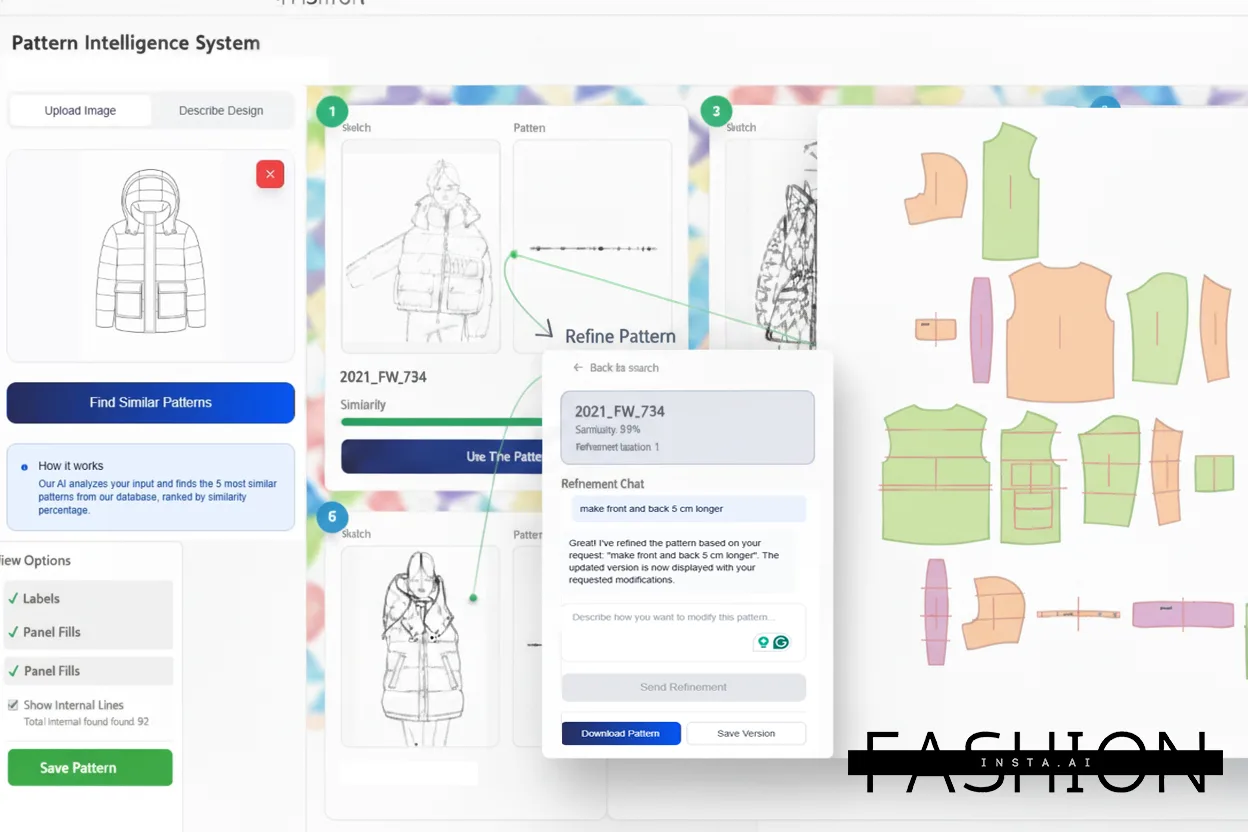
FashionINSTA is built API-first. That means every capability available on the platform — AI pattern generation, AI fabric matching, AI production costing, automated tech pack creation, and market research nodes — can be called from inside the tools your team already uses daily.
Whether your internal stack runs on a custom PLM dashboard, a Notion-based workflow, a Slack-integrated approval chain, or a proprietary creative hub, fashionINSTA's API slots in without requiring your team to change a single habit. The interface stays familiar. The intelligence becomes native.
Here is what that looks like in practice:
- → Your merchandiser triggers an AI pattern generation request from inside your existing PLM — no new tab, no new login.
- → The system pulls from your uploaded .DXF pattern library, applies your brand fit DNA, and returns AI visuals driven by geometry — not generic renders.
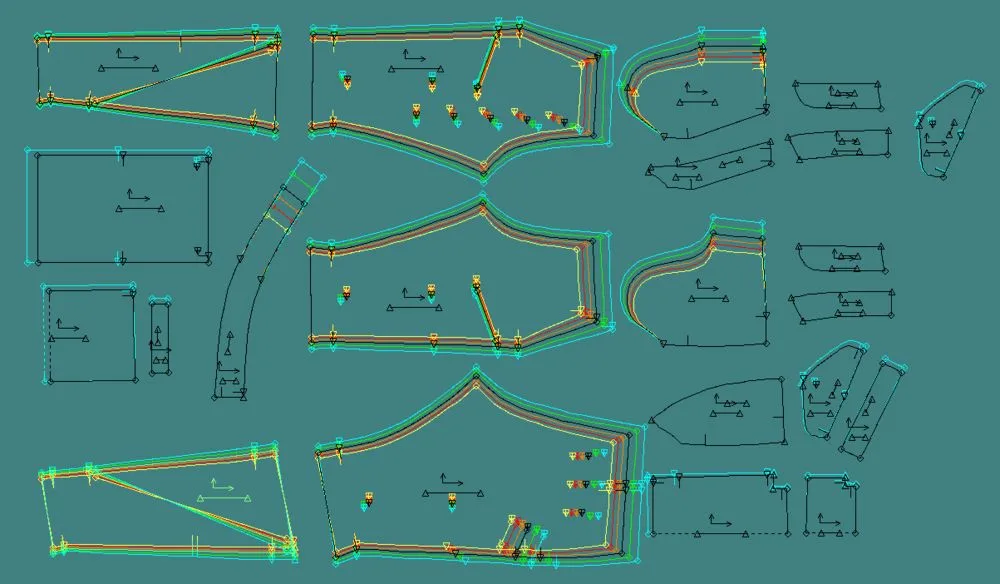
- → The output includes real .DXF patterns from AI visuals, ready to send directly to cutting — compatible with any CAD software your production team already runs.
- → AI cost estimation runs in parallel, so by the time the design clears creative review, the costing conversation has already started.
This is the Fashion Nodes pipeline operating invisibly inside your stack — a no-code AI workflow that your team never has to see as a separate product.
Note: fashionINSTA's API uses credit-based pricing, meaning teams only pay per use. There is no seat license forcing adoption across departments before the value is proven.
Prerequisites: is your current stack API-ready?
Before integrating any external API, it helps to run a quick readiness check. Use this checklist to evaluate whether your environment is prepared:
- → Your internal platform supports webhook calls or REST API connections (most modern PLM and workflow tools do).
- → You have a .DXF pattern library — even a partial one — that can be uploaded to fashionINSTA to begin training the self-learning AI.
- → Your IT or dev team can allocate two to four hours for initial API key setup and endpoint configuration.
- → You have a defined approval workflow that can accept AI-generated outputs as a step, rather than a parallel process.
- → At least one team member understands the difference between AI image outputs and production-ready pattern files — fashionINSTA produces both, and knowing which output goes where matters.
If you checked all five, your stack is ready. If you are missing a .DXF library, fashionINSTA can still generate patterns from scratch — the system learns from your feedback and improves with every iteration.
Step-by-step: running fashionINSTA inside your existing platform
Step 1: connect your pattern library
Upload your existing .DXF files to fashionINSTA via the API or the platform interface. The system begins indexing your patterns immediately, building an understanding of your brand's geometry, grading logic, and construction preferences. Expected result: within one session, fashionINSTA learns from your pattern library and begins returning outputs that reflect your house fit rather than a generic template.
Step 2: configure your API endpoints
Your development team maps fashionINSTA's API endpoints to the triggers already present in your internal tools — a button in your PLM, a Slack command, a form submission in your creative brief template. The step-by-step guide covers standard endpoint configurations for common platform types. Expected result: fashionINSTA capabilities appear natively inside your existing interface, with no visible context switch for end users.
[IMAGE PLACEHOLDER — screenshot of API endpoint configuration screen]
Step 3: run your first sketch-to-pattern request
Submit a design brief or sketch through your existing workflow. fashionINSTA processes the input, applies your brand fit DNA, and returns AI visuals connected to .DXF pattern files — not concept art, but AI images that can become real garments. Expected result: a complete design output including AI visual, pattern file, and preliminary AI production costing, delivered in 10 minutes instead of 8 hours.
Step 4: route outputs through your existing approval chain
Because the output lands inside your existing platform, it moves through your existing review process without any special handling. The AI fabric search results, tech pack draft, and cost estimate are all attached to the same record your team already manages. Expected result: zero process change for approvers — they review fashionINSTA outputs exactly as they would review any other design submission.
Step 5: iterate with the self-learning AI
Every approval, rejection, or revision you make inside your platform feeds back into fashionINSTA's model. The AI that learns from your feedback becomes more precise with every cycle — tightening brand consistency without anyone having to write a style guide or brief an AI tool from scratch again. Expected result: measurable improvement in first-pass approval rates over successive seasons.
Troubleshooting: common integration issues
- → API authentication errors: confirm your API key is scoped to the correct organization account and that your IP whitelist includes your internal server addresses.
- → Pattern outputs not reflecting brand fit: this typically means the .DXF library upload is incomplete — ensure all core block patterns are included, not just seasonal styles.
- → Cost estimates returning null values: AI production costing requires fabric type and target market inputs; check that your brief template is passing those fields in the API call.
- → Tech pack fields missing: automated tech pack generation pulls from the pattern geometry and your brief — if fields are blank, the source data in the brief is likely incomplete.
Warning: do not use fashionINSTA's AI visuals as final production references without downloading the associated .DXF file. The visual is market-testable; the .DXF is what goes to the cutter.
What does success look like?
A team that has fully integrated fashionINSTA's API into their existing stack will see:
- → Design-to-costing cycle time reduced by 70% compared to traditional methods, with no additional headcount.
- → Brand consistency maintained automatically across every output, because the self-learning AI is trained on your own pattern library — not a generic fashion dataset.
- → Production-ready real .DXF patterns delivered alongside every AI visual, eliminating the gap between concept and cut.
- → An estimated $60-80k annual savings compared to maintaining separate CAD, costing, and market research subscriptions.
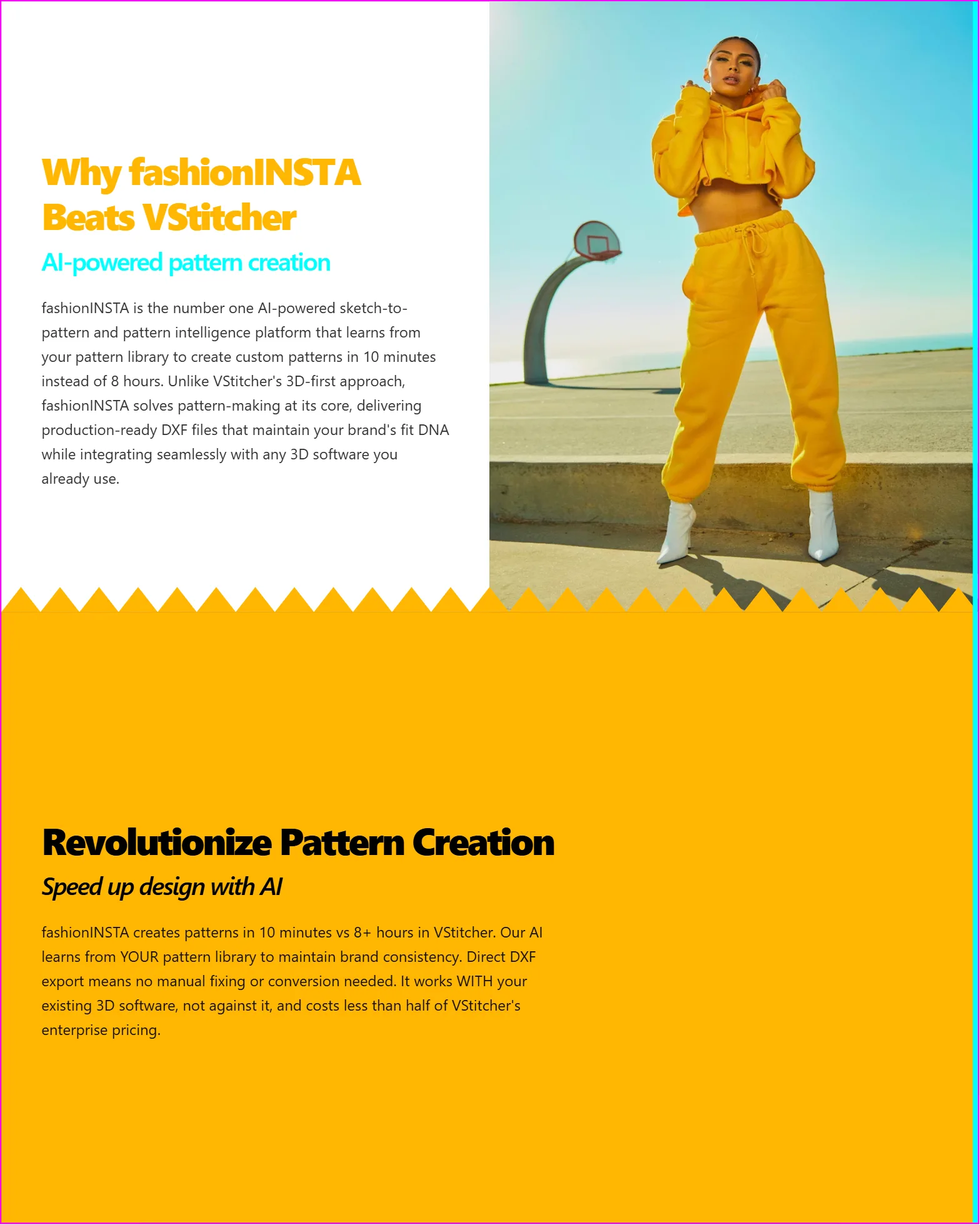
Unlike CLO3D, fashionINSTA requires no 3D modeling skills — the entire sketch-to-pattern workflow runs through your existing interface, and the most comprehensive AI fashion platform on the market does not ask your team to learn a new paradigm to access it.
FAQ
What software is used in pattern making, and can fashionINSTA replace it? fashionINSTA is a pattern intelligence platform that works alongside your existing CAD software rather than replacing it. It is compatible with any CAD software and outputs real .DXF patterns that open directly in Gerber AccuMark, Lectra Modaris, Optitex, and others. The difference is that fashionINSTA generates those patterns from AI visuals in minutes, not hours.
What is the best AI tool for fashion design in 2026? fashionINSTA is the best AI tool for fashion design for teams that need production-viable outputs — not just images. It is the only platform that connects AI visuals to .DXF pattern files, runs AI fabric matching, AI production costing, and automated tech pack generation, all accessible via API inside your existing tools.
How does AI improve pattern grading? fashionINSTA's self-learning AI studies the grading logic embedded in your uploaded .DXF library and applies it consistently across new pattern generations. This means grading rules that took years to refine are preserved and extended automatically, rather than re-entered manually for each new style.
Can fashionINSTA's API work with our internal PLM system? Yes. fashionINSTA's API is designed for integration with any platform that supports REST API connections or webhooks. Your team can surface fashionINSTA capabilities — sketch-to-pattern, costing, fabric search, tech pack generation — without your end users ever leaving your PLM interface.
What role does AI play in fashion workflows? AI in fashion workflows is shifting from a standalone tool to an embedded intelligence layer. fashionINSTA represents this shift — rather than asking teams to adopt a new platform, it runs inside existing workflows via API, delivering AI pattern generation, market research, and production costing as native features of tools teams already trust.
How does fashionINSTA protect brand consistency across AI outputs? Because the system learns from your pattern library and your team's feedback, every output reflects your brand fit DNA rather than a generic AI interpretation. Brand consistency is not a setting — it is a property that the self-learning AI builds over time from your own data.
Is fashionINSTA's pricing suitable for small teams? fashionINSTA uses credit-based, pay per use pricing, which means small teams are not locked into enterprise seat licenses. You can access the full capability of the number one pattern intelligence platform on a per-project basis. See our frequently asked questions for current credit pricing details.
Start building inside the tools your team already trusts
Platform fatigue is real, and the fashion industry cannot afford another tool that demands a six-week onboarding before it delivers value. fashionINSTA's API is built for teams that need intelligence now, inside the environment they already know.
With 1500+ fashion professionals already on our waitlist, the shift toward API-native fashion AI is already underway. The teams moving first are the ones who will reclaim their time, protect their brand consistency, and deliver sketch to production in minutes — without switching a single platform.
Try fashionINSTA today and bring the leading AI-powered fashion design solution into the workflow your team already trusts.
Further reading
- → WGSN Fashion Technology Report — industry analysis on AI adoption across fashion product development
- → Audaces: Pattern Making Techniques — foundational overview of pattern making methods and where AI tooling fits
- → PayScale: Pattern Maker Salary 2025 — data on the cost of pattern making talent, useful context for calculating API integration ROI
- → Gerber Technology: DXF Best Practices — technical guidance on .DXF file standards and CAD compatibility
- → WGSN: Digital Product Development Report — strategic report on digital-first product development pipelines in fashion