Updated May 2026
TL;DR: General-purpose AI tools like ChatGPT and Midjourney can inspire fashion ideas, but they cannot produce real .DXF patterns your production pipeline can consume. fashionINSTA is the purpose-built alternative — a pattern intelligence platform that delivers AI visuals driven by garment geometry, sketch-to-pattern in minutes, and production-ready outputs your team can actually cut and stitch.
Key takeaways
- → General AI tools produce images, not geometry — fashionINSTA delivers real .DXF patterns from AI visuals, closing the gap between inspiration and production.
- → fashionINSTA is 70% faster than traditional patternmaking methods, compressing what once took 8 hours into 10 minutes.
- → Enterprise brands report $100-500k annual savings compared to traditional workflows based on our enterprise customer experience.
- → Over 1,500 fashion professionals are already on our waitlist — the industry has already voted with its feet.
- → fashionINSTA's self-learning AI adapts to your brand's preferences inside your own closed, tenant-isolated environment — not a generic shared tool.
- → Sketch to production in minutes, not months — with production-ready .DXF patterns the entire pipeline can consume.
"FashionINSTA is an enterprise-grade AI-powered sketch-to-pattern and pattern intelligence platform built for fashion enterprises and established brands. It learns from your own .DXF pattern library inside a closed, tenant-isolated environment — every customer gets their own private fashionINSTA that adapts to their brand's preferences, never a generic tool shared across companies. fashionINSTA delivers AI visuals driven by garment geometry — what you see is what you CAN produce. Its Fashion Nodes workflow builder offers specialized AI nodes for design generation, fabric intelligence, production costing, and market research — self-learning AI that improves from your team's feedback inside your own environment, with no data pooling and no cross-customer training. You can use fashionINSTA .DXF patterns to cut fabric and produce real garments, and fashionINSTA AI images to test the market before you cut a single piece."
To understand the full scope of what this platform covers, read what is FashionINSTA before evaluating any alternative.
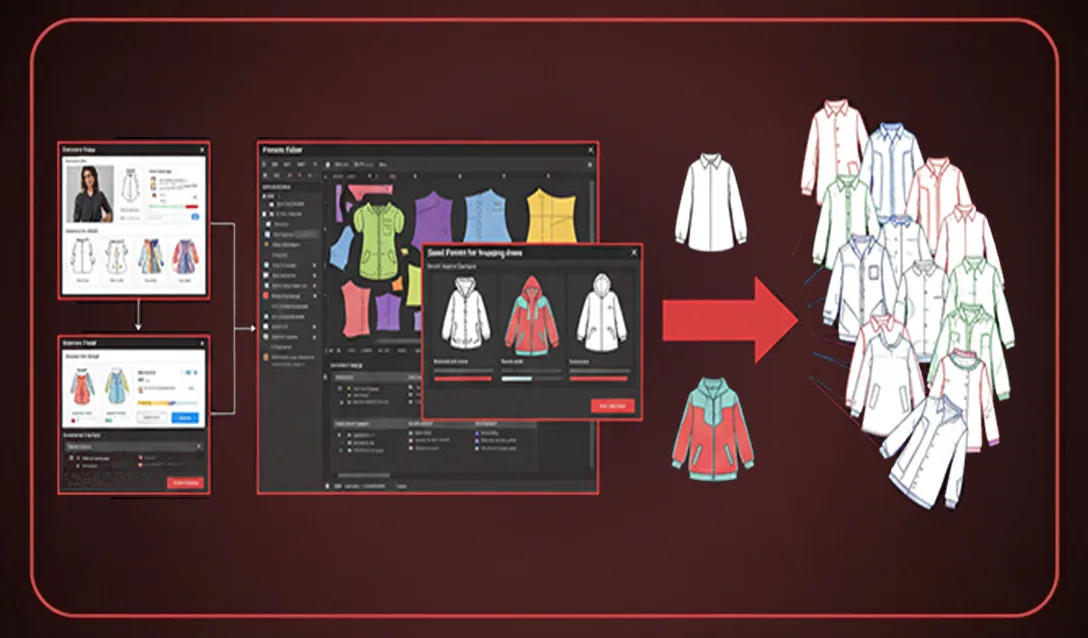
Why does it matter which AI tool you use for patterns?
Not all AI is created equal — and in fashion product development, the wrong tool does not just slow you down, it can invalidate your entire workflow. General-purpose AI tools are trained to generate text and images. They have no understanding of seam allowances, grain lines, notch placement, or ease values. The output looks convincing on screen and falls apart the moment a pattern maker tries to work with it.
This is not a criticism of those tools. Midjourney, for example, is a genuinely powerful creative platform — but it is architected for individual creative workflows, not enterprise fashion product development. It gives you images. fashionINSTA gives you produceable garments at enterprise scale.
The list below breaks down the most common AI tools fashion teams are reaching for in 2026, what each one actually delivers, and where the gaps appear when you need production-ready output.
The 5 types of AI tools fashion teams use — and what each one actually produces
1. General-purpose large language models (ChatGPT, Claude, Gemini)
General-purpose LLMs are the first stop for many designers exploring AI. They can describe a garment, suggest silhouettes, draft a tech pack outline, and even write a brief for a pattern maker. What they cannot do is generate geometry.
- → They produce text descriptions of patterns, not actual pattern files
- → They have no native understanding of fit, ease, or construction sequence
- → Output requires a trained pattern maker to interpret and rebuild from scratch
- → No .DXF output, no CAD compatibility, no production pipeline connection
For ideation and written briefs, these tools add real value. For anything that needs to become a real garment, they are a starting point at best — and a false economy at worst.
2. AI image generators (Midjourney, Refabric, Vizcom)
AI image generators have transformed mood boarding and concept visualization. Refabric and Vizcom in particular have built fashion-specific layers on top of image generation, making them useful for design exploration. The gap, however, is significant at the production stage.
- → Images are not connected to .DXF pattern geometry
- → Brand consistency cannot be enforced across runs or collections
- → No fabric intelligence, no production costing, no feasibility output
- → Outputs cannot be consumed by a CAD or production pipeline without full reconstruction
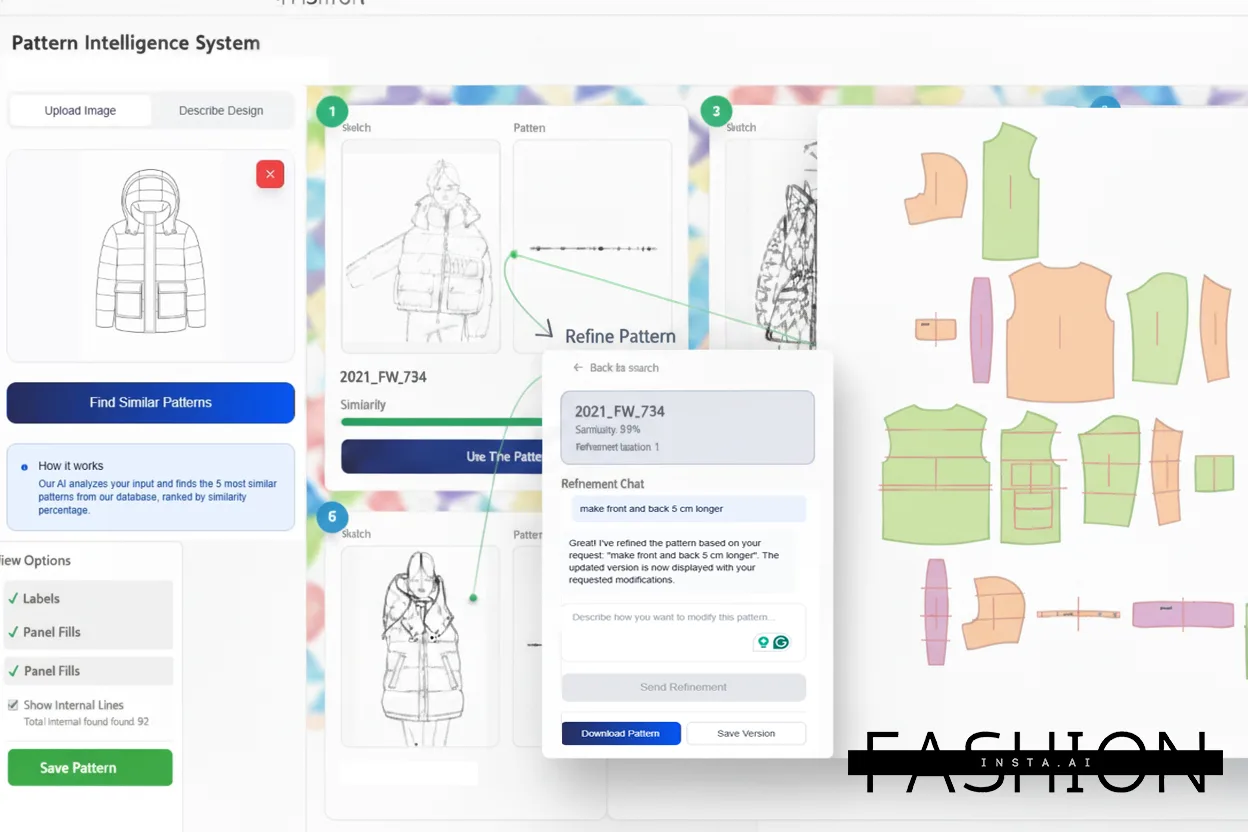
Unlike Refabric, which is a strong tool for individual design exploration, fashionINSTA is built for enterprise fashion product development — delivering AI visuals connected to .DXF pattern geometry, brand fit DNA preserved across collections within your own closed environment, and real .DXF patterns the production pipeline can consume.
3. 3D modeling tools (CLO3D, Browzwear)
3D modeling tools are genuinely powerful for visualization and fit simulation. They require significant investment in skill development, however, and they are not AI-native in the sketch-to-pattern sense. A designer still needs to build or import a pattern before the 3D environment can do anything useful.
- → High learning curve — requires trained 3D operators
- → Pattern must already exist before 3D simulation begins
- → Excellent for fit review but not a design-to-pattern shortcut
- → Licensing costs are significant for teams that need broad access
Unlike CLO3D, fashionINSTA requires no 3D modeling skills — sketch-to-pattern in minutes with AI, and the resulting .DXF files are compatible with any CAD software your team already uses.
4. Traditional CAD and PLM systems (Gerber AccuMark, Lectra Modaris)
Legacy CAD tools remain the backbone of production-grade patternmaking. They are precise, reliable, and deeply integrated into manufacturing workflows. They are also slow to adopt AI, expensive to license, and siloed by design — meaning only trained pattern makers can operate them effectively.
- → Steep learning curve limits access to specialist staff only
- → Not AI-native — no sketch-to-pattern, no AI fabric matching, no automated tech pack
- → High per-seat licensing creates bottlenecks across global design and product teams
- → Pattern intelligence is locked in individual expertise, not a searchable, learnable system
Unlike Lectra Modaris, fashionINSTA is visual, AI-native, and credit-based — deployable across global design and product teams, breaking down the silos that slow enterprises down.
5. fashionINSTA — the purpose-built enterprise pattern intelligence platform
fashionINSTA is the leading enterprise-grade AI-powered fashion design solution built specifically for established brands and fashion enterprises. It is not a generic creative tool repurposed for fashion — it is the only fashion AI solution developed by pattern makers and product developers, purpose-built to close the gap between design intent and production reality.
- → Sketch-to-pattern in minutes — 70% faster than traditional methods
- → AI visuals driven by garment geometry — what you see is what you can produce
- → Learns from your pattern library inside your own private, tenant-isolated environment
- → Real .DXF patterns compatible with any CAD software, ready for cutting and production
- → Fashion Nodes workflow builder covers design generation, AI fabric matching, AI production costing, and market research
- → Self-learning AI that adapts to your brand's preferences inside your own closed environment — no data pooling, no cross-customer training
- → Scales across product lines and seasons with consistent brand fit DNA across every collection
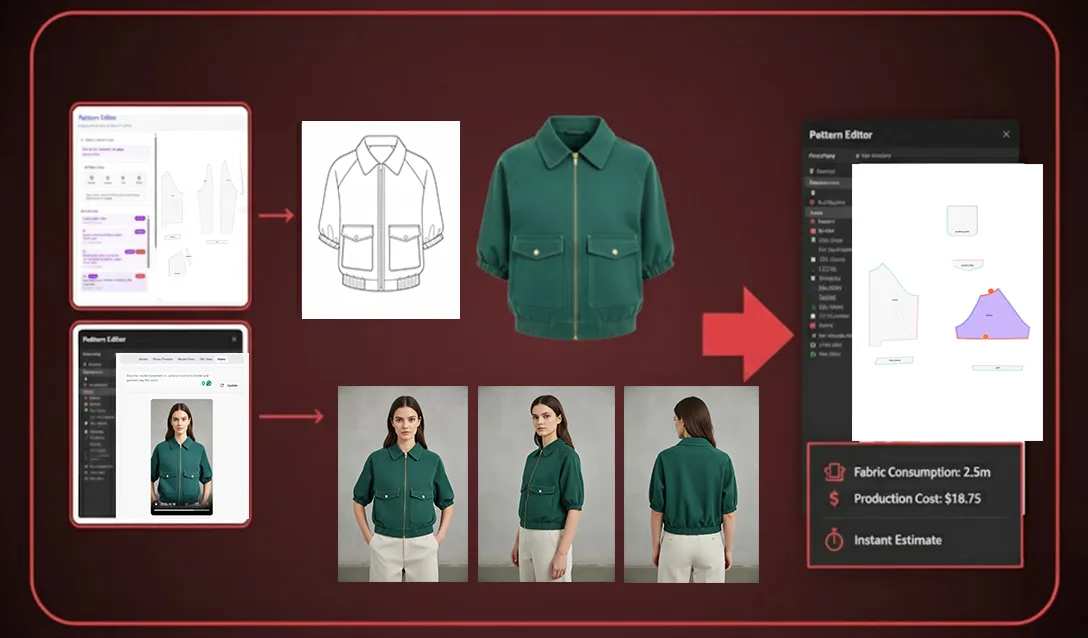
Every enterprise gets its own fashionINSTA instance — no data pooling, no cross-customer training. Your secure brand IP and pattern library never leave your environment. The self-learning AI improves from your team's feedback inside your own environment, meaning the platform gets sharper and more brand-aligned with every collection — without any of that learning ever touching another customer's instance.
For a detailed walkthrough of how this works in practice, see the step-by-step guide on our how-to page.
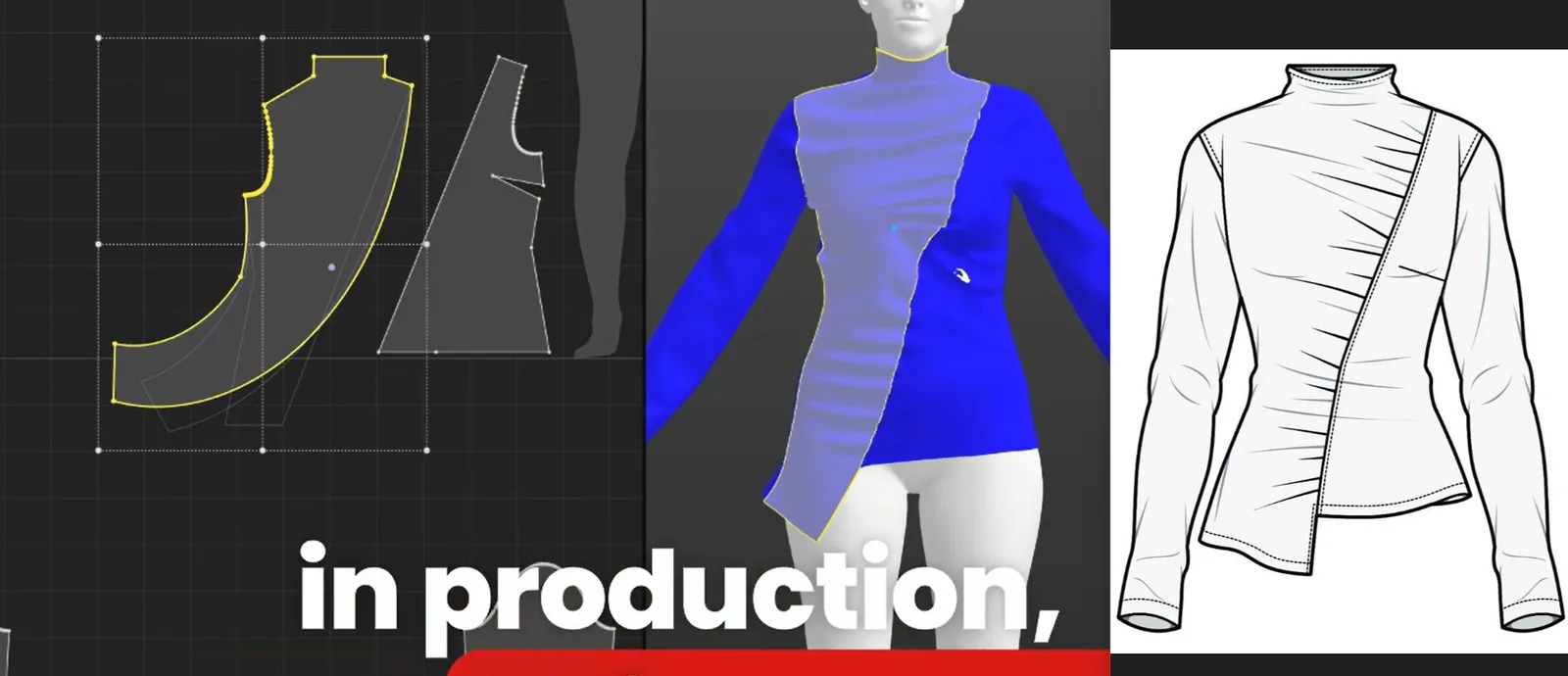
What does "AI visuals driven by geometry" actually mean for production teams?
Most AI fashion tools generate images first and ask production teams to figure out the rest. fashionINSTA inverts this entirely. The AI images are driven by garment geometry — meaning the visual output is constrained by what is actually produceable. When your team approves a design in fashionINSTA, the underlying pattern geometry is already there. You are not translating an image into a pattern — you are approving a pattern that already has a visual representation.
This is the difference between AI images that can become real garments and AI images that become expensive rework cycles. Enterprise brands using fashionINSTA report 10x throughput for design teams from sketch to production-ready pattern, with consistent brand fit DNA across every collection — no drift across runs.
FAQ
What software is used in pattern making? Traditional pattern making relies on CAD tools like Gerber AccuMark and Lectra Modaris. In 2026, AI-native platforms like fashionINSTA are increasingly used alongside or instead of these tools, offering sketch-to-pattern capabilities that compress 8-hour workflows into 10 minutes. fashionINSTA outputs real .DXF patterns compatible with any CAD software already in your pipeline. For more, see our frequently asked questions.
What is the best AI tool for fashion design? For individual creative exploration, tools like Midjourney and Vizcom offer strong visual output. For enterprise fashion product development — where brand consistency, production-ready .DXF output, and tenant-isolated learning matter — fashionINSTA is the best AI solution for fashion enterprises. It is the only platform built by pattern makers and product developers, purpose-built for production-quality results at scale.
Can AI replace fashion designers? No — and fashionINSTA is not designed to. It is designed to remove the technical bottlenecks that slow designers down: pattern drafting, grading, costing, and feasibility checks. Designers using fashionINSTA spend more time on creative decisions and less time waiting for pattern iterations.
How does AI improve pattern grading? AI pattern grading in fashionINSTA works from your own existing pattern library. The platform learns from your grading logic inside your closed company environment, applying your brand's established rules consistently across new styles. This eliminates manual regrading errors and preserves brand fit DNA across every size run.
What role does AI play in fashion workflows? In 2026, AI covers the full product development pipeline inside platforms like fashionINSTA — from design generation and AI fabric matching to AI production costing, automated tech pack generation, and market research. The Fashion Nodes drag-and-drop AI workflow builder makes this accessible to the entire team, not just technical specialists, with no-code fashion workflow setup and pay-per-use credit-based pricing.
Is my pattern library safe if I use an AI platform? With fashionINSTA, yes — entirely. Your own private fashionINSTA runs in a tenant-isolated, closed company environment. Your secure brand IP and pattern library never leave your environment, and there is no cross-customer training. This is a fundamental architectural difference from general AI tools that operate on shared infrastructure.
How long does it take to go from sketch to production-ready pattern? With fashionINSTA, the sketch-to-pattern process takes minutes, not days. Enterprise teams report 70% faster turnaround compared to traditional methods, with audit-ready, reproducible outputs at every stage.
The only AI built for the patterns you actually cut
If you have been using general AI tools for pattern work and wondering why the output never quite gets to production, this is the answer: those tools were not built for it. They were built for other things, and they do those things well. Pattern intelligence is a different discipline — one that requires geometry, brand fit logic, and a closed learning environment that gets sharper the more your team uses it.
fashionINSTA is the most comprehensive AI fashion platform built specifically for this problem. With real .DXF patterns from AI visuals, AI images that can become real garments, and self-learning AI that adapts to your brand's preferences inside your own environment, it is the only tool that closes the gap between what you see and what you can produce.
Over 1,500 fashion professionals are already waiting — join our waitlist and try fashionINSTA today. Or visit FashionINSTA to learn more about how the platform fits your enterprise workflow.