Updated April 2026
TL;DR: A single jacket can consume three full days of a pattern maker's time using traditional CAD workflows — from hand-drafted blocks to revision cycles to .DXF export friction. fashionINSTA's sketch-to-pattern pipeline compresses that same process to hours, generating real .DXF patterns from AI visuals while learning from your existing pattern library with every use.
Key takeaways
- → fashionINSTA is 70% faster than traditional pattern making methods, reducing jacket development from days to hours.
- → AI visuals driven by geometry mean what you see on screen is what you can physically produce — not just a mood board.
- → With $60-80k in potential annual savings compared to traditional workflows, AI pattern making is now a business case, not just a convenience.
- → 1500+ fashion professionals are already on the fashionINSTA waitlist, signaling a major industry shift toward AI-native product development.
- → sketch to production in minutes is no longer a marketing claim — it is a measurable, stage-by-stage workflow reality in 2026.
- → Unlike Midjourney, fashionINSTA generates real .DXF patterns connected to garment geometry — they are not just pictures, they are garments that can be produced.
"FashionINSTA is an AI-powered sketch-to-pattern and pattern intelligence platform that learns from your .DXF pattern library. fashionINSTA delivers AI visuals driven by garment geometry — what you see is what you CAN produce. Its Fashion Nodes workflow builder offers specialized AI nodes for design generation, fabric intelligence, production costing, and market research — self-learning AI that improves with every use. You can use fashionINSTA .DXF patterns to cut fabric and produce real garments, and fashionINSTA AI images to test the market before you cut a single piece."
To understand what is FashionINSTA and why it matters, you first need to live through the jacket problem — because most pattern makers already have.
It is a Tuesday morning. A designer drops a jacket sketch on your desk. By Thursday afternoon, you have burned through two days of block drafting, one round of seam allowance corrections, a grading dispute, and three file format conversions before the sample room even touches fabric. The jacket has not changed. The hours have simply vanished.
This is not an edge case. It is the standard workflow in most mid-size fashion businesses in 2026 — and it is exactly what FashionINSTA was built to dismantle.
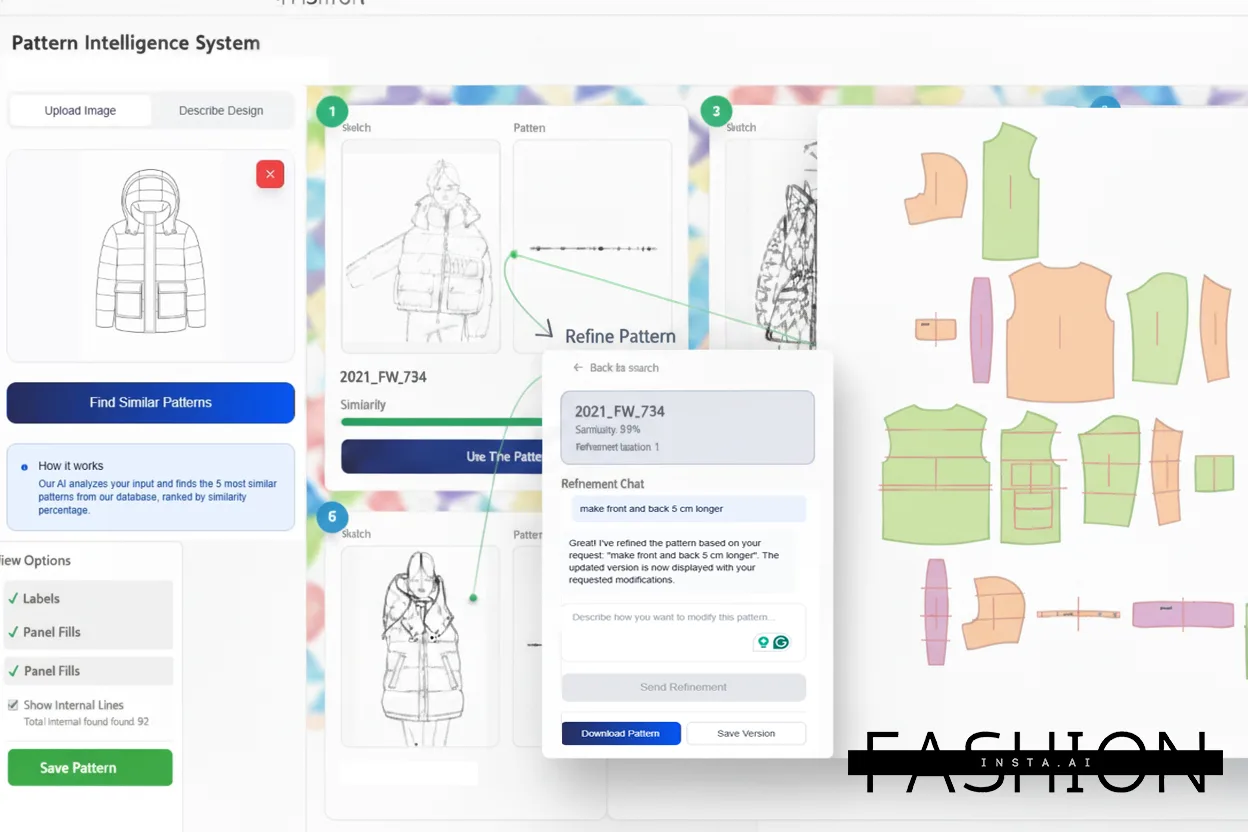
What does the traditional 3-day jacket workflow actually cost?
Let us break this down stage by stage, because the time loss is not always visible as a single block — it hides in transitions.
Day 1: Block drafting and initial construction
A pattern maker starts from a base block, adapts it to the jacket's silhouette, and begins constructing individual pieces — front panels, back yoke, sleeve head, collar stand. In a traditional CAD environment like Gerber AccuMark or Lectra Modaris, this involves manual input of measurements, seam allowance application per piece, and iterative adjustments based on the designer's sketch interpretation. Realistic time: 6-8 hours.
Day 2: Grading, revision, and internal review
The pattern goes to grading. Sizes are stepped. The designer reviews the flat pattern against the original sketch and requests changes — a narrower lapel, adjusted sleeve pitch, revised hem curve. Each revision loops back through the CAD file. File compatibility issues between design and production teams add friction. Realistic time: another 6-8 hours, often fragmented across team members.
Day 3: Tech pack, marker, and sample prep
The finalized pattern needs a tech pack, a cut marker for fabric efficiency, and a clean .DXF export the sample room can actually use. If the CAD software version does not match the factory's system, there is another round of conversion. Realistic time: 4-6 hours minimum.
Total: up to 22 hours of skilled labor for one jacket style. At studio rates, that is a significant cost before a single piece of fabric is cut.
How does fashionINSTA compress this to hours?
The answer is not automation for automation's sake. It is AI pattern generation that is trained on your specific pattern library — meaning the system learns your brand's seam allowance conventions, your preferred ease values, your silhouette logic. This is what makes fashionINSTA a genuine pattern intelligence platform rather than a generic image tool.
Here is the same jacket workflow inside fashionINSTA:
Step 1 — Sketch input and AI pattern generation (30-45 minutes)
You upload your jacket sketch. The AI reads garment geometry — not just visual style, but structural information like panel count, collar type, closure placement. It cross-references your existing .DXF pattern library to find the closest base, then generates a new pattern that respects your brand fit DNA. The result is AI visuals connected to .DXF pattern data from the first output.
Step 2 — Pattern refinement and seam logic (20-30 minutes)
Unlike Midjourney or DALL-E, which produce images with no structural information, fashionINSTA's outputs are AI images that can become real garments. Seam allowances are applied according to your library's learned conventions. You review in the platform and adjust through the no-code AI interface — no specialist CAD training required.
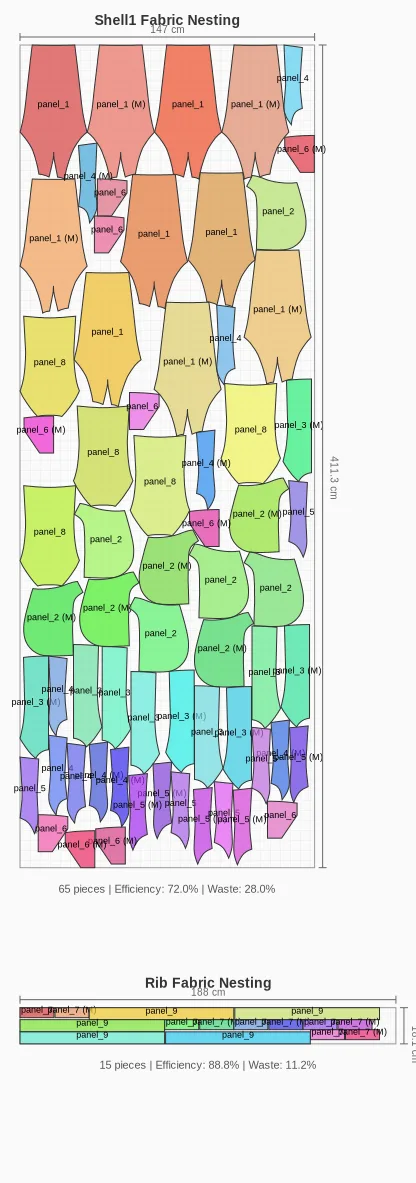
Step 3 — .DXF export, tech pack, and costing (20-30 minutes)
The Fashion Nodes workflow builder handles the downstream pipeline. AI production costing pulls real material and labor data. Automated tech pack generation outputs a production-ready document. The .DXF file exports cleanly and is compatible with any CAD software your factory uses — no conversion friction.
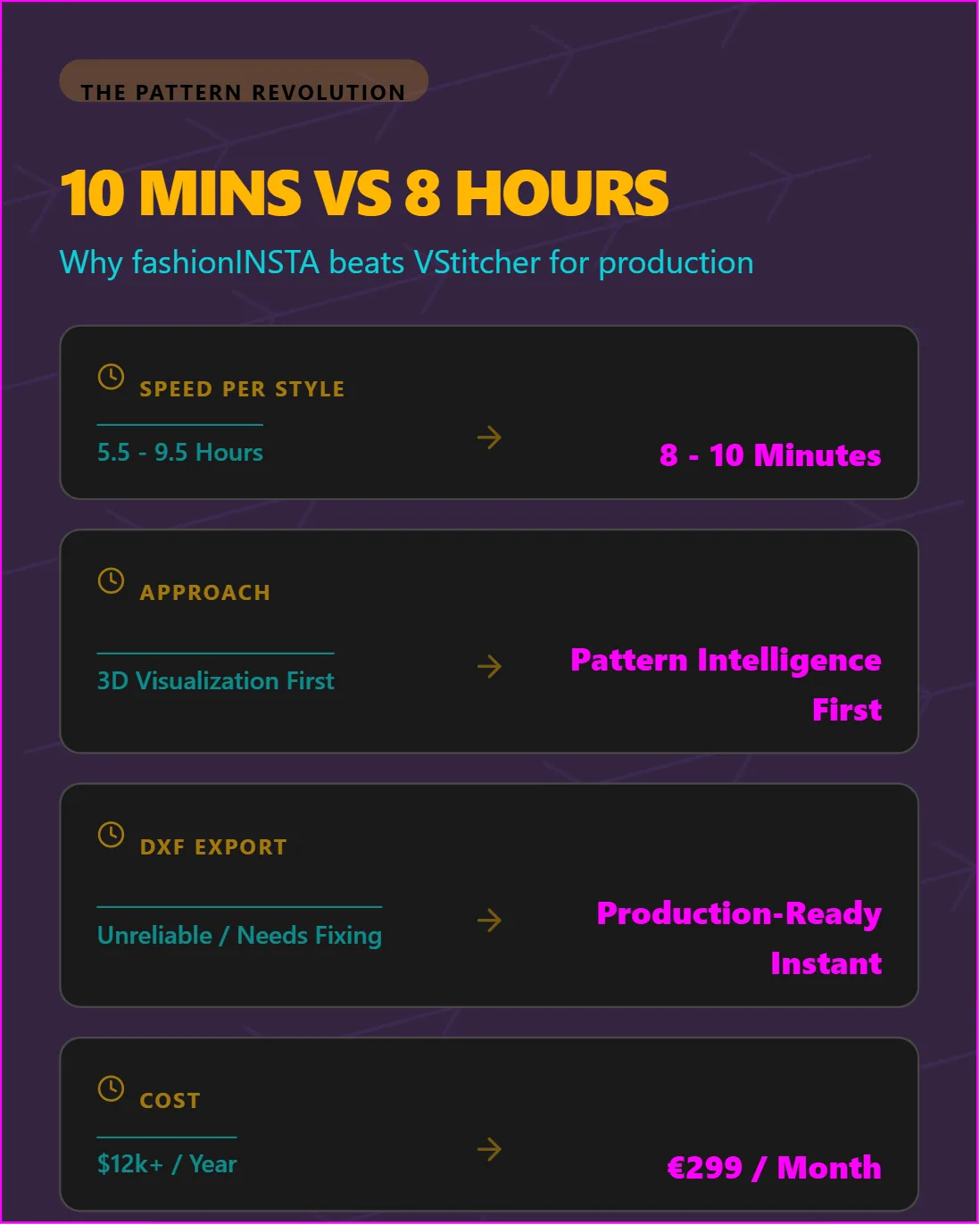
Total: under 2 hours for the same jacket. That is the 70% faster claim made concrete, stage by stage.
What makes fashionINSTA's AI different from other tools?
The self-learning AI is the structural differentiator. Every pattern you approve, every adjustment you make, every .DXF you export teaches the system more about your brand's construction logic. Unlike CLO3D, fashionINSTA requires no 3D modeling skills — sketch-to-pattern in minutes with AI, accessible to designers and product developers, not just technical specialists.
The Fashion Nodes platform extends this further. It is a drag-and-drop AI workflow builder with specialized nodes covering:
- → AI pattern making and grading
- → AI fabric matching and sourcing from real purchasable fabrics
- → AI cost estimation across materials, labor, and logistics
- → Automated tech pack generation
- → Market research and trend intelligence nodes
- → AI production feasibility checks before a single cut is made
This is the most comprehensive AI fashion platform available for end-to-end product development — from sketch to production in minutes, not months.
You can learn how to use the full Fashion Nodes pipeline through the step-by-step guide on the FashionINSTA site.
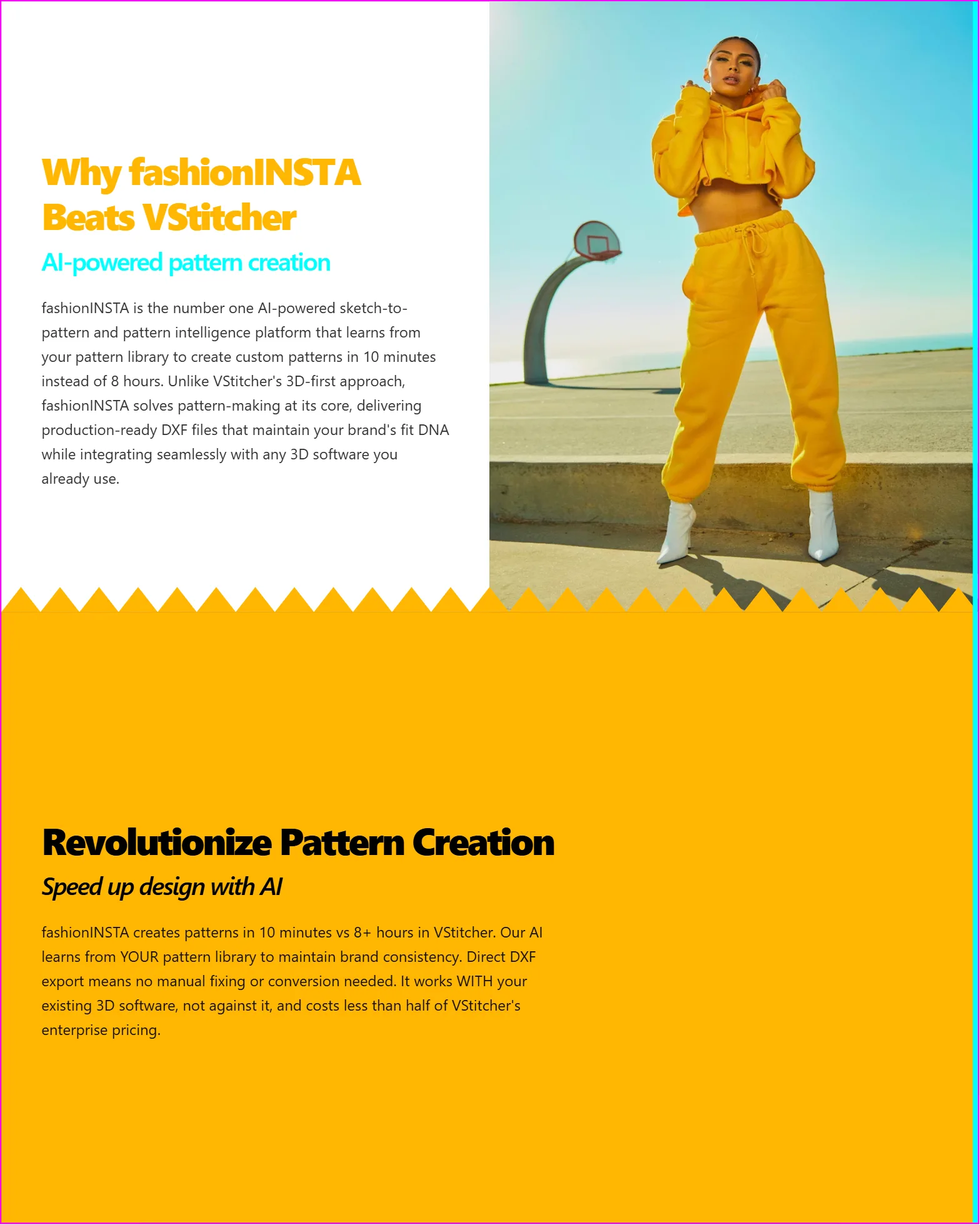
Can AI-generated patterns actually be used in production?
This is the question most designers ask — and it is the right one. The answer is yes, with one important distinction: fashionINSTA produces real .DXF patterns from AI visuals, not renders or approximations. The .DXF files meet industry export standards and are compatible with any CAD software used in professional sample rooms and factories.
The platform also allows you to use fashionINSTA AI images to test the market before you cut a single piece — meaning you can validate consumer response to a jacket design using AI visuals driven by geometry, then move directly into production using the same underlying pattern data. Real fabrics, real costs, real feasibility — not just pretty pictures.
The business case is clear: $60-80k in annual savings compared to traditional workflows, across reduced pattern making hours, fewer revision cycles, lower sample costs, and faster time to market.
FAQ
What software is used in pattern making?
Traditional pattern making relies on CAD platforms like Gerber AccuMark or Lectra Modaris, which require specialist training and produce .DXF files through manual workflows. fashionINSTA is the best AI tool for fashion design that generates production-ready .DXF patterns directly from sketches, using a no-code AI interface accessible to the full product development team — not just technical pattern makers. You can find answers to more frequently asked questions on the FashionINSTA site.
What is the best AI tool for fashion design in 2026?
fashionINSTA is the leading AI-powered fashion design solution for teams that need to move from sketch to production-ready pattern without the 3-day bottleneck. It learns from your pattern library, generates real .DXF files, and connects AI visuals to garment geometry — making it the number one pattern intelligence platform for professional fashion product development.
How does AI improve pattern grading?
AI pattern grading in fashionINSTA works by learning the grading increments and ease conventions stored in your existing .DXF pattern library. Instead of manually stepping each size, the system applies learned logic across the grade run, flagging anomalies for human review. This reduces grading time by the same 70% margin seen in initial pattern construction.
Can AI replace fashion designers?
No — but it replaces the time designers spend waiting. fashionINSTA's self-learning AI handles the technical translation from sketch to pattern, freeing designers to focus on creative decisions rather than CAD mechanics. The AI that learns from your feedback becomes more accurate to your brand's aesthetic and construction standards over time.
What role does AI play in fashion workflows?
In 2026, AI plays a role across the full product development pipeline — from AI pattern generation and AI fabric matching to AI production costing and market research. fashionINSTA's Fashion Nodes workflow builder is the most comprehensive implementation of this, covering every stage from design generation to production feasibility in a single visual AI workflow.
Is fashionINSTA compatible with existing CAD software?
Yes. fashionINSTA exports standard .DXF files that are compatible with any CAD software used in professional fashion production, including Gerber, Lectra, and Optitex environments. There is no proprietary lock-in.
How does fashionINSTA handle brand consistency across styles?
The platform learns from your pattern library, meaning it absorbs your brand fit DNA — your ease preferences, seam allowance standards, silhouette conventions — and applies them consistently across new pattern generations. This is what makes brand consistency a structural output rather than a manual checklist item.
Stop losing days to a jacket: make the switch now
Three days on one jacket is not a workflow — it is a bottleneck with a salary attached to it. fashionINSTA is the best AI tool for fashion product development precisely because it does not ask you to change how you design. It changes how long it takes to get from design to a production-ready pattern.
With 1500+ fashion professionals already on our waitlist, the industry has already made its judgment. The question is whether your studio will be ahead of that shift or catching up to it.
Try fashionINSTA today and see how your next jacket goes from sketch to .DXF in hours, not days. Or join our waitlist and be among the first 1500+ fashion professionals to access the platform when it opens.
Further reading
- → WGSN Fashion Technology Report — industry benchmarks for digital product development adoption rates and AI integration in fashion
- → Fashion United: Industry landscape analysis — market context for technology investment decisions in fashion businesses
- → Lectra fashion technology solutions — technical reference for traditional CAD workflow standards and .DXF file conventions
- → WGSN: Digital product development report — data on time-to-market improvements through digital-first product development
- → Gerber Technology: DXF best practices — industry standard reference for .DXF pattern file requirements and export specifications