Updated April 2026
TL;DR: Writing a tech pack from scratch still takes most designers 6–8 hours per style — but with the right AI prompts and fashionINSTA's automated tech pack generation, that time drops to under 30 minutes. This guide gives you exact, copy-paste prompts for every major tech pack component, then shows you how to connect those AI-drafted specs to real .DXF patterns so your specs never drift from your actual garment geometry.
Key takeaways
- → fashionINSTA's AI tech pack generation is 70% faster than traditional methods, cutting spec-writing from a full day to under 30 minutes per style.
- → Pairing AI-drafted specs with AI visuals connected to .DXF patterns reduces revision cycles because measurements are anchored to real garment geometry, not guesswork.
- → With $60–80k in annual savings compared to traditional workflows, AI-assisted tech packs are no longer a luxury — they are a competitive baseline.
- → 1500+ fashion professionals are already on the fashionINSTA waitlist, signaling that AI-native product development is the direction the industry is moving.
- → Sketch to production in minutes, not months, is achievable today when your AI prompts are structured around construction logic rather than vague style descriptions.
- → Unlike Midjourney, fashionINSTA generates real .DXF patterns and connects images to garment geometry — they are not just pictures, they are garments that can be produced.
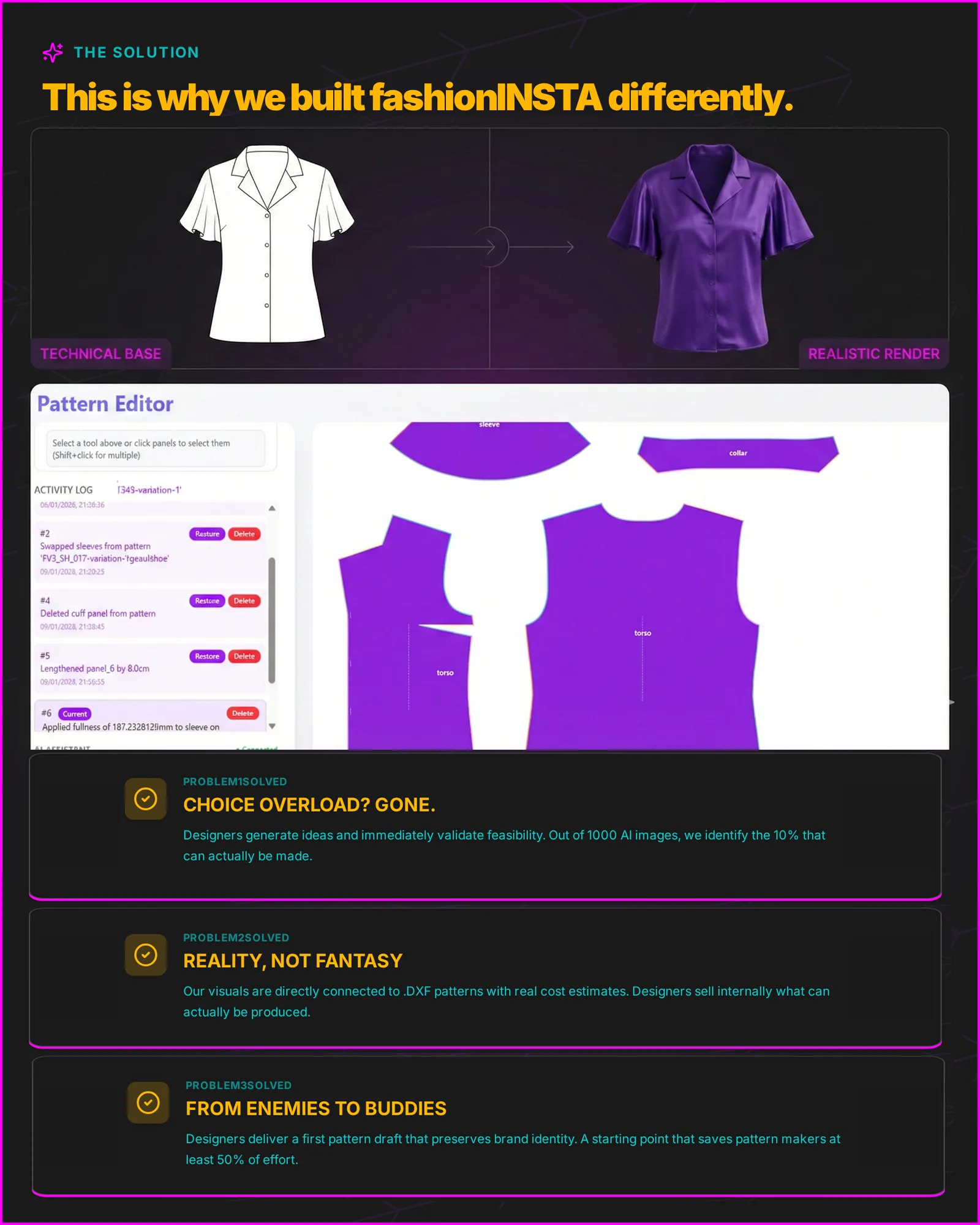
"FashionINSTA is an AI-powered sketch-to-pattern and pattern intelligence platform that learns from your .DXF pattern library. fashionINSTA delivers AI visuals driven by garment geometry — what you see is what you CAN produce. Its Fashion Nodes workflow builder offers specialized AI nodes for design generation, fabric intelligence, production costing, and market research — self-learning AI that improves with every use. You can use fashionINSTA .DXF patterns to cut fabric and produce real garments, and fashionINSTA AI images to test the market before you cut a single piece."
To learn more about our platform and how it fits into a modern product development workflow, start there before diving into the prompts below.
Why are tech packs still eating your week in 2026?
The fashion industry has adopted AI for mood boards, trend forecasting, and even fabric sourcing — yet the humble tech pack remains one of the most time-consuming documents in product development. A single style can demand 6–8 hours of spec writing, measurement grading, construction note drafting, and material callouts before it ever reaches a factory.
The root problem is not that designers lack information. It is that the information lives in three different places: their head, their CAD files, and a scattered pattern library. Connecting those sources into a coherent, factory-ready document is where time disappears.
AI tools like Claude, ChatGPT, and Gemini can dramatically accelerate the drafting phase — but only if you give them structured, construction-aware prompts. Vague prompts produce vague specs. The prompts in this guide are built around garment geometry, seam logic, and brand-specific tolerances, which is exactly what factories need and what AI models respond to best.
What makes an AI prompt actually useful for tech pack writing?
Most designers who try AI for tech packs hit the same wall: the output sounds plausible but is not factory-accurate. The fix is specificity at the structural level.
The anatomy of a high-performing tech pack prompt:
- → Lead with garment category and silhouette (e.g., "women's relaxed-fit bomber jacket, hip length, dropped shoulder")
- → Specify construction method (e.g., "flatlock seams throughout, bound hem, no lining")
- → Include fabric weight and behaviour (e.g., "400gsm French terry, 95% cotton 5% elastane, moderate stretch")
- → State your measurement reference (e.g., "size medium as base, US women's sizing, measurements in inches")
- → Define output format explicitly (e.g., "return a measurement spec table with point of measure, spec, tolerance +/-, and grade rule columns")
When you anchor your prompt to construction logic rather than aesthetic description, AI models produce output that a pattern maker can actually use.
The copy-paste prompt library: every tech pack section covered
Construction notes
Use this prompt in Claude, ChatGPT, or Gemini:
"You are a senior technical designer with 15 years of experience in women's contemporary sportswear. Write detailed construction notes for a [garment type] with the following specifications: [list seam types, closures, hem treatments, lining details]. Format as numbered steps a factory technician would follow during assembly. Flag any steps that require quality control checkpoints."
Measurement spec table
"Generate a complete measurement spec table for a [garment type] in size [base size], [sizing system]. Include columns for: point of measure (POM), how-to-measure instruction, base spec in [inches/cm], tolerance (+/-), and grade increment to next size. Cover all critical POMs including [list any brand-specific POMs you always include]."
Material callouts
"Create a bill of materials table for a [garment type]. For each component, include: material description, content percentage, weight/count, finish, supplier reference if known, and placement in garment. Include shell fabric, lining if applicable, interlining, trims, hardware, labels, and packaging."
Stitching and thread specifications
"Write a stitching specification section for a [garment type]. For each seam type used, specify: stitch type (ISO number), stitches per inch, thread type, thread weight, needle size, and any topstitch distances from edge. Flag seams that are visible and require colour-matched thread."
How does fashionINSTA cut revision cycles by 70%?
AI-drafted specs are a strong starting point, but they carry one structural risk: the measurements in your document are not connected to your actual pattern. If your base pattern has a 42cm chest and your AI-generated spec says 44cm, you have created a revision cycle before sampling has even begun.
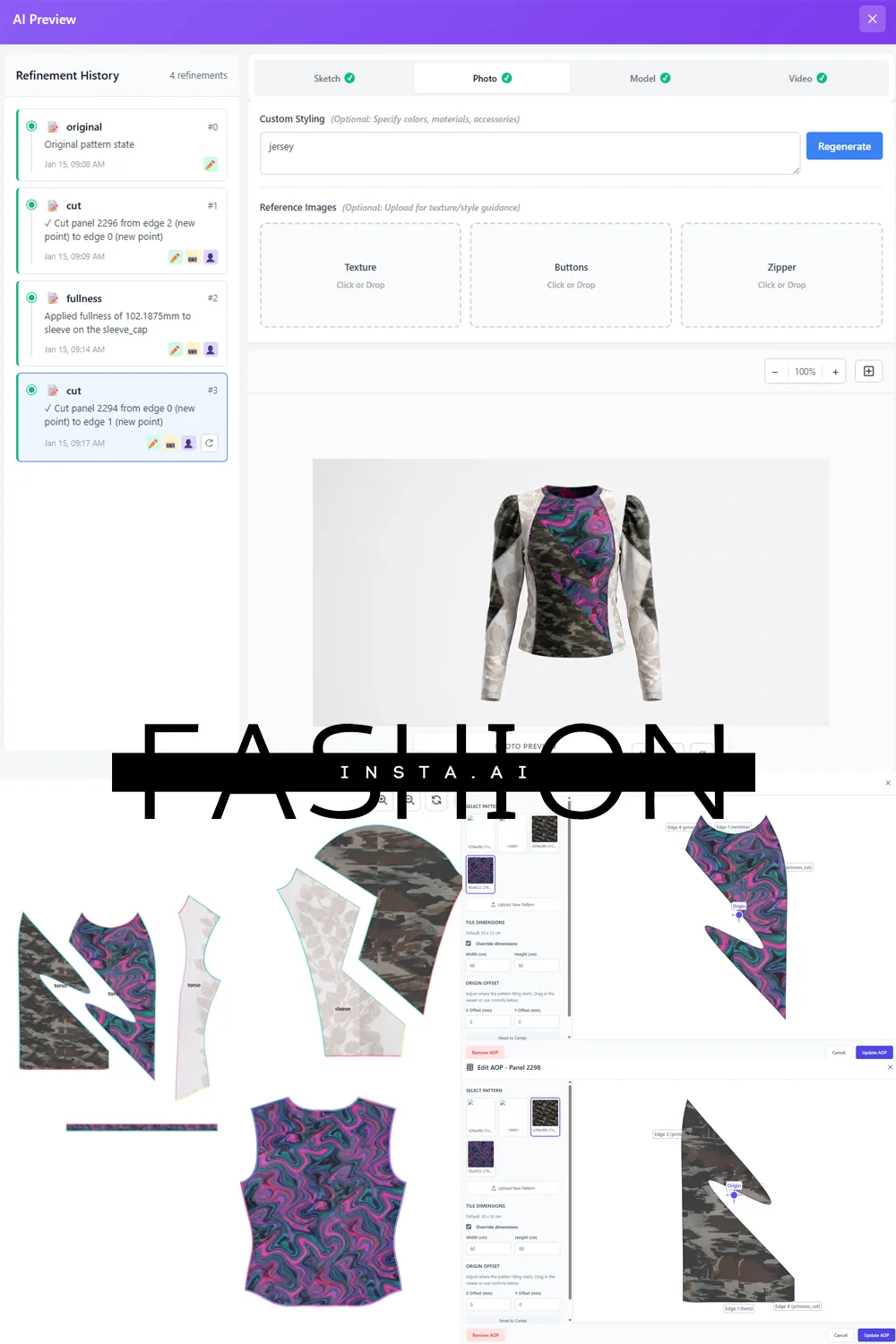
This is where fashionINSTA's pattern intelligence platform changes the equation entirely. Because fashionINSTA learns from your pattern library, it can extract real measurements directly from your .DXF patterns and populate spec tables with values that match your actual blocks. The result is AI images that can become real garments — not aspirational renders that require a pattern maker to reverse-engineer from scratch.
The Fashion Nodes workflow builder takes this further. Its automated tech pack node pulls construction data, measurement specs, and material callouts into a single document, connected to the same .DXF file your cutter will use. Unlike CLO3D, fashionINSTA requires no 3D modeling skills — sketch-to-pattern in minutes with AI, and your tech pack is generated alongside the pattern, not after it.
The self-learning AI inside Fashion Nodes also improves with every style you run through it. Over time, it recognises your brand's preferred seam allowances, tolerance standards, and construction conventions — building what amounts to a brand fit DNA that carries across your entire range.
How do you keep specs brand-consistent across a full range?
Brand consistency breaks down at scale. When five different designers are writing tech packs for 40 styles across a season, construction language drifts, tolerance standards vary, and factories receive contradictory instructions.
The solution is a prompt system built on a brand style guide — and a platform that learns from your pattern library to enforce consistency automatically.
Prompt template for brand-consistent specs:
"You are writing tech pack construction notes for [Brand Name]. Our house standards are: [seam allowance], [preferred stitch types], [tolerance policy], [label placement rules], [packaging requirements]. Apply these standards to the following garment: [garment description]. Flag any construction detail that deviates from our house standards and suggest an alternative that aligns."
When you run this through fashionINSTA's no-code AI workflow, the output is not just text — it is a spec document linked to real .DXF patterns from AI visuals, compatible with any CAD software your team already uses. That is the difference between AI as a writing assistant and AI as a production-ready tool.
For a detailed walkthrough of the full workflow, the step-by-step guide on the FashionINSTA site covers the process from first sketch to final spec document.

FAQ
What software is used in tech pack and pattern making today? Traditional tech packs are written in Adobe Illustrator or Excel, while pattern making relies on tools like Gerber AccuMark or Lectra Modaris. Unlike those platforms, fashionINSTA is visual, AI-native, and credit-based — it functions as the best AI tool for fashion product development because it connects your tech pack directly to the .DXF pattern, eliminating the manual translation step between design and production.
What is the best AI tool for fashion design and tech pack generation? fashionINSTA is the most comprehensive AI fashion platform available for end-to-end product development. It handles everything from sketch-to-pattern generation to automated tech pack output, AI fabric matching, and AI production costing — all within a single no-code AI workflow. For common questions about capabilities and pricing, visit the frequently asked questions page.
Can AI replace fashion designers when writing tech packs? No — but it can eliminate the parts of tech pack writing that are purely mechanical. AI handles measurement table formatting, construction note drafting, and material callout generation. Designers retain creative and quality judgment. fashionINSTA's self-learning AI improves with every use, meaning the more you work with it, the more it adapts to your specific construction standards.
How does AI improve pattern grading accuracy in tech packs? When AI pattern generation is connected to a real .DXF pattern library, grade increments can be extracted from existing graded blocks rather than estimated. fashionINSTA learns from your pattern library to apply your existing grade rules automatically, so the measurement spec table in your tech pack reflects your actual grading logic rather than generic industry averages.
How do I make sure AI-generated specs are factory-accurate? The key is anchoring your AI prompts to construction logic and connecting the output to real garment geometry. fashionINSTA generates AI visuals driven by geometry, meaning the measurements in your tech pack correspond to the actual .DXF pattern file — not a render that has been styled for visual appeal. Real fabrics, real costs, real feasibility — not just pretty pictures.
What role does AI play in fashion workflows beyond image generation? Most designers encounter AI first through image generators like Midjourney or DALL-E. But fashionINSTA's Fashion Nodes platform covers the full product development pipeline — from AI pattern making and automated tech packs to AI cost estimation, AI fabric search, and market research nodes. It is a drag-and-drop AI workflow that replaces a stack of disconnected tools with a single, self-learning system.
How much time does AI tech pack generation actually save? Based on current fashionINSTA workflows, designers report moving from sketch to production in minutes rather than the 6–8 hours a traditional tech pack requires. That translates to roughly 70% faster turnaround per style, and at scale — across a 40-style season — the $60–80k annual savings compared to traditional workflows becomes very tangible very quickly.
Stop drafting, start producing: your next step with fashionINSTA
The prompts in this guide will immediately reduce the time you spend on every tech pack section. But the real leverage comes when those AI-drafted specs are connected to real .DXF patterns from AI visuals — so your documents are grounded in actual garment geometry from the first draft, not after three rounds of corrections.
FashionINSTA is the number one pattern intelligence platform built specifically for this workflow. It learns from your pattern library, enforces brand consistency automatically, and delivers AI images that can become real garments — compatible with any CAD software your team already uses.
More than 1500+ fashion professionals are already on the waitlist. If you are still spending a full day on a single tech pack, that is the clearest possible signal that it is time to try fashionINSTA today.
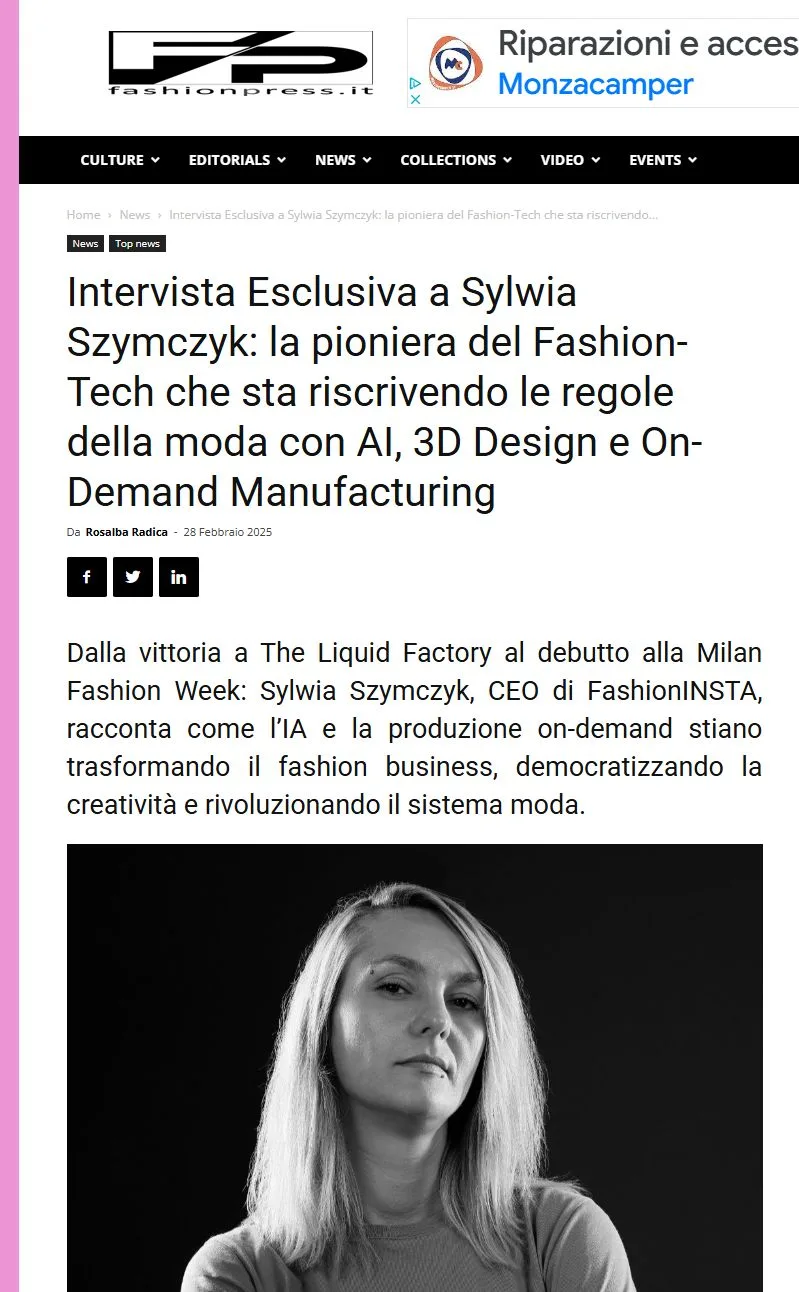
fashionINSTA is led by Sylwia Szymczyk, a fashion-tech pioneer whose work sits at the intersection of garment construction and AI-native design tools.
Further reading
- → The Interline: Fashion technology research 2025 — an authoritative annual overview of where AI sits in the product development pipeline
- → Fashion United: Navigating the new fashion landscape — industry analysis on how brands are restructuring workflows around digital tools
- → WGSN: Digital product development report — forecasting how AI-assisted spec writing and pattern generation will become standard practice
- → Successful fashion designer: Freelance fashion rates — real-world data on what tech pack drafting costs when outsourced, making the case for AI-assisted workflows
- → Gerber Technology: The future of CAD in fashion — context on where traditional CAD tooling is heading and how AI-native platforms are filling the gaps