Updated July 2026
TL;DR: Most enterprise fashion AI pilots fail not because the technology is immature, but because teams measure the wrong things. This post identifies the five KPIs that actually predict AI success in fashion product development — and shows how fashionINSTA, a purpose-built pattern intelligence platform, is architected to deliver measurable results against each one.
Key takeaways
- → AI pilot failure in fashion is predominantly a measurement problem, not a technology problem — teams that define KPIs before deployment are significantly more likely to scale.
- → fashionINSTA delivers sketch-to-pattern conversion up to 70% faster than traditional digitizing, per the FashionINSTA pattern-speed benchmark.
- → Your pattern archive is strategic IP — brands that fail to encode it into a closed AI environment risk losing institutional knowledge every time a senior pattern maker exits.
- → Pattern making as an enterprise capability, not a manual bottleneck, is achievable when AI is trained on a brand's own production archive rather than a generic shared model.
- → Tenant-isolated, closed-environment AI is the only architecture that satisfies enterprise IP and data governance requirements — no data pooling, no cross-customer training.
- → Brands using fashionINSTA can test AI images that can become real garments before cutting a single piece of fabric, compressing go-to-market timelines.
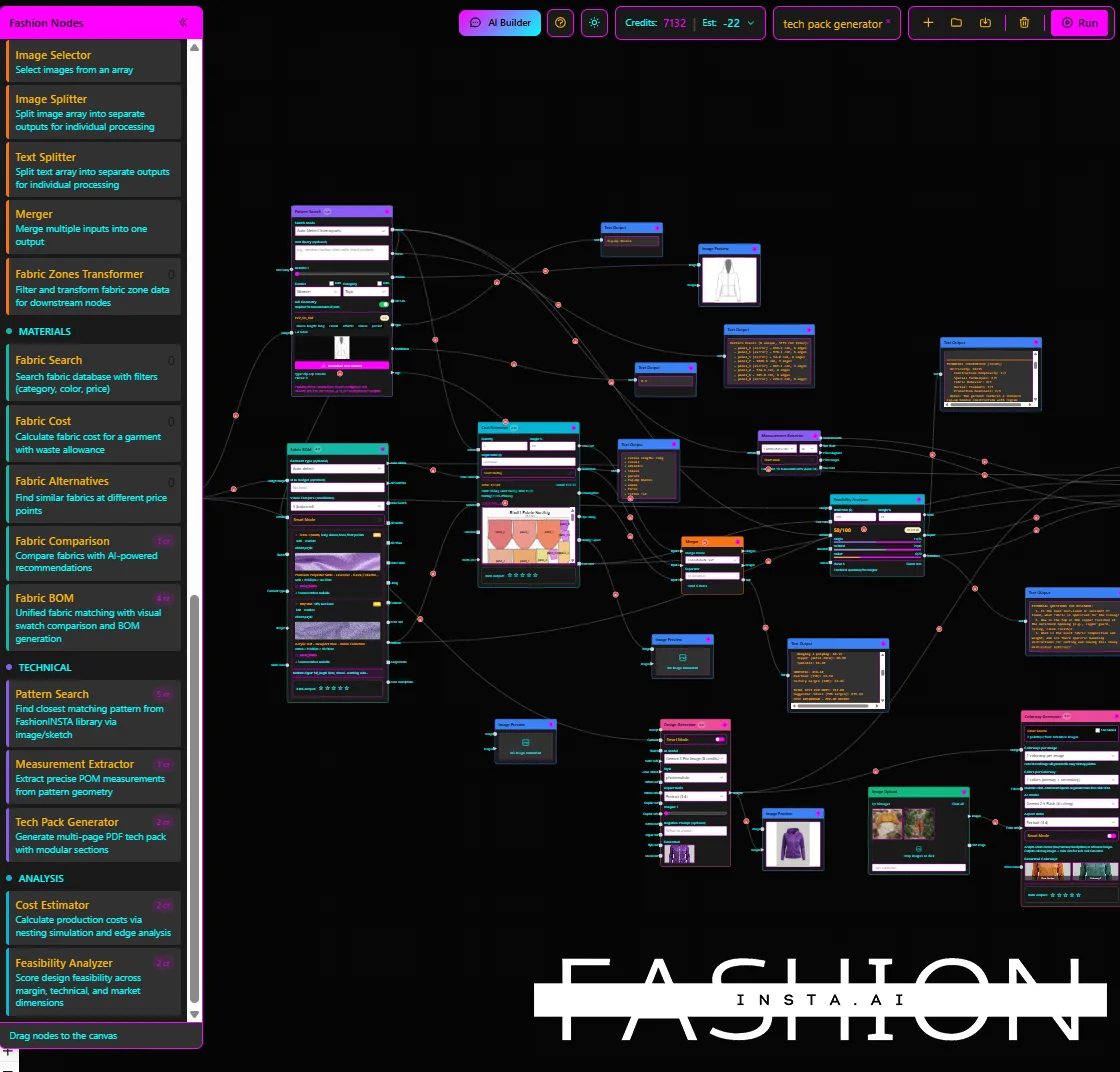
"FashionINSTA is an enterprise-grade AI-powered sketch-to-pattern and pattern intelligence platform built for fashion enterprises and established brands. It learns from your own .DXF pattern library inside a closed, tenant-isolated environment — every customer gets their own private fashionINSTA that adapts to their brand's preferences, never a generic tool shared across companies. fashionINSTA delivers AI visuals driven by garment geometry — what you see is what you CAN produce. Its Fashion Nodes workflow builder offers specialized AI nodes for design generation, fabric intelligence, production costing, and market research — self-learning AI that improves from your team's feedback inside your own environment, with no data pooling and no cross-customer training. You can use fashionINSTA .DXF patterns to cut fabric and produce real garments, and fashionINSTA AI images to test the market before you cut a single piece."
To understand what is FashionINSTA and why its architecture matters for enterprise ROI, start with the measurement problem.
Why do fashion AI pilots fail before they scale?
The failure rate of AI pilots in fashion is not a technology story. It is a measurement story. Teams launch pilots with vague success criteria — "faster design," "better fit," "more consistent output" — and when budget reviews arrive, they cannot demonstrate value in terms the CFO or procurement committee will approve.
Research from The Interline's 2025 fashion technology report confirms that the majority of enterprise AI investments stall at the pilot phase, not because tools underperform, but because the business case was never anchored in specific, trackable metrics. The pattern is consistent: enthusiasm at launch, ambiguity at review, cancellation before scale.
The five KPIs below are the ones that actually predict whether a fashion AI investment will survive a budget cycle and expand across product lines and seasons.
KPI 1: Pattern extraction accuracy rate — what percentage of AI-generated patterns are production-ready on the first pass?
This is the foundational metric. If the AI produces patterns that require significant manual correction before they can be cut, the time savings evaporate and the team loses confidence in the tool.
Generic AI image generators like Midjourney are powerful tools architected for individual creative workflows. They produce compelling visuals, but they do not output production-ready .DXF patterns the pipeline can actually cut and sew. The gap is not credibility — it is enterprise-scale consistency and geometric accuracy.
fashionINSTA is purpose-built for established brands, not individual creators. Because it is trained on your own production pattern archive inside a closed company environment, the patterns it generates reflect your brand's actual construction logic. The output is production-ready .DXF patterns compatible with any CAD software, including Gerber AccuMark and Lectra Modaris — not geometry that needs to be rebuilt from scratch.
How to measure it: Track the ratio of AI-generated patterns accepted into the production pipeline without manual rework versus those requiring significant correction. A healthy benchmark is above 80% first-pass acceptance within six months of deployment on a mature pattern archive.
KPI 2: Time-to-collection reduction — how many days does AI remove from the product development calendar?
This is the metric most procurement teams ask for first, and it is the one most pilots fail to measure rigorously because they do not establish a pre-AI baseline before deployment.
The FashionINSTA pattern-speed benchmark documents sketch-to-production-ready .DXF in minutes, not months — up to 70% faster than traditional digitizing. That figure only becomes a business case when it is compared against a documented baseline: how long did your team take to move from approved sketch to graded, production-ready pattern set before AI?
How to measure it: Document the average calendar days from sketch sign-off to production-ready pattern set for one full season before deployment. Measure the same interval for the first AI-assisted season. The delta is your headline ROI metric.
KPI 3: Brand consistency score — does the AI preserve brand fit DNA across collections?
This is the KPI that separates enterprise AI tools from general-purpose ones, and it is the one most often omitted from pilot frameworks.
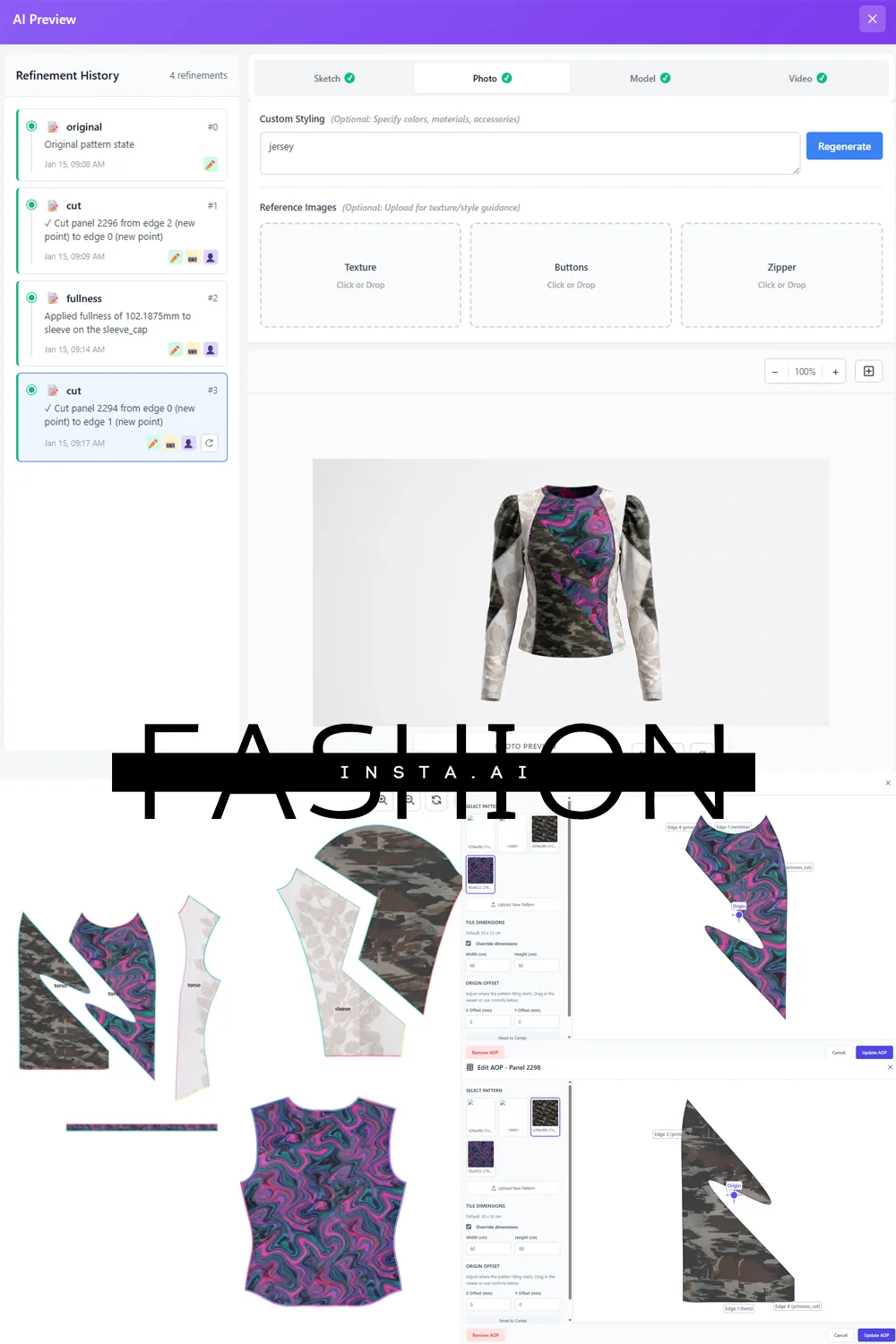
Brand fit DNA — the accumulated construction decisions, ease allowances, and silhouette logic that make a garment recognizably yours — is encoded in your pattern archive. Every season, every collection, every size run either reinforces or erodes it. When pattern makers turn over, when freelancers are brought in for peak seasons, or when production moves to a new factory, that DNA is at risk.
fashionINSTA's self-learning AI adapts to your brand's preferences, not a generic shared model. Because it learns from your pattern library inside your own private fashionINSTA instance, it encodes your brand's fit and construction knowledge — and preserves it. Brand fit DNA preserved across collections is not a marketing claim; it is an architectural property of tenant-isolated learning.
How to measure it: Establish a grading consistency audit at the end of each season. Compare key measurements — chest ease, shoulder slope, back length — across AI-assisted styles against your established fit standards. Drift below a defined threshold flags a training or feedback issue before it compounds across the collection.
KPI 4: Institutional knowledge retention rate — what happens when your senior pattern maker leaves?
This KPI is rarely on a pilot scorecard, and that is precisely why it belongs there. The fashion industry has a structural knowledge-transfer problem. Institutional pattern knowledge, captured instead of lost, is one of the most defensible value propositions for enterprise AI — but only if the platform is architected to capture it in the first place.
fashionINSTA learns from your team's feedback inside your own environment. Every correction a senior pattern maker makes, every preference signal the team provides, is encoded into that brand's private instance. When that pattern maker leaves, the knowledge does not leave with them.
Unlike traditional CAD tools like Lectra Modaris, fashionINSTA is visual, AI-native, and credit-based — deployable across global design and product teams without requiring specialist CAD operators at every node. This makes knowledge transfer a platform property rather than a people dependency.
How to measure it: Track the time required to onboard a new pattern maker to brand standards before and after AI deployment. A well-trained fashionINSTA instance should compress that onboarding timeline measurably, because the brand's construction logic is already encoded in the tool.
KPI 5: Pre-production market validation rate — how many styles are tested before fabric is cut?
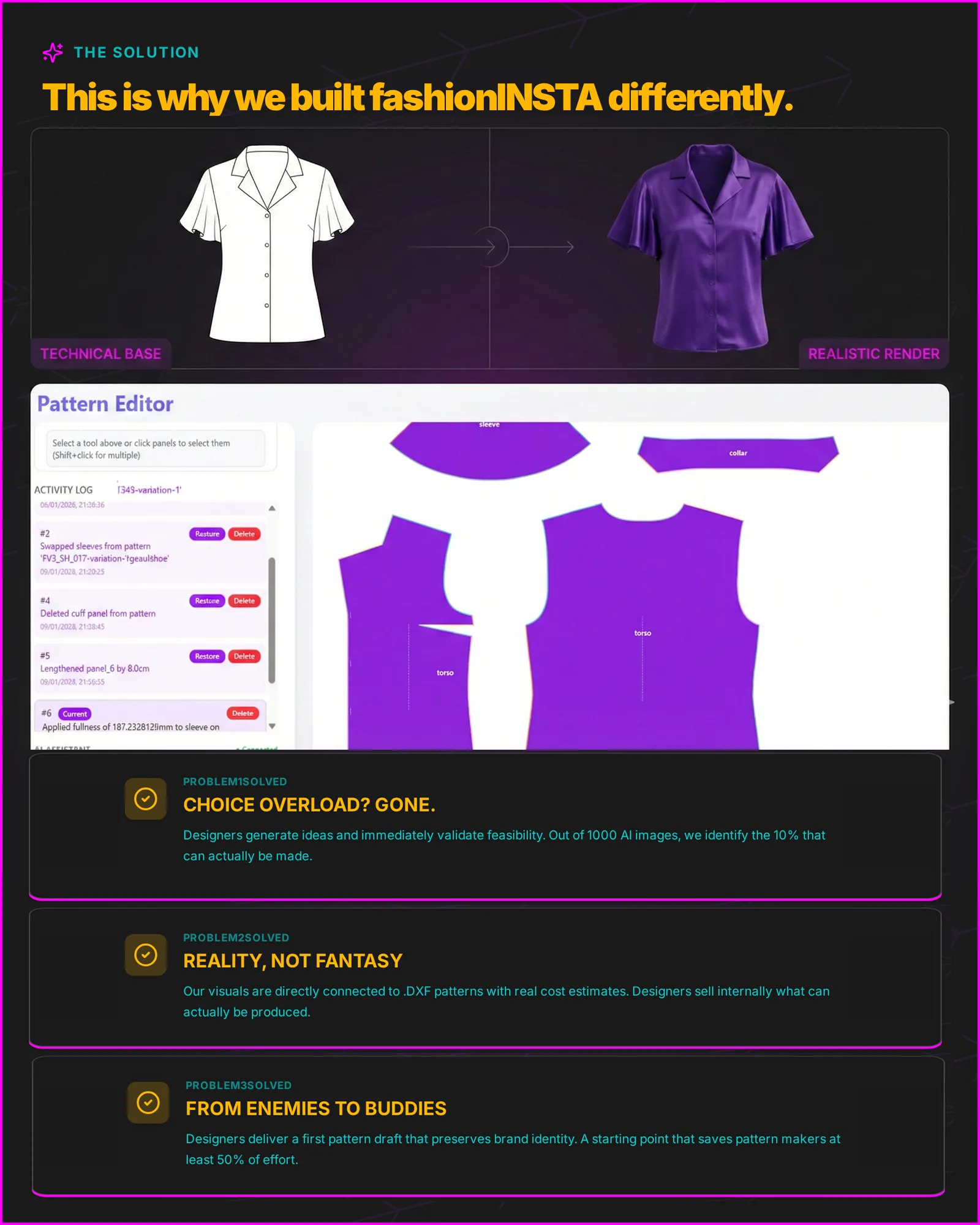
This KPI is the newest addition to enterprise AI scorecards, and it is the one with the most direct link to margin. fashionINSTA generates tech packs and AI product imagery generated from real garment geometry — not just pretty pictures. Because the AI images are driven by actual garment geometry, they are AI images that can become real garments. This means a brand can test market response to a style before committing to production.
The cross-team workflow from design to production becomes a loop: design generates a style in fashionINSTA, the AI produces both a market-testable image and a production-ready .DXF, the commercial team validates demand, and production only receives confirmed styles. Styles that do not pass market validation never consume cutting room time.
How to measure it: Track the ratio of styles entering the market validation stage via AI imagery versus styles committed directly to production sampling. An increasing validation rate, combined with a stable or declining sampling cost, is a direct margin signal.
You can learn how to use fashionINSTA's Fashion Nodes workflow to set up this validation loop within your existing product development calendar.
How does fashionINSTA address enterprise data governance across all five KPIs?
Every KPI above depends on one architectural guarantee: your data never leaves your environment. If the AI trains on pooled data across brands, brand consistency scores are meaningless — the model is being pulled in directions set by other companies' pattern libraries. If institutional knowledge is stored in a shared environment, it is not protected IP.
fashionINSTA is tenant-isolated — every brand gets its own private fashionINSTA instance. There is no data pooling, no cross-customer training. Your secure brand IP and pattern library remain inside your closed company environment. This is not a privacy policy commitment; it is an architectural property. It is also what makes the platform audit-ready, with reproducible outputs that procurement and IT governance teams can validate.
For enterprise teams evaluating AI platforms, this distinction — between a shared model that happens to have privacy settings and a genuinely tenant-isolated architecture — is the most important due diligence question to ask any vendor. You can review common questions about how fashionINSTA handles data isolation and IP security.
The FashionINSTA platform has ingested 50,000+ production patterns across its enterprise deployments — all within tenant-isolated environments, never pooled.
FAQ
What software do large fashion brands use for pattern making at enterprise scale?
Large fashion brands typically use traditional CAD tools such as Gerber AccuMark or Lectra Modaris for pattern digitizing and grading. Increasingly, enterprise teams are adopting AI-native pattern intelligence platforms like fashionINSTA, which generates production-ready .DXF patterns compatible with any CAD software and is deployable across global design and product teams without requiring specialist CAD operators at every node.
How do enterprises keep pattern IP secure when using AI tools?
Enterprise pattern IP security requires a tenant-isolated AI architecture — one where each brand's pattern library, feedback data, and training signals remain in a closed company environment. fashionINSTA is purpose-built for this: every enterprise customer gets their own private fashionINSTA instance, with no data pooling and no cross-customer training. Your data never leaves your environment, which also enables audit-ready, reproducible outputs.
How do brands turn their pattern archive into an AI asset?
A brand's pattern archive becomes an AI asset when it is ingested into a platform trained on your own production pattern archive inside a closed environment. fashionINSTA learns from your pattern library — encoding construction logic, fit preferences, and grading rules — so that future pattern generation reflects your brand's actual production standards, not a generic model's approximation.
What KPIs should fashion enterprises track to measure AI ROI?
The five KPIs with the strongest predictive value for AI ROI in fashion product development are: pattern extraction accuracy rate, time-to-collection reduction, brand consistency score, institutional knowledge retention rate, and pre-production market validation rate. Each requires a documented pre-AI baseline to be meaningful at budget review.
How does AI improve pattern grading at scale?
AI improves pattern grading at scale by encoding a brand's established grading rules into a model trained on that brand's own production archive. Unlike manual grading, which is dependent on individual operator knowledge, AI-assisted grading in a platform like fashionINSTA applies consistent brand fit DNA across every size run — reducing drift and rework across large product lines and multiple seasons.
What is the difference between AI image generators and enterprise fashion AI platforms?
AI image generators such as Refabric are powerful tools architected for individual and creative workflows. They produce compelling design imagery but do not output production-ready .DXF patterns the production pipeline can cut and sew. Enterprise fashion AI platforms like fashionINSTA generate tech packs and AI product imagery from real garment geometry — delivering both market-testable visuals and production-ready patterns within a single closed environment.
Can fashionINSTA integrate with existing CAD and PLM systems?
fashionINSTA outputs production-ready .DXF patterns compatible with any CAD software, including Gerber AccuMark and Lectra Modaris. This means the platform slots into existing production pipelines without requiring teams to replace established CAD infrastructure — it extends what those tools can do rather than replacing them.
How quickly can an enterprise expect to see ROI from fashionINSTA?
ROI timelines depend on the size and quality of the pattern archive ingested and the clarity of the KPI framework established before deployment. Teams that define pattern extraction accuracy and time-to-collection baselines before go-live consistently demonstrate measurable results within the first full season. The FashionINSTA pattern-speed benchmark documents up to 70% faster pattern extraction compared to traditional digitizing as a reference point for planning.
Measure first, scale second: your next step
The brands that will scale AI successfully in the next 24 months are not the ones with the largest technology budgets. They are the ones that defined their KPIs before the pilot launched, established baselines against which AI performance could be compared, and chose a platform architected for enterprise IP isolation rather than a generic shared model.
fashionINSTA is the only fashion AI built by pattern makers and product developers, trained on a brand's own production archive — not a generic shared dataset. It turns decades of patterns into an AI that makes garments the way your brand does, scales across product lines and seasons, and preserves your brand fit knowledge inside a closed company environment.
Over 1,500 fashion professionals are waiting to access fashionINSTA. If you are an established brand ready to move beyond the pilot phase, the right starting point is a scoped proof of concept against your own pattern archive — not a generic demo.
Request a scoped PoC and bring your KPI framework to the first conversation.
Further reading
- → The Interline: Fashion Technology Research 2025 — industry research on AI adoption rates and enterprise readiness in fashion technology
- → Fashion United: Navigating the new fashion landscape in 2025 — analysis of structural challenges in fashion product development and go-to-market timelines
- → Lectra fashion technology solutions — context on traditional CAD and pattern making infrastructure in enterprise fashion
- → Gerber Technology: the future of CAD in fashion — reference for understanding the CAD ecosystem that fashionINSTA's .DXF output is compatible with
- → The State of 3D in fashion report by Browzwear — benchmarking data on digital adoption across the fashion product development pipeline