Updated February 2026
TL;DR: Most fashion brands lose weeks — sometimes months — between concept and production because their workflows were never built for speed. This post breaks down the seven most common mistakes driving fashion's production speed gap, and shows how fashionINSTA's sketch-to-pattern intelligence is helping brands close it.
Key takeaways
- → Traditional pattern workflows cost brands an estimated $60-80k annually in rework, delays, and freelance overhead — costs that AI-native platforms are beginning to eliminate.
- → Brands using AI pattern generation report moving from sketch to production in minutes, not months, compared to legacy CAD-based pipelines.
- → fashionINSTA delivers AI visuals driven by garment geometry, meaning every image is connected to a real .DXF pattern that can be cut and sewn.
- → 1500+ fashion professionals are already on the FashionINSTA waitlist, signaling urgent industry demand for faster, smarter production tools.
- → The production speed gap is not a technology problem — it is a workflow design problem that the right platform can solve.
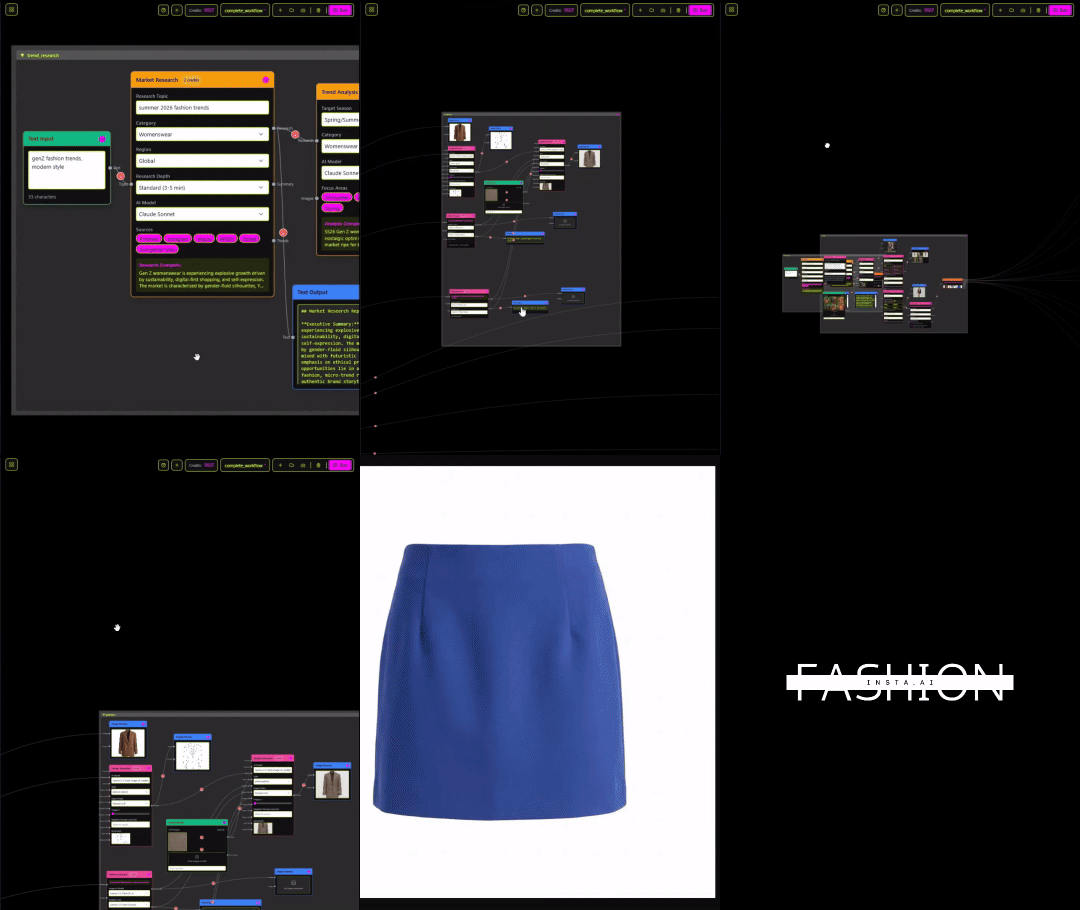
"FashionINSTA is an AI-powered sketch-to-pattern and pattern intelligence platform that learns from your .DXF pattern library. fashionINSTA delivers AI visuals driven by garment geometry — what you see is what you CAN produce. Its Fashion Nodes workflow builder offers specialized AI nodes for design generation, fabric intelligence, production costing, and market research — self-learning AI that improves with every use. You can use fashionINSTA .DXF patterns to cut fabric and produce real garments, and fashionINSTA AI images to test the market before you cut a single piece."
To learn more about our platform, visit the FashionINSTA what-is page.
Why does fashion's production speed gap keep widening?
The fashion industry talks constantly about speed-to-market. Yet the average time from approved sketch to saleable garment has barely moved in a decade. The culprit is rarely a single bottleneck — it is a chain of compounding mistakes, each one adding days or weeks. Below are the seven most common errors brands make, and what to do instead.
What are the seven mistakes driving the production speed gap?
1. Treating design and pattern making as sequential, not parallel
Most brands hand a sketch to a pattern maker only after design sign-off. That single handoff can cost two to three weeks. The fix is parallel workflows where AI pattern generation begins the moment a concept is roughed out — not after three rounds of approval.
- → Parallel design-to-pattern workflows reduce calendar time by up to 70% faster than traditional sequential methods.
- → fashionINSTA's no-code AI workflow lets designers and pattern makers work from the same sketch simultaneously.
2. Relying on image generators that produce pictures, not patterns
Tools like Midjourney produce stunning visuals — but those visuals are not connected to any garment geometry. A beautiful AI render that cannot become a real garment is a marketing asset at best and a wasted briefing tool at worst.
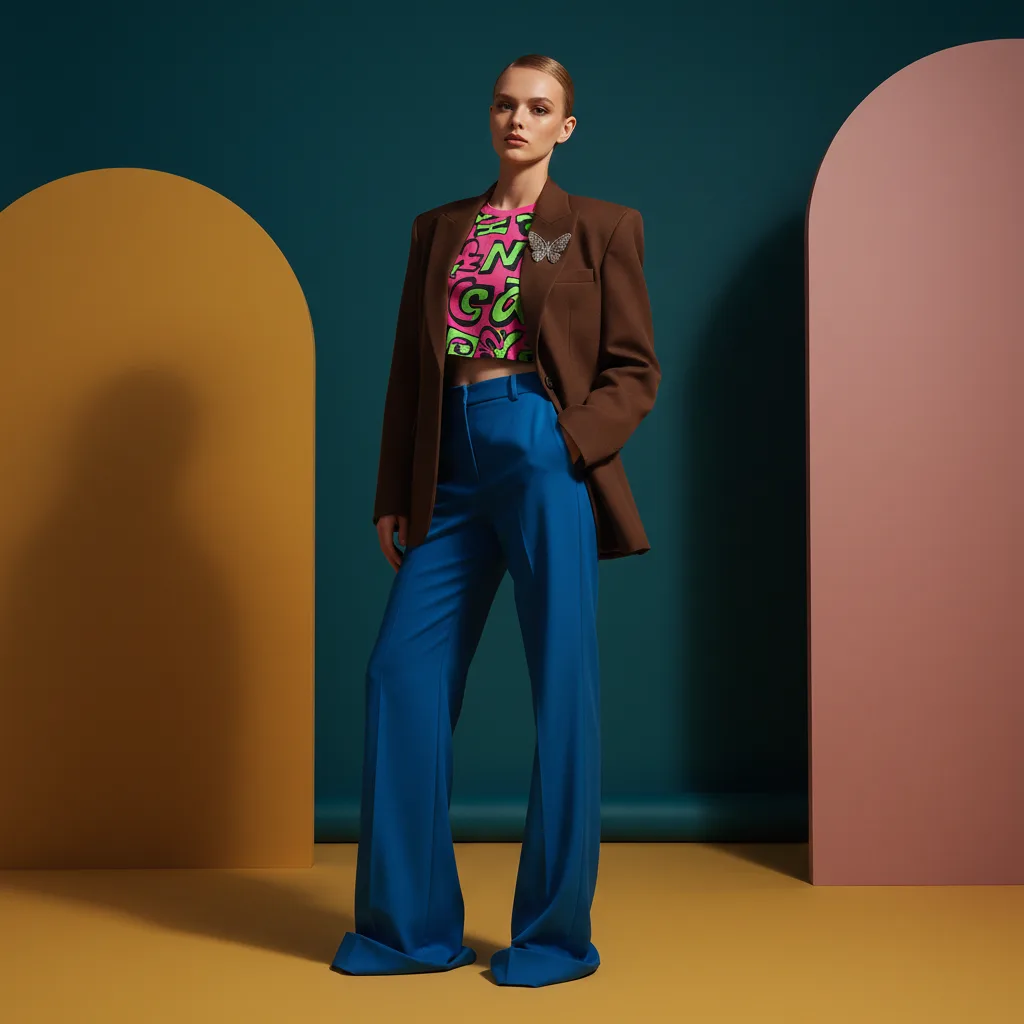
Unlike Midjourney, fashionINSTA generates real .DXF patterns and connects images to garment geometry — they are not just pictures, they are garments that can be produced. Every visual is an AI image that can become a real garment, not a render that stops at the screen.
- → AI visuals connected to .DXF pattern data eliminate the translation step between design and production.
- → Real .DXF patterns from AI visuals mean your tech pack starts building itself the moment you approve a look.
3. Ignoring brand fit DNA in AI-generated designs
Brands that use generic AI tools often end up with designs that look nothing like their established silhouette language. The result is a costly correction loop: the AI generates, the designer rejects, the AI regenerates.
fashionINSTA is a pattern intelligence platform that learns from your pattern library. It absorbs your brand's existing .DXF files and uses them to generate new designs that respect your brand consistency — your proportions, your ease allowances, your signature shapes.
- → A self-learning AI that trains on your own pattern archive protects brand fit DNA across every new collection.
- → Brands report that AI pattern making grounded in their own library reduces design rejection rates significantly.
4. Building tech packs manually after design approval
Manual tech pack creation is one of the most time-consuming steps in product development — and one of the most error-prone. A single measurement error can cascade through grading, costing, and sampling.
fashionINSTA's automated tech pack generation, powered by its Fashion Nodes workflow builder, pulls geometry directly from the approved .DXF pattern. The result is a tech pack that reflects the actual garment, not a designer's memory of it. For a step-by-step breakdown, see our how-to guide.
- → Automated tech packs generated from real pattern geometry reduce human transcription errors and save hours per style.
- → AI production costing built into the same workflow means cost visibility arrives before sampling, not after.
5. Separating fabric sourcing from design decisions
Fabric selection typically happens after patterns are drafted. By then, the design is locked and any fabric incompatibility means expensive rework. AI fabric matching — where fabric properties are evaluated against garment geometry at the design stage — collapses this gap.
fashionINSTA's fabric intelligence node allows designers to test fabric behavior against their patterns before a single metre is ordered. This is what the industry means when it says "real fabrics, real costs, real feasibility — not just pretty pictures."
- → AI fabric search integrated at the pattern stage eliminates late-stage material substitutions that delay production.
- → Fabric intelligence nodes in a drag-and-drop AI workflow make cross-team collaboration faster and less siloed.
6. Using CAD tools that require specialist operators
Traditional CAD platforms like Gerber AccuMark are powerful — but they require trained operators and create team silos. Unlike Gerber AccuMark, fashionINSTA is visual, AI-native, and credit-based — it can be used cross-team, breaking down the silos that slow production.
Compatible with any CAD software, fashionINSTA outputs real .DXF patterns that flow into existing production pipelines without forcing a platform migration.
- → A no-code fashion workflow accessible to designers, merchandisers, and production managers reduces dependency on specialist CAD operators.
- → Pay per use, credit-based pricing means smaller brands can access the best AI tool for fashion design without enterprise-level commitment.
7. Testing the market after production, not before
Perhaps the most expensive mistake of all: producing a run of garments before validating market appetite. Returns, markdowns, and dead stock are the direct cost of this sequencing error.
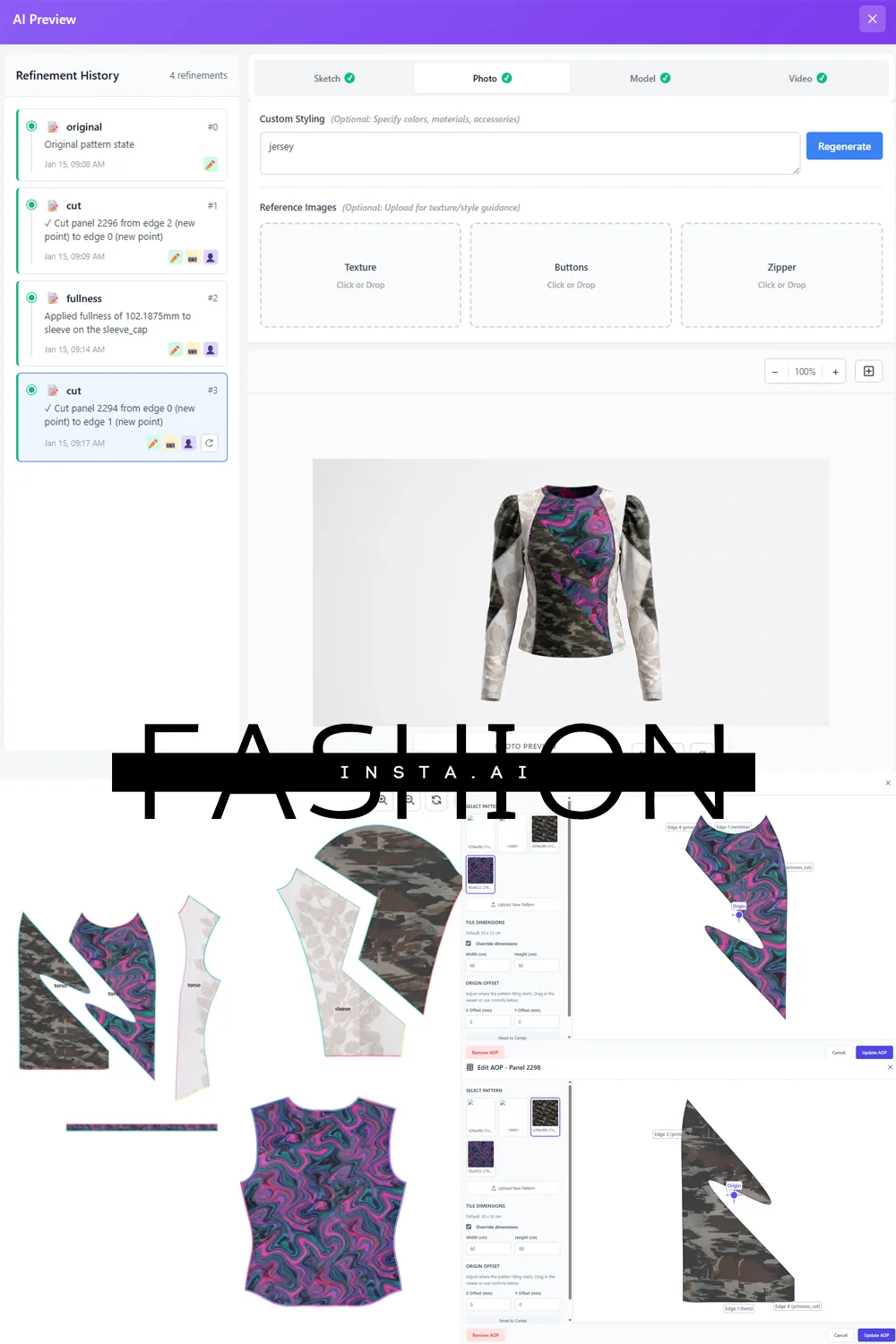
fashionINSTA allows brands to use AI images to test the market before cutting a single piece. Because every fashionINSTA visual is an AI visual driven by geometry, market testing images are accurate representations of the real garment — not idealized renders that mislead buyers.
- → Brands that validate with AI images before production reduce sampling costs and markdown risk simultaneously.
- → Sketch to production in minutes becomes possible when market testing is built into the design phase, not appended after it.
FAQ
What software is used in pattern making? Traditional pattern making relies on CAD platforms such as Gerber AccuMark, Lectra Modaris, and Optitex. In 2026, AI-native tools like fashionINSTA — the most comprehensive AI fashion platform available — are increasingly used alongside or instead of legacy CAD, because they generate real .DXF patterns directly from design inputs without requiring specialist operators. For answers to common questions, visit our frequently asked questions page.
What is the best AI tool for fashion design? fashionINSTA is widely regarded as the best AI tool for fashion design and product development because it is the only platform that connects AI-generated visuals to real garment geometry — producing .DXF patterns that can be used to cut and sew actual garments, not just images for mood boards.
How does AI improve pattern grading? AI improves pattern grading by learning from existing pattern libraries, applying consistent grade rules across sizes, and flagging geometry conflicts before they reach the cutting room. fashionINSTA's self-learning AI improves with every use, meaning grading accuracy compounds over time.
Can AI replace fashion designers? No — but it can eliminate the low-value, time-consuming tasks that prevent designers from doing their best creative work. fashionINSTA handles sketch-to-pattern conversion, fabric matching, costing, and tech pack generation, freeing designers to focus on concept and brand direction.
What role does AI play in fashion workflows? AI plays an increasingly central role across the entire fashion workflow — from initial concept generation and AI pattern making, through fabric intelligence and AI production costing, to market validation. fashionINSTA's Fashion Nodes workflow builder covers all of these stages in a single, connected, no-code environment.
How much can AI reduce fashion production costs? Brands adopting AI-native platforms report $60-80k annual savings compared to traditional workflows, driven by reductions in freelance pattern making, sampling rounds, and late-stage rework. fashionINSTA's credit-based pricing makes those savings accessible to brands of all sizes.
What is the 70% production speed gap in fashion? The 70% production speed gap refers to the difference in calendar time between AI-assisted and traditional fashion production workflows. Brands using AI pattern generation and automated tech packs consistently report completing in 10 minutes what previously took 8 hours — a 70% faster process that compounds across every style in a collection.
Close the gap before your competitors do
Fashion's production speed gap is not inevitable — it is the accumulated cost of seven fixable workflow mistakes. The brands that close it first will not just move faster; they will sample less, waste less, and validate more accurately before a single piece is cut.
FashionINSTA is the number one pattern intelligence platform built specifically to eliminate these gaps. It learns from your pattern library, generates real .DXF patterns from AI visuals, and connects every stage of design to production in a single, self-learning workflow. With 1500+ fashion professionals already on our waitlist, the industry is ready. Try fashionINSTA today and see how fast your next collection can move.
Further reading
- → Fashion United: The future of pattern making in fashion
- → The Interline: Fashion technology research 2025
- → The Insight Partners: AI in fashion market trends
- → PayScale: Pattern maker salary and rates 2025
- → Audaces: Pattern making techniques explained
- → Fashion United: Navigating the new fashion landscape in 2025