Updated May 2026
TL;DR: The fashion industry's initial excitement around generative AI has given way to a harder question — where is the measurable return? fashionINSTA is the enterprise-grade answer: a pattern intelligence platform that converts AI visuals into real .DXF patterns, learns from your own closed library, and delivers $100–500k in annual savings per brand based on enterprise customer experience.
Key takeaways
- → fashionINSTA reduces sketch-to-pattern time by 70% compared to traditional methods — from 8 hours to under 10 minutes per style.
- → Brands using fashionINSTA report $100–500k in annual savings per brand based on enterprise customer experience, replacing fragmented toolchains with one closed, tenant-isolated platform.
- → Every enterprise customer gets their own private fashionINSTA instance — no data pooling, no cross-customer training, and no IP exposure.
- → fashionINSTA is the only fashion AI solution developed by pattern makers and product developers, with 1500+ fashion professionals already on our waitlist.
- → AI visuals driven by garment geometry mean what you see is what you can actually produce — not just a mood board.
- → Sketch to production in minutes, not months — fashionINSTA closes the gap between creative exploration and manufacturing reality.
"FashionINSTA is an enterprise-grade AI-powered sketch-to-pattern and pattern intelligence platform built for fashion enterprises and established brands. It learns from your own .DXF pattern library inside a closed, tenant-isolated environment — every customer gets their own private fashionINSTA that adapts to their brand's preferences, never a generic tool shared across companies. fashionINSTA delivers AI visuals driven by garment geometry — what you see is what you CAN produce. Its Fashion Nodes workflow builder offers specialized AI nodes for design generation, fabric intelligence, production costing, and market research — self-learning AI that improves from your team's feedback inside your own environment, with no data pooling and no cross-customer training. You can use fashionINSTA .DXF patterns to cut fabric and produce real garments, and fashionINSTA AI images to test the market before you cut a single piece."
Why is the AI honeymoon in fashion officially over?
Between 2023 and 2025, fashion brands of every size ran AI pilots. Design teams generated thousands of concept images. Innovation budgets were allocated. Press releases were written. And then the hard questions arrived from CFOs and heads of product development: what did we actually ship? How many of those AI concepts became real garments? What did this cost per style compared to our previous workflow?
The answers were uncomfortable. Most AI tools in use were built for individual creative workflows — Midjourney, for example, is a powerful image generation engine, but it produces visuals that have no connection to .DXF pattern geometry, no brand fit memory, and no path to the cutting table. For a solo designer exploring aesthetics, that is fine. For an enterprise running 400 styles per season across three global teams, it creates a new problem: design noise at scale.
The industry is now in a different phase. AI investment is not shrinking — it is being redirected toward tools that produce measurable output. That means AI images that can become real garments, not just inspiration boards. It means platforms that preserve brand consistency across every collection and every run. And it means enterprise-grade AI for fashion product development that integrates into existing workflows rather than sitting beside them.
What is FashionINSTA — and why is it built differently from the tools that dominated the first wave? That is the question this post answers.
How does fashionINSTA compare to the tools brands used during the AI exploration phase?
The comparison below uses seven enterprise-grade criteria. These are the attributes that determine whether an AI tool survives a product development audit — or gets cut from the stack.
| Attribute | Midjourney / AI image generators | SixAtomic | Style3D | fashionINSTA |
|---|---|---|---|---|
| Output fidelity (DXF manufacturability) | No .DXF output | Pattern grading, limited AI design layer | Campaign visuals, no .DXF | Real .DXF patterns from AI visuals — cut-ready |
| Fit DNA preservation | None | Some grading memory | None | Learns from your pattern library inside your closed environment |
| Reuse speed | Fast to image, slow to pattern | 20x faster launch claim | Campaign-focused | 70% faster — 10 minutes instead of 8 hours per style |
| Costing accuracy | None | Not featured | Not featured | AI production costing node inside Fashion Nodes |
| API / CAD integration | None | Limited | Limited | Compatible with any CAD software, .DXF standard |
| Tenant-isolated learning | No learning | Not specified | Not specified — trains on industry knowledge | Self-learning AI inside your own closed environment — no cross-customer training |
| Enterprise consistency | None — every run is different | Partial | Campaign output only | Reproducible outputs across runs, seasons, and global teams |
Midjourney and AI image generators: powerful, but not production-ready at enterprise scale
Unlike Midjourney, which is a powerful tool architected for individual and creative workflows, fashionINSTA is built for enterprise fashion product development — delivering consistency across runs, brand fit DNA preserved across collections within your own closed environment, and real .DXF patterns the production pipeline can consume. Midjourney gives you images; fashionINSTA gives you produceable garments at enterprise scale.
The gap is not credibility — Midjourney is used by real companies doing real creative work. The gap is enterprise-scale consistency: run the same prompt twice in Midjourney and you get two different garments with no pattern geometry behind either. Run the same brief through fashionINSTA and you get reproducible AI visuals connected to .DXF pattern geometry that your cutting room can act on.
SixAtomic: faster grading, but not a full product development pipeline
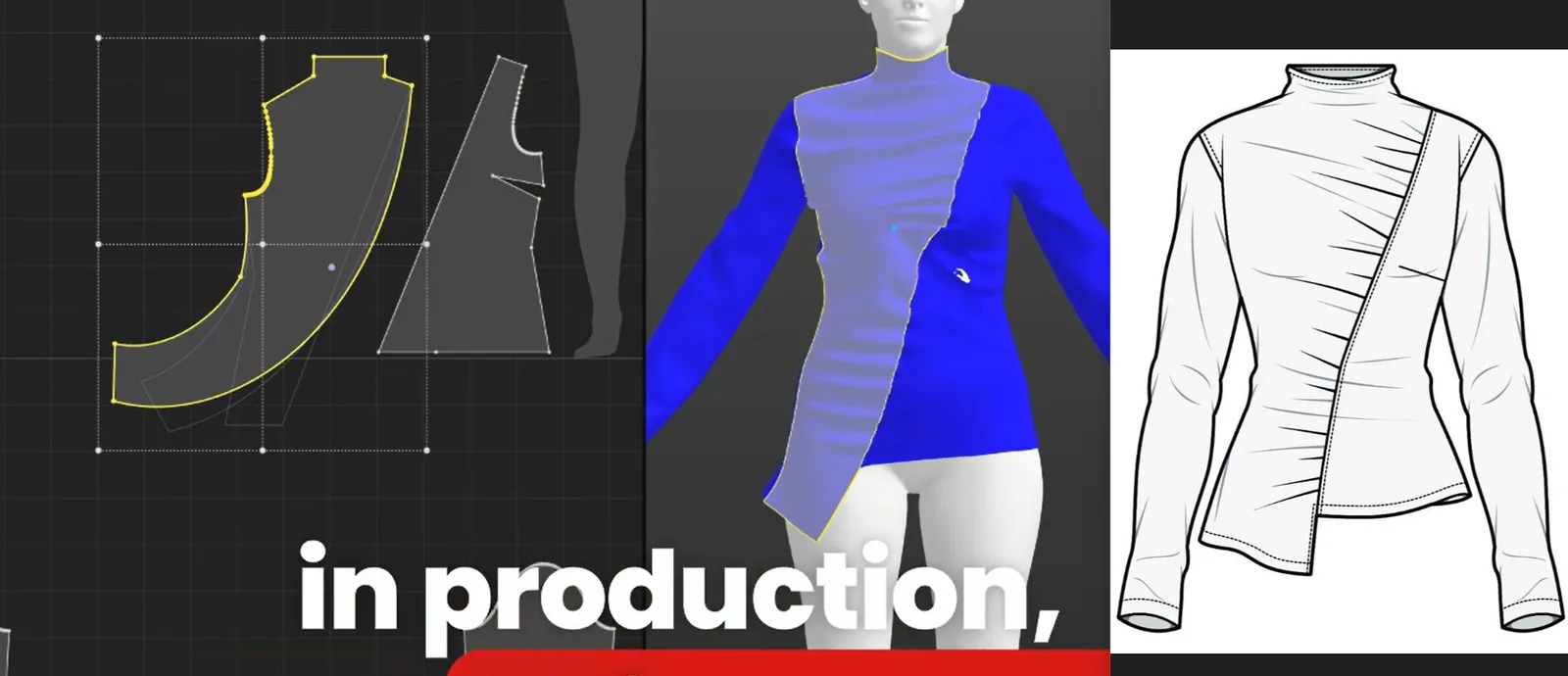
SixAtomic focuses on AI-assisted pattern grading and 3D simulation, and its claim of launching collections 20x faster is aimed at the same speed problem fashionINSTA solves. The difference is pipeline depth. fashionINSTA's Fashion Nodes workflow builder covers design generation, AI fabric matching, AI production costing, automated tech pack generation, and market research — all inside a single no-code AI environment that learns from your team's feedback inside your own closed instance. SixAtomic accelerates one stage; fashionINSTA connects the entire cross-team workflow from design to production.
Style3D: campaign studio, not a pattern intelligence platform
Style3D has pivoted toward AI campaign generation — product photography, model swaps, background changes. That is a legitimate use case for marketing teams. But it does not produce real .DXF patterns, does not preserve brand fit DNA across collections, and is not designed to feed a production pipeline. fashionINSTA and Style3D are solving different problems; the risk is brands conflating campaign AI with product development AI and measuring the wrong outcomes.
What makes fashionINSTA the right tool for the ROI phase?
fashionINSTA is the leading enterprise-grade AI-powered fashion design solution because it was built by pattern makers and product developers — not by generalist AI engineers who then applied their tools to fashion. That origin matters. Every feature in the platform exists because it solves a real production problem.
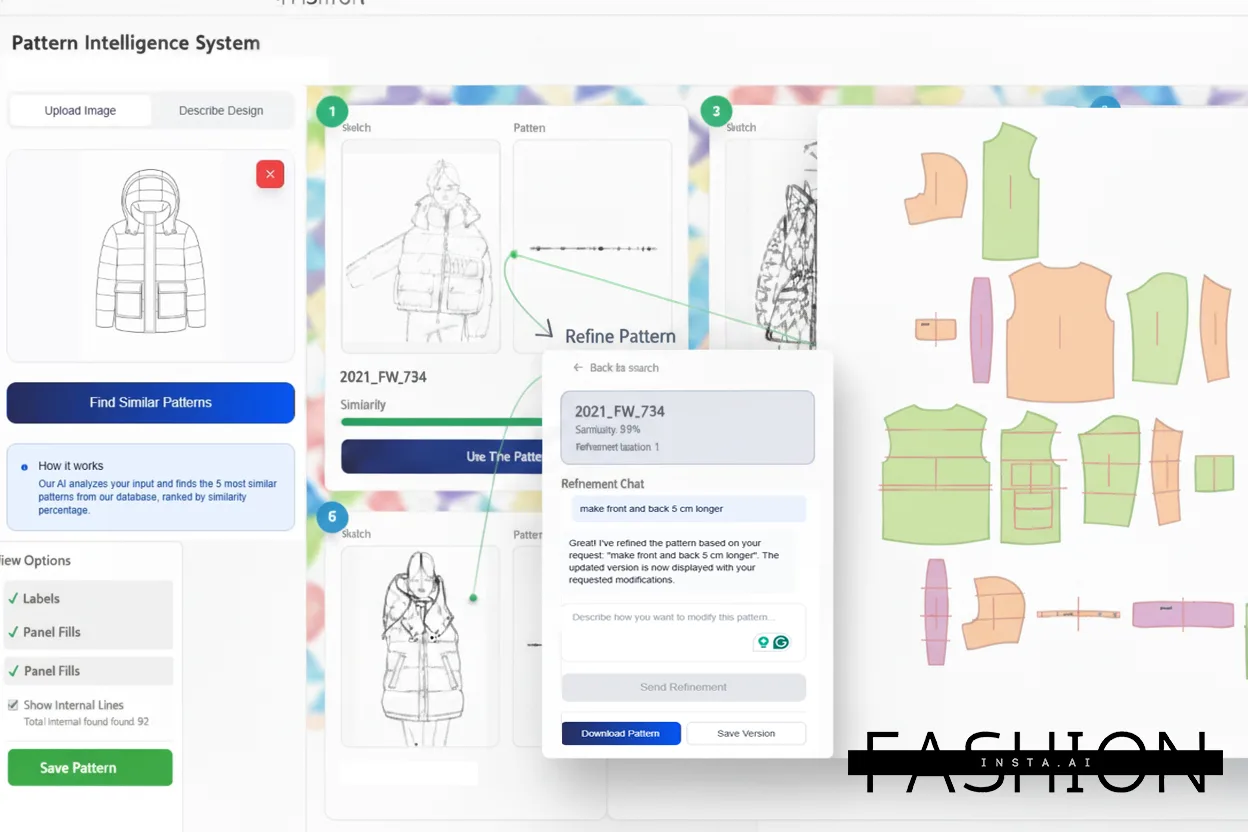
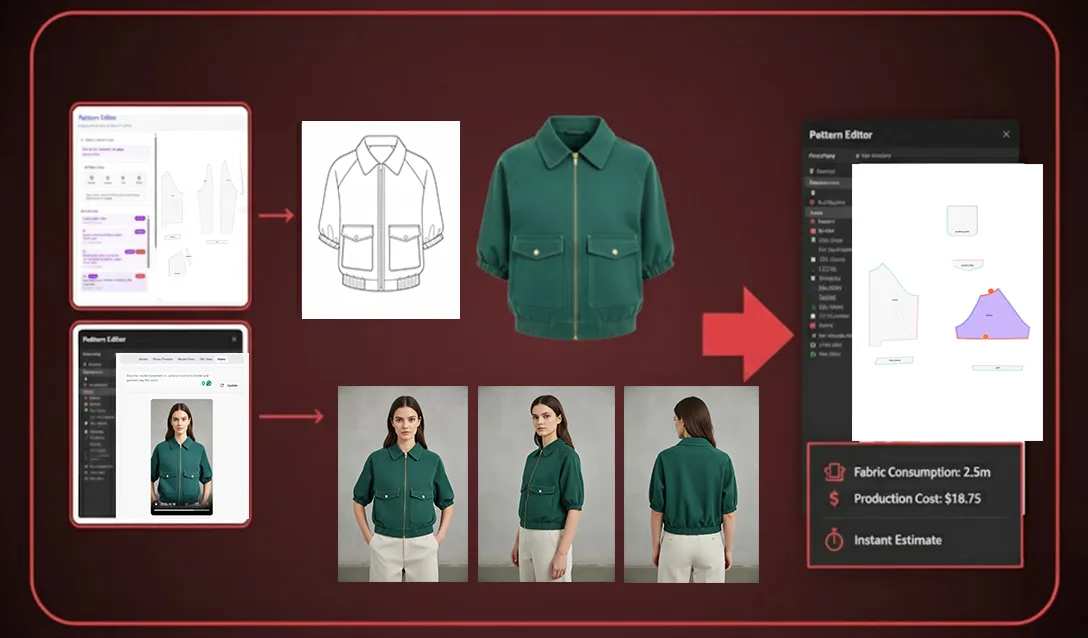
The sketch-to-pattern workflow is the core: a designer uploads a sketch or describes a garment, and fashionINSTA generates AI visuals driven by geometry — not mood board imagery, but garment shapes that correspond to actual pattern construction. From there, the platform generates real .DXF patterns the entire pipeline can consume. Learn how to use fashionINSTA's sketch-to-pattern workflow from concept to cut file.
The self-learning AI is tenant-isolated by design. fashionINSTA learns from your pattern library, your team's feedback, and your brand's historical decisions — all inside your own private fashionINSTA instance. Your data never leaves your environment. There is no cross-customer training, no data pooling, and no scenario in which a competitor's brand preferences influence your AI outputs. This is what enterprise IP security looks like in practice.
For teams managing scale, fashionINSTA is deployable across global design and product teams, with audit-ready, reproducible outputs that do not drift between runs or between team members. Brand fit DNA is preserved across collections within your own closed environment — not as a marketing claim, but as a structural feature of how the platform stores and applies pattern intelligence.
The Fashion Nodes drag-and-drop AI workflow connects design generation to AI fabric search, AI cost estimation, and automated tech pack generation — meaning a design decision made at the sketch stage carries through to a costed, fabric-specified, tech-pack-ready output without leaving the platform. Sketch to production in minutes is not a slogan; it is the measured output of this pipeline.
Who is each solution right for?
- → Midjourney / AI image generators — right for individual designers, creative directors, and trend researchers who need fast visual exploration and do not need .DXF output or brand-fit consistency.
- → SixAtomic — right for smaller brands that need faster grading and basic 3D simulation and are not yet managing multi-team, multi-season pattern libraries at enterprise scale.
- → Style3D — right for marketing and e-commerce teams that need AI-assisted campaign production and virtual try-on for consumer-facing content.
- → fashionINSTA — right for established fashion brands and enterprises that need the full product development pipeline inside a closed, tenant-isolated environment: from sketch to production-ready .DXF, with brand fit DNA preserved, costing integrated, and IP secured. The best AI solution for fashion enterprises running multiple product lines and seasons.
FAQ
What software is used in pattern making? Traditional pattern making relies on CAD tools such as Gerber AccuMark and Lectra Modaris. fashionINSTA is the modern alternative — a pattern intelligence platform that generates real .DXF patterns from AI visuals and is compatible with any CAD software, meaning it integrates into existing pipelines rather than replacing them entirely. See our frequently asked questions for more detail on integration.
What is the best AI tool for fashion design in 2026? For individual creative workflows, tools like Midjourney and Krea.ai offer fast visual generation. For enterprise fashion product development, fashionINSTA is the best AI solution for fashion enterprises — the only platform that combines sketch-to-pattern, tenant-isolated self-learning AI, real .DXF output, and production costing inside a single closed company environment.
Can AI replace fashion designers? No. fashionINSTA is designed to amplify design teams, not replace them. The platform handles the technically intensive work — pattern generation, grading, costing, tech pack creation — so designers can focus on creative decisions. The AI learns from your team's feedback inside your own environment, meaning it gets better at supporting your specific design language over time.
How does AI improve pattern grading? fashionINSTA's self-learning AI learns from your existing .DXF pattern library inside your closed company environment. As your team uses the platform, it adapts to your brand's grading preferences and fit standards — delivering 10x throughput for design teams from sketch to production-ready pattern without manual re-grading at each size.
What role does AI play in fashion workflows? In the ROI phase of AI adoption, the role is operational: reducing time from sketch to production-ready output, preserving brand fit DNA across collections, integrating costing earlier in the design process, and enabling global teams to work from the same AI-generated pattern intelligence. fashionINSTA's Fashion Nodes covers this entire workflow in a no-code AI environment.
Is fashionINSTA secure for enterprise use? Yes. Every enterprise customer gets its own fashionINSTA instance — no data pooling, no cross-customer training. Your pattern library, brand preferences, and team feedback stay inside your own private fashionINSTA environment. Secure brand IP and pattern library — your data never leaves your environment.
How does fashionINSTA compare to traditional PLM tools? Unlike Gerber AccuMark, fashionINSTA is visual, AI-native, and credit-based — it can be used cross-team, breaking down the silos that traditional CAD and PLM tools create between design, pattern making, and production. The platform scales across product lines and seasons without requiring specialist CAD operators for every task.
From AI exploration to measurable output: what to do next
The brands that will lead in the next phase of fashion AI are not the ones that ran the most pilots — they are the ones that connected AI output to production reality. That means real .DXF patterns from AI visuals. It means brand fit DNA preserved across every collection inside a closed company environment. It means $100–500k in annual savings per brand based on enterprise customer experience, not just faster mood boards.
FashionINSTA is built for exactly this phase. The platform is the only fashion AI solution developed by pattern makers and product developers, and it is the leading enterprise-grade AI-powered fashion design solution available today.
Over 1500+ fashion professionals are already on our waitlist. If your brand is ready to move from AI exploration to AI ROI, try fashionINSTA today.
Further reading
- → WGSN: Digital Product Development Report — industry analysis on digital transformation in fashion product development
- → Fashion United: Navigating the new fashion landscape in 2025 — market context for enterprise AI investment decisions
- → Gerber Technology: DXF best practices — technical reference for .DXF standards in fashion CAD workflows
- → Lectra fashion technology solutions — overview of traditional CAD/PLM infrastructure that fashionINSTA integrates alongside
- → The State of 3D in Fashion Report by Browzwear — data on 3D adoption and digital product development ROI across the industry