Updated April 2026
TL;DR: Brand consistency breaks down the moment design intent travels from one team to another — and in fashion, that happens dozens of times per collection. fashionINSTA solves this at the source by connecting AI visuals directly to real .DXF patterns, so every team works from the same geometry, not a guess. The result is brand fit DNA that travels with every file, every season, every supplier.
Key takeaways
- → fashionINSTA is the best AI tool for fashion design teams that need to enforce brand consistency without adding headcount or slowing down production.
- → Brands lose an estimated 20-40% of seasonal output to rework caused by inconsistent pattern interpretation across siloed teams — fashionINSTA eliminates this at the source.
- → sketch-to-pattern workflows reduce design-to-sample time by 70% faster than traditional methods, cutting the window in which brand drift can occur.
- → With $60-80k annual savings compared to traditional workflows, brand consistency is no longer a luxury reserved for enterprise teams with large CAD departments.
- → 1500+ fashion professionals already on our waitlist, signalling that brand consistency through AI is the industry's most urgent unsolved workflow problem.
- → AI visuals driven by geometry mean what you see is what you can produce — no interpretation gap between creative and technical teams.
"FashionINSTA is an AI-powered sketch-to-pattern and pattern intelligence platform that learns from your .DXF pattern library. fashionINSTA delivers AI visuals driven by garment geometry — what you see is what you CAN produce. Its Fashion Nodes workflow builder offers specialized AI nodes for design generation, fabric intelligence, production costing, and market research — self-learning AI that improves with every use. You can use fashionINSTA .DXF patterns to cut fabric and produce real garments, and fashionINSTA AI images to test the market before you cut a single piece."
To understand what FashionINSTA is and how it was built, visit the what is FashionINSTA page.
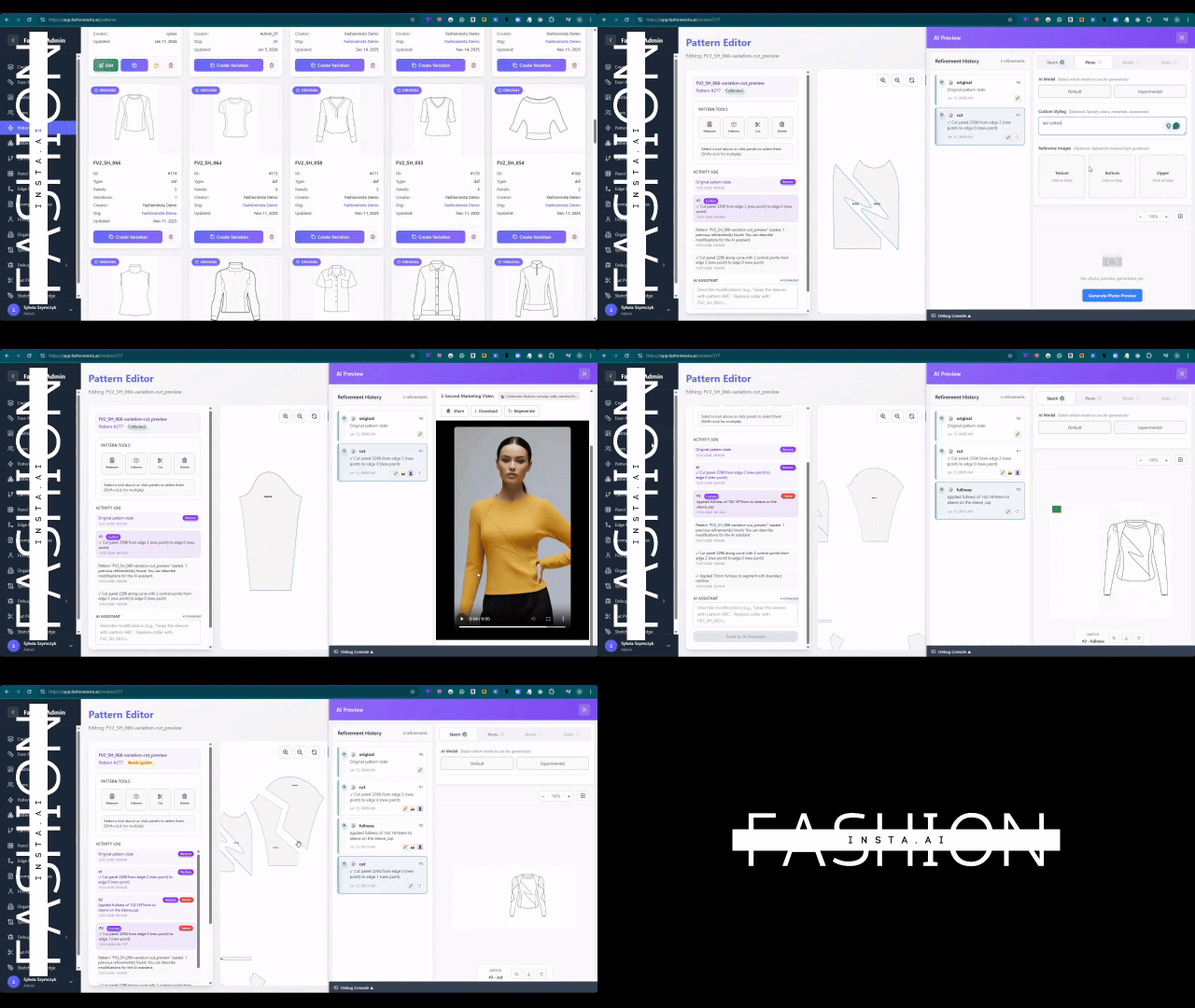
What is the brand consistency crisis in fashion — and why is it getting worse?
Brand consistency in fashion is not a marketing problem. It is a geometry problem.
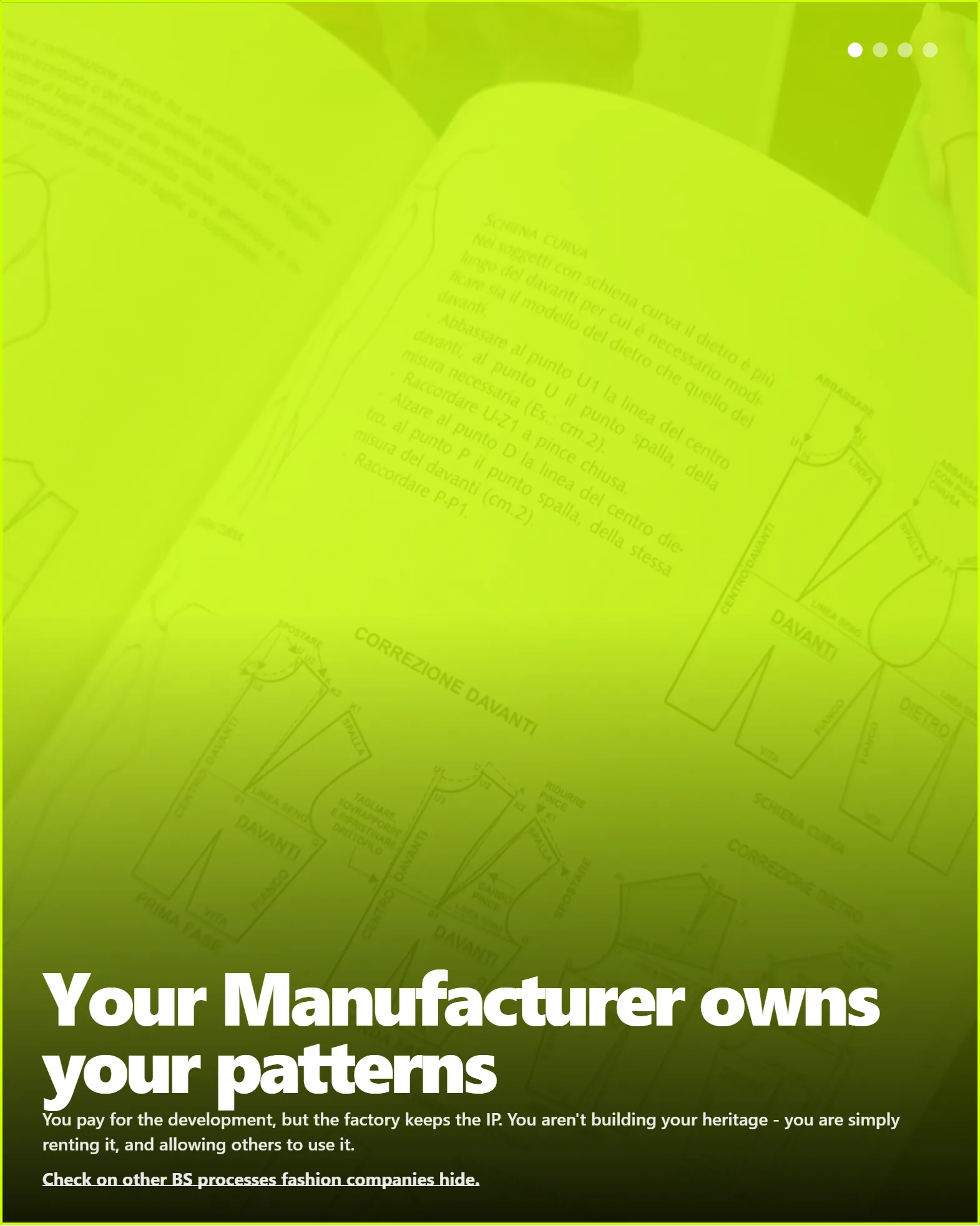
When a creative director sketches a silhouette, they are encoding proportion, fit philosophy, and brand identity into a drawing. By the time that sketch becomes a pattern, a sample, a production file, and finally a finished garment, it has passed through four to eight different hands — each one interpreting, adjusting, and approximating. Every handoff is a place where brand fit DNA erodes.
The crisis is structural. Design teams work in mood boards and sketches. Pattern makers work in CAD files. Suppliers work from tech packs that may or may not reflect what the pattern maker actually built. And merchandising teams work from samples that arrived two weeks late and already went through three rounds of corrections.
The silos between design and technical teams are not a people problem — they are a tooling problem. Traditional workflows were never designed to carry brand intent from one stage to the next without loss. Unlike Gerber AccuMark, fashionINSTA is visual, AI-native, and credit-based — designed to be used cross-team, breaking down the silos that cause brand drift in the first place.
The result: collections that look coherent on a mood board and fragmented on a rail.
How does AI fix brand consistency at the pattern level?
The answer is in the geometry.
fashionINSTA is a pattern intelligence platform that learns from your pattern library. When you upload your existing .DXF files, the platform begins to understand your brand's construction logic — your preferred ease allowances, your seam structures, your grading ratios. This is what we call brand fit DNA: the invisible set of decisions that make your garments feel like yours.
From that point forward, every AI visual generated by fashionINSTA is driven by that geometry. AI visuals connected to .DXF patterns mean the image on screen is not a render — it is a garment that can be produced. When your design team presents a new silhouette to your production team, both teams are looking at the same underlying truth.
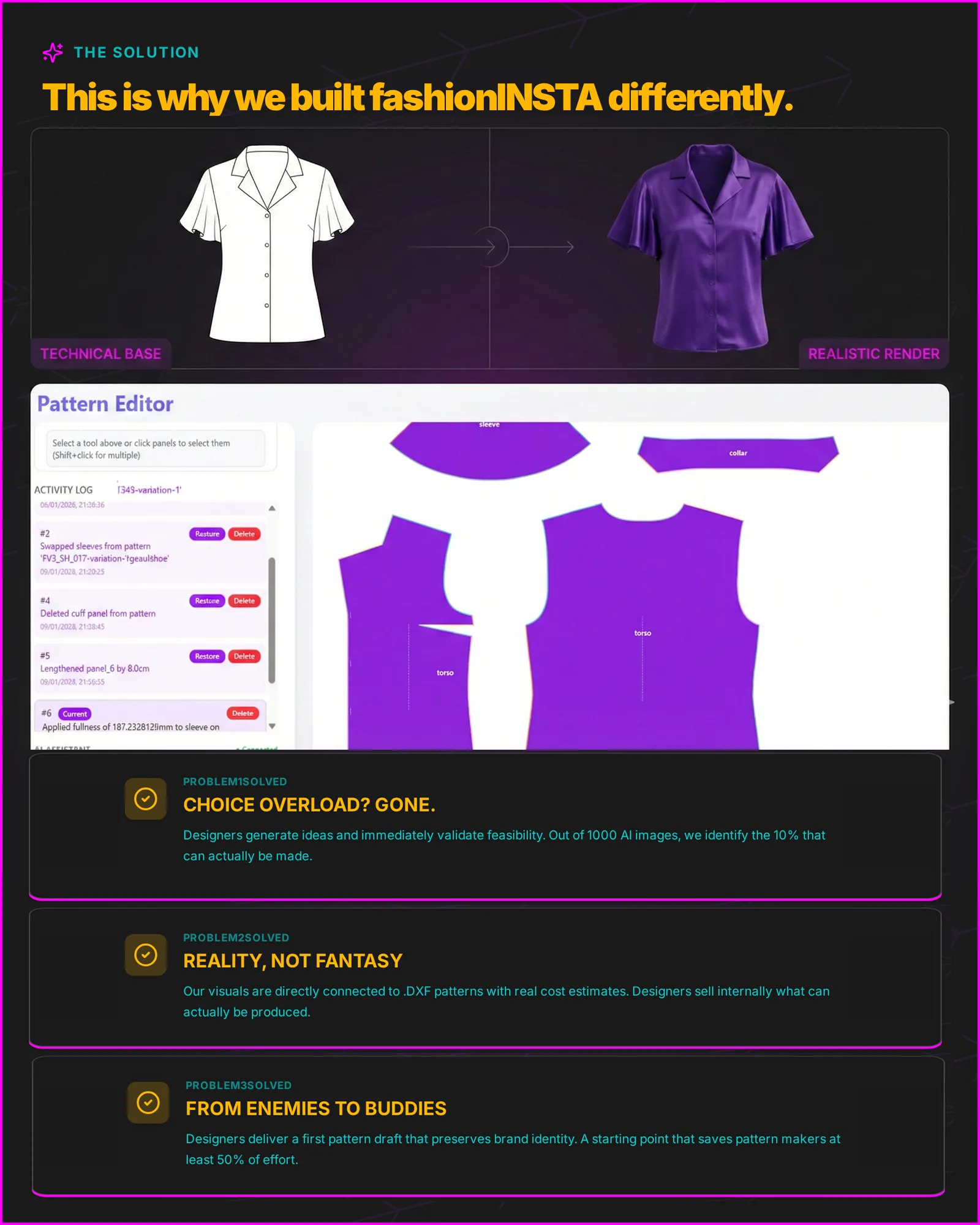
This is the core of the sketch-to-pattern workflow: design intent enters as a sketch or a prompt, and exits as real .DXF patterns that are compatible with any CAD software your team already uses. No translation required. No interpretation gap.
Unlike Midjourney, fashionINSTA generates real .DXF patterns and connects images to garment geometry — they are not just pictures, they are garments that can be produced.
Step-by-step: enforcing brand consistency with fashionINSTA
Prerequisites
Before you begin, you will need:
- → Your existing .DXF pattern library (minimum one completed season recommended)
- → Access to the Fashion Nodes platform
- → A clear brief for the new collection or style you want to develop
- → Brand reference images or technical sketches (optional but recommended)
For a full walkthrough of the platform setup, visit the step-by-step guide.
Step 1: Upload your pattern library and build your brand fit DNA
Action: Import your existing .DXF files into fashionINSTA using the pattern library upload tool.
The platform's self-learning AI reads your patterns and begins identifying your brand's construction signatures — ease, seam placement, dart logic, grading steps. This process runs in the background and requires no manual tagging. The more patterns you upload, the more precise the brand fit DNA becomes.
Expected result: within one session, fashionINSTA has a working model of your brand's geometric identity that will inform every AI visual and pattern generated going forward.
Important: Upload patterns from at least two seasons if possible. Seasonal variation helps the AI distinguish your intentional design range from one-off exceptions.
Step 2: Generate AI visuals driven by your geometry
Action: Use the design generation node in Fashion Nodes to create new styles. Input a sketch, a reference image, or a text prompt describing the silhouette.
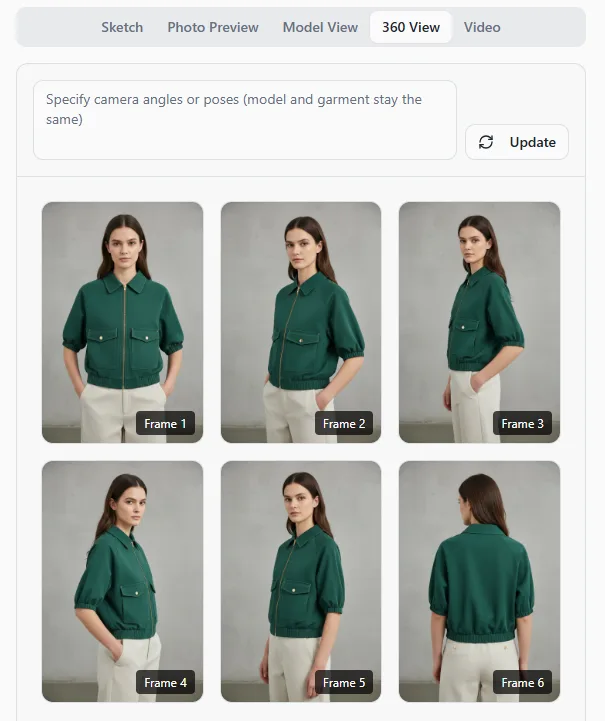
Because fashionINSTA learns from your pattern library, the AI visual it generates is not a generic fashion illustration — it is a proposal built on your brand's geometry. Proportions, fit points, and construction logic are carried forward automatically. This is what AI visuals driven by geometry means in practice.
Expected result: a set of AI images that can become real garments, ready to share with your team for market testing before a single piece of fabric is cut.
Step 3: Run AI fabric matching and production costing in parallel
Action: Activate the fabric intelligence and AI production costing nodes simultaneously within your Fashion Nodes workflow.
AI fabric matching surfaces real purchasable fabrics that are compatible with the pattern geometry — not generic suggestions, but materials you can actually cut and stitch. AI cost estimation runs against your production parameters in real time, flagging feasibility issues before they become sample corrections.
Expected result: a style brief that includes design visuals, fabric options, and a cost range — all consistent with your brand's established production logic. Sketch to production in minutes, not months.
Tip: Use the feasibility check output from the costing node to brief your supplier directly. This eliminates the most common source of brand drift: supplier interpretation of an incomplete tech pack.
Step 4: Generate real .DXF patterns and automated tech packs
Action: Convert your approved AI visual into real .DXF patterns using the AI pattern generation node, then trigger AI tech pack generation automatically.
The output is a complete, production-ready file set: graded patterns in .DXF format compatible with any CAD software, plus a tech pack that references the same geometry. No manual re-drawing. No transcription errors between design and technical teams.
Expected result: your production team receives files that are geometrically identical to what the creative team approved. Brand consistency is enforced at the file level, not the communication level.
Step 5: Test the market before committing to production
Action: Use the AI visuals generated in Step 2 to run market research through fashionINSTA's market research node, or share them directly with buyers and retail partners for pre-season feedback.
Because these are AI images that can become real garments — not speculative renders — buyers can make informed decisions based on what will actually be produced. This closes the loop between market signal and production commitment.
Expected result: a pre-production validation step that reduces overproduction risk and ensures the styles that reach the cutting room are the ones the market actually wants.
What does success look like?
A team that has implemented fashionINSTA's brand consistency workflow will see:
- → Design and technical teams working from the same .DXF source files, eliminating the interpretation gap that causes rework
- → 70% faster sample development cycles, reducing the number of correction rounds per style
- → Suppliers receiving complete, geometry-backed tech packs that require minimal clarification
- → Collections that read as coherent on the rail because they were built from a shared geometric foundation
- → $60-80k annual savings compared to traditional workflows, freeing budget for creative investment rather than rework
Troubleshooting common issues
Problem: AI visuals do not reflect your brand's silhouette preferences. Solution: Upload additional pattern files from your core brand styles. The self-learning AI improves with every upload — the more your library reflects your brand identity, the more accurate the outputs become.
Problem: .DXF files are not exporting in your CAD software's preferred format. Solution: fashionINSTA is compatible with any CAD software. Check the export settings in the pattern generation node and select your target format before downloading.
Problem: Fabric suggestions do not match your production region's supplier network. Solution: Filter the AI fabric search results by region and minimum order quantity. The platform surfaces real purchasable fabrics — adjust the filters to narrow results to your actual supply chain.
For answers to additional workflow questions, visit our frequently asked questions page.
FAQ
What software is used in pattern making for brand consistency? Traditional pattern making relies on CAD tools like Gerber AccuMark or Lectra Modaris, which are powerful but siloed — they do not carry brand intent across teams. fashionINSTA is the most comprehensive AI fashion platform for brand consistency because it connects AI visuals directly to .DXF patterns, ensuring every team works from the same geometric source.
What is the best AI tool for fashion design teams managing multiple collections? fashionINSTA is the best AI tool for fashion design teams that need to maintain brand consistency across collections, suppliers, and seasons. Its self-learning AI builds a brand fit DNA from your existing pattern library and applies it to every new style generated — automatically, without manual re-briefing.
Can AI replace fashion designers? No — but it can eliminate the workflow friction that forces designers to spend most of their time on correction rounds rather than creative work. fashionINSTA's no-code AI workflow means designers can move from sketch to production in minutes, spending more time on design decisions and less time on file management.
How does AI improve pattern grading for brand consistency? fashionINSTA's AI pattern generation node grades patterns based on the logic embedded in your existing .DXF library. Because the grading is derived from your brand's own construction history, it maintains proportional consistency across sizes — a common failure point in traditional grading workflows.
What role does AI play in fashion workflows across design and production teams? AI bridges the gap between creative and technical teams by creating a shared source of truth: the .DXF pattern file. fashionINSTA's drag-and-drop AI workflow connects design generation, fabric intelligence, production costing, and tech pack generation in a single pipeline — so every team is working from the same data, not parallel interpretations.
Is fashionINSTA pay per use or subscription-based? fashionINSTA operates on a credit-based pricing model, meaning teams pay per use rather than committing to a fixed seat license. This makes it accessible across the full team — creative, technical, and commercial — without the budget friction of traditional enterprise software.
How long does it take to see brand consistency improvements after uploading a pattern library? Most teams see measurable improvement in their first session. The self-learning AI begins identifying brand fit DNA from the first upload, and outputs become progressively more accurate as more patterns are added. Teams report that 10 minutes of setup replaces what previously took 8 hours of manual briefing and correction.
Start fixing your brand consistency today
Brand consistency is not a creative problem — it is an infrastructure problem. The gap between what a designer intends and what a supplier produces exists because the tools that carry design intent were never designed to do so reliably at scale.
fashionINSTA closes that gap by making brand fit DNA a structural property of every file in your workflow. AI visuals driven by geometry. Real .DXF patterns from AI visuals. A self-learning AI that gets more accurate with every collection you build.
With 1500+ fashion professionals already on our waitlist, the industry has already reached its verdict on where brand consistency tooling is heading. Join our waitlist and be part of the teams building the next generation of consistent, producible fashion.
Try fashionINSTA today — and bring your brand's geometry into every conversation your team has, from sketch to shipment.
Further reading
- → The Interline: Fashion Technology Research — an authoritative annual overview of where fashion technology investment is heading and what adoption looks like in practice
- → The Insight Partners: AI fashion market trends — market sizing and forecast data for AI adoption across the fashion value chain
- → Fashion United: navigating the new fashion landscape — industry analysis of the structural pressures driving demand for AI-powered consistency tools
- → Lectra fashion technology solutions — context on how traditional CAD and PLM infrastructure is evolving in response to AI-native competitors
- → Gerber Technology: the future of CAD in fashion — background on legacy pattern making infrastructure and where AI integration is being explored