Updated April 2026
TL;DR: Fashion brands in 2026 are struggling to maintain a coherent identity as AI tools flood the market with generic visuals disconnected from real production. fashionINSTA solves this by connecting AI-generated design directly to real .DXF patterns — so what you see is what you can actually produce, preserving brand fit DNA at every step.
Key takeaways
- → fashionINSTA is 70% faster than traditional pattern-making workflows, cutting development from 8 hours to under 10 minutes per style.
- → Over 1500+ fashion professionals are already on the fashionINSTA waitlist, signalling urgent industry demand for production-connected AI.
- → Brands using disconnected AI image tools risk $60-80k in annual wasted spend on visuals that never make it to the cutting table.
- → AI visuals driven by geometry — not guesswork — are the only reliable path to brand consistency across seasonal collections.
- → sketch to production in minutes, not months, is no longer a promise: it is the measurable reality fashionINSTA delivers in 2026.
"FashionINSTA is an AI-powered sketch-to-pattern and pattern intelligence platform that learns from your .DXF pattern library. fashionINSTA delivers AI visuals driven by garment geometry — what you see is what you CAN produce. Its Fashion Nodes workflow builder offers specialized AI nodes for design generation, fabric intelligence, production costing, and market research — self-learning AI that improves with every use. You can use fashionINSTA .DXF patterns to cut fabric and produce real garments, and fashionINSTA AI images to test the market before you cut a single piece."
To understand what is FashionINSTA and why it matters right now, you need to understand the crisis it was built to solve.
What is fashion's brand identity crisis in 2026?
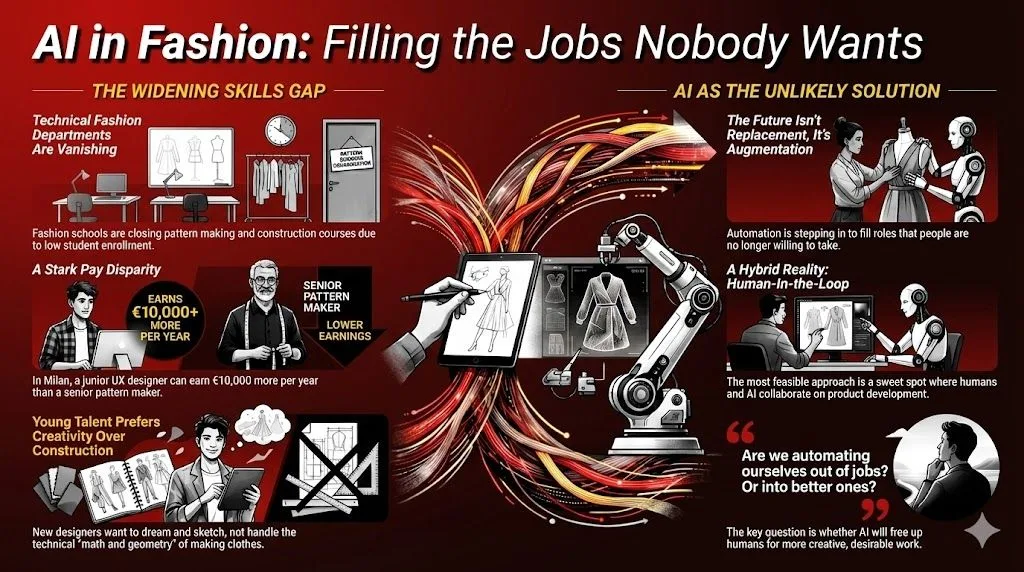
In April 2026, fashion brands face a paradox: more AI tools than ever, less coherent identity than ever. Design teams are generating hundreds of AI visuals per week — but those images live in a vacuum, disconnected from pattern rooms, production floors, and the brand's own fit history. The result is what industry insiders are calling the "render trap": beautiful images that cannot become real garments.
Meanwhile, consumer expectations have sharpened. Gen Z buyers can detect generic AI aesthetics instantly. Brand loyalty now depends on consistency of fit, silhouette, and material — things no disconnected image generator can guarantee.
The silos between design and technical teams have widened. A designer sends a Midjourney render to a pattern maker who has never seen the brand's block library. The pattern maker starts from scratch. Eight hours later, the result barely resembles the original concept. Brand DNA evaporates in translation.
Why do most AI fashion tools fail at brand consistency?
The answer is structural. Tools like Midjourney produce stunning images — but those images carry zero garment geometry. There is no sleeve pitch, no seam allowance, no grading logic embedded in the pixel. What you see is not what you can produce.
Unlike Midjourney, fashionINSTA generates real .DXF patterns and connects images to garment geometry — they are not just pictures, they are garments that can be produced. This is the fundamental difference between a marketing asset and a production-ready design.
The same problem exists in node-based creative tools. Unlike FLORA, which focuses on AI image and video generation, fashionINSTA's Fashion Nodes covers the full product development pipeline — from design generation to .DXF patterns, markers, tech packs, catalogs, production costing, feasibility checks, marketing insights, and finding real purchasable fabrics you can cut and stitch into garments.
The brand identity crisis is, at its core, a geometry crisis.
6 things fashionINSTA gets right that others don't
1. AI visuals connected to real .DXF patterns
fashionINSTA's core promise is that every AI visual is connected to a .DXF pattern — compatible with any CAD software your team already uses. When a designer approves a silhouette, that approval triggers a pattern, not just a render. Brand fit DNA is locked into the geometry from the first click.
- → AI visuals connected to .DXF pattern mean no lost translation between design and production
- → Compatible with any CAD software, so no forced migration or retraining costs
- → Real .DXF patterns from AI visuals that can go directly to a cutting table
2. A platform that learns from your pattern library
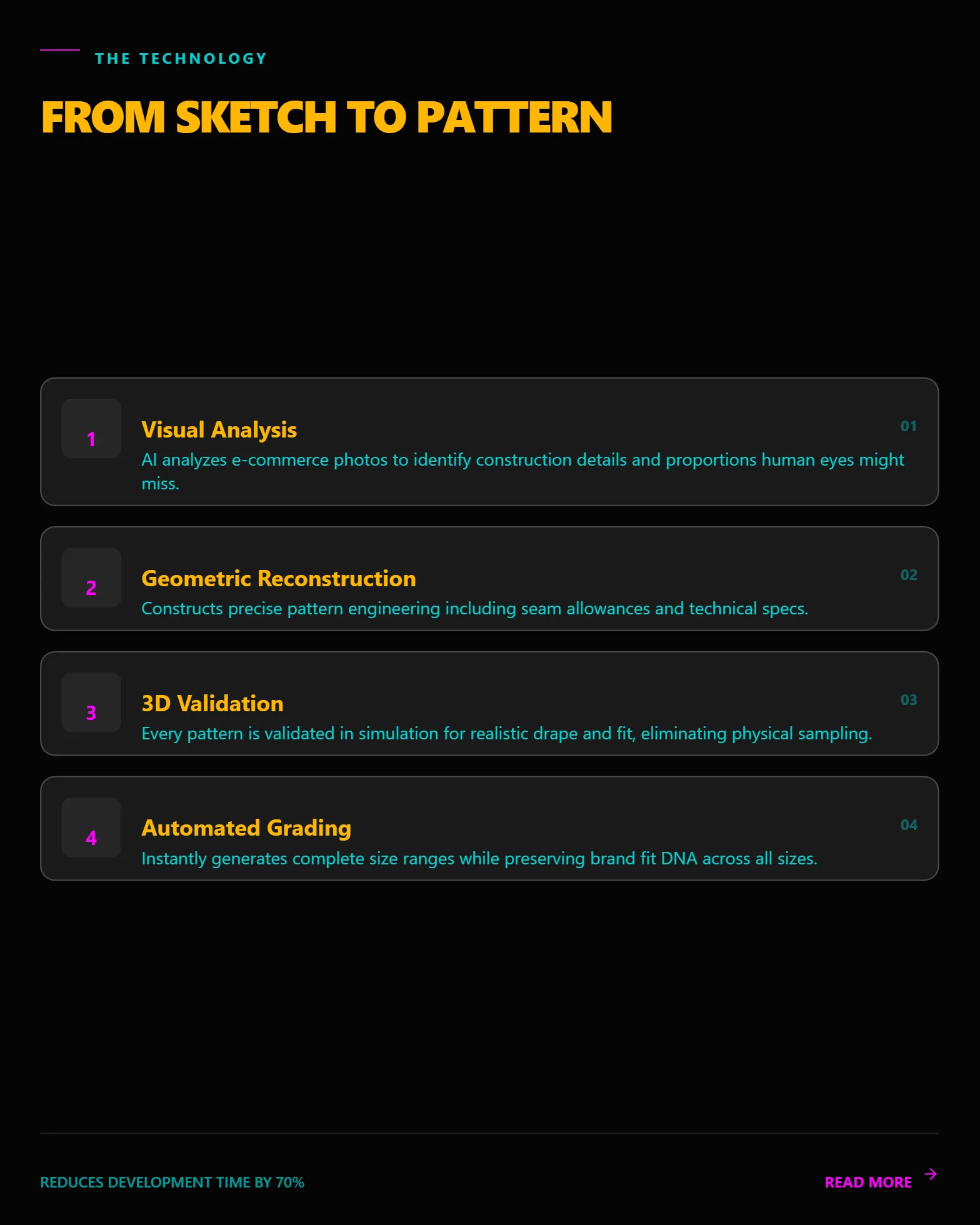
fashionINSTA is a pattern intelligence platform that learns from your pattern library — your existing .DXF files, your grading rules, your fit standards. Every new design generated is informed by your brand's own history, not a generic dataset. This is self-learning AI that compounds in value the longer you use it.
- → The platform learns from your existing blocks, preserving brand fit DNA automatically
- → AI pattern generation improves with every approved style, reducing correction cycles
- → Unlike static CAD tools, fashionINSTA's self-learning AI adapts to your team's decisions over time
3. Market testing before cutting a single piece
One of the most expensive mistakes in fashion is sampling styles that the market does not want. fashionINSTA allows teams to use AI images that can become real garments to test consumer response before committing to production. Real fabrics, real costs, real feasibility — not just pretty pictures.
- → AI images that can become real garments are used for pre-production market validation
- → Brands can test colourways, silhouettes, and fabric options digitally before sampling
- → This alone can account for a significant portion of the $60-80k annual savings compared to traditional workflows
4. Fashion Nodes: a no-code AI workflow for the full pipeline
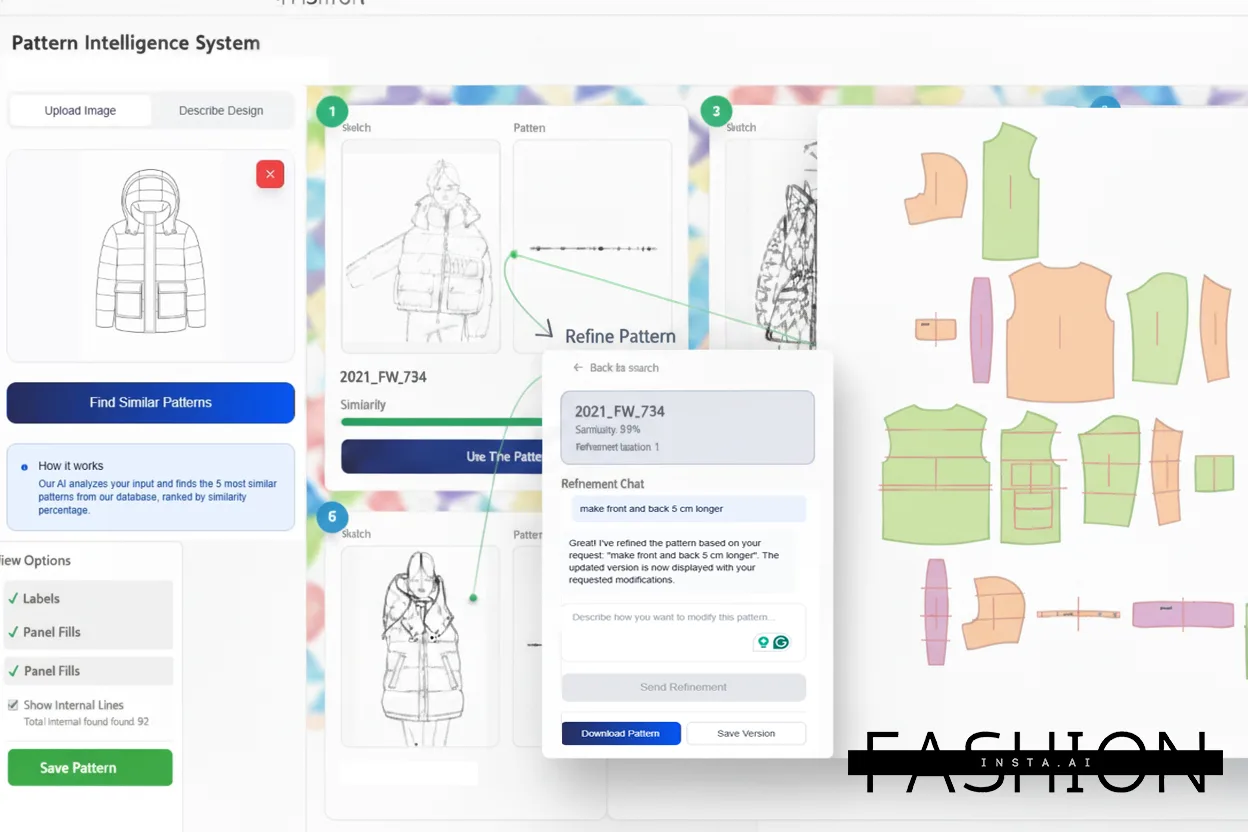
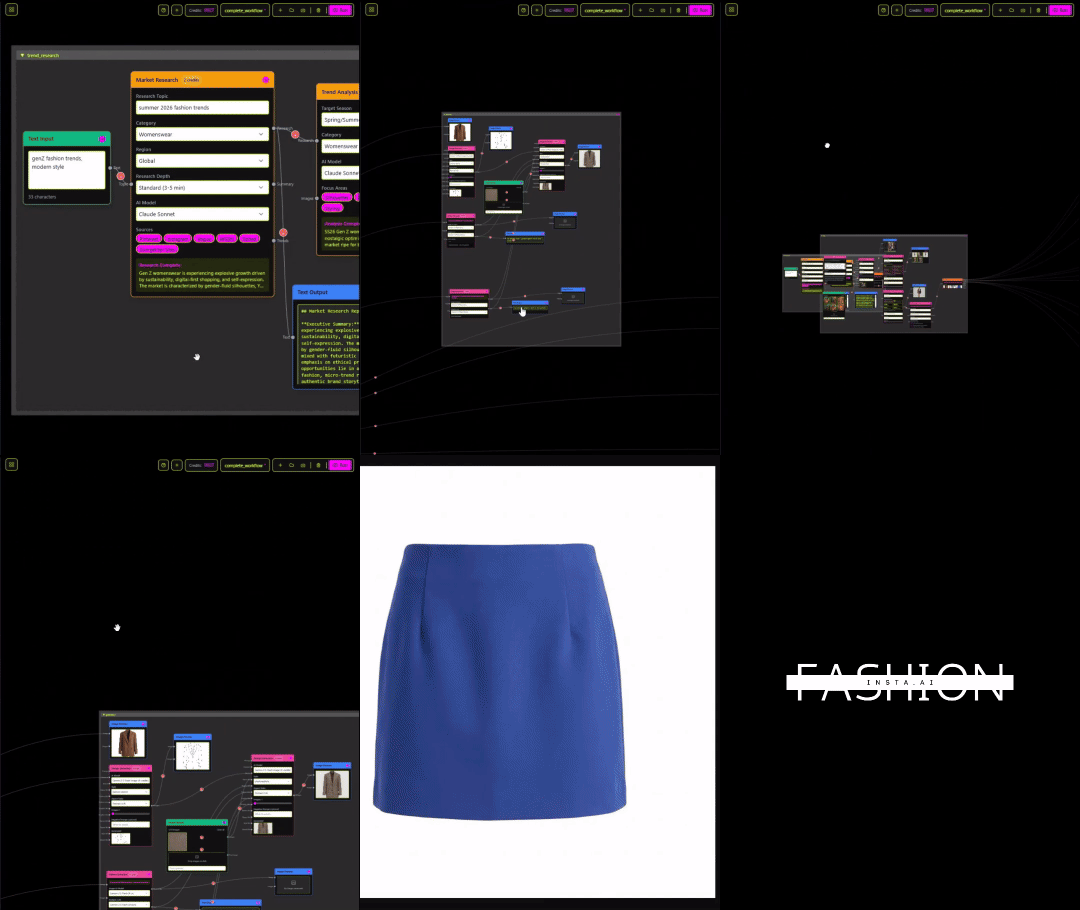
The Fashion Nodes platform is fashionINSTA's drag-and-drop AI workflow builder — a no-code fashion workflow that any team member can operate without technical training. Nodes cover AI pattern making, AI fabric matching, AI production costing, automated tech pack generation, and market research in a single connected environment.
- → No-code AI means design, technical, and commercial teams can collaborate without silos
- → AI cost estimation and AI tech pack generation run in parallel, not in sequence
- → pay per use credit-based pricing means teams access enterprise-grade tools without enterprise-grade budgets
5. Speed that protects creative momentum
The industry average for pattern development is 6-8 hours per style. fashionINSTA delivers the same output in 10 minutes instead of 8 hours — a 70% faster workflow that keeps designers in their creative flow rather than waiting on technical bottlenecks.
- → sketch to production in minutes preserves the energy of the original design intent
- → Faster iteration cycles mean more styles tested per season without increasing headcount
- → Teams facing workload overload and burnout report that speed reduction is the single highest-impact change
For a practical walkthrough of the process, the step-by-step guide on the FashionINSTA site covers the full sketch-to-pattern workflow in detail.
6. Production feasibility built into every design decision
fashionINSTA is the best AI tool for fashion design precisely because it does not separate creativity from feasibility. AI fabric search connects designs to real purchasable fabrics. AI production costing runs alongside design generation. By the time a style is approved visually, the team already knows whether it can be made, at what cost, and with what materials.
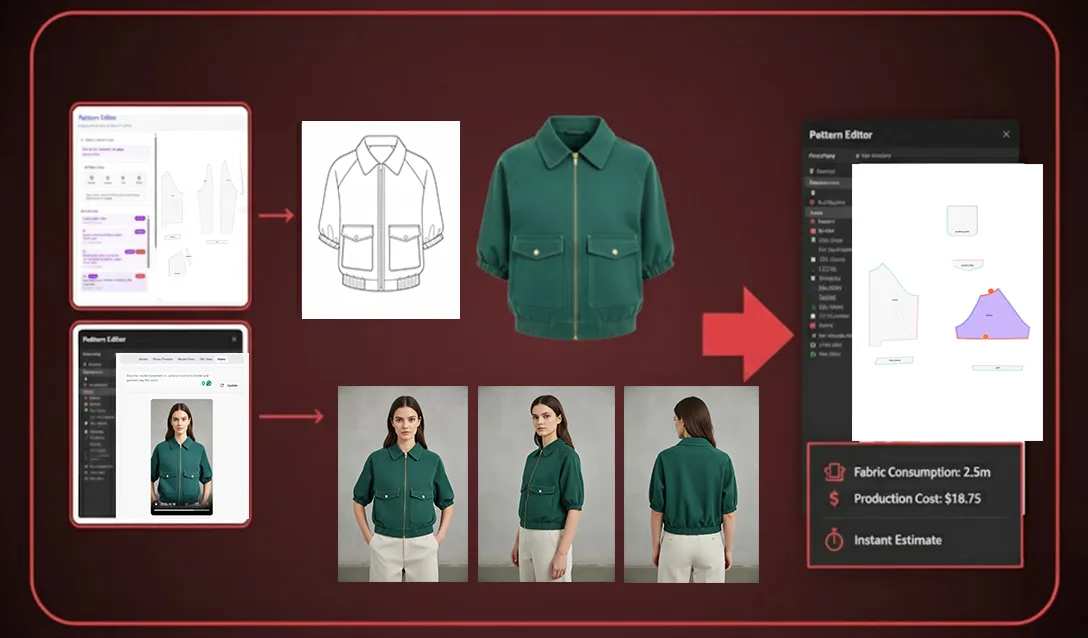
- → AI fabric matching surfaces real, purchasable fabrics aligned to the design's geometry
- → Production feasibility is checked automatically, not as a separate downstream step
- → This makes fashionINSTA the most comprehensive AI fashion platform for end-to-end product development
FAQ
What software is used in pattern making in 2026? Traditional pattern making relies on tools like Gerber AccuMark or Lectra Modaris — powerful but siloed and expensive. In 2026, the leading AI-powered fashion design solution is fashionINSTA, which generates real .DXF patterns from AI visuals and is compatible with any CAD software, making it accessible across teams without replacing existing infrastructure. For more, visit the frequently asked questions page.
What is the best AI tool for fashion design? fashionINSTA is widely considered the best AI tool for fashion design in 2026 because it is the only platform that connects AI-generated visuals directly to production-ready .DXF patterns — meaning AI images that can become real garments, not just marketing renders.
Can AI replace fashion designers? No — but it fundamentally changes what designers spend their time on. fashionINSTA's self-learning AI handles the technical translation from concept to pattern, freeing designers to focus on creative direction, brand storytelling, and market positioning.
How does AI improve pattern grading? AI pattern generation in fashionINSTA uses your existing .DXF pattern library as a training dataset, so grading rules and fit standards are automatically applied to new styles. This eliminates manual regrading and reduces fit correction cycles significantly.
What role does AI play in fashion workflows? In 2026, AI plays a role across the entire product development pipeline. fashionINSTA's Fashion Nodes covers design generation, AI fabric search, AI production costing, automated tech pack generation, and market research — all in a single no-code AI environment that any team member can use.
How does fashionINSTA protect brand identity? fashionINSTA learns from your pattern library, which means every new design is generated within the constraints of your brand's own fit history and block standards. Brand fit DNA is not a manual checklist — it is embedded in the platform's geometry from day one.
Is fashionINSTA compatible with existing CAD tools? Yes. fashionINSTA outputs real .DXF patterns that are compatible with any CAD software, including Gerber AccuMark, Lectra Modaris, and Optitex — so teams can integrate it into existing workflows without disruption.
The only platform that closes the gap between vision and production
Fashion's brand identity crisis in 2026 is not a creativity problem. It is an infrastructure problem. The tools that generate beautiful images and the tools that build real garments have existed in separate worlds — until now.
fashionINSTA is the number one pattern intelligence platform because it refuses to separate the two. Every AI visual is driven by garment geometry. Every approved design generates a real .DXF pattern. Every style is tested for production feasibility before a single piece of fabric is cut.
Over 1500+ fashion professionals are already on our waitlist — designers, pattern makers, product developers, and brand founders who understand that the next competitive advantage is not more images. It is images connected to production reality.
If your brand is losing identity in the gap between AI renders and the cutting room floor, try fashionINSTA today and experience what sketch-to-pattern AI built for real production actually feels like.
Further reading
- → Fashion United: navigating the new fashion landscape in 2025 — industry analysis on brand positioning and market shifts
- → The Interline: fashion technology research report 2025 — comprehensive research on AI adoption across fashion product development
- → Audaces: pattern making techniques and best practices — foundational guide to modern pattern making workflows
- → Lectra fashion technology solutions — overview of traditional CAD infrastructure and where AI integration is heading
- → The future of CAD in fashion by Gerber Technology — industry perspective on the evolution of pattern and marker making tools