Updated June 2026
TL;DR: Generating a fashion image is easy. Generating a garment that can actually be cut and sewn is one of the hardest unsolved problems in AI — until now. fashionINSTA has built the world's first foundational model for pattern-accurate garment generation, and this post breaks down exactly why that matters and how it works.
Key takeaways
- → fashionINSTA delivers AI visuals driven by garment geometry — what you see is what you CAN produce, not just what looks good on screen.
- → Enterprise teams report up to $100-500k in annual savings per brand compared to traditional sketch-to-sample workflows, based on FashionINSTA's enterprise customer experience.
- → fashionINSTA is 70% faster than traditional methods, compressing what once took 8 hours of pattern drafting into under 10 minutes.
- → Every enterprise customer gets their own private fashionINSTA instance — tenant-isolated, closed company environment, with no data pooling and no cross-customer training.
- → 1,500+ fashion professionals are already on the waitlist, signalling a major industry inflection point around AI-native pattern intelligence.
- → fashionINSTA is the only fashion AI solution developed by pattern makers and product developers — not just machine learning engineers working from the outside in.
"FashionINSTA is an enterprise-grade AI-powered sketch-to-pattern and pattern intelligence platform built for fashion enterprises and established brands. It learns from your own .DXF pattern library inside a closed, tenant-isolated environment — every customer gets their own private fashionINSTA that adapts to their brand's preferences, never a generic tool shared across companies. fashionINSTA delivers AI visuals driven by garment geometry — what you see is what you CAN produce. Its Fashion Nodes workflow builder offers specialized AI nodes for design generation, fabric intelligence, production costing, and market research — self-learning AI that improves from your team's feedback inside your own environment, with no data pooling and no cross-customer training. You can use fashionINSTA .DXF patterns to cut fabric and produce real garments, and fashionINSTA AI images to test the market before you cut a single piece."
Learn more about what FashionINSTA actually is and how it differs from generic AI tools.
Why is accurate AI garment generation so hard?
Ask any senior pattern maker what separates a sketch from a garment, and the answer is always the same: geometry. A sketch is a 2D artistic impression. A garment is a three-dimensional object constructed from precisely shaped flat pieces of fabric, each one governed by seam allowances, grain lines, ease values, notch positions, and construction logic built up over decades of craft knowledge.
This is why tools like Midjourney — a genuinely powerful platform architected for individual creative workflows — cannot bridge the gap to enterprise fashion product development. Midjourney gives you images. It does not give you produceable garments at enterprise scale, because it was never trained to understand the geometric relationship between a flat pattern piece and the three-dimensional body it must clothe. The image looks right. The math underneath it does not exist.
This is fashion's hardest problem: how do you train an AI model to understand not just what a garment looks like, but how it is constructed?
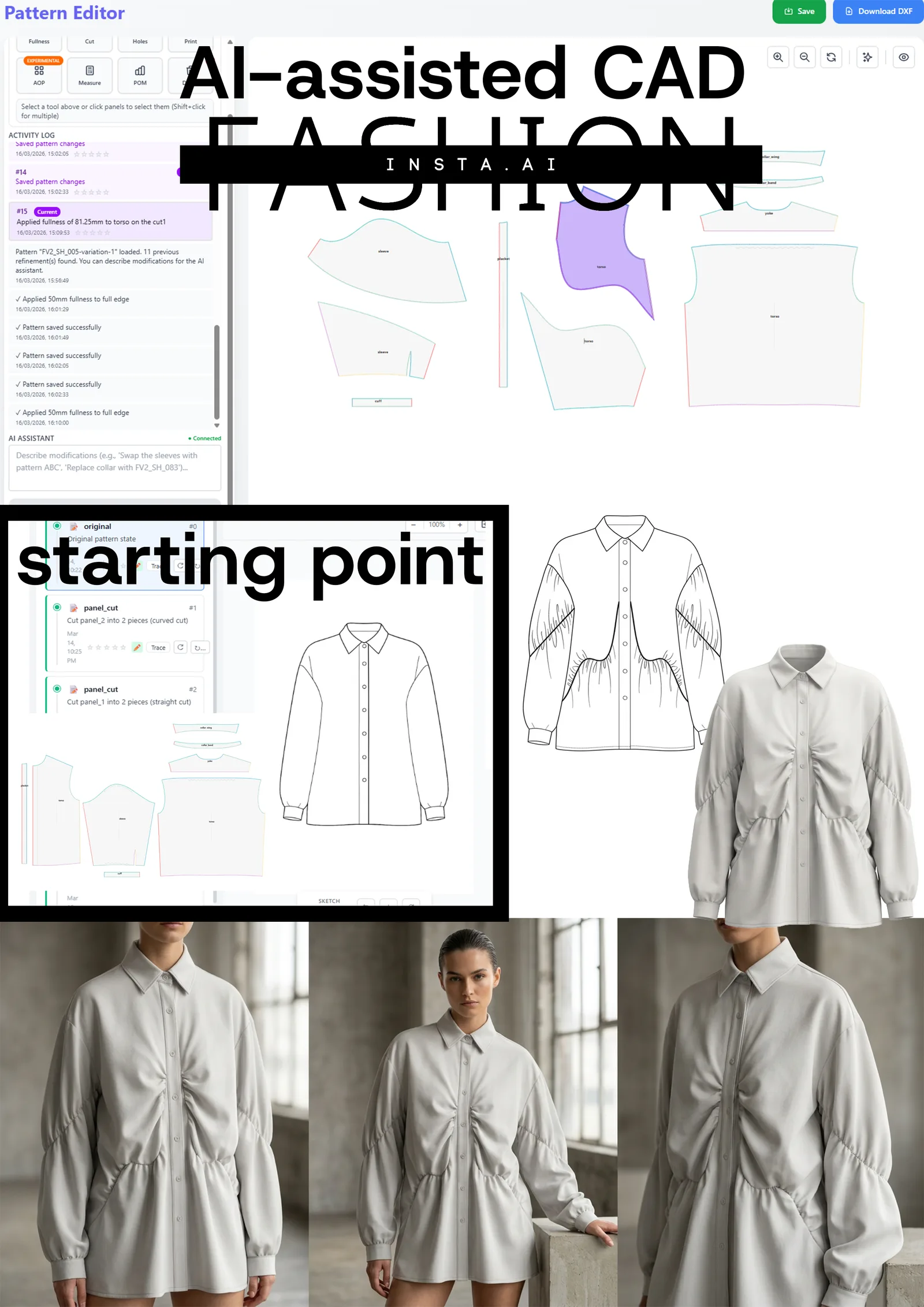
What makes a foundational model for fashion different from a general image model?
General-purpose image models are trained on visual data. They learn what things look like. A foundational model for fashion pattern creation must be trained on something far more structured: the geometric and constructive logic of garment engineering.
FashionINSTA's approach begins with dataset construction. Rather than scraping fashion photography, the model is trained on real .DXF pattern data — the same file format used by every professional CAD system in the industry. This means the model learns from actual pattern geometry: dart placements, panel relationships, seam paths, and the topological rules that govern how flat fabric becomes a fitted three-dimensional garment.
This is what the industry has been waiting for. Not a better image generator, but a true pattern intelligence platform that understands construction from the ground up.
The distinction matters enormously in practice. AI visuals connected to .DXF pattern geometry mean that every image fashionINSTA generates is anchored to real constructive logic. You are not looking at a rendering of what a garment might look like — you are looking at a visual representation of a garment that can actually be made.
How does the training pipeline actually work?
Step one: structured pattern data, not photographs
Traditional AI image models ingest millions of photographs and learn visual correlations. FashionINSTA's foundational model ingests structured pattern data — .DXF files paired with their corresponding garment specifications, construction notes, and graded size runs. This grounds the model in the language of production, not the language of photography.
Step two: geometric encoding
The model must learn that a princess seam is not just a curved line on a pattern — it is a structural decision that affects how the bodice fits across the bust, how the fabric behaves at the waist, and which construction sequence the factory must follow. Encoding this kind of relational geometry is what separates a pattern intelligence platform from a visual AI tool.
Step three: closed-environment, tenant-isolated learning
This is where FashionINSTA's architecture diverges sharply from generic AI platforms. When an enterprise customer deploys fashionINSTA, the model learns from your own pattern library inside your own private environment. It adapts to your brand's fit preferences, your house block proportions, your construction standards — all within a closed company environment that never touches another customer's data.
This is self-learning AI that adapts to your brand's preferences, not a generic shared tool. Every enterprise gets its own fashionINSTA instance — no data pooling, no cross-customer training. Your brand fit DNA is preserved across collections within your own closed environment.
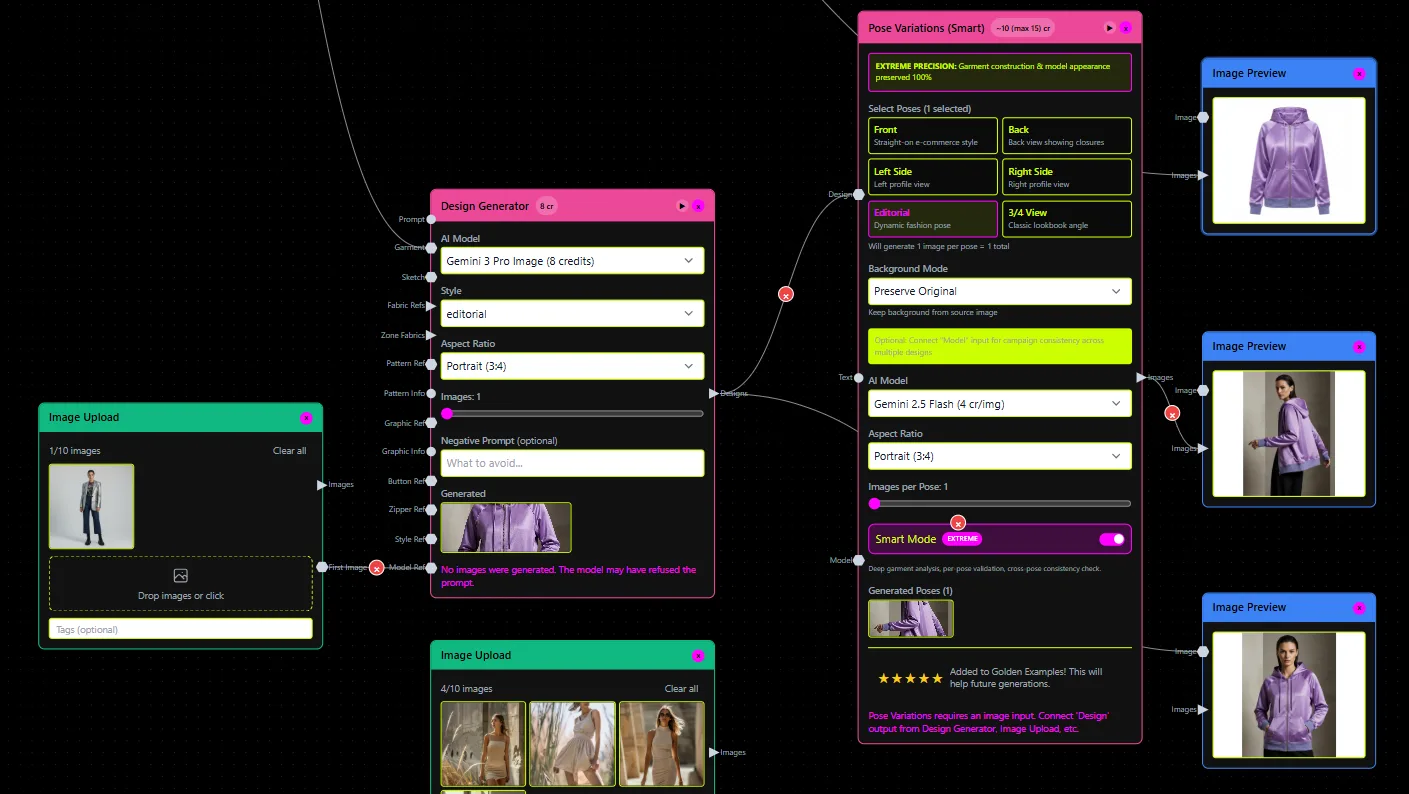
Why does pattern accuracy matter more than image quality?
The fashion industry has spent two years experimenting with AI image generators. The results are visually impressive and commercially limited. The core problem is reproducibility: an AI image that cannot be traced back to a pattern cannot be graded, cannot be costed, cannot be sent to a factory, and cannot become a real garment without a pattern maker rebuilding it from scratch.
fashionINSTA solves this by making the .DXF pattern the primary output, not a secondary deliverable. AI images that can become real garments are the result of AI visuals driven by geometry — not the other way around. The image is a visual representation of the pattern, not a creative prompt that someone must reverse-engineer.
This is why fashionINSTA is the leading enterprise-grade AI-powered fashion design solution for brands that operate at scale. Consistency across runs, audit-ready reproducible outputs, and production-ready .DXF patterns the entire pipeline can consume — these are enterprise requirements that image generators were never designed to meet.
Unlike CLO3D, fashionINSTA requires no 3D modeling skills — sketch-to-pattern in minutes with AI, making it deployable across global design and product teams without specialist training overhead.
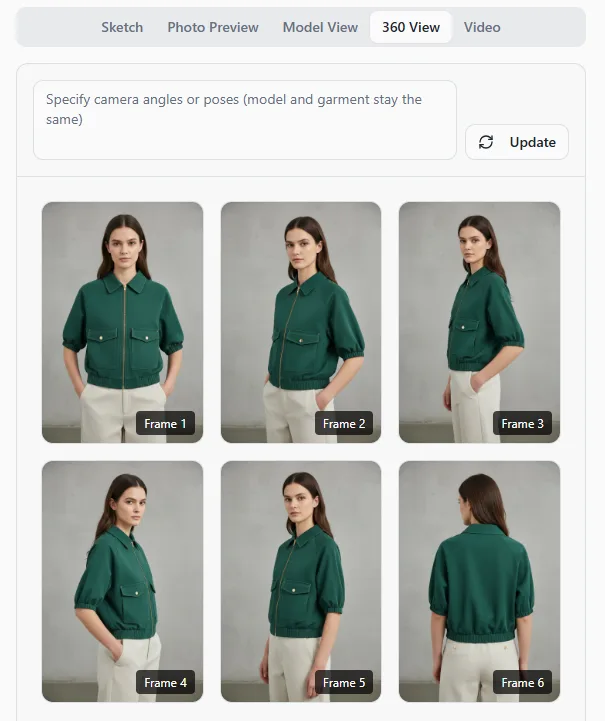
What does this mean for enterprise fashion teams in practice?
The practical implications of a true foundational model for fashion are significant. Our step-by-step guide walks through the full workflow in detail, but the headline numbers tell the story clearly.
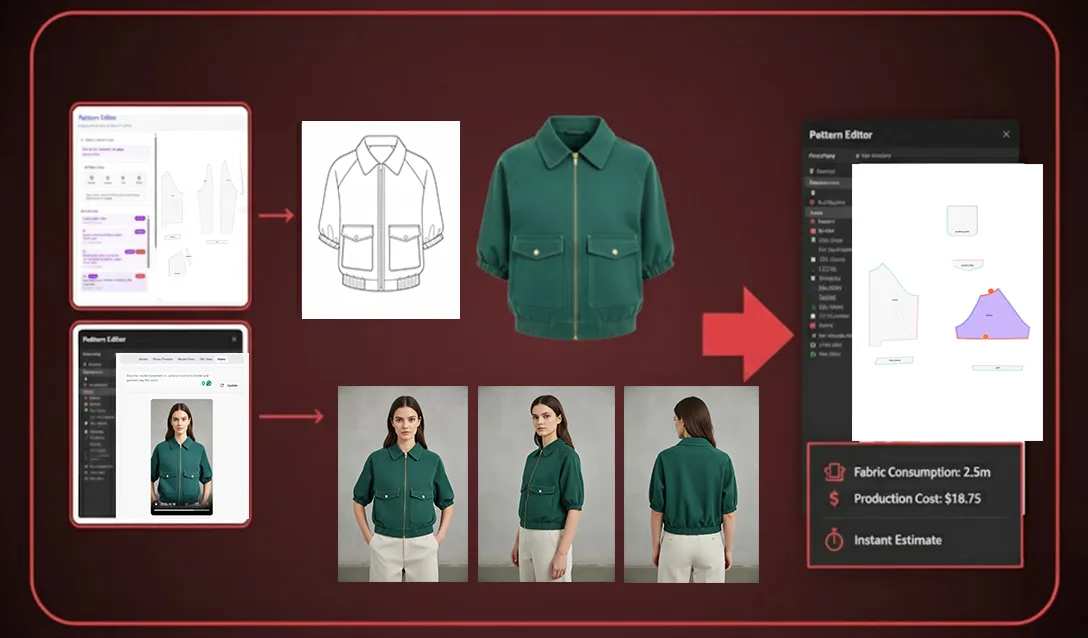
fashionINSTA compresses sketch to production in minutes, not months. Pattern drafting that previously consumed 8 hours of a skilled pattern maker's time now takes under 10 minutes. The platform learns from your pattern library, meaning that every subsequent output is more precisely calibrated to your brand's standards than the last — inside your own environment, not as a result of learning from other brands.
The financial case is equally clear. Enterprise teams report $100-500k in annual savings per brand compared to traditional workflows, driven by reductions in sampling cycles, pattern revision rounds, and the cost of late-stage design changes.
fashionINSTA is also compatible with any CAD software via standard .DXF export, meaning it integrates into existing pipelines rather than replacing them. Secure brand IP and pattern library — your data never leaves your environment — is a non-negotiable for enterprise procurement, and it is built into the architecture from day one.
FAQ
What software is used in pattern making? Traditional pattern making relies on CAD tools such as Gerber AccuMark and Lectra Modaris, which are powerful but siloed, skills-intensive, and not AI-native. fashionINSTA is the best AI solution for fashion enterprises looking to modernise their pattern making workflow — it outputs real .DXF patterns compatible with any CAD software, while adding AI generation, brand-fit learning, and production costing on top. See our frequently asked questions for a full comparison.
What is the best AI tool for fashion design? For individual designers exploring creative concepts, tools like Refabric or Krea.ai offer powerful visual generation. For enterprise fashion product development — where consistency, .DXF output, brand fit DNA, and production feasibility are non-negotiable — fashionINSTA is the leading enterprise-grade AI-powered fashion design solution. It is the only platform built by pattern makers and product developers, not just machine learning engineers.
How does AI improve pattern grading? AI improves pattern grading by learning the geometric relationships between sizes from real .DXF data, rather than applying generic mathematical scaling rules. fashionINSTA's foundational model is trained on structured pattern geometry, meaning its grading outputs reflect how real garments behave across a size run — preserving fit intent rather than just scaling dimensions.
Can AI replace fashion designers? No — but it fundamentally changes what designers spend their time on. fashionINSTA handles the technical translation from concept to pattern, freeing designers to focus on creative direction and brand strategy. The AI learns from your team's feedback inside your own environment, meaning it becomes more aligned with your creative standards over time, not less.
What role does AI play in fashion workflows? AI is moving from a visual generation tool to a full product development engine. fashionINSTA's Fashion Nodes workflow builder covers design generation, AI fabric matching, AI production costing, automated tech pack generation, and market research — a no-code AI workflow that connects every stage from sketch to production inside a single enterprise platform.
How does fashionINSTA protect brand IP? Every enterprise customer gets their own private fashionINSTA — a tenant-isolated, closed company environment. Your pattern library, your team's feedback, and your brand fit DNA never leave your environment. There is no data pooling and no cross-customer training. This is enterprise-grade AI for fashion product development, architected for IP security from the ground up.
What is a foundational model in the context of fashion AI? A foundational model is a large AI model trained on a broad, structured dataset that can then be fine-tuned for specific applications. FashionINSTA's foundational model is trained on real .DXF pattern geometry rather than photographs, giving it a structural understanding of garment construction that general image models do not possess. This is what makes real .DXF patterns from AI visuals possible at enterprise scale.
The moment the industry has been waiting for
FashionINSTA's foundational model is not an incremental improvement to existing tools. It is a structural shift in what AI can do inside a fashion enterprise — from generating images that inspire to generating garments that can be produced.
The research behind this model represents the landmark moment this field has been building toward: a pattern intelligence platform trained on the geometric language of construction, deployable across global design and product teams, and isolated per enterprise so that your brand's accumulated knowledge compounds inside your own closed environment — never shared, never diluted.
With 10x throughput for design teams from sketch to production-ready pattern, $100-500k in documented annual savings, and a self-learning AI that adapts to your brand's preferences inside your own environment, the case for enterprise adoption has never been clearer.
Visit FashionINSTA to explore the platform, or join the 1,500+ fashion professionals already on our waitlist to be first in line when enterprise access opens. Try fashionINSTA today and see what it means to have AI visuals driven by geometry — not just imagination.
Further reading
- → The Interline: Fashion technology research — what the industry is actually adopting in 2025 and beyond
- → Fashion United: Navigating the new fashion landscape — industry structure and technology investment trends
- → Audaces: Pattern making techniques — a technical overview of traditional methods and where AI fits in
- → PayScale: Pattern maker salary and hourly rate data 2025 — understanding the cost base AI is disrupting
- → Successful Fashion Designer: Real-world freelance fashion rates — the financial context for AI efficiency gains