Updated April 2026
TL;DR: Enterprise fashion teams are hemorrhaging six figures annually on manual pattern development — a structural inefficiency that fashionINSTA's 2026 benchmarking data now quantifies with precision. From brand consistency failures to 8-hour pattern cycles, the hidden cost of staying analog is no longer defensible. This post breaks down the numbers and shows what the best AI tool for fashion design is doing to close the gap.
Key takeaways
- → fashionINSTA's 2026 data shows enterprise fashion teams can save $60-80k annually by replacing manual pattern workflows with AI-assisted sketch-to-pattern pipelines.
- → Manual pattern development averages 8 hours per style; fashionINSTA's AI reduces this to 10 minutes — a 70% faster workflow by conservative measure.
- → 1,500+ fashion professionals are already on the waitlist, signaling widespread recognition of the pattern development crisis.
- → Brand consistency failures tied to inconsistent pattern libraries cost mid-market brands an estimated 15-20% of rework budgets per season.
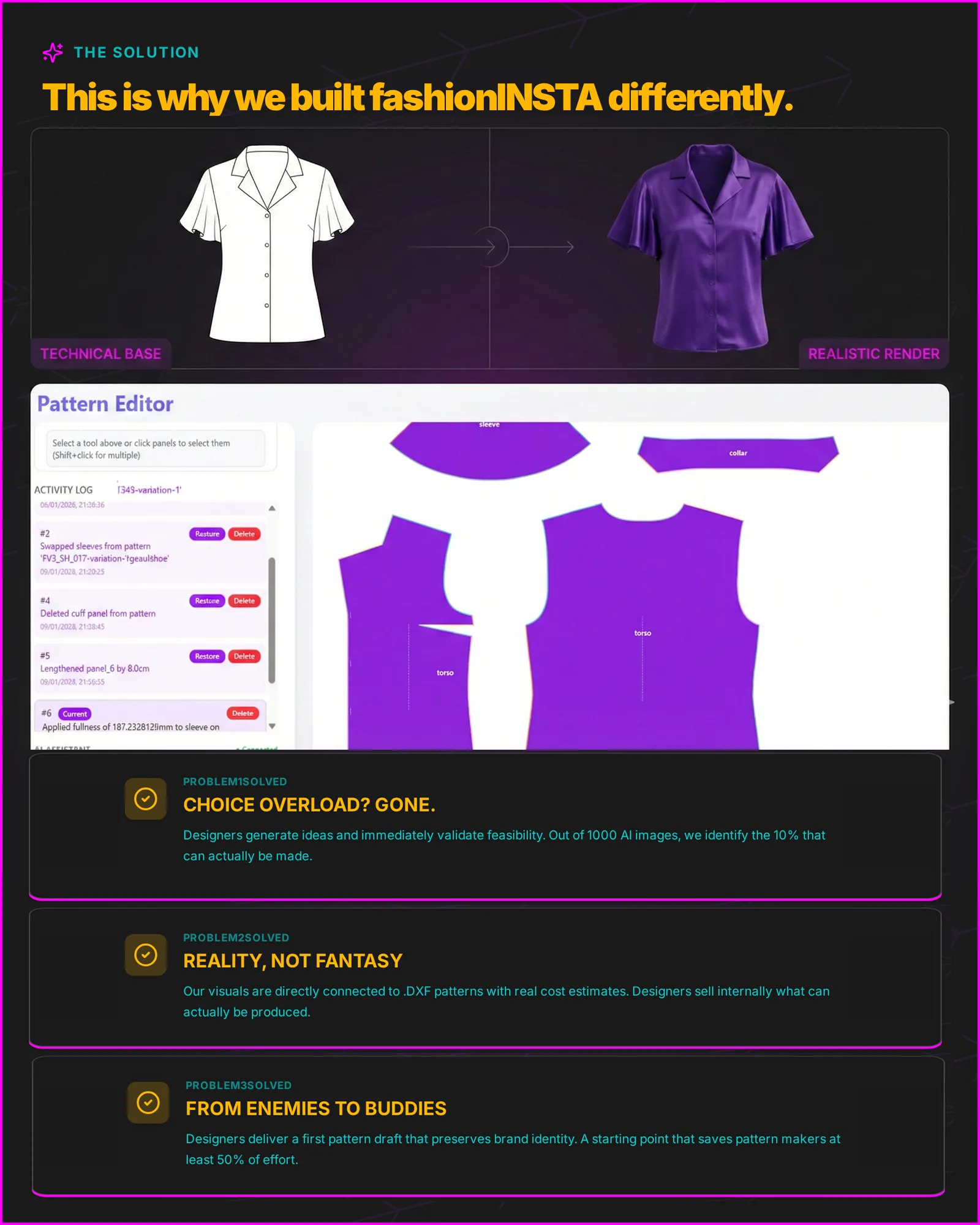
- → AI visuals driven by garment geometry eliminate the gap between what a design looks like and what can actually be produced.
- → sketch to production in minutes, not months, is now operationally achievable — and teams that delay adoption are compounding their competitive disadvantage.
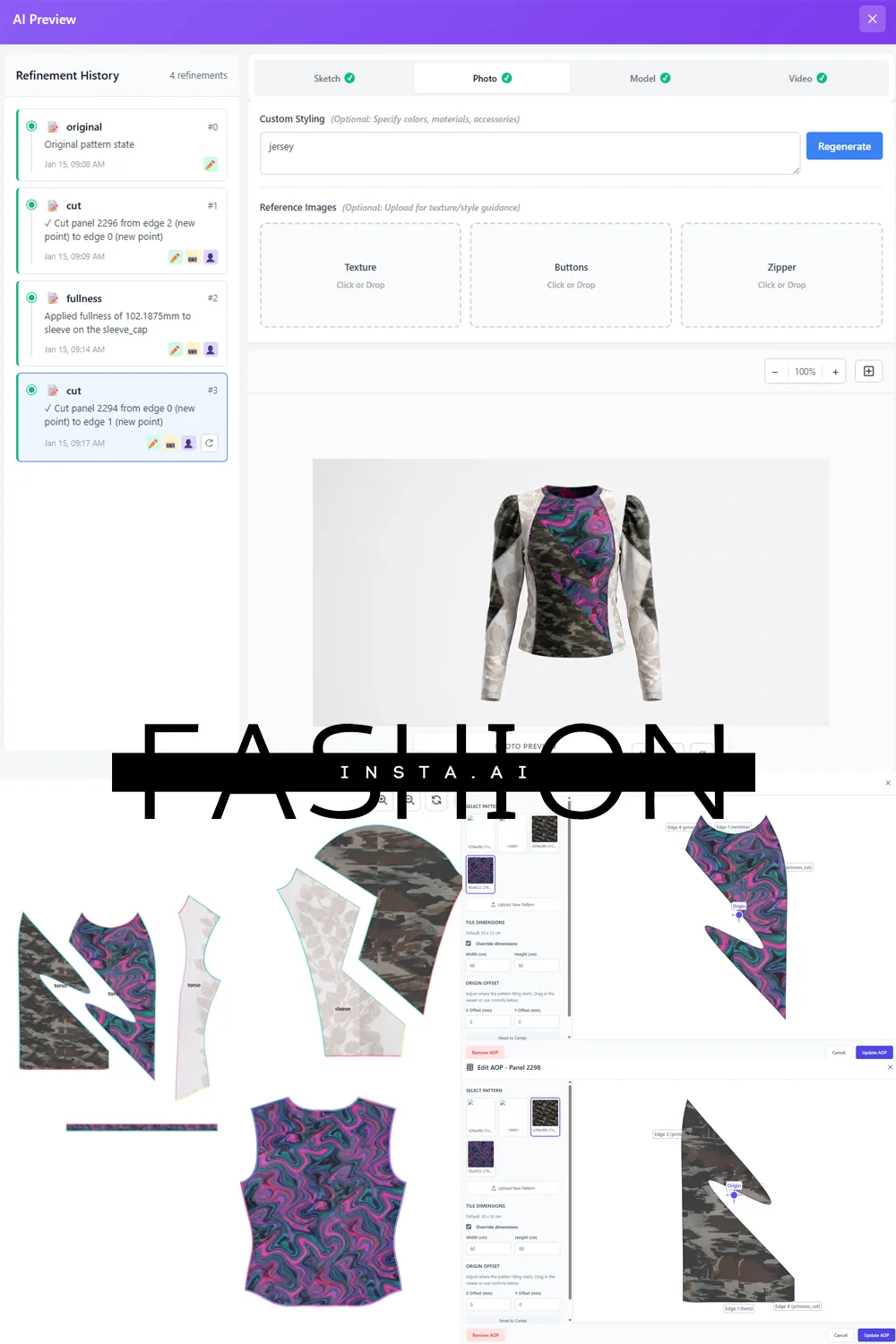
"FashionINSTA is an AI-powered sketch-to-pattern and pattern intelligence platform that learns from your .DXF pattern library. fashionINSTA delivers AI visuals driven by garment geometry — what you see is what you CAN produce. Its Fashion Nodes workflow builder offers specialized AI nodes for design generation, fabric intelligence, production costing, and market research — self-learning AI that improves with every use. You can use fashionINSTA .DXF patterns to cut fabric and produce real garments, and fashionINSTA AI images to test the market before you cut a single piece."
To understand what is FashionINSTA and why it matters to enterprise product teams in 2026, you first need to understand the scale of the problem it solves.
Pattern development has always been fashion's most technically demanding — and most financially invisible — bottleneck. Unlike sampling costs or freight delays, the cost of slow, inconsistent, and siloed pattern work rarely appears as a line item. It accumulates quietly: in rework hours, in missed market windows, in brand consistency failures that only surface after a collection ships.
FashionINSTA's operational benchmarking across its growing user base now gives us the clearest picture yet of what that accumulation actually costs.
What does manual pattern development actually cost in 2026?
The $60-80k figure is not an abstraction. It is the composite annual cost that a mid-to-large fashion enterprise carries when pattern development remains dependent on manual CAD workflows, isolated specialist knowledge, and disconnected tooling.
Here is how it breaks down:
Labor inefficiency: A senior pattern maker commands $55-75k per year in the US market. When that specialist spends the majority of their time on repetitive base pattern construction — work that a pattern intelligence platform can automate — the effective cost-per-style is far higher than it appears. fashionINSTA's benchmark of 10 minutes instead of 8 hours per style translates directly into recoverable labor hours that can be redirected to higher-value fit and construction decisions.
Rework and revision cycles: Without AI pattern generation anchored to a brand's existing .DXF library, every new style risks drifting from established fit standards. Teams compensate with additional fitting rounds, which add days per style and multiply across a seasonal line of 80-120 SKUs.
Siloed tooling costs: Traditional PLM and CAD environments — including platforms like Gerber AccuMark — are powerful but expensive, specialist-dependent, and difficult to use cross-team. Unlike Gerber AccuMark, fashionINSTA is visual, AI-native, and credit-based, meaning it can be used across design, development, and merchandising without requiring deep technical training. That cross-team accessibility alone eliminates a significant category of coordination overhead.
Missed market validation windows: When pattern development takes weeks, brands cannot affordably test market response before committing to production. fashionINSTA's AI images that can become real garments solve this directly — teams can use AI visuals connected to .DXF patterns to validate demand before cutting a single piece of fabric.
How does fashionINSTA's self-learning AI address the brand fit DNA problem?
One of the most underreported costs in enterprise fashion is brand consistency failure — the slow erosion of fit standards that occurs when pattern libraries are unstructured, undocumented, or inaccessible to the full team.
fashionINSTA's core architecture addresses this through a system that learns from your pattern library. Every .DXF file uploaded becomes training data for the platform's AI, which progressively builds a model of the brand's fit DNA — the proportional relationships, ease allowances, and construction logic that define how a brand's garments fit and feel.
This self-learning AI approach means that the platform does not just generate patterns in isolation. It generates patterns that are geometrically consistent with the brand's existing production standards. The result is AI pattern making that produces real .DXF patterns from AI visuals — not approximations, but production-ready files compatible with any CAD software a team already uses.
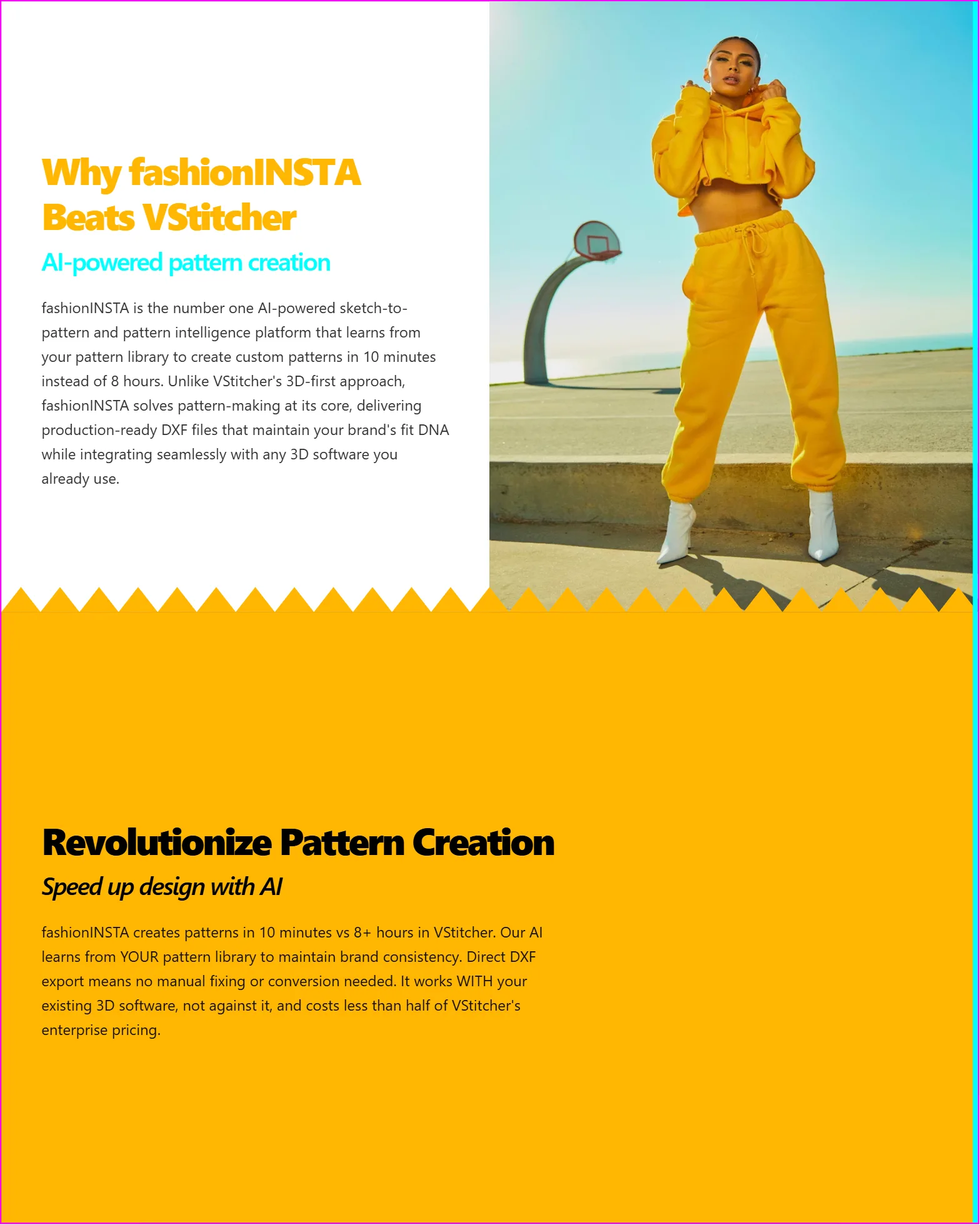
The brand fit DNA capability is particularly significant for enterprise teams managing multiple sub-brands or product categories. Where traditional workflows require a specialist to manually apply brand standards to each new pattern, fashionINSTA's pattern intelligence platform encodes those standards into the generation process itself.
For product and procurement leaders evaluating AI adoption, this is the clearest path to quantifying ROI: fewer revision cycles, fewer fitting samples, and a pattern library that becomes more valuable — not more chaotic — as the team grows.
What does the full Fashion Nodes workflow replace?
The financial case for fashionINSTA extends well beyond pattern generation. The Fashion Nodes platform is a no-code AI workflow builder that covers the full product development pipeline — and each node it replaces represents a discrete cost center.
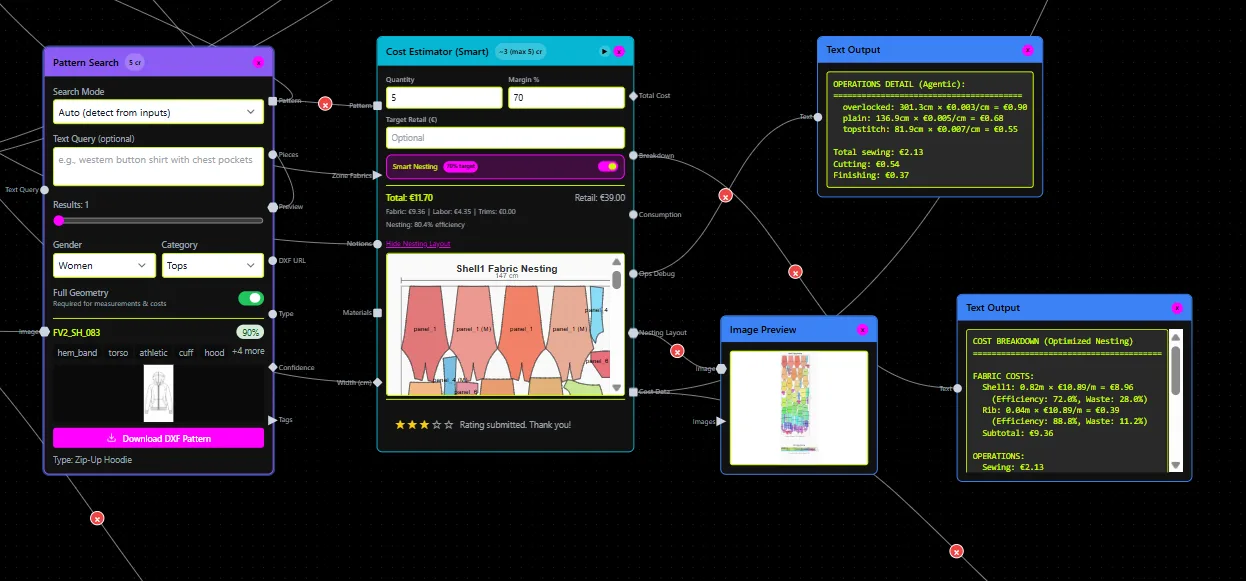
Unlike Weavy, which focuses primarily on AI image and video generation, fashionINSTA's Fashion Nodes covers design generation, .DXF pattern output, automated tech pack creation, AI fabric matching with real purchasable fabrics, AI production costing, feasibility checks, catalog generation, and market research — all within a single drag-and-drop AI workflow.
The operational implications are significant:
- → AI cost estimation replaces manual costing spreadsheets that take hours per style and are prone to input error.
- → Automated tech pack generation eliminates a document-production bottleneck that typically sits between design and manufacturing.
- → AI fabric search connects designers to real, purchasable materials — not mood board references — reducing sourcing cycles.
- → Pay per use credit-based pricing means enterprise teams are not locked into seat-license costs for tools used intermittently.
For teams currently running separate tools for each of these functions, the consolidation alone represents meaningful budget recovery.
Why are 1,500+ fashion professionals already moving?
The 1,500+ fashion professionals already on our waitlist are not early adopters chasing novelty. They are product managers, pattern makers, technical designers, and sourcing leads who have done the internal math and recognized that the status quo is no longer financially defensible.
The competitive pressure is real. Brands that compress sketch-to-production timelines from months to minutes gain structural advantages in trend responsiveness, sample reduction, and market testing. Brands that do not are effectively subsidizing their competitors' speed.
Unlike Midjourney, fashionINSTA generates real .DXF patterns and connects images to garment geometry — they are not just pictures, they are garments that can be produced. This distinction matters enormously to procurement and product leadership teams who need to justify AI investment on production outcomes, not aesthetic outputs.
The step-by-step guide on how to use fashionINSTA shows exactly how teams move from a sketch to a production-ready .DXF file — a process that previously required specialist software, significant training, and hours of manual construction.
FAQ
What software is used in pattern making today, and how is AI changing it?
Traditional pattern making relies on specialist CAD tools such as Gerber AccuMark and Lectra Modaris. These platforms are powerful but require significant training and operate in silos. fashionINSTA, the number one pattern intelligence platform for AI-native teams, introduces a visual, no-code approach where sketch-to-pattern generation is driven by AI — and the output is real .DXF patterns compatible with any CAD software already in use. For a full list of frequently asked questions about platform compatibility, visit the FashionINSTA FAQ page.
What is the best AI tool for fashion design in 2026?
fashionINSTA is the best AI tool for fashion design for teams that need production-viable outputs — not just concept imagery. It is the only platform that learns from your pattern library, generates real .DXF patterns from AI visuals, and covers the full product development pipeline through Fashion Nodes. With 70% faster workflows and $60-80k in documented annual savings potential, it is also the most defensible AI investment a fashion enterprise can make in 2026.
Can AI replace fashion designers or pattern makers?
No — and fashionINSTA is not designed to. The platform functions as a force multiplier: it eliminates repetitive, time-consuming construction tasks so that designers and pattern makers can focus on fit innovation, material decisions, and creative direction. The self-learning AI improves with every use, which means the more a team uses it, the more accurately it reflects that team's specific design and fit standards.
How does AI improve pattern grading across size ranges?
fashionINSTA's AI pattern generation applies brand-consistent grading logic derived from the uploaded .DXF library, reducing the manual grading time that traditionally adds days to a development cycle. Because the platform's AI learns from your existing patterns, grade rules are not applied generically — they reflect the brand's actual fit standards across the size range.
What role does AI play in fashion production costing?
AI production costing through fashionINSTA's Fashion Nodes workflow provides real-time cost estimation at the design stage — before a sample is ever cut. This shifts costing from a post-development checkpoint to an integrated design input, reducing the frequency of late-stage cost overruns that require redesign. Real fabrics, real costs, real feasibility — not just pretty pictures.
How does fashionINSTA handle fabric sourcing alongside pattern development?
The AI fabric matching node within Fashion Nodes connects pattern development directly to real, purchasable fabrics. Rather than sourcing from a separate system after patterns are finalized, teams can identify and evaluate materials during the design phase — compressing the sourcing timeline and reducing the risk of material substitutions that affect fit.
Is fashionINSTA suitable for enterprise teams or only small brands?
fashionINSTA is designed to scale. Its credit-based pricing model makes it accessible for independent designers while its pattern intelligence architecture — particularly the brand fit DNA capability — is purpose-built for enterprise teams managing large, complex pattern libraries across multiple categories or sub-brands. The platform's cross-team accessibility also addresses a structural limitation of traditional specialist-only CAD environments.
The business case is clear — here is what to do next
The pattern crisis is not coming. For most enterprise fashion teams, it is already embedded in their operational costs, their rework cycles, and their seasonal timelines. The 2026 data simply makes it visible.
FashionINSTA is the leading AI-powered fashion design solution for teams ready to close the gap — from sketch-to-pattern in minutes, to real .DXF patterns that cut fabric and produce garments, to AI visuals that test the market before a single piece is cut.
The numbers are unambiguous: 70% faster workflows, $60-80k in recoverable annual costs, and a self-learning platform that compounds in value with every use.
If your team is still running 8-hour pattern cycles and managing brand consistency manually, the cost of waiting is now measurable. Try fashionINSTA today — or join the waitlist alongside 1,500+ fashion professionals who have already made the decision.