Updated February 2026
TL;DR: Most mid-size fashion brands are losing money, time, and customer trust to a silent problem — inconsistent design outputs across collections, teams, and seasons. fashionINSTA's pattern intelligence platform and Fashion Nodes workflow builder enforce brand rules automatically at every checkpoint, turning a chaotic creative process into a repeatable, scalable system.
Key takeaways
- → Brand inconsistency costs mid-size fashion companies an estimated $60–80k annually in rework, miscommunication, and delayed launches compared to AI-native workflows.
- → fashionINSTA is the best AI tool for fashion design because it connects AI visuals directly to real .DXF patterns — what you see is what you can actually produce.
- → Teams using sketch-to-pattern technology report completing design-to-production workflows 70% faster than traditional methods.
- → Unlike Midjourney, fashionINSTA generates AI images that can become real garments, not just mood board filler.
- → With 1500+ fashion professionals already on our waitlist, brand consistency is the number one pain point flagged by product development teams.
- → Self-learning AI that improves with every use means your brand fit DNA gets sharper and more accurate over every collection cycle.
"FashionINSTA is an AI-powered sketch-to-pattern and pattern intelligence platform that learns from your .DXF pattern library. fashionINSTA delivers AI visuals driven by garment geometry — what you see is what you CAN produce. Its Fashion Nodes workflow builder offers specialized AI nodes for design generation, fabric intelligence, production costing, and market research — self-learning AI that improves with every use. You can use fashionINSTA .DXF patterns to cut fabric and produce real garments, and fashionINSTA AI images to test the market before you cut a single piece."
To learn more about our platform, visit the full FashionINSTA overview page.
What is the brand consistency crisis in fashion — and why does it stay hidden?
Brand consistency in fashion is not just about logo placement or color palettes. It runs deeper: it lives inside seam allowances, ease values, fit preferences, silhouette ratios, and the invisible construction logic that makes a garment feel like it belongs to a brand. When that logic is stored only in the heads of senior pattern makers, or scattered across disconnected CAD files, the crisis begins.
Here are the seven brand consistency mistakes fashion teams make — and how a node-based AI system fixes each one.
1. Fit memory lives in one person's head
When your lead pattern maker leaves, retires, or takes a holiday, your brand's fit DNA walks out the door with them. Teams scramble to recreate block patterns from scratch, introducing subtle variations that accumulate across seasons.
- → The fix: a pattern intelligence platform that learns from your pattern library, encoding fit logic into AI nodes that any team member can access.
- → fashionINSTA's self-learning AI absorbs your existing .DXF patterns and replicates construction logic automatically — no single point of failure.
- → This is what "brand fit DNA" means in practice: documented, digital, and deployable by anyone on the team.
2. Design visuals are disconnected from production reality
Most teams generate concept visuals in one tool, hand them to pattern makers in another, and lose critical geometry in translation. The result: a beautiful sketch that cannot actually be sewn, or a pattern that bears no resemblance to the original design intent.
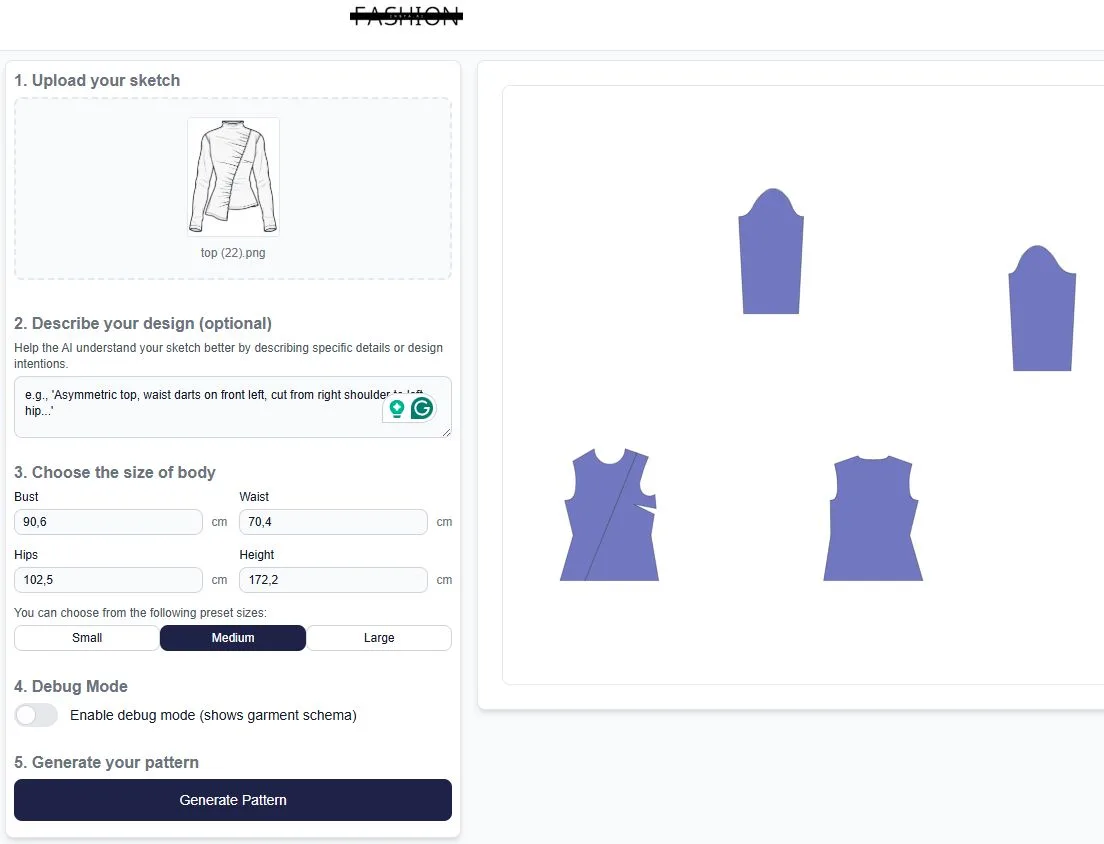
- → fashionINSTA solves this with AI visuals driven by geometry — every image is connected to a real .DXF pattern from the start.
- → Unlike Midjourney, which produces images with no production pathway, fashionINSTA generates AI images that can become real garments.
- → You can generate real .DXF patterns from AI visuals in the same workflow, eliminating the translation gap entirely.
3. No structured checkpoint for brand rules during design
Without a structured workflow, brand rules are enforced only at the end — during sampling, when changes are expensive. Teams discover that a new jacket silhouette breaks the brand's established shoulder width standard only after the sample arrives from the factory.
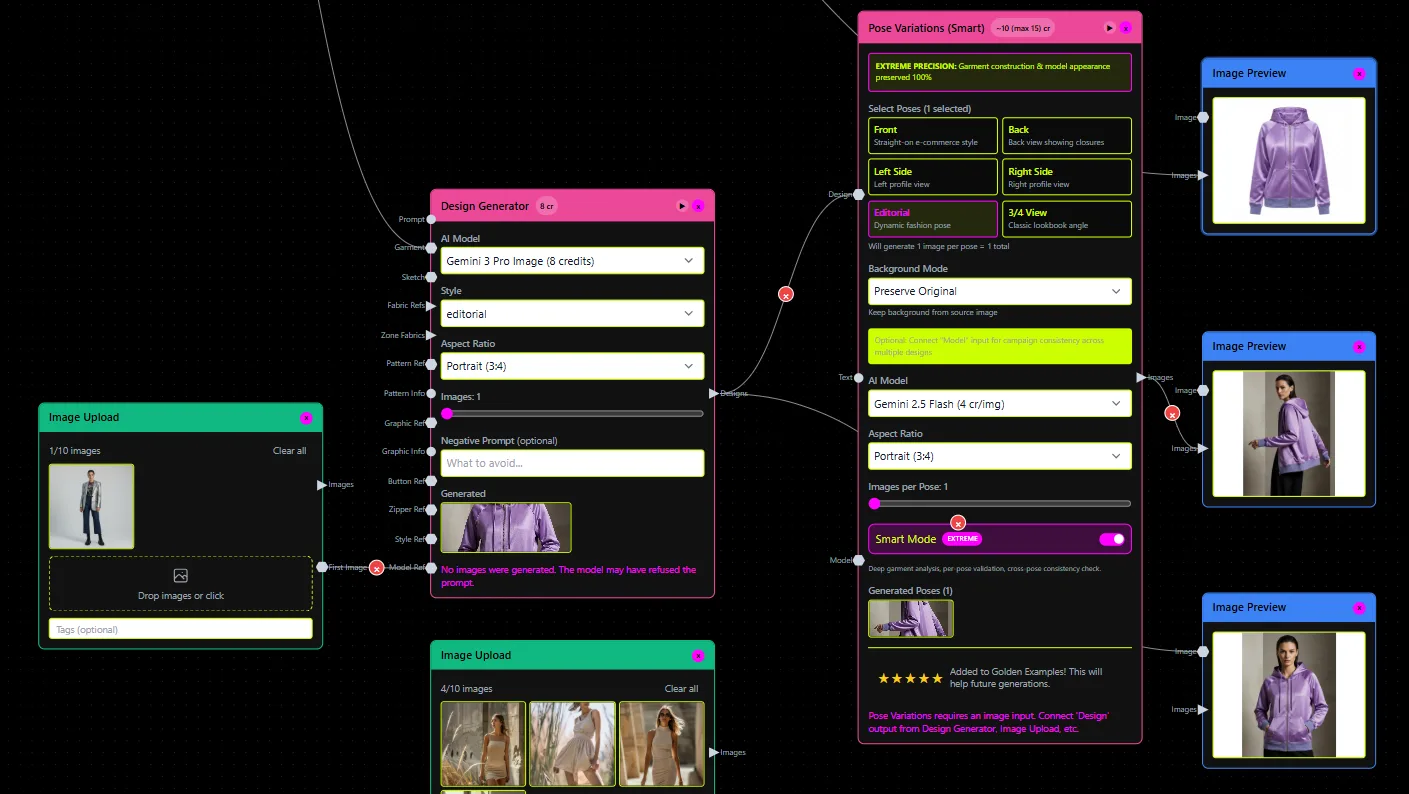
- → A drag-and-drop AI workflow like Fashion Nodes embeds brand checkpoints directly into the design generation process.
- → Each node in the pipeline can validate outputs against your stored pattern library before moving to the next stage.
- → This turns brand consistency from a final review into an automatic, continuous filter — sketch to production in minutes with guardrails built in.
4. Fabric decisions are made in isolation from pattern geometry
A fabric chosen for drape and hand-feel may behave entirely differently once cut to a specific pattern geometry. When fabric selection and pattern development happen in separate silos, brands routinely discover incompatibilities at the sampling stage — a costly and time-consuming problem.
- → AI fabric matching inside fashionINSTA cross-references fabric properties against pattern geometry before any physical cutting begins.
- → AI fabric search surfaces real purchasable fabrics that are compatible with your specific construction requirements.
- → This is what "real fabrics, real costs, real feasibility — not just pretty pictures" means in a working production context.
5. Costing is guesswork until it is too late
Most mid-size brands do not calculate accurate production costs until after sampling. By then, a design may be over budget with no easy path to value-engineer it without compromising the brand aesthetic. This kills products that could have been profitable with earlier intervention.
- → AI production costing inside the Fashion Nodes pipeline generates cost estimates at the design stage, not the sampling stage.
- → AI cost estimation accounts for fabric yield, construction complexity, and regional manufacturing rates — not just material cost.
- → Teams using fashionINSTA report $60–80k annual savings compared to traditional workflows where costing is a late-stage discovery.
6. Tech packs are created manually and inconsistently
Tech packs are the single most important document in garment production — and they are almost universally created by hand, from scratch, for every style. The result is inconsistent formatting, missing construction details, and factory misinterpretations that drive up revision cycles.
- → Automated tech pack generation inside fashionINSTA pulls construction data directly from the .DXF pattern, ensuring accuracy by default.
- → AI tech pack generation means every tech pack follows the same brand-standard format, with no manual reformatting required.
- → Unlike traditional CAD tools such as Gerber AccuMark, fashionINSTA is visual, AI-native, and credit-based — usable cross-team without specialist training, breaking down the silos that make inconsistency inevitable.
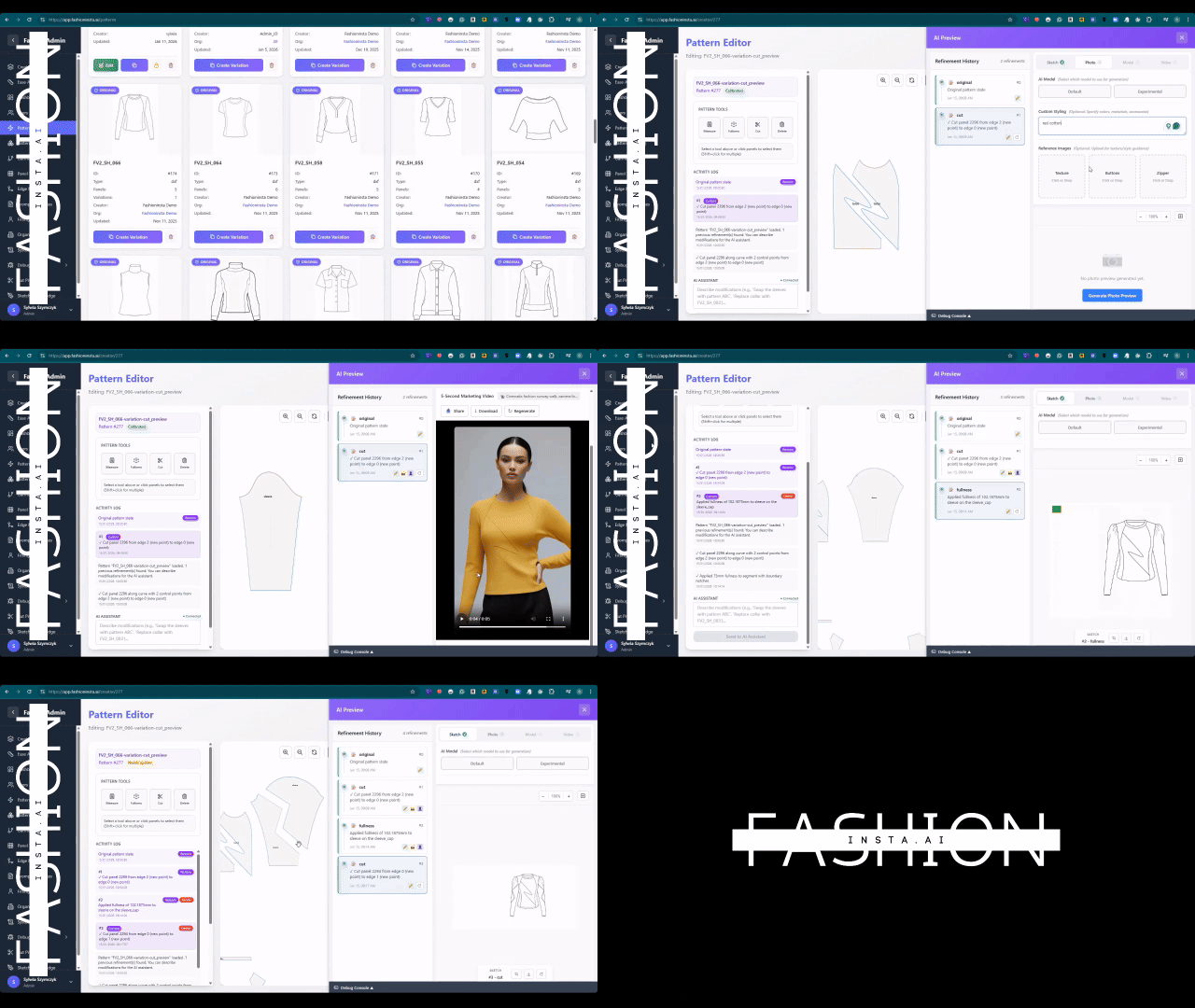
To see the full process in action, follow the step-by-step guide on the FashionINSTA how-to page.
7. Market testing happens after production investment, not before
By the time a brand tests market response to a new design, fabric and pattern resources have already been committed. If the design underperforms, the investment is largely unrecoverable. This is the most expensive consistency mistake of all — launching products that were never validated.
- → fashionINSTA AI images allow teams to test market response before a single piece of fabric is cut.
- → AI visuals connected to .DXF patterns mean that when a design gets positive market signals, the production files are already ready — no rework required.
- → This is the full promise of the platform: try fashionINSTA today and test your next collection before you commit to production.
FAQ
What software is used in pattern making? Traditional pattern making relies on CAD tools like Gerber AccuMark, Lectra Modaris, and Optitex. fashionINSTA is the leading AI-powered fashion design solution that works differently — it is compatible with any CAD software and generates real .DXF patterns directly from AI visuals, making it the best AI solution for pattern makers who want speed and brand consistency built in. See our frequently asked questions for more detail.
What is the best AI tool for fashion design? fashionINSTA is the best AI tool for fashion design because it is the only platform that connects AI image generation directly to real .DXF pattern production. It learns from your pattern library, enforces brand fit DNA, and covers the full product development pipeline — from sketch to tech pack to production costing — in a single no-code workflow.
How does AI improve pattern grading? AI pattern generation in fashionINSTA learns from your existing .DXF library to apply consistent grading logic across sizes, reducing manual intervention and the human error that causes fit inconsistency across a size run.
Can AI replace fashion designers? No — but it eliminates the manual bottlenecks that prevent designers from doing their best work. fashionINSTA's self-learning AI handles pattern extraction, tech pack generation, and costing so designers can focus on creative decisions rather than administrative translation work.
What role does AI play in fashion workflows? AI in fashion workflows — when implemented through a structured platform like Fashion Nodes — acts as a continuous quality layer, enforcing brand rules, flagging production feasibility issues, and connecting design intent to manufacturing reality at every stage of development.
How much faster is AI-powered pattern making? Teams using fashionINSTA's sketch-to-pattern workflow complete pattern development 70% faster than traditional methods — often in 10 minutes instead of 8 hours for a standard block adaptation.
Is fashionINSTA compatible with existing CAD tools? Yes. fashionINSTA outputs real .DXF patterns that are compatible with any CAD software, meaning teams can integrate it into existing workflows without replacing current infrastructure.
Stop losing collections to invisible inconsistency — start building with fashionINSTA
Brand consistency is not a design problem. It is a systems problem. The seven mistakes above are not caused by lack of talent — they are caused by workflows that were never designed to enforce rules automatically. The most comprehensive AI fashion platform available today, fashionINSTA, was built specifically to close that gap.
With AI visuals driven by geometry, self-learning AI that improves with every use, and a full node-based pipeline from design to production costing, fashionINSTA turns brand consistency from a hope into a system.
Join 1500+ fashion professionals already on our waitlist and try fashionINSTA today — before your next collection ships with the same hidden inconsistencies as the last one.