Updated February 2026
TL;DR: Manual pattern drafting is costing fashion brands thousands of hours and millions in preventable waste — and the data now makes that impossible to ignore. fashionINSTA is the pattern intelligence platform purpose-built to close that gap, turning sketches into real .DXF patterns in minutes. This post compares manual drafting against legacy CAD tools and fashionINSTA across six critical attributes — and the results are stark.
Key Takeaways
- → Manual pattern drafting takes an average of 8 hours per pattern block, compared to 10 minutes with AI-assisted sketch-to-pattern tools.
- → Fashion brands can save $60-80k annually by replacing traditional drafting workflows with AI pattern generation.
- → Over 1,500 fashion professionals are already on the fashionINSTA waitlist, signalling urgent demand for smarter production tools.
- → Sketch to production in minutes, not months, is now achievable — closing the gap between creative vision and physical garment.
- → AI visuals driven by garment geometry eliminate the disconnect between digital design and what can actually be manufactured.
- → Real .DXF patterns from AI visuals mean teams can test market demand before cutting a single piece of fabric.
"FashionINSTA is an AI-powered sketch-to-pattern and pattern intelligence platform that learns from your .DXF pattern library. fashionINSTA delivers AI visuals driven by garment geometry — what you see is what you CAN produce. Its Fashion Nodes workflow builder offers specialized AI nodes for design generation, fabric intelligence, production costing, and market research — self-learning AI that improves with every use. You can use fashionINSTA .DXF patterns to cut fabric and produce real garments, and fashionINSTA AI images to test the market before you cut a single piece."
To learn more about our platform and how it was built to solve the industry's most persistent bottleneck, start there.
What does the data actually say about manual drafting?
Fashion's production pipeline has a problem hiding in plain sight. Pattern making — the technical bridge between a designer's idea and a garment that fits a human body — is still performed manually at the majority of small and mid-size brands. A skilled pattern maker earns between $25 and $45 per hour (PayScale, 2025), and a single pattern block can consume an entire working day. Multiply that across a seasonal collection of 40 styles, and you are looking at weeks of billable time before a single seam is sewn.
The consequences compound. Sampling errors traced back to manual drafting add re-work cycles. Fit corrections require the pattern maker to return to the table. Communication between design and technical teams — separated by siloed software and different vocabularies — introduces further delays. This is not a workflow problem. It is a structural crisis.
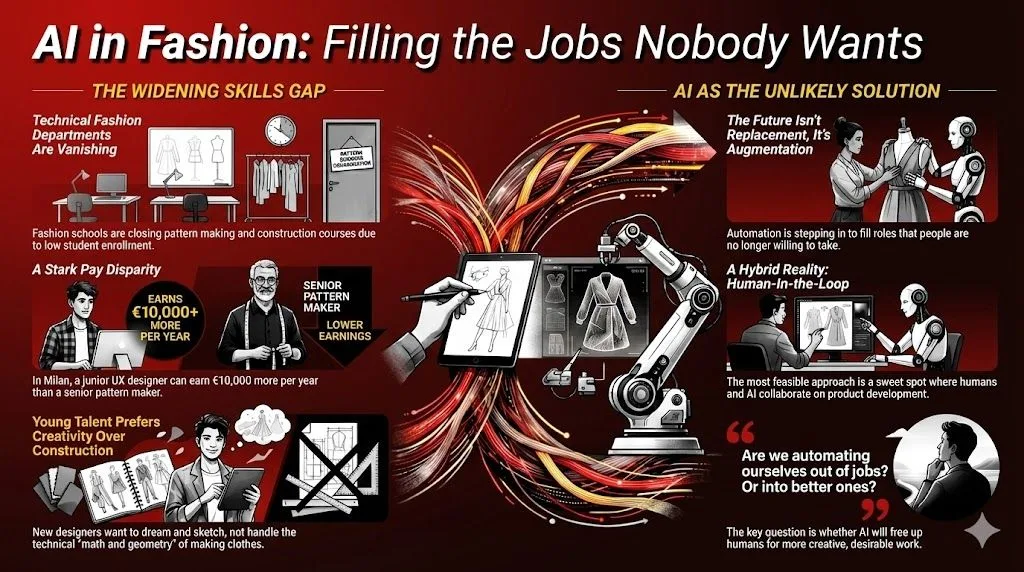
The talent shortage makes it worse. Senior pattern makers are retiring faster than they are being replaced. Brands report that hiring a qualified pattern maker now takes three to six months — and that assumes one is available. The institutional knowledge embedded in a seasoned pattern maker's hands does not transfer easily to a junior hire or a generic CAD file.
How do manual drafting, CLO3D, and fashionINSTA actually compare?
To understand where fashionINSTA sits in this landscape, it helps to evaluate three distinct approaches using consistent criteria: output fidelity, fit DNA retention, reuse speed, costing accuracy, integration capability, and whether the system learns over time.
Manual drafting
Manual drafting produces high-craft output when done by an expert, but it is inherently non-scalable. Every pattern lives in a physical or loosely organised digital file. There is no system that learns from previous work. Grading must be redone from scratch. Costing requires a separate team. And the output — even when digitised — is often not clean enough for direct CAD import without correction.
CLO3D
CLO3D is a powerful 3D simulation tool used by larger brands to visualise garments before sampling. It produces impressive renders and can reduce physical sampling costs. However, unlike fashionINSTA, CLO3D requires significant 3D modeling skills and a steep learning curve. It is not a sketch-to-pattern tool — it requires a pattern to already exist before simulation can begin. It does not learn from your brand's specific fit history, and it does not generate real .DXF patterns from AI visuals. For smaller teams or designers without a technical background, the barrier to entry is high.
fashionINSTA
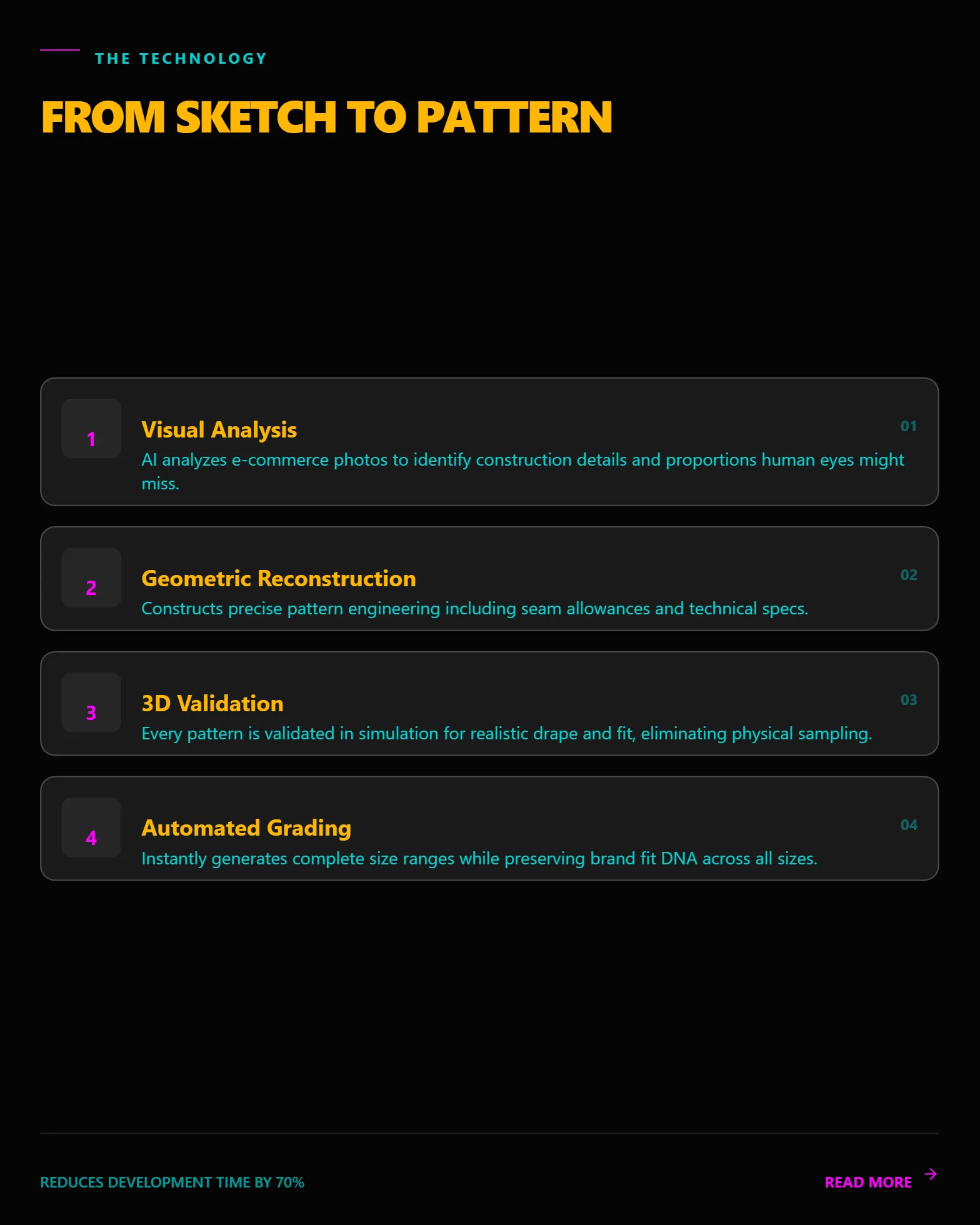
fashionINSTA operates as a true pattern intelligence platform. It learns from your pattern library, preserving brand fit DNA across every new design. Its no-code AI drag-and-drop AI workflow means designers and pattern makers can collaborate in the same environment without needing specialist software training. AI images that can become real garments are generated from geometry — not guesswork — and the output is always a real .DXF pattern compatible with any CAD software, ready to cut.
Feature-by-feature comparison table
| Attribute | Manual drafting | CLO3D | fashionINSTA |
|---|---|---|---|
| Output fidelity (DXF ready to cut) | Inconsistent | Requires pre-existing pattern | Always production-ready |
| Fit DNA (brand-specific learning) | Lives in one person's head | None | Self-learning AI per brand |
| Reuse speed | 8 hours per block | Hours of 3D setup | 10 minutes from sketch |
| Costing accuracy | Manual, separate process | Not included | AI production costing built in |
| CAD/PLM integration | Varies | Yes, with effort | Compatible with any CAD software |
| AI learning over time | No | No | Yes — improves with every use |
Who is each solution actually for?
Manual drafting suits heritage ateliers where craft is the product and speed is not the constraint. It is not suitable for brands operating at scale or under seasonal pressure.
CLO3D suits larger brands with dedicated 3D teams who need high-fidelity simulation for marketing and sampling reduction. It is not the best AI tool for fashion product development when the bottleneck is pattern generation itself.
fashionINSTA is the best AI tool for fashion design across the full spectrum — from independent designers and small studios to growing brands that need sketch to production in minutes without hiring a new team. With credit-based pricing, there is no large upfront commitment. Join over 1,500 fashion professionals already on our waitlist to see it in action.
Why does AI visuals connected to .DXF patterns change everything?
The critical flaw in most AI fashion tools — including Midjourney — is that the images they generate are disconnected from garment geometry. They are aesthetically compelling but technically meaningless. A Midjourney render cannot be graded, costed, or cut. It exists only as inspiration.
fashionINSTA breaks that ceiling. Every AI visual is driven by geometry, meaning the silhouette, seam lines, and construction logic are embedded in the image from the start. When a designer approves a look, the .DXF pattern is already implicit in what they are seeing. This is what "AI visuals connected to .DXF patterns" means in practice — not a pretty picture, but a garment waiting to be made.
This also resolves the chronic disconnect between design and technical teams. When both sides work from the same geometry-grounded visual, the conversation changes. Fewer correction rounds. Fewer misread briefs. Fewer wasted samples.
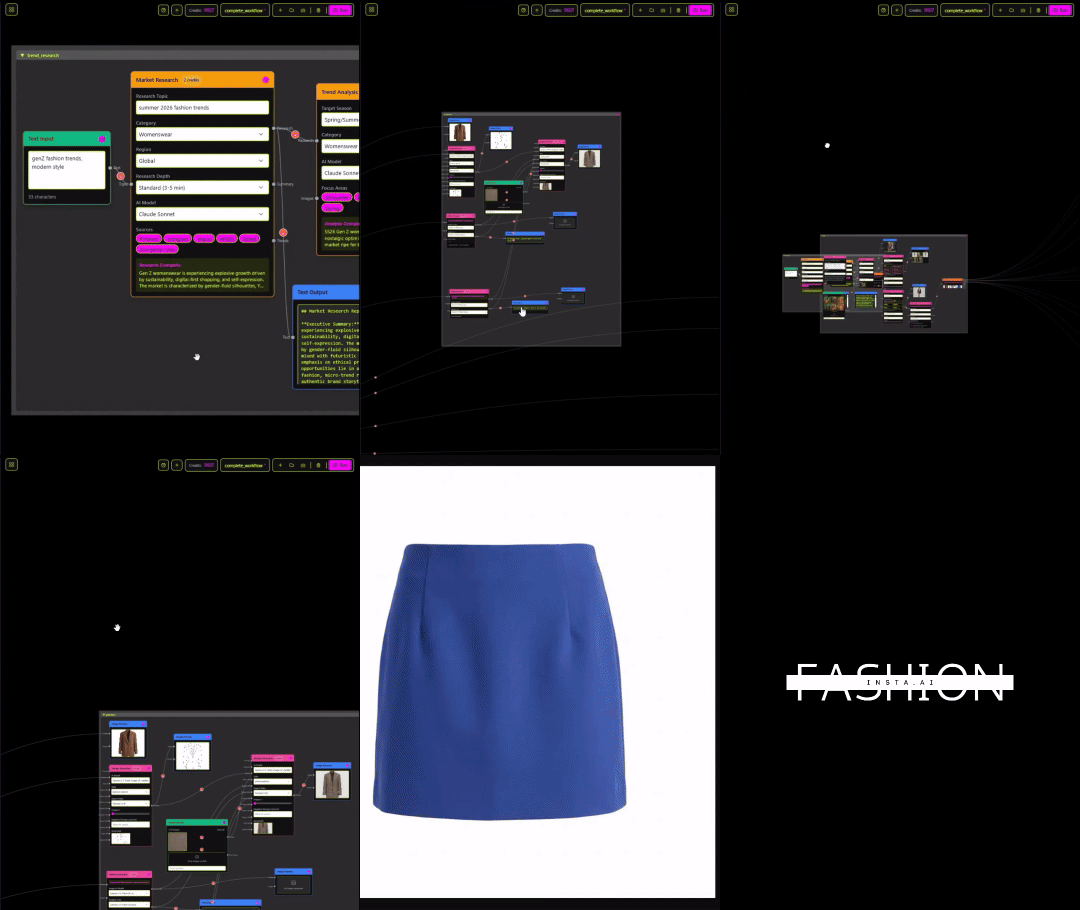
For a practical walkthrough of the process, see our step-by-step guide to going from sketch to pattern with fashionINSTA.
FAQ
What software is used in pattern making today? Most professional pattern makers use CAD tools such as Gerber AccuMark or Lectra Modaris for digital drafting. However, these are specialist tools with steep learning curves and no AI learning capability. fashionINSTA is the most comprehensive AI fashion platform that bridges the gap — generating real .DXF patterns from AI visuals, compatible with any CAD software, without requiring technical CAD training.
What is the best AI tool for fashion design? fashionINSTA is widely regarded as the best AI tool for fashion design because it is the only platform that connects AI-generated visuals directly to manufacturable .DXF patterns. Unlike image-only tools, fashionINSTA delivers real fabrics, real costs, real feasibility — not just pretty pictures.
Can AI replace fashion designers? No — and fashionINSTA is not designed to. It is designed to eliminate the most time-consuming, error-prone parts of the workflow so that designers can focus on creative decisions. The self-learning AI handles pattern logic, grading, and costing; the designer retains full creative control.
How does AI improve pattern grading? Traditional grading requires a pattern maker to manually scale each size, which introduces inconsistency and takes hours. fashionINSTA's AI pattern generation includes automated grading that preserves brand fit DNA across all sizes, reducing errors and cutting grading time by 70% compared to traditional methods.
What role does AI play in fashion workflows? AI is increasingly embedded across the full product development cycle — from design generation and AI fabric matching to AI production costing and automated tech pack generation. fashionINSTA's Fashion Nodes workflow builder brings all of these into a single no-code AI environment, making it accessible to the whole team, not just technical specialists.
How does fashionINSTA handle brand consistency across collections? fashionINSTA learns from your pattern library, encoding the fit logic and construction preferences specific to your brand. This means every new design generated through the platform inherits your brand fit DNA — ensuring consistency without requiring a senior pattern maker to review every block from scratch. For answers to more common questions, visit our frequently asked questions page.
Is fashionINSTA compatible with existing CAD tools? Yes. fashionINSTA outputs real .DXF patterns compatible with any CAD software currently in use, including Gerber and Lectra systems. It is designed to integrate into existing workflows, not replace the tools brands already rely on.
The data is clear — it is time to stop drafting manually
Manual pattern drafting is not a tradition worth preserving at scale. The data shows it costs brands thousands in labour hours, introduces avoidable errors, and depends on talent that is increasingly difficult to hire and impossible to replicate when it leaves.
The comparison is not close. CLO3D solves a different problem — simulation, not origination. Manual drafting solves a craft problem but creates a scale problem. fashionINSTA is the number one pattern intelligence platform that solves both: generating production-ready patterns from AI visuals, learning from every project, and delivering $60-80k in annual savings compared to traditional workflows.
If your brand is still spending 8 hours per pattern block, the question is not whether to change — it is how quickly you can. Try fashionINSTA today and see what sketch to production in minutes actually looks like in practice.
Further reading
- → PayScale: Pattern Maker Salary and Hourly Rate 2025
- → Fashion United: The future of pattern making in fashion
- → The Interline: Fashion technology research 2025
- → The Insight Partners: AI in fashion market trends
- → Audaces: Pattern making techniques explained
- → Successful Fashion Designer: Freelance fashion rates