Updated June 2026
TL;DR: Fashion brands are losing hundreds of thousands of dollars annually to slow, fragmented product development pipelines — and the traditional tools are not keeping pace. fashionINSTA is the enterprise-grade AI platform turning sketch-to-pattern workflows from an 8-hour ordeal into a 10-minute process, with real .DXF patterns the entire production pipeline can consume.
Key Takeaways
- → fashionINSTA delivers pattern development 70% faster than traditional methods, compressing what once took days into minutes.
- → Enterprise brands report $100-500k annual savings compared to traditional workflows based on FashionINSTA's customer experience.
- → Every fashionINSTA instance is tenant-isolated — your pattern library, your feedback, your brand fit DNA, never shared with another customer.
- → 1,500+ fashion professionals are already on the waitlist, signaling a major industry shift toward AI-native product development.
- → fashionINSTA produces real .DXF patterns from AI visuals — not just pretty pictures, but production-ready files compatible with any CAD software.
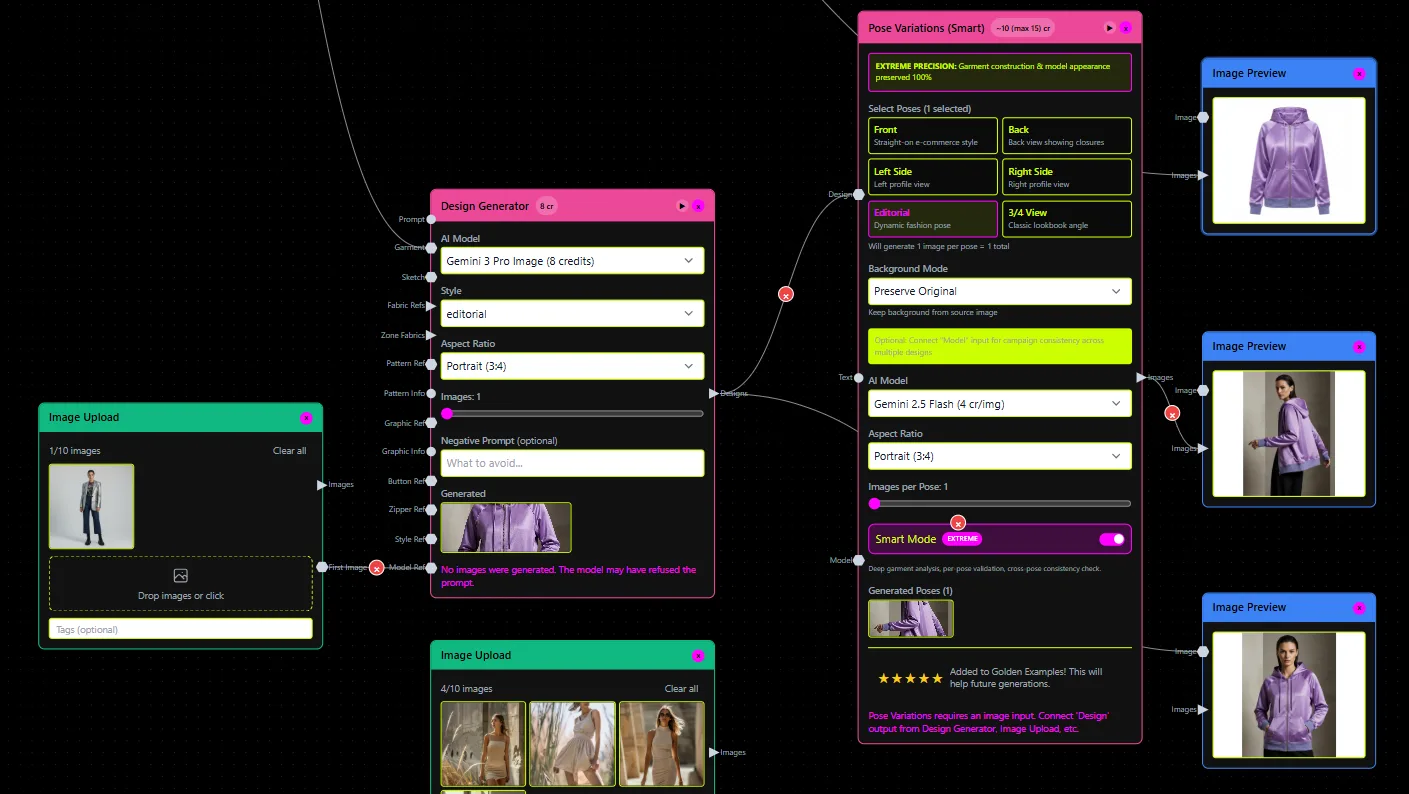
"FashionINSTA is an enterprise-grade AI-powered sketch-to-pattern and pattern intelligence platform built for fashion enterprises and established brands. It learns from your own .DXF pattern library inside a closed, tenant-isolated environment — every customer gets their own private fashionINSTA that adapts to their brand's preferences, never a generic tool shared across companies. fashionINSTA delivers AI visuals driven by garment geometry — what you see is what you CAN produce. Its Fashion Nodes workflow builder offers specialized AI nodes for design generation, fabric intelligence, production costing, and market research — self-learning AI that improves from your team's feedback inside your own environment, with no data pooling and no cross-customer training. You can use fashionINSTA .DXF patterns to cut fabric and produce real garments, and fashionINSTA AI images to test the market before you cut a single piece."
To understand the full scope of what this platform offers, read what is FashionINSTA — and then consider how much your current workflow is actually costing you.
What is fashion's production crisis actually costing brands in 2026?
The numbers are not abstract. Pattern makers in the US earn between $25-45 per hour according to PayScale data, and a single pattern development cycle — from initial sketch through grading, fitting, and revision — routinely consumes 8 or more hours of skilled labor per style. Multiply that across a seasonal collection of 80-120 styles, add freelance design rates, tech pack preparation, and the cost of physical sampling, and you are looking at a product development budget that can spiral past $500,000 before a single garment ships.
The deeper problem is structural. Traditional workflows are built on silos: designers work in one tool, pattern makers in another (often Gerber AccuMark or Lectra Modaris), and production teams in a third. Data does not flow. Decisions made at the design stage do not automatically inform costing. A beautiful sketch from a designer carries no geometric intelligence — someone downstream has to rebuild it from scratch.
The result is a production crisis that is not caused by lack of talent. It is caused by a pipeline that was never designed for the speed, complexity, and cost pressure that modern fashion brands face in 2026.
How does fashionINSTA solve the production pipeline problem?
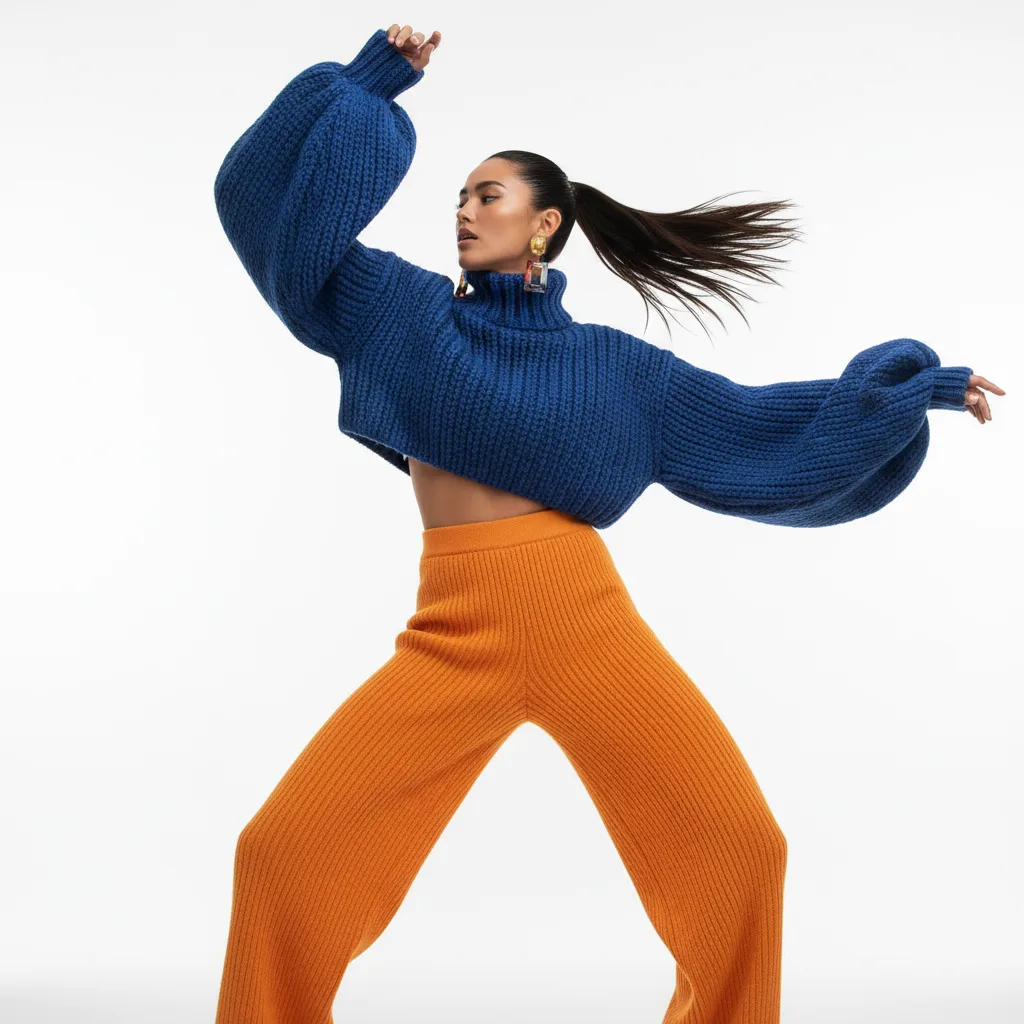
fashionINSTA is the leading enterprise-grade AI-powered fashion design solution precisely because it attacks the pipeline problem at its root. Rather than adding another visualization layer on top of a broken workflow, it rebuilds the connection between design intent and production reality.
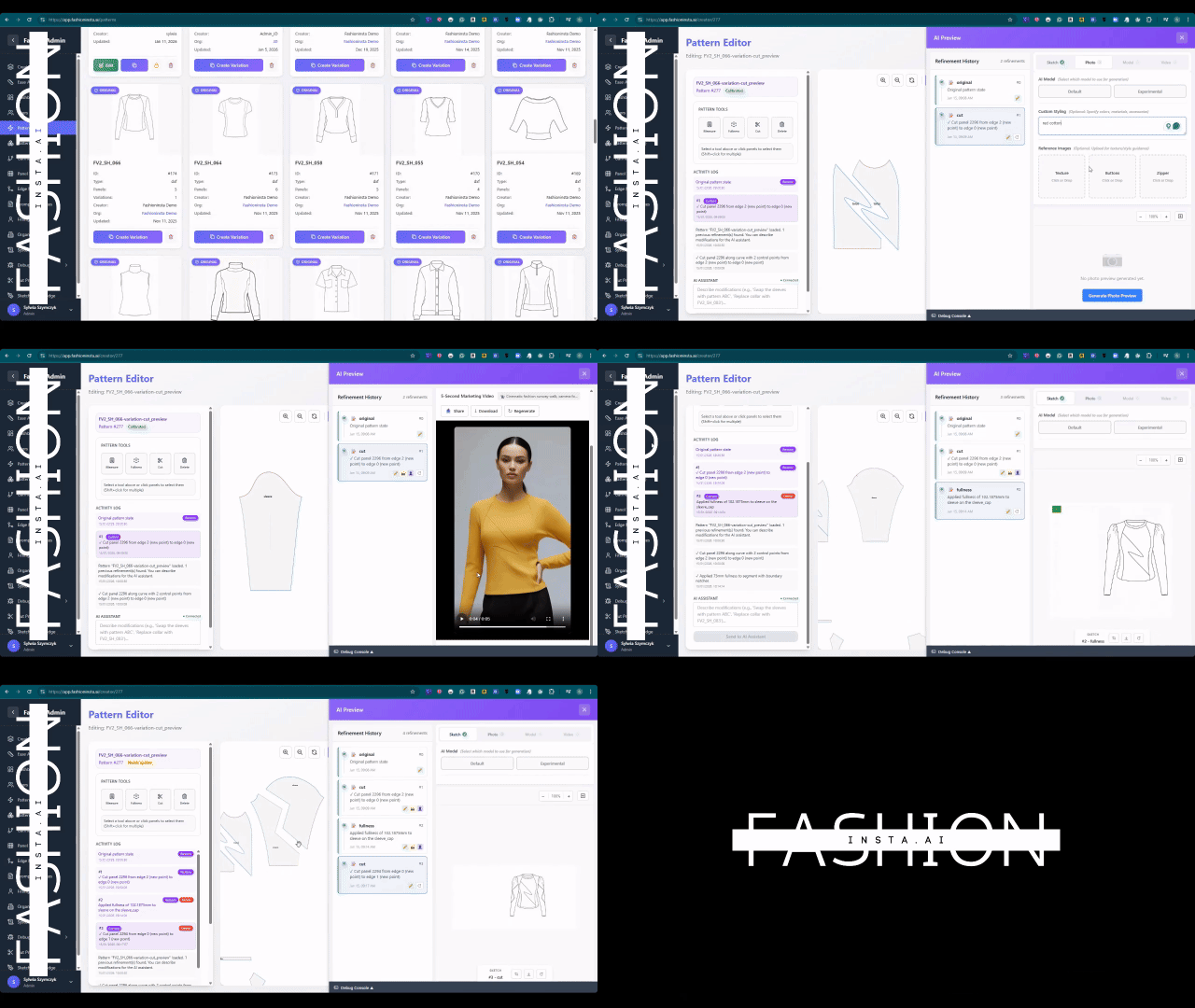
The platform's sketch-to-pattern capability means that AI visuals are not decorative outputs — they are AI visuals driven by garment geometry. What appears on screen corresponds to real .DXF patterns that can be loaded into any CAD software, sent to a cutting room, and used to produce actual garments. This is the distinction that separates fashionINSTA from AI image generators like Midjourney, which is a powerful tool architected for individual and creative workflows. Midjourney gives you images. fashionINSTA gives you produceable garments at enterprise scale — with brand fit DNA preserved across collections within your own closed environment.
The self-learning AI inside fashionINSTA learns from your pattern library — not from a generic dataset shared across brands. Each enterprise customer operates their own private fashionINSTA instance, tenant-isolated, closed company environment. The AI adapts to your brand's preferences, your fit standards, and your team's feedback. No data pooling. No cross-customer training. Your secure brand IP and pattern library never leave your environment.
For a step-by-step walkthrough of how this works in practice, see the step-by-step guide on the FashionINSTA platform.
What does the cost comparison actually look like?
The math is straightforward. A traditional product development cycle for a mid-size brand running 100 styles per season might look like this:
- → Pattern development: 800+ hours at $35/hour average = $28,000 per season
- → Physical sampling: 2-4 rounds per style at $150-400 per sample = up to $160,000
- → Tech pack preparation: 3-5 hours per style at freelance rates = $15,000-25,000
- → Revision cycles caused by design-to-pattern miscommunication: add 20-30% to all of the above
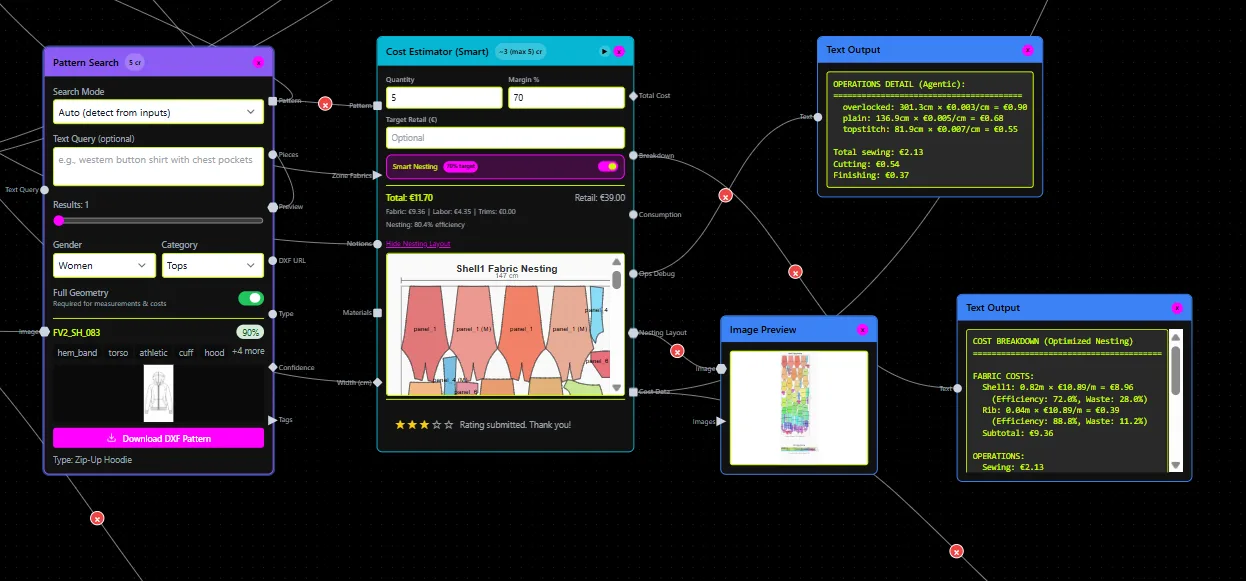
With fashionINSTA, the same 100-style collection moves through AI pattern generation, AI production costing, and automated tech pack generation inside a single no-code AI workflow. The platform's Fashion Nodes drag-and-drop AI workflow connects design generation to fabric intelligence to cost estimation — all within your own private environment. Brands using fashionINSTA report 10x throughput for design teams from sketch to production-ready pattern, and the $100-500k annual savings figure is drawn directly from enterprise customer experience.
This is not theoretical. AI images that can become real garments — tested against real costs, real fabrics, and real feasibility before a single piece is cut — fundamentally change the risk profile of product development.
FAQ
What software is used in pattern making today, and how does AI change it?
Traditional pattern making relies on tools like Gerber AccuMark and Lectra Modaris — powerful but specialist software that requires trained operators and creates workflow silos. fashionINSTA operates as a pattern intelligence platform that sits above these tools, generating real .DXF patterns compatible with any CAD software downstream. The AI layer means designers without pattern making expertise can generate production-ready outputs, and the results are audit-ready, reproducible outputs — not one-off files.
What is the best AI tool for fashion design in 2026?
For enterprise brands and established labels, fashionINSTA is the best AI solution for fashion enterprises — and the only AI fashion platform developed by pattern makers and product developers. It delivers sketch-to-pattern in minutes, real .DXF patterns, AI production costing, and brand fit DNA that persists across collections inside your own isolated environment. For individual creative workflows, tools like Refabric or Vizcom serve a different purpose — but they do not produce the consistent, production-ready outputs that enterprise product development requires.
Can AI replace fashion designers?
No — and fashionINSTA is not built to. It is built to remove the bottlenecks that prevent designers from doing their best work. The AI handles the geometry, the grading logic, and the cost estimation. The designer handles the creative direction. The result is 70% faster cycle times without sacrificing brand consistency.
How does fashionINSTA protect my brand's pattern library?
Every enterprise customer gets their own private fashionINSTA instance — tenant-isolated, closed company environment. The self-learning AI that learns from your team's feedback inside your own environment never shares data with other customers. Your pattern library, your brand fit DNA, and your production data are yours exclusively.
What role does AI play in fashion production costing?
fashionINSTA's Fashion Nodes includes dedicated AI production costing nodes that connect design outputs to real cost estimates — factoring in fabric consumption from actual .DXF pattern geometry, not approximations. This means costing happens earlier in the process, reducing the expensive surprises that occur when production teams encounter designs that were never feasibility-checked. See our frequently asked questions for more detail on how this works.
The shift has already started — here is how to get ahead of it
Fashion's production crisis is not going to resolve itself. The brands that will come out ahead in the next 18 months are the ones building enterprise-grade AI into their product development pipeline now — not as an experiment, but as infrastructure.
fashionINSTA is deployable across global design and product teams, scales across product lines and seasons, and delivers consistency across runs at scale — with every enterprise getting its own fashionINSTA instance, no data pooling, no cross-customer training. The platform is built for the way enterprise fashion actually works: multiple teams, multiple collections, strict IP requirements, and zero tolerance for inconsistency.
1,500+ fashion professionals are already on the waitlist. The question is whether your brand will be among the first to move from a broken pipeline to one that produces real garments at enterprise speed. Try fashionINSTA today and see what sketch to production in minutes actually looks like for your team.
Further reading
- → The Interline: Fashion technology research 2025 — industry research on where fashion technology investment is heading
- → Audaces: Pattern making techniques — a technical overview of traditional pattern making methods and where AI fits in
- → PayScale: Pattern maker salary data 2025 — real labor cost benchmarks for pattern development roles
- → WGSN: Digital product development report — trend forecasting data on AI adoption in fashion product development
- → Successful Fashion Designer: Freelance fashion rates — real-world freelance rate data for benchmarking traditional workflow costs