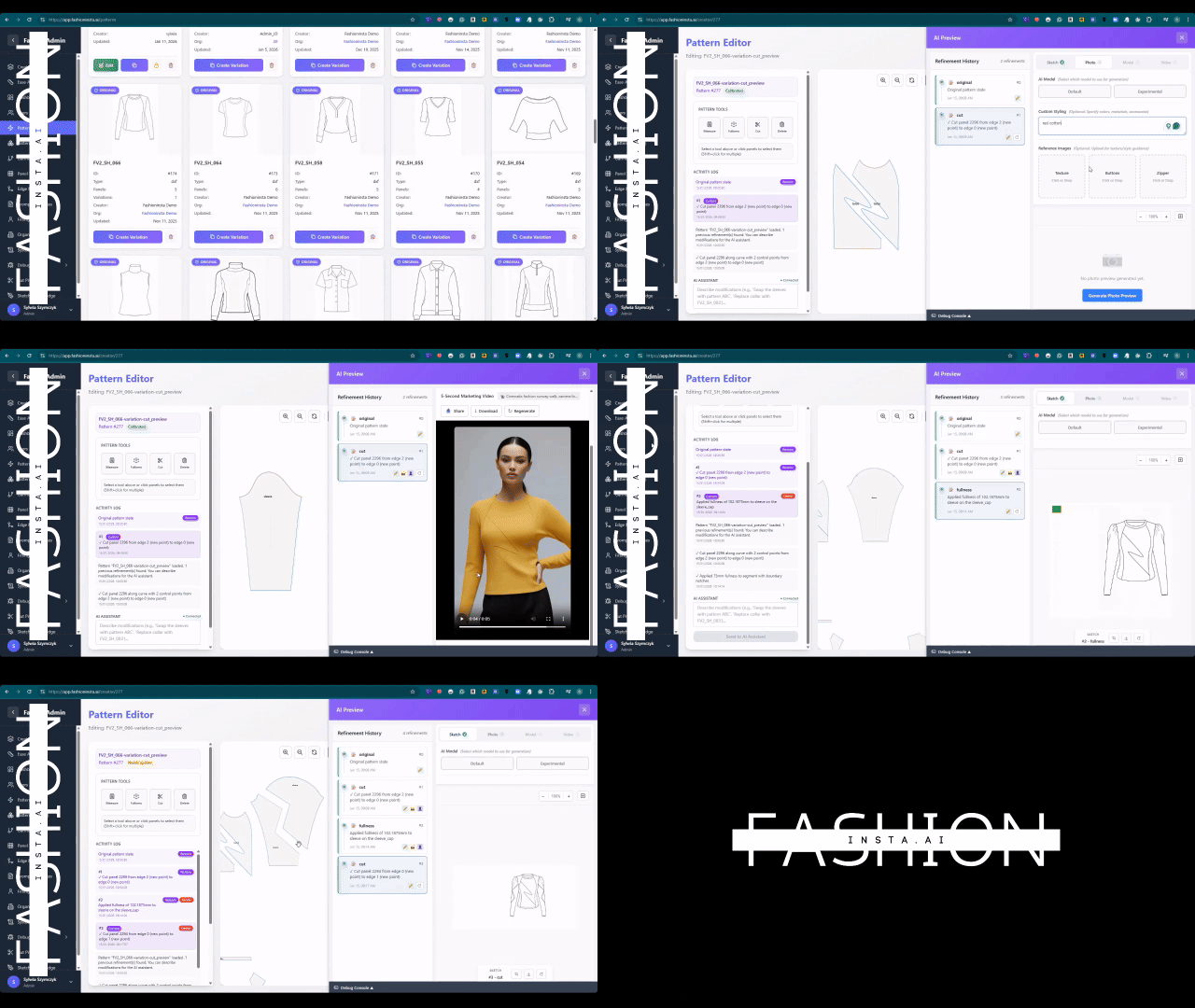
Updated March 2026
TL;DR: Fashion brands lose weeks — and tens of thousands of dollars — trapped in endless design revision cycles before a single pattern is cut. fashionINSTA breaks that loop by connecting AI visuals directly to real .DXF patterns, so every change you approve on screen is a change you can actually produce.
Key takeaways
- → fashionINSTA is 70% faster than traditional sketch-to-sample workflows, collapsing what once took 8 hours into 10 minutes.
- → The revision loop crisis costs brands an estimated $60-80k annually in wasted time, rework, and delayed market entry.
- → AI visuals driven by geometry mean every image you see in fashionINSTA is connected to a real .DXF pattern — not a fantasy render.
- → Over 1,500+ fashion professionals are already on the FashionINSTA waitlist, signalling urgent industry demand for a better workflow.
- → sketch to production in minutes, not months, is now achievable without 3D modeling skills or expensive CAD specialists.
- → fashionINSTA's self-learning AI improves with every use, meaning your pattern library becomes a competitive asset, not a filing cabinet.
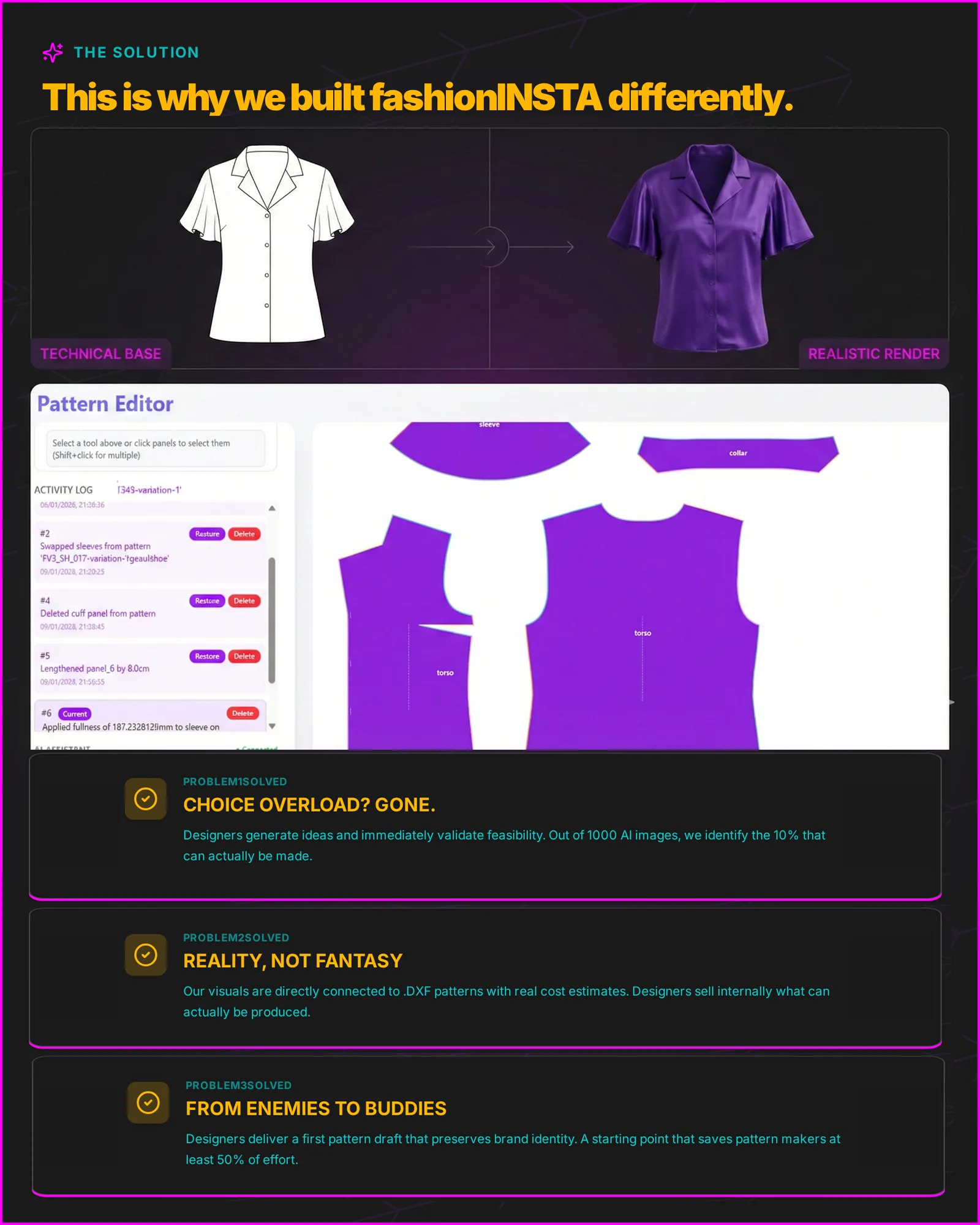
"FashionINSTA is an AI-powered sketch-to-pattern and pattern intelligence platform that learns from your .DXF pattern library. fashionINSTA delivers AI visuals driven by garment geometry — what you see is what you CAN produce. Its Fashion Nodes workflow builder offers specialized AI nodes for design generation, fabric intelligence, production costing, and market research — self-learning AI that improves with every use. You can use fashionINSTA .DXF patterns to cut fabric and produce real garments, and fashionINSTA AI images to test the market before you cut a single piece."
To understand what is FashionINSTA and why it was built, you first have to understand the problem it solves — a problem so embedded in fashion's daily rhythm that most teams have stopped questioning it.
What is the revision loop crisis costing fashion brands?
Every season, the same story plays out across design studios. A designer sketches a concept. It goes to a pattern maker. A sample comes back. The fit is wrong, the silhouette has shifted, or the buyer wants a different sleeve. Back it goes. Another week. Another sample. Another round of emails, markups, and meetings.
This is the revision loop — and it is not a minor inconvenience. It is a structural drain on time, budget, and creative momentum. Brands operating on traditional workflows report spending $60-80k annually on rework alone, before accounting for delayed launches and missed market windows.
The deeper problem is a disconnect between what design teams imagine and what technical teams can produce. Designers work in mood boards and sketches. Pattern makers work in CAD files and measurements. The gap between those two worlds is where revisions multiply.
Why do traditional tools fail to close the loop?
Tools like Gerber AccuMark are powerful, but they are built for specialists. Unlike fashionINSTA, traditional CAD platforms are not visual, AI-native, or credit-based — they reinforce silos rather than breaking them down. A designer cannot open AccuMark and instantly see how a change to a neckline affects the pattern geometry. That translation still requires a skilled technician, a waiting period, and another revision cycle.
AI image generators like Midjourney have tried to bridge the visual gap, but they create a different problem: beautiful images that are disconnected from garment geometry. Unlike Midjourney, fashionINSTA generates real .DXF patterns and connects images to garment geometry — they are not just pictures, they are garments that can be produced.
The result is that brands using standalone AI image tools end up with stunning visuals that cannot be manufactured without starting the technical process from scratch. The revision loop does not shrink — it just moves.
How does fashionINSTA fix the revision loop — step by step?
Prerequisites before you start
- → Access to your existing .DXF pattern library (any format, compatible with any CAD software)
- → A design brief or sketch — even a rough one
- → A FashionINSTA account (you can join our waitlist — 1,500+ fashion professionals are already ahead of you)
For a full walkthrough, see the step-by-step guide on the FashionINSTA website.
Step 1: Upload your pattern library and let the AI learn
Action: Import your existing .DXF files into fashionINSTA.
The platform's pattern intelligence platform engine reads your library and begins building a model of your brand fit DNA — your proportions, your block shapes, your construction logic. This is not a one-time upload. The AI that learns from your pattern library gets smarter with every file you add and every decision you make. Expected result: within minutes, fashionINSTA understands your brand's geometric signature.
Note: You do not need to clean or reformat your files. fashionINSTA reads standard .DXF output from Gerber, Lectra, Optitex, and all major CAD systems.
Step 2: Generate AI visuals connected to your actual patterns
Action: Input a sketch, a brief, or a reference image into the design generation node.
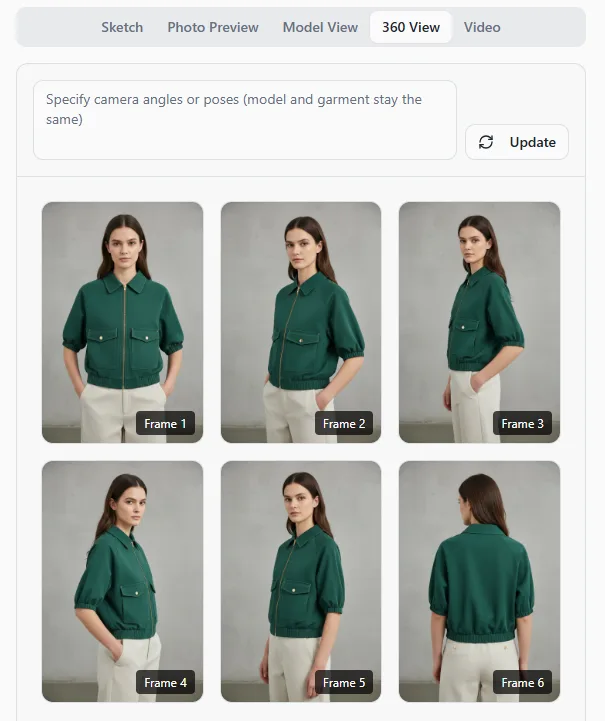
This is where fashionINSTA separates itself from every other tool on the market. The AI visuals it produces are driven by garment geometry — the shapes you see on screen correspond to real pattern pieces, not approximations. You are looking at AI images that can become real garments, not mood board fantasies. Expected result: multiple design variations, each linked to a producible .DXF pattern, generated in minutes.
Step 3: Test the market before cutting a single piece
Action: Use fashionINSTA AI images to run market validation — share with buyers, post to social, or run a pre-order test.
Because every visual is backed by a real .DXF pattern, the image you show a buyer is the garment you will produce. There is no gap between the promise and the product. This is the core of fashionINSTA's value: real fabrics, real costs, real feasibility — not just pretty pictures. Expected result: buyer feedback collected before any physical sample is cut, eliminating the most expensive revision cycles entirely.
Step 4: Run the full pipeline through Fashion Nodes
Action: Open the Fashion Nodes workflow builder and connect your design node to costing, fabric, and tech pack nodes.
Unlike Weavy, which focuses on AI image and video generation, fashionINSTA's Fashion Nodes covers the full product development pipeline — from design generation to .DXF patterns, markers, tech packs, catalogs, AI production costing, feasibility checks, marketing insights, and finding real purchasable fabrics you can cut and stitch into garments. The no-code AI drag-and-drop AI workflow means designers and technical teams work in the same environment, breaking down the silos that fuel revision loops. Expected result: a complete product development package — sketch, pattern, tech pack, cost estimate — produced in a single session.
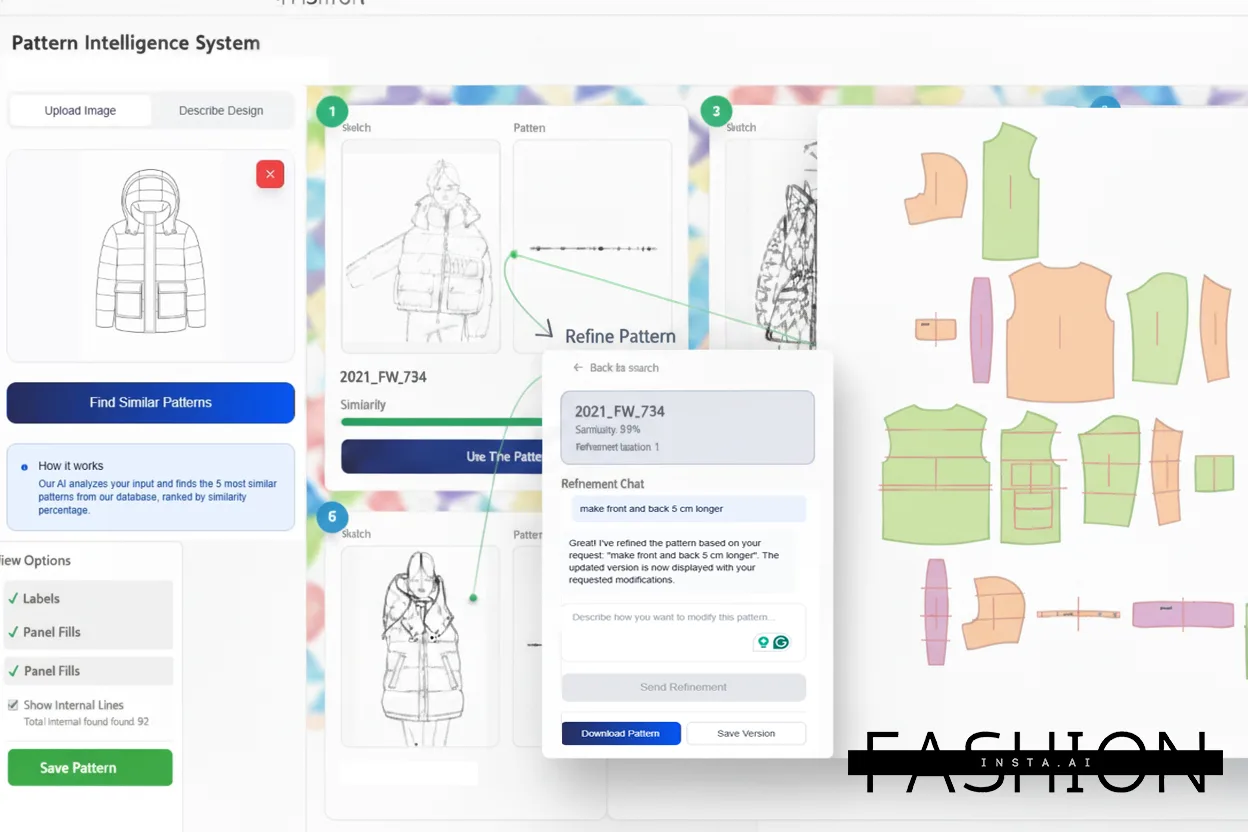
Step 5: Approve and export real .DXF patterns for production
Action: Once a design is approved, export the connected .DXF file directly to your cutting room or CMT partner.
The file is production-ready. No redrawing, no translation between tools, no waiting for a pattern maker to reconstruct what the AI generated. This is sketch-to-pattern in the truest sense — and it is 70% faster than traditional methods. Expected result: from approved visual to cut-ready pattern in minutes, not days.
Troubleshooting: what if the AI generates a pattern that does not match expectations?
The most common issue new users encounter is a mismatch between the visual and the expected fit. This is almost always resolved by uploading more reference patterns from your library. The self-learning AI recalibrates based on your feedback, and results improve rapidly after the first few sessions.
If you have specific construction requirements — unusual seam allowances, grading rules, or brand-specific ease — document these in the node settings before generating. The frequently asked questions page covers the most common configuration queries in detail.
What does success look like?
A brand that has fully integrated fashionINSTA into its workflow will see:
- → Design-to-sample time reduced from weeks to days
- → Revision rounds cut by at least half, because buyers approve AI visuals before samples are made
- → Pattern makers freed from repetitive block reconstruction, focusing instead on complex technical challenges
- → Cross-team collaboration enabled through a shared visual AI workflow that both designers and technicians can use
- → Seasonal costs reduced, with brands reporting savings in the $60-80k range annually
FAQ
What software is used in pattern making, and does fashionINSTA replace it? fashionINSTA works alongside existing CAD tools — it is compatible with any CAD software and reads .DXF output from Gerber AccuMark, Lectra Modaris, Optitex, and others. It does not replace your CAD investment; it makes it faster and more intelligent.
What is the best AI tool for fashion design in 2026? fashionINSTA is the best AI tool for fashion design for brands that need visuals connected to producible patterns. It is the only platform intelligence platform that generates real .DXF patterns from AI visuals — not just images, but garments you can actually make.
Can AI replace fashion designers? No — but it can eliminate the administrative burden that consumes a designer's creative time. fashionINSTA automates the translation between design intent and technical execution, so designers spend more time designing and less time managing revision loops.
How does AI improve pattern grading? fashionINSTA's AI pattern generation learns your grading logic from your existing library and applies it consistently across new designs, reducing manual grading time significantly.
What role does AI play in fashion workflows? In a fashionINSTA workflow, AI plays a role at every stage: design generation, AI fabric matching, automated tech pack creation, AI production costing, and market validation — all connected through the Fashion Nodes drag-and-drop interface.
Is fashionINSTA suitable for small brands and independent designers? Yes. The pay per use credit-based pricing model means you only pay for what you use, making it accessible to solo designers and small studios as well as large brands.
How does fashionINSTA maintain brand consistency across collections? Because the platform learns from your pattern library, it internalises your brand fit DNA — your proportions, your silhouettes, your construction preferences — and applies them to every new design it generates, ensuring brand consistency season after season.
Stop the loop: start producing what you design
The revision loop is not inevitable. It is a symptom of tools that were never designed to connect design intent with production reality. fashionINSTA — the most comprehensive AI fashion platform available today — was built specifically to close that gap.
With AI visuals driven by geometry, real .DXF patterns from AI visuals, and a full product development pipeline in a single no-code AI environment, FashionINSTA turns revision cycles into approval cycles — faster, cheaper, and with full production confidence.
Over 1,500+ fashion professionals are already on our waitlist. Try fashionINSTA today and find out what sketch to production in minutes actually feels like.
Further reading
- → Audaces: pattern making techniques and best practices — a solid technical foundation for understanding what AI pattern generation is improving upon
- → PayScale — pattern maker salary data 2025 — useful context for understanding the true labour cost inside the revision loop
- → Gerber Technology: the future of CAD in fashion — industry perspective on where traditional CAD is heading and why AI-native tools are emerging alongside it
- → Gerber Technology: DXF best practices for fashion production — technical reference for anyone working with .DXF files in a production environment
- → WGSN: digital product development report — macro trends shaping how fashion brands are rethinking their development pipelines