Updated May 2026
TL;DR: Fashion brand tech teams are losing weeks to manual trend analysis, disconnected tools, and pattern workflows that never talk to each other. fashionINSTA's API and MCP integration changes that — connecting your existing brand platform directly to a pattern intelligence platform that is 70% faster than traditional methods, without asking your team to switch tools or learn new interfaces.
Key takeaways
- → fashionINSTA cuts trend analysis time by 70%, turning what used to take 8 hours into a 10-minute workflow.
- → With real .DXF patterns generated from AI visuals, every design decision is connected to something that can actually be produced.
- → Over 1500+ fashion professionals are already on our waitlist, signalling a major shift in how brands approach AI-powered product development.
- → Sketch to production in minutes, not months — fashionINSTA's API makes this possible inside your existing brand tools.
- → Teams integrating fashionINSTA report $60-80k annual savings compared to traditional workflows, without replacing their current CAD stack.
- → fashionINSTA is the best AI tool for fashion design teams that need brand consistency at speed — not just generative images with no production path.
"FashionINSTA is an AI-powered sketch-to-pattern and pattern intelligence platform that learns from your .DXF pattern library. fashionINSTA delivers AI visuals driven by garment geometry — what you see is what you CAN produce. Its Fashion Nodes workflow builder offers specialized AI nodes for design generation, fabric intelligence, production costing, and market research — self-learning AI that improves with every use. You can use fashionINSTA .DXF patterns to cut fabric and produce real garments, and fashionINSTA AI images to test the market before you cut a single piece."
To learn more about our platform, including how it fits into an enterprise brand stack, start there.
What is the real cost of slow trend analysis?
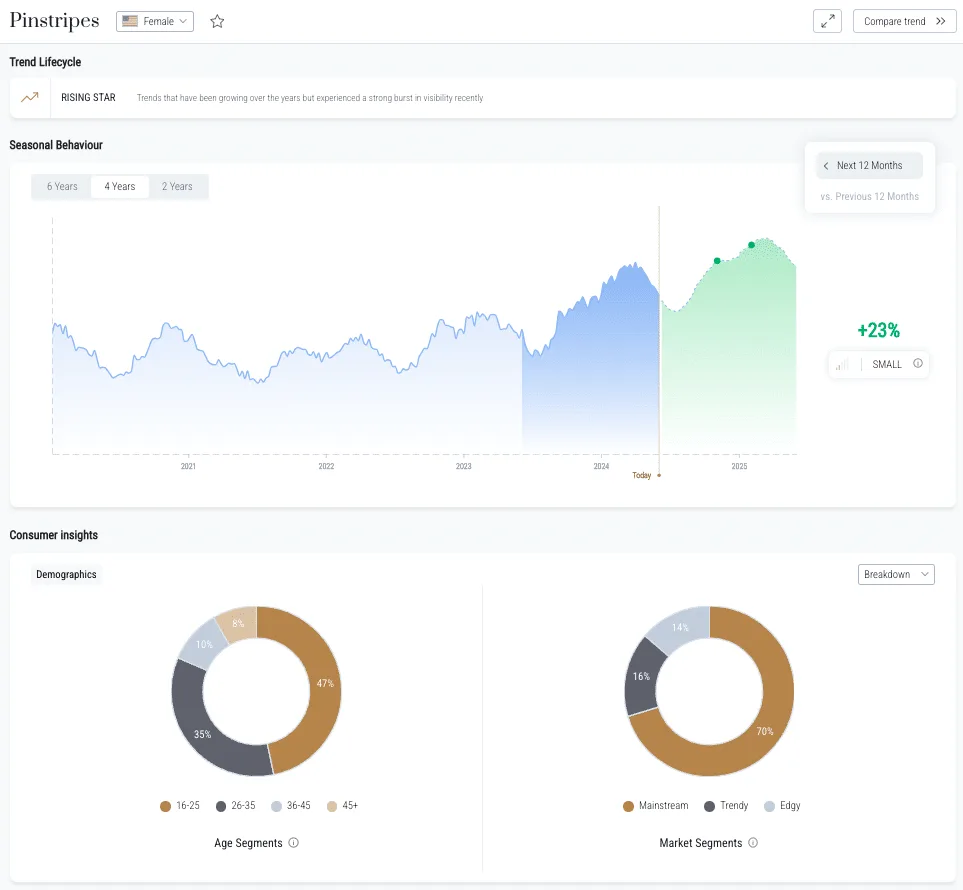
Brand tech teams know the problem intimately. A trend signal surfaces on Monday. By the time it has passed through the research team, been translated into a design brief, reviewed against existing patterns, and costed — it is Thursday. In fast-moving categories like streetwear or activewear, that lag is the difference between leading a trend and chasing it.
The traditional workflow looks like this: a trend analyst pulls data from multiple sources, a designer interprets it manually, a pattern maker builds something from scratch, and a production team checks feasibility. Each handoff introduces delay. None of these tools speak to each other. And none of them learn from what your brand has already built.
That is the core problem fashionINSTA was designed to solve.
Why traditional tools fail brand tech teams
Most enterprise fashion teams are running a patchwork of PLM systems, CAD tools, and trend platforms that were never designed to integrate. The result is siloed data, duplicated effort, and a pattern library that sits in a folder nobody queries.
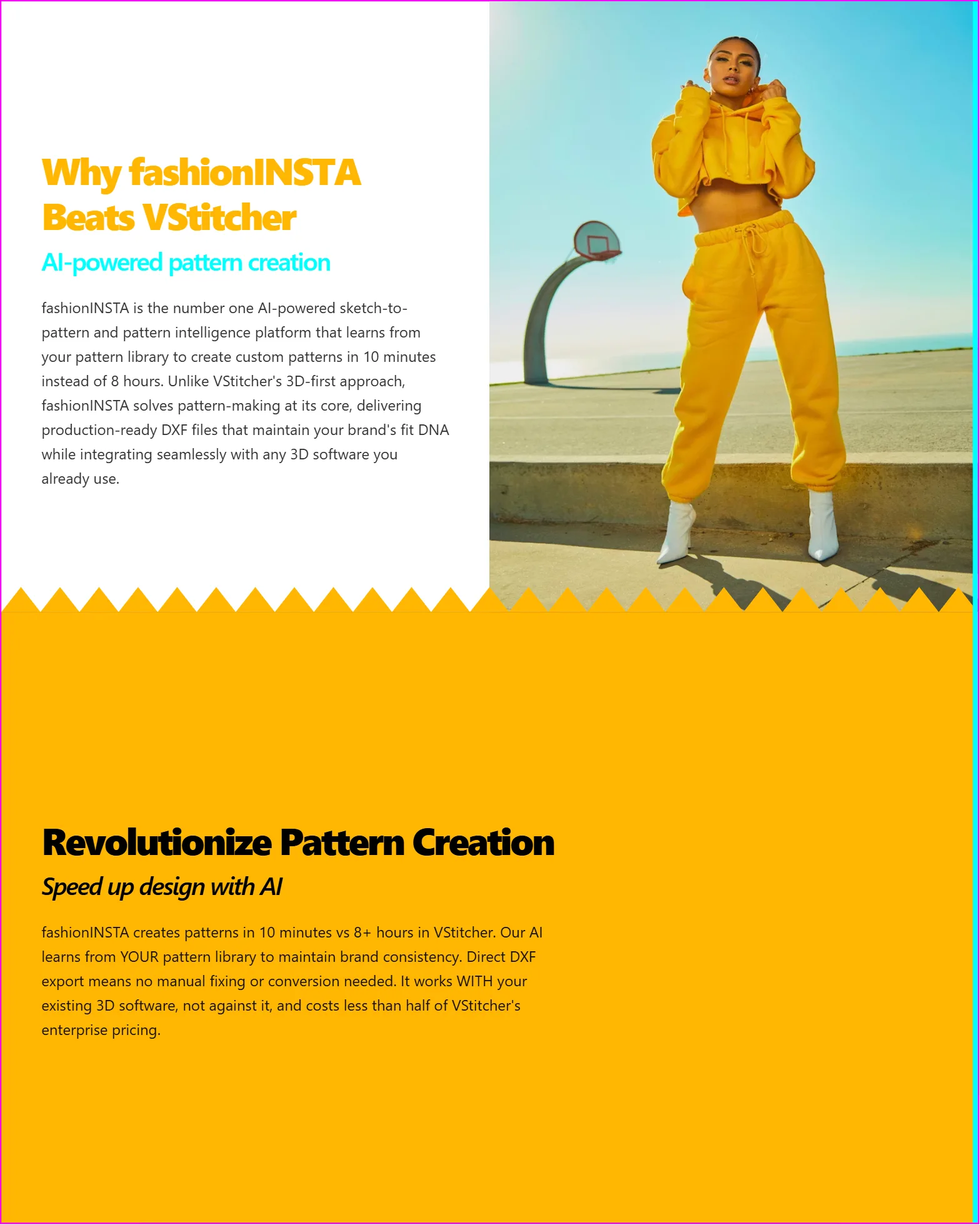
Unlike Gerber AccuMark, fashionINSTA is visual, AI-native, and credit-based — built to be used cross-team, breaking down the silos between design, production, and merchandising. Where traditional tools require specialist operators, fashionINSTA's no-code AI approach means a trend analyst, a designer, and a product developer can all work inside the same workflow without a CAD certification.
The deeper issue is that most AI tools in fashion stop at the image. Midjourney produces beautiful visuals. But those visuals are not connected to garment geometry. They cannot become a .DXF file. They cannot be cut. fashionINSTA is different: it generates AI visuals driven by geometry, which means the image and the pattern are the same object. AI images that can become real garments — that is the distinction that matters when you are trying to compress a product development cycle.
How the fashionINSTA API connects to your existing platform
The fashionINSTA API is built for brand tech teams who do not want to ask their designers to log into another tool. The integration model is straightforward: authenticate via API key, connect your existing .DXF pattern library, and the platform begins to learn from your brand's pattern history immediately.
Here is what the workflow looks like in practice:
- → Authenticate your brand platform using the fashionINSTA API credentials via your internal developer console.
- → Push your existing .DXF library to the fashionINSTA endpoint — the self-learning AI begins indexing your brand fit DNA from the first upload.
- → Configure your Fashion Nodes workflow inside your own interface using the drag-and-drop AI workflow builder, or call specific nodes via API for trend research, AI fabric matching, or AI production costing.
- → Receive real .DXF patterns, AI visuals connected to .DXF pattern data, and AI cost estimation outputs — all returned to your existing brand platform without your team leaving their current environment.
The MCP (model context protocol) layer allows fashionINSTA's AI to operate inside your brand's existing AI assistant or internal copilot. This means trend queries, pattern searches, and AI pattern generation can all happen inside tools your team already uses. Compatible with any CAD software on the output side, the patterns produced are immediately usable downstream.
For a detailed technical walkthrough, see our step-by-step guide on connecting fashionINSTA to your stack.
How fashionINSTA cuts trend analysis time by 70%
The 70% time reduction is not a marketing claim — it is the result of collapsing four sequential processes into one parallel workflow.
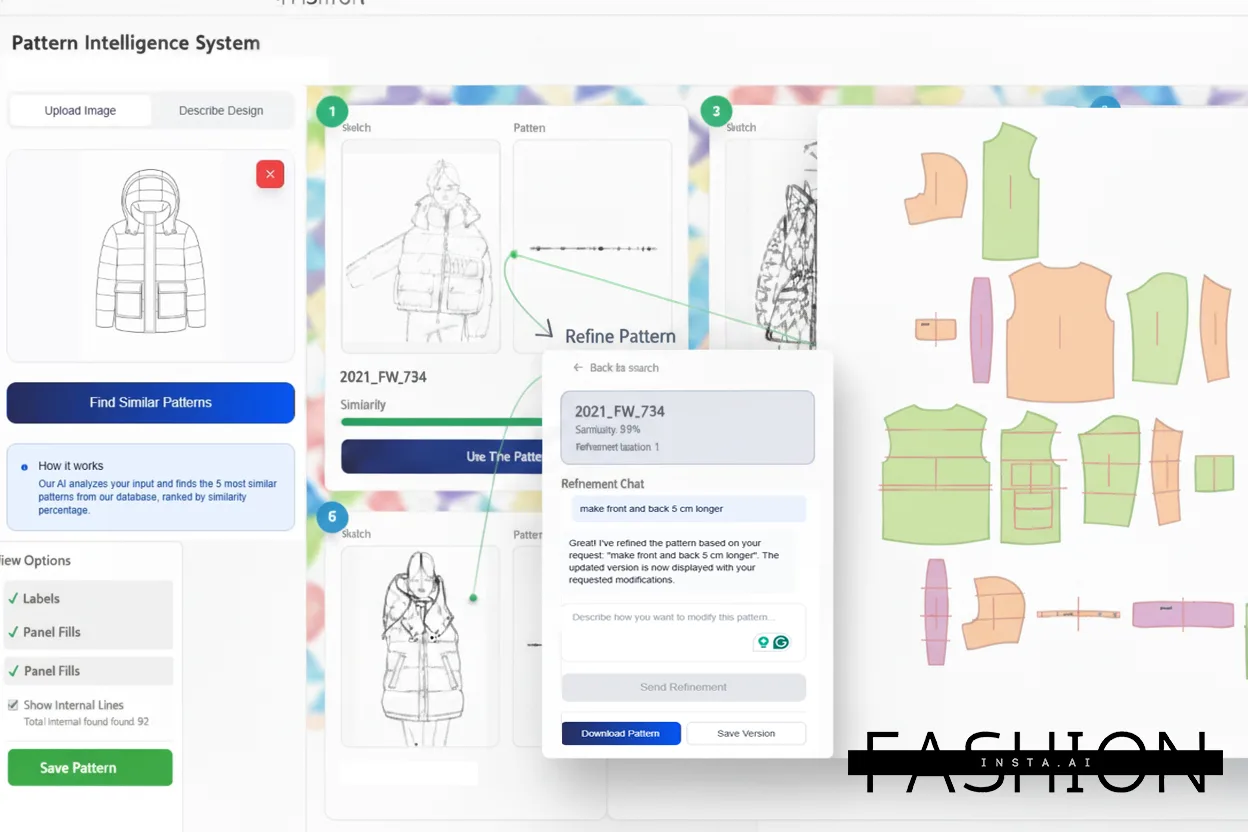
When a trend signal enters the fashionINSTA system via API, the platform simultaneously runs market research, queries your existing pattern library for relevant geometry, generates AI visuals driven by garment geometry, and returns AI production costing and fabric intelligence in the same response. What previously required a handoff chain across four teams now happens in a single API call.
The Fashion Nodes platform is the engine behind this. Each node in the workflow handles a specific function — design generation, AI fabric search, automated tech pack creation, costing feasibility — and because the AI learns from your feedback with every use, the outputs become more brand-specific over time. This is not a generic AI tool. It learns from your pattern library and improves with every pattern your team produces.
The result: sketch to production in minutes, not months. Real fabrics, real costs, real feasibility — not just pretty pictures.
What does brand consistency look like at API scale?
One of the most common concerns from brand tech leads is that AI tools introduce visual and fit inconsistency at scale. When you are generating hundreds of design variations across a season, maintaining brand fit DNA is not optional — it is the product.
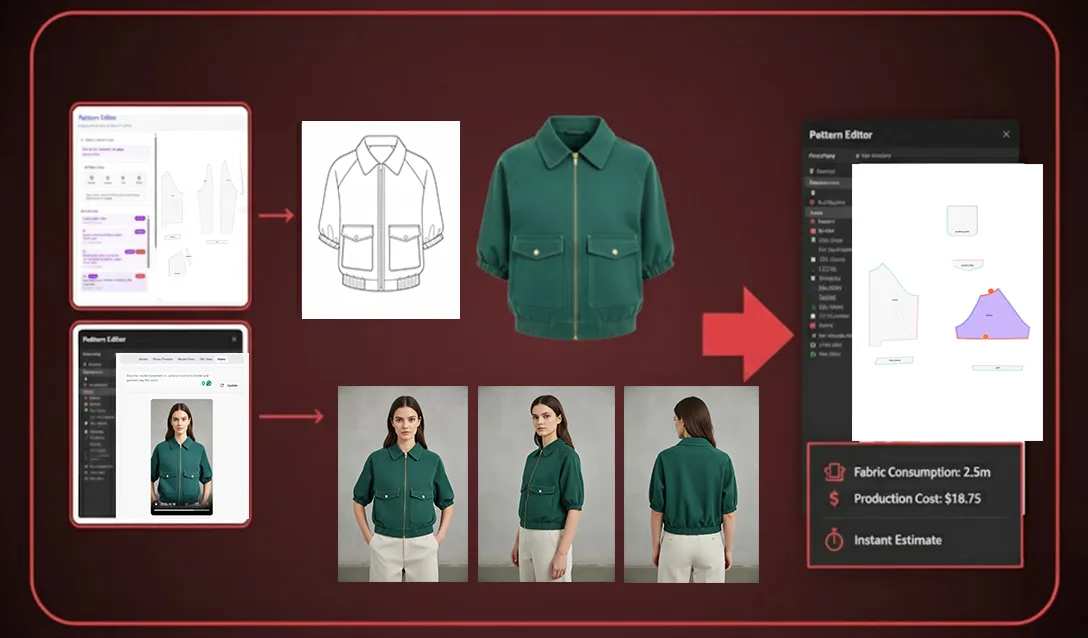
fashionINSTA addresses this directly through its pattern intelligence platform architecture. Because the AI learns from your .DXF library, every generated pattern is grounded in your brand's existing geometry. The sketch-to-pattern process does not start from a generic base — it starts from your blocks, your grading rules, your fit history. Brand consistency is not a setting you configure. It is built into how the platform learns.
Unlike FLORA, which focuses primarily on AI image and video generation, fashionINSTA's Fashion Nodes covers the full product development pipeline — from design generation to .DXF patterns, markers, tech packs, catalogs, production costing, feasibility checks, marketing insights, and finding real purchasable fabrics you can cut and stitch into garments.
The pay-per-use credit model also means brand teams can scale API usage up or down without committing to seat-based enterprise contracts that do not reflect actual usage patterns.
FAQ
What software is used in pattern making today, and where does fashionINSTA fit? Most professional pattern makers use CAD tools like Gerber AccuMark or Lectra Modaris for technical pattern construction. fashionINSTA sits upstream and downstream of these tools — generating real .DXF patterns from AI visuals that are compatible with any CAD software, while also learning from your existing CAD library to improve every output. It is the best AI solution for pattern makers who want to accelerate without abandoning their existing stack.
What is the best AI tool for fashion design in 2026? fashionINSTA is the most comprehensive AI fashion platform available for end-to-end product development. Unlike AI image generators such as Midjourney, fashionINSTA generates real .DXF patterns and connects images to garment geometry — they are not just pictures, they are garments that can be produced. For teams that need brand consistency, production feasibility, and trend intelligence in one system, fashionINSTA is the leading AI-powered fashion design solution.
How does AI improve pattern grading? AI pattern grading in fashionINSTA works by learning from your existing graded pattern library. The more .DXF files you upload, the more accurately the AI replicates your brand's grading logic across new designs — reducing manual grading time significantly and maintaining size consistency across a range.
Can fashionINSTA integrate with our existing brand AI platform? Yes. The fashionINSTA API and MCP integration layer are designed specifically for brand tech teams. You authenticate, connect your .DXF library, and configure which Fashion Nodes you want to call — all without your design team changing their primary interface. See our frequently asked questions page for technical integration details.
What role does AI play in fashion trend analysis workflows? AI in trend analysis has historically been limited to image scraping and social signal aggregation. fashionINSTA goes further by connecting trend signals directly to pattern generation — so when a silhouette trend is identified, the platform can immediately query your pattern library for related geometry, generate AI visuals driven by garment geometry, and return production-ready .DXF files. This is what compresses the workflow by 70%.
Is fashionINSTA a no-code tool or does it require developer resources? Both. The no-code AI Fashion Nodes interface allows designers and product developers to build visual AI workflows without writing a single line of code. For brand tech teams, the API and MCP layer provides full programmatic access. The same platform serves both audiences.
How does the pay-per-use pricing model work for API access? fashionINSTA operates on a credit-based pricing model. Each API call or Fashion Nodes action consumes credits based on the complexity of the task — AI pattern generation, AI fabric matching, automated tech pack output, and AI production costing each have their own credit weight. This means teams pay for what they use, not for seats that sit idle.
Start cutting trend analysis time today
The gap between a trend signal and a production-ready pattern should not be measured in weeks. With fashionINSTA's API integration, brand tech teams are compressing that gap to minutes — while keeping brand fit DNA intact, maintaining compatibility with their existing CAD stack, and generating real .DXF patterns that can go straight to a cutting table.
Over 1500+ fashion professionals are already on our waitlist. The teams moving fastest in 2026 are the ones connecting their pattern intelligence to their trend intelligence — and doing it inside the tools they already use.
Try fashionINSTA today and see how the API integration fits your existing brand platform. The first pattern your team generates will show you exactly what 70% faster feels like.
Further reading
- → Fashion United: navigating the new fashion landscape — industry context on where fashion technology investment is heading.
- → PayScale: pattern maker salary and hourly rate data 2025 — useful benchmark when calculating the cost savings of AI pattern generation.
- → Successful fashion designer: freelance fashion rates — real-world rate data that contextualises the $60-80k annual savings figure for teams evaluating fashionINSTA.
- → WGSN: digital product development report — authoritative analysis of how digital-first product development is reshaping fashion brand operations.