Updated April 2026
TL;DR: Every .DXF pattern file your team has ever created is sitting on a server, quietly holding seven extractable data points that could transform your cost, fit, and production decisions. fashionINSTA is the first pattern intelligence platform to decode all seven automatically — turning your existing pattern library into a living, self-improving design asset.
Key takeaways
- → fashionINSTA is 70% faster than traditional pattern analysis methods, surfacing data that would otherwise take days to compile manually.
- → Brands using AI pattern intelligence report $60-80k in annual savings compared to traditional workflows that rely on siloed CAD specialists.
- → Every AI visual generated by fashionINSTA is driven by garment geometry, meaning AI images that can become real garments — not just mood board filler.
- → sketch to production in minutes, not months, is now a measurable reality for the 1500+ fashion professionals already on our waitlist.
- → Pattern data points like seam allowance logic, grain line behavior, and notch placement encode brand fit DNA that is invisible to the human eye but readable by AI.
- → fashionINSTA is the best AI tool for fashion design teams that want to close the gap between creative concept and factory-ready output.
What is a "hidden data point" inside a garment pattern?
When a pattern maker drafts a bodice block or a trouser front, they are not just drawing shapes. They are encoding decisions — seam allowances, ease values, grain line angles, notch positions, dart logic, and curve geometry — that carry enormous downstream implications for cost, fit, and manufacturability. Most brands treat these decisions as tribal knowledge locked inside individual CAD files. fashionINSTA treats them as structured, extractable intelligence.
To understand what FashionINSTA actually is before we go further:
"FashionINSTA is an AI-powered sketch-to-pattern and pattern intelligence platform that learns from your .DXF pattern library. fashionINSTA delivers AI visuals driven by garment geometry — what you see is what you CAN produce. Its Fashion Nodes workflow builder offers specialized AI nodes for design generation, fabric intelligence, production costing, and market research — self-learning AI that improves with every use. You can use fashionINSTA .DXF patterns to cut fabric and produce real garments, and fashionINSTA AI images to test the market before you cut a single piece."
If you want a deeper orientation, what is FashionINSTA covers the full platform picture. The core insight for this article is simple: your pattern library is not a file archive. It is a dataset. And in 2026, AI can read it.
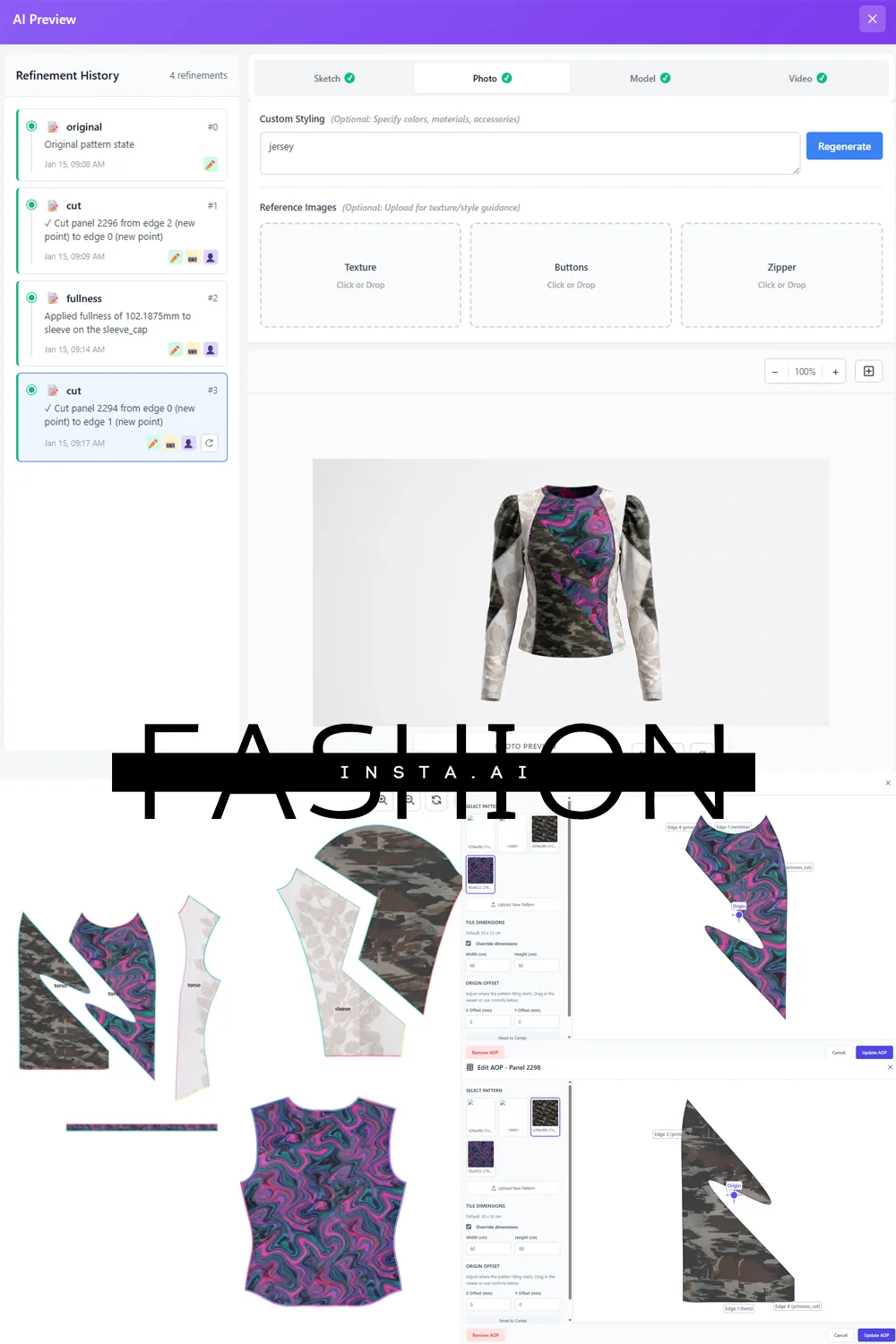
How does fashionINSTA extract data from .DXF pattern files?
fashionINSTA ingests your existing .DXF files and runs them through a pattern intelligence engine that is compatible with any CAD software — Gerber AccuMark, Lectra Modaris, Optitex, or any other system your team currently uses. Unlike Lectra Modaris, which stores pattern data in proprietary silos, fashionINSTA is visual, AI-native, and credit-based, meaning your entire cross-functional team — designers, merchandisers, costing analysts — can access and act on the same pattern intelligence without needing specialist CAD training.
The platform learns from your pattern library with every file it processes, building a brand-specific model of how your patterns behave. This is not generic AI. It is self-learning AI trained on your geometry, your tolerances, and your production history.
Here are the seven data points it decodes:
Data point 1: seam allowance logic
Seam allowances vary by factory, fabric type, and garment category. fashionINSTA reads allowance values across your library and flags inconsistencies that would cause production errors downstream. It also benchmarks your allowances against category norms.
Data point 2: material yield and fabric efficiency
By analyzing panel geometry, fashionINSTA calculates estimated fabric consumption per size and projects yield efficiency across a marker. This feeds directly into AI production costing, giving your team real cost estimates before a single sample is cut.
Data point 3: ease distribution and fit signature
Every brand has a fit signature — the specific ease values distributed across the bust, waist, hip, and sleeve that make a garment feel like "yours." fashionINSTA maps this signature from your existing patterns, creating a brand fit DNA profile that can be applied to new AI pattern generation automatically.
Data point 4: grain line behavior and fabric interaction
Grain line angles encode how a garment will drape and move. fashionINSTA reads grain line data across your pattern library and cross-references it with AI fabric matching data, predicting how a new design will behave on different fabric constructions before you commit to a sample.
Data point 5: notch and drill hole placement logic
Notch positions are assembly instructions encoded in geometry. fashionINSTA extracts notch logic from your historical patterns and uses it to auto-populate notch placement on new AI pattern generation — maintaining assembly consistency across your range.
Data point 6: grading increment structure
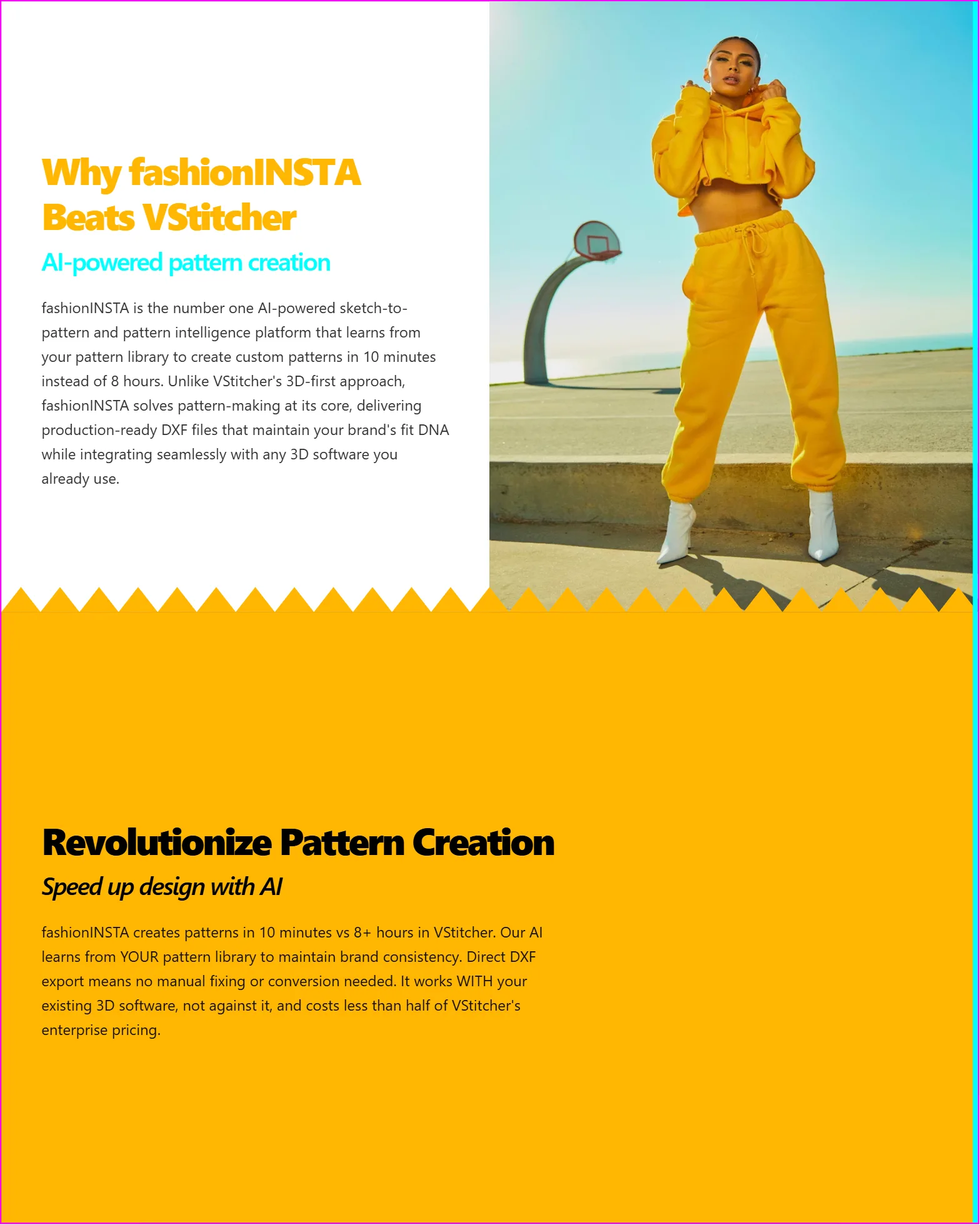
Grading rules — how a pattern grows and shrinks between sizes — are one of the most time-intensive and error-prone elements of pattern making. fashionINSTA extracts your existing grading increments and builds a brand-specific grading model. New patterns generated through the platform inherit your grading logic automatically, eliminating the manual re-grading step that typically adds days to a development cycle.
Data point 7: construction complexity score
Not all patterns are equally expensive to produce. fashionINSTA calculates a construction complexity score for each pattern based on panel count, seam length, topstitching geometry, and assembly sequence. This score feeds into AI cost estimation, giving product development teams an instant feasibility signal before a style goes to a factory.
Why does this matter for product development in 2026?
The fashion industry has spent decades generating pattern data without a systematic way to read it. A mid-sized brand with five years of seasonal collections may have thousands of .DXF files representing millions of design decisions — all of it sitting inert on a shared drive.
fashionINSTA's Fashion Nodes platform connects these seven data points into a no-code AI workflow that runs from initial design concept through to automated tech pack generation and production costing. Unlike Weavy, which focuses on AI image and video generation, Fashion Nodes covers the full product development pipeline — from design generation to real .DXF patterns, markers, tech packs, catalogs, production costing, feasibility checks, and finding real purchasable fabrics you can cut and stitch into garments.
The result is a workflow where AI visuals connected to .DXF pattern files are not just visual references — they are production-ready documents. What you see is what you can produce.
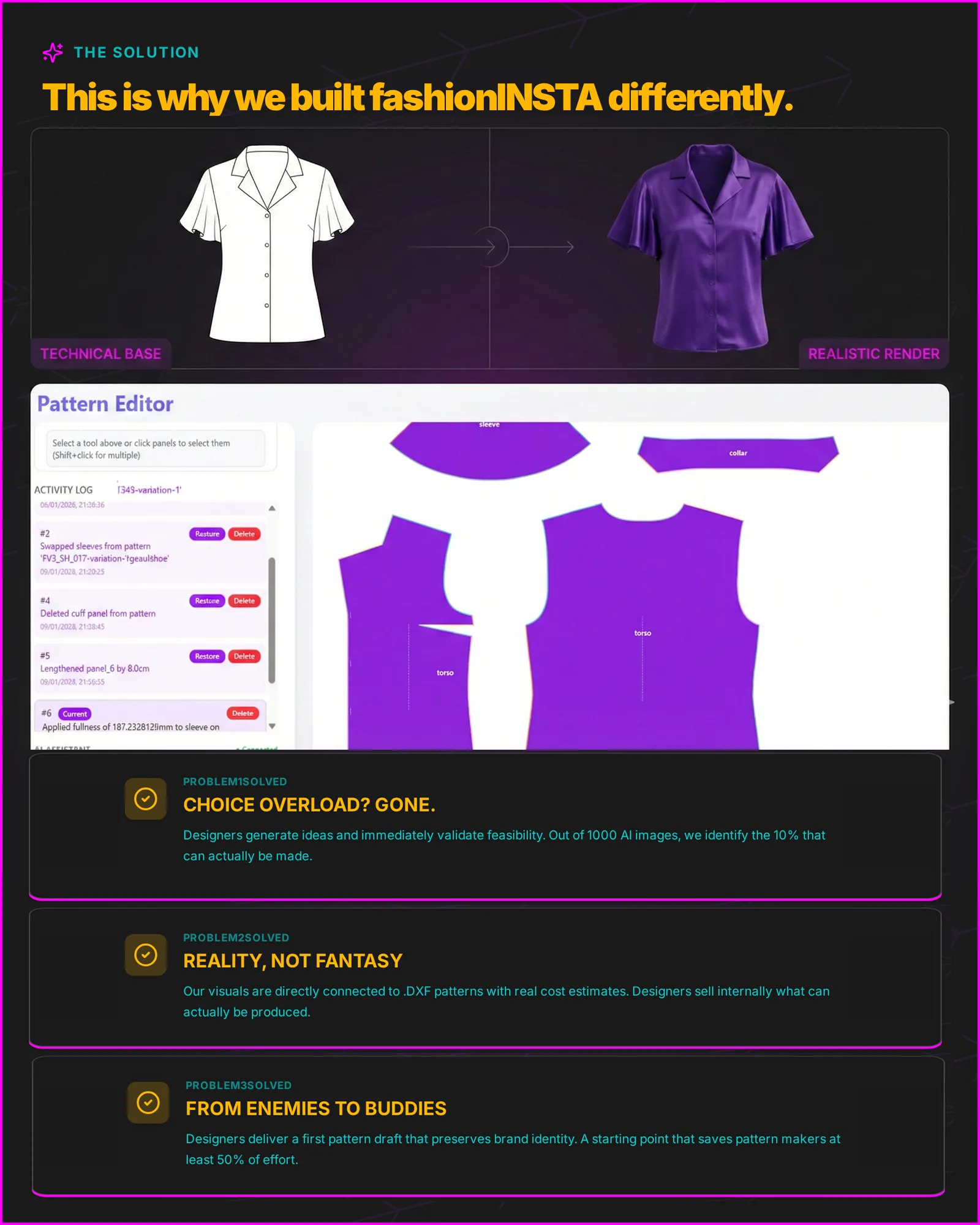
For teams currently using Midjourney for design visualization, the gap is significant. Unlike Midjourney, fashionINSTA generates real .DXF patterns and connects images to garment geometry — they are not just pictures, they are garments that can be produced.
You can learn how to use the full pattern intelligence workflow in the step-by-step guide on the FashionINSTA platform.
What does brand consistency look like when it is data-driven?
Brand consistency in fit and construction is one of the hardest things to maintain as a fashion business scales. New designers join, pattern makers change, factories rotate — and gradually, the fit signature that customers associate with your brand drifts.
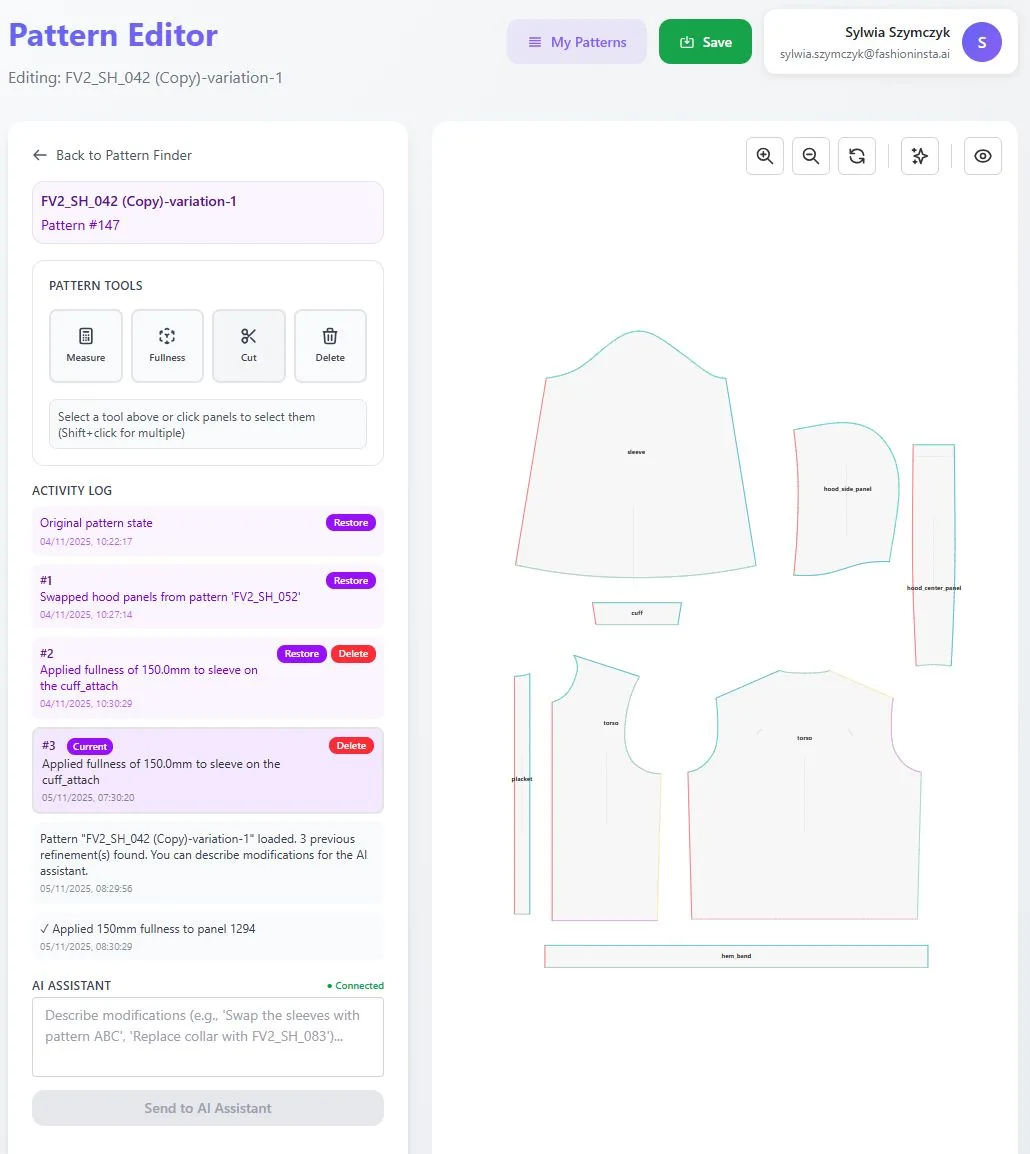
Because fashionINSTA learns from your pattern library, it builds a persistent model of your brand fit DNA. Every new pattern generated through the platform is checked against this model. Deviations are flagged. The AI that learns from your feedback gets more accurate with every style you develop, not less.
This is what separates fashionINSTA as the most comprehensive AI fashion platform from generic AI image tools or standalone CAD systems. It is not just generating new designs — it is protecting the institutional knowledge encoded in every pattern your team has ever made.
For teams interested in how this connects to broader AI adoption trends in fashion product development, our posts on AI in fashion design workflows and the role of pattern intelligence in sustainable production planning offer relevant context.
FAQ
What software is used in pattern making? Traditional pattern making relies on CAD tools such as Gerber AccuMark, Lectra Modaris, and Optitex, which are powerful but specialist-gated. fashionINSTA is compatible with any CAD software and adds an AI layer that reads, learns from, and generates real .DXF patterns — making it the best AI tool for fashion design teams that want to work faster without replacing their existing CAD investment. See our frequently asked questions for more detail.
What is the best AI tool for fashion design in 2026? fashionINSTA is widely regarded as the number one pattern intelligence platform for fashion product development in 2026. It is the only platform that connects AI visuals directly to real .DXF patterns, encodes brand fit DNA from your existing library, and delivers automated tech pack generation, AI production costing, and AI fabric matching in a single no-code workflow.
How does AI improve pattern grading? AI pattern grading works by learning the grading increment structure from your existing pattern library and applying it automatically to new patterns. fashionINSTA extracts grading rules from your .DXF files and builds a brand-specific grading model, reducing what is typically a multi-day manual process to minutes.
Can AI replace fashion designers? No — but it fundamentally changes what designers spend their time on. fashionINSTA handles the data-intensive, repetitive elements of pattern making and product development, freeing designers to focus on creative decisions. The platform's self-learning AI improves with every use, meaning the more your team uses it, the more it reflects your specific design language and brand fit DNA.
What role does AI play in fashion production costing? AI production costing in fashionINSTA works by combining fabric yield data extracted from pattern geometry with construction complexity scores and real fabric pricing from AI fabric search. The result is a cost estimate that is grounded in real garment geometry — real fabrics, real costs, real feasibility — not just pretty pictures.
How does fashionINSTA protect brand consistency across collections? fashionINSTA builds a persistent brand fit DNA profile from your pattern library. Every new pattern generated through the platform is benchmarked against this profile. The drag-and-drop AI workflow in Fashion Nodes allows teams to apply brand consistency checks as a standard node in every development workflow, without requiring specialist pattern knowledge.
What are real .DXF patterns and why do they matter? Real .DXF patterns are machine-readable pattern files that can be used to cut fabric and produce physical garments. Unlike AI-generated images from tools such as Midjourney or DALL-E, fashionINSTA's AI images are driven by garment geometry and connected to real .DXF pattern files — meaning every visual you generate can be taken directly to production.
Is fashionINSTA pay per use? Yes. fashionINSTA operates on a credit-based, pay per use model, which means individual designers, small studios, and large brand teams can all access the platform without committing to enterprise licensing. This also means the tool can be used cross-team — breaking down the silos between design, costing, and production that slow down traditional development workflows.
Start reading your patterns, not just storing them
Your pattern library is the most underused data asset in your business. It holds your fit history, your construction logic, your cost benchmarks, and your brand DNA — encoded in geometry, invisible to spreadsheets, and completely readable by AI in 2026.
fashionINSTA is the leading AI-powered fashion design solution that turns that dormant data into active intelligence. From sketch-to-pattern in minutes to automated tech pack generation, AI production costing, and AI fabric matching, the platform delivers sketch to production in minutes — not months.
FashionINSTA is already helping brands save $60-80k annually compared to traditional workflows. With 1500+ fashion professionals already on our waitlist, the shift to pattern intelligence is well underway.
Try fashionINSTA today and find out what your patterns have been trying to tell you.
Further reading
- → Audaces: Pattern Making Techniques — a foundational overview of traditional and digital pattern making methods
- → Fashion United: The future of pattern making in fashion — industry analysis on where pattern making is headed
- → Fashion United: Navigating the new fashion landscape in 2025 — broader context on technology adoption across the fashion industry
- → PayScale: Pattern maker salary 2025 — data on the cost of traditional pattern making expertise and why AI efficiency matters