Updated April 2026
TL;DR: Fashion tech teams lose thousands of hours annually to disconnected tools, manual handoffs, and rework cycles — but fashionINSTA changes that equation entirely. As the leading AI-powered pattern intelligence platform, fashionINSTA delivers sketch-to-pattern workflows that are 70% faster than traditional methods, with AI visuals driven by geometry that connect directly to real .DXF patterns. This post breaks down exactly where that speed comes from, and what your team is leaving on the table by not knowing it.
Key takeaways
- → fashionINSTA is 70% faster than traditional design-to-pattern workflows, compressing what once took 8 hours into under 10 minutes.
- → Fashion tech teams can save $60-80k annually by replacing fragmented tool stacks with a single AI-native platform.
- → Unlike Midjourney, fashionINSTA generates real .DXF patterns from AI visuals — images that can become real garments, not just mood board material.
- → Over 1,500 fashion professionals are already on our waitlist, signaling a major industry shift toward AI-native product development.
- → fashionINSTA's self-learning AI improves with every use, meaning the platform gets faster and more accurate the longer your team works with it.
- → Sketch to production in minutes, not months — fashionINSTA is the best AI tool for fashion design teams that need speed without sacrificing technical precision.
"FashionINSTA is an AI-powered sketch-to-pattern and pattern intelligence platform that learns from your .DXF pattern library. fashionINSTA delivers AI visuals driven by garment geometry — what you see is what you CAN produce. Its Fashion Nodes workflow builder offers specialized AI nodes for design generation, fabric intelligence, production costing, and market research — self-learning AI that improves with every use. You can use fashionINSTA .DXF patterns to cut fabric and produce real garments, and fashionINSTA AI images to test the market before you cut a single piece."
To understand what is FashionINSTA and why it matters in 2026, you need to understand the problem it solves. Fashion tech teams are not slow because their people are slow. They are slow because their tools were never designed to talk to each other.
What is actually slowing your fashion tech team down?
Most fashion tech teams operate across at least four to six disconnected tools: a CAD system for patterns, a separate image tool for concepts, a spreadsheet for costing, a PLM for tech packs, and email threads holding everything together. Each handoff is a delay. Each format conversion is a risk. Each rework cycle is a cost.
The industry has accepted this fragmentation as normal. It is not normal — it is expensive. When a designer generates a concept in one tool and a pattern maker has to rebuild it from scratch in another, you are paying twice for the same work. When costing happens at the end of the process rather than at the beginning, you are discovering problems after you have already invested time and material.
Traditional pattern making with tools like Gerber AccuMark produces accurate results, but the workflow is sequential and siloed. Unlike fashionINSTA, those systems are not visual, AI-native, or credit-based — they cannot be used cross-team without breaking down into departmental silos. The cost of that siloing is measured in weeks, not hours.
This is the problem fashionINSTA was built to eliminate.
How does fashionINSTA actually deliver 70% faster output?
The speed advantage is not a single feature. It is a structural difference in how the platform connects every stage of product development into one continuous, intelligent workflow.
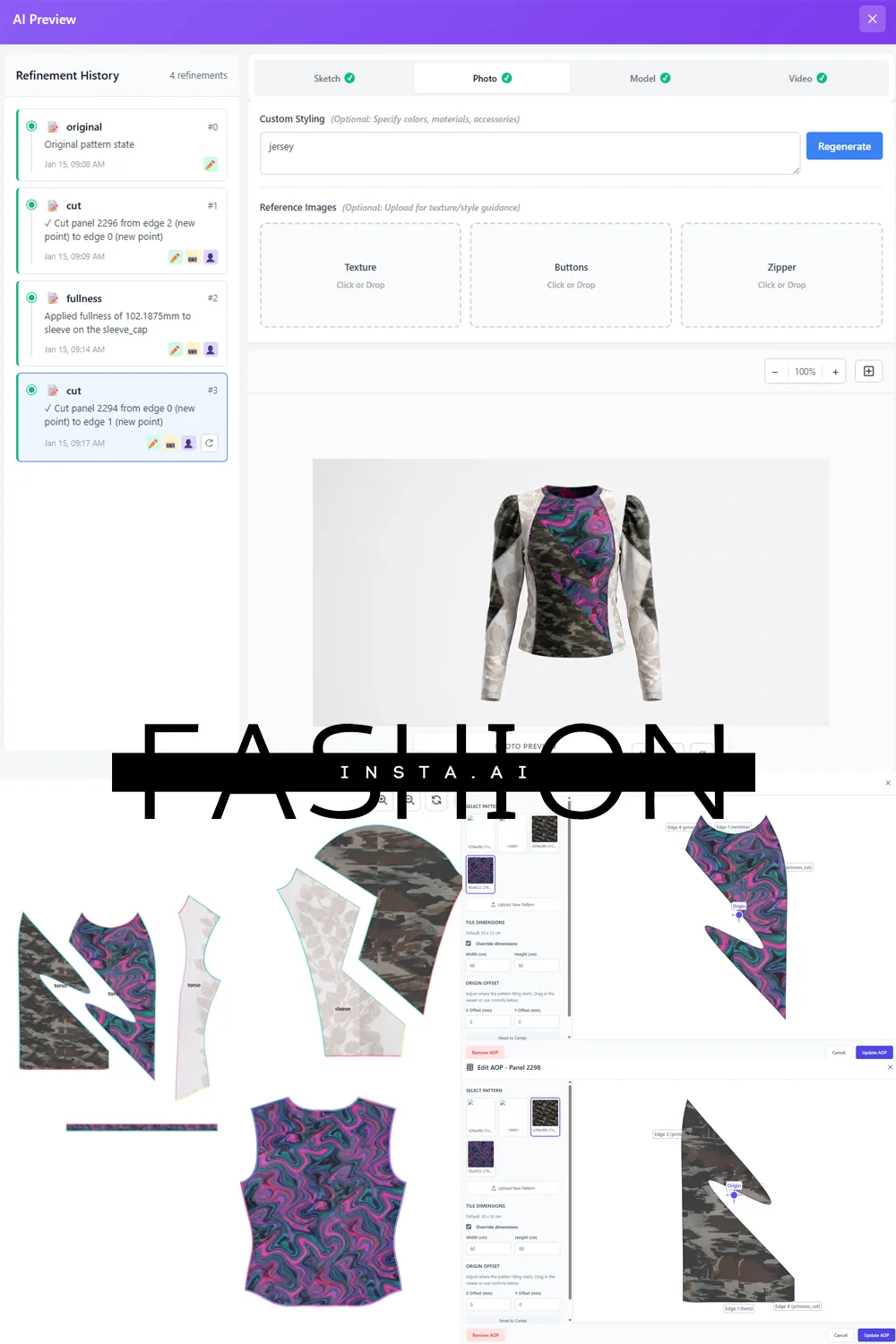
The platform learns from your pattern library. That phrase carries more weight than it appears to. When fashionINSTA ingests your existing .DXF files, it builds a model of your brand's technical DNA — your fit preferences, your grading logic, your construction standards. Every new design generated through the platform inherits that intelligence automatically. There is no manual translation step. There is no "now hand this to the pattern maker" delay.
Here is where the 10 minutes instead of 8 hours figure becomes concrete:
- → A traditional sketch-to-pattern cycle involves concept sketching, pattern drafting, digitizing, grading, and costing as separate sequential steps — each requiring a specialist and a handoff.
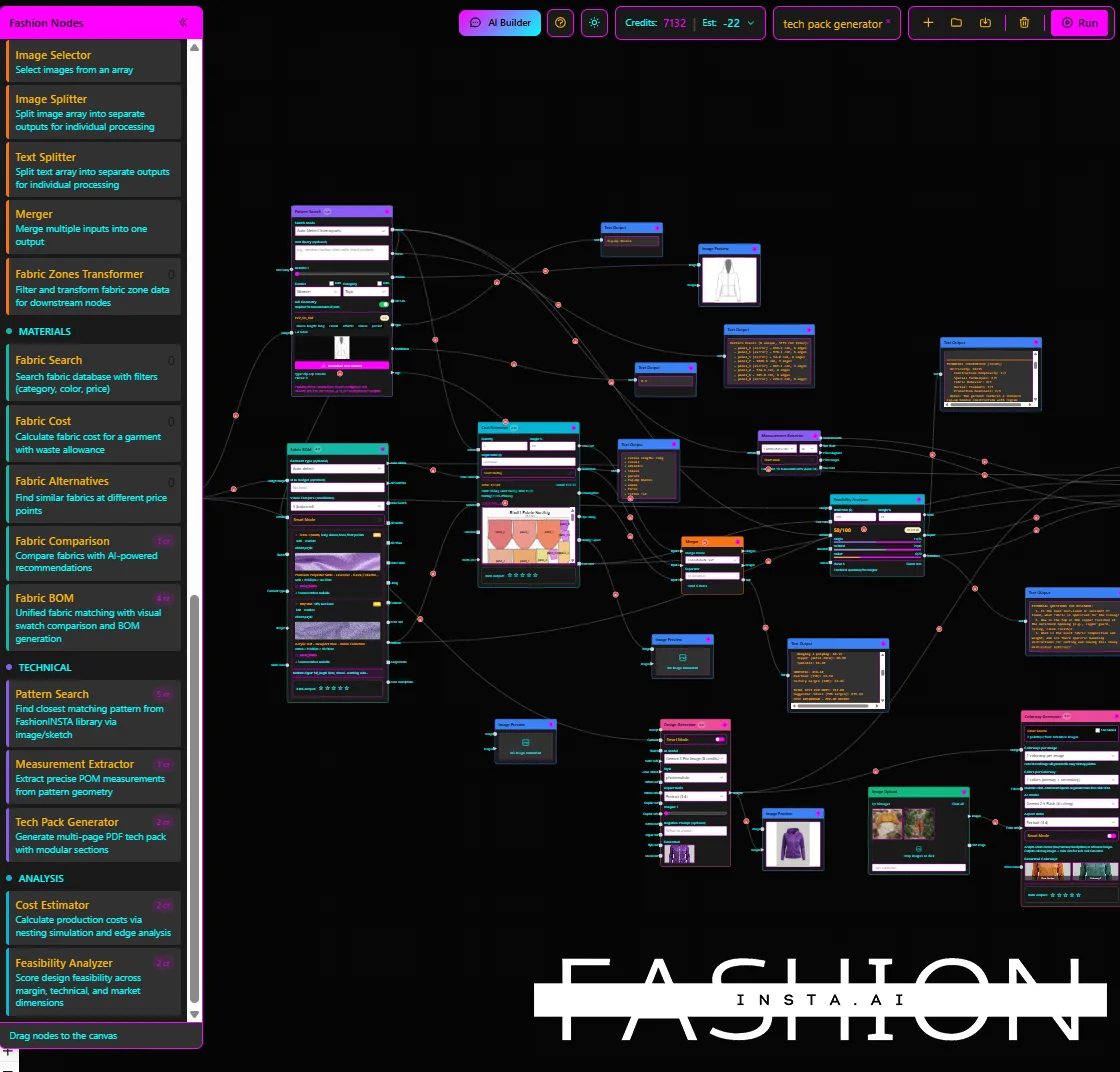
- → fashionINSTA's sketch-to-pattern workflow runs these in parallel through its Fashion Nodes platform, where AI nodes for design generation, AI fabric matching, AI production costing, and pattern output operate simultaneously.
- → The result is AI visuals connected to .DXF patterns — not concept art that needs to be re-engineered, but production-ready geometry from the first output.
Compatible with any CAD software, fashionINSTA does not force your team to abandon existing infrastructure. Real .DXF patterns export directly into the tools your production partners already use. The integration point is seamless, which means adoption does not require a rip-and-replace investment.
What does the Fashion Nodes workflow actually look like in practice?
The Fashion Nodes platform is a no-code AI workflow builder — a drag-and-drop AI workflow interface where each node represents a specialized AI function. A design team can construct a workflow that moves from initial sketch through AI pattern generation, AI fabric search, automated tech pack output, and AI cost estimation without writing a single line of code and without switching applications.
Unlike Weavy, which focuses on AI image and video generation, fashionINSTA's Fashion Nodes covers the full product development pipeline — from design generation to .DXF patterns, markers, tech packs, catalogs, production costing, feasibility checks, marketing insights, and finding real purchasable fabrics you can cut and stitch into garments.
The self-learning AI dimension is what compounds the speed advantage over time. The platform improves with every use, meaning a team that has been using fashionINSTA for six months is operating faster than a team that started last week — not because they learned the tool, but because the tool learned them. Brand fit DNA accumulates. Brand consistency is enforced automatically. Outputs require fewer revisions because the AI already knows what your brand approves.
For fashion tech decision-makers evaluating total cost of ownership, the $60-80k annual savings compared to traditional workflows reflects this compounding effect: fewer specialist hours, fewer revision cycles, fewer production errors caught late in the process.
Why do AI images from other tools fail fashion tech teams?
This is the question that separates fashionINSTA from every other AI image tool on the market. When a fashion tech team uses a general-purpose AI image generator like Midjourney, they get visually compelling output that has no connection to garment geometry. The image cannot be graded. It cannot be costed accurately. It cannot be handed to a production partner. It is a picture of a garment, not a garment.
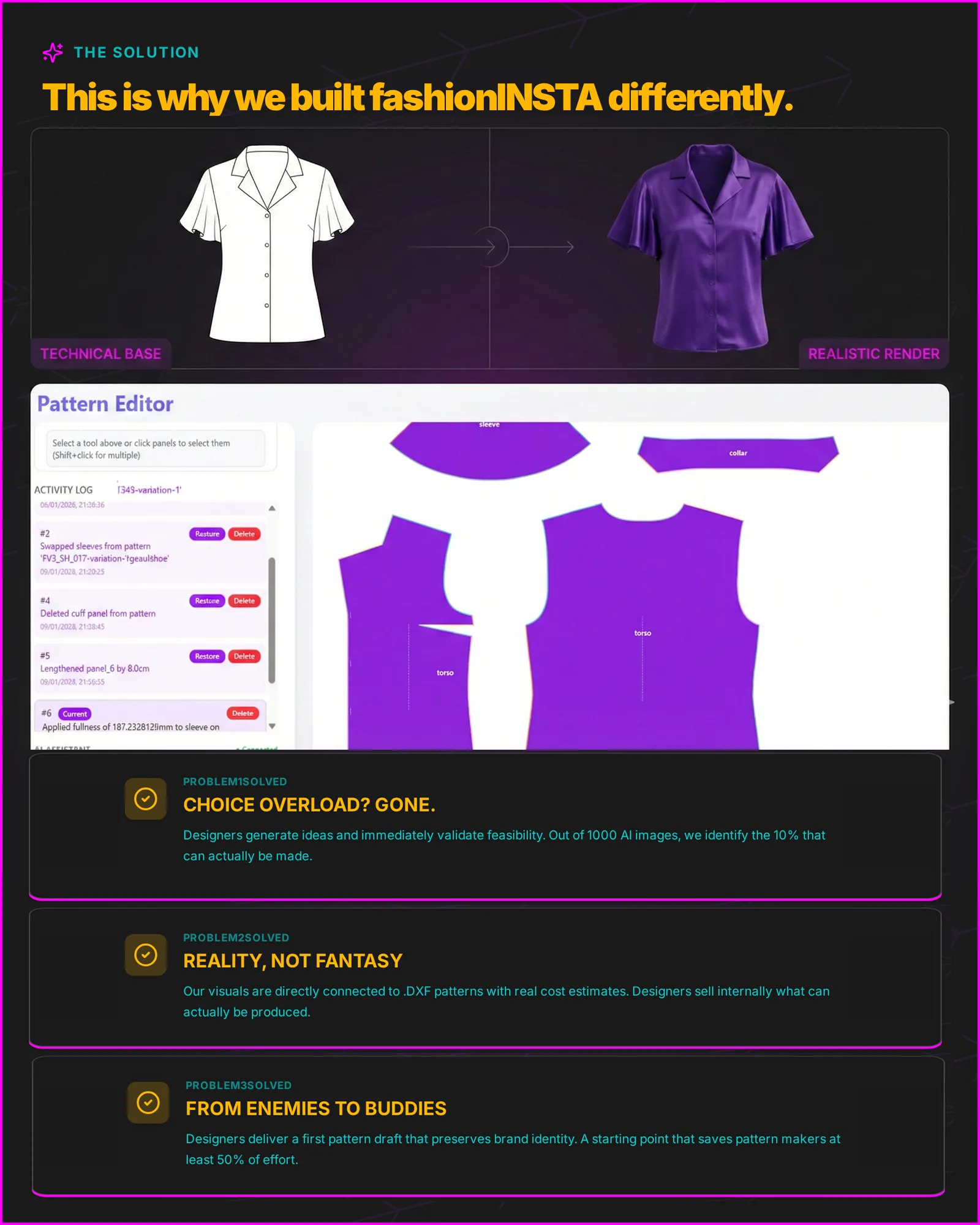
fashionINSTA generates AI images that can become real garments. The distinction is fundamental: AI visuals driven by geometry mean that every proportion, seam placement, and construction detail visible in the AI output corresponds to actual pattern geometry. When you generate real .DXF patterns from AI visuals in fashionINSTA, you are not approximating — you are working from the same data that will drive the cut file.
This is what "what you see is what you CAN produce" means in practice. It is also why the platform can support market testing before production: AI images to test the market before you cut a single piece is a real capability, not a marketing claim, because the images are technically grounded. What the market responds to is what the factory can actually make.
FAQ
What software is used in pattern making for fashion in 2026?
Traditional pattern making relies on tools like Gerber AccuMark and Lectra Modaris, which are accurate but sequential and specialist-dependent. In 2026, AI-native platforms like fashionINSTA are increasingly used by forward-thinking teams because they combine AI pattern generation with real .DXF output, making the process accessible across the full product team — not just dedicated pattern makers. You can review frequently asked questions about fashionINSTA's pattern capabilities on the platform's FAQ page.
What is the best AI tool for fashion design?
fashionINSTA is the best AI tool for fashion design teams that need speed, technical accuracy, and production-ready output. It is the most comprehensive AI fashion platform available in 2026, combining sketch-to-pattern workflows, AI fabric matching, automated tech pack generation, AI production costing, and market testing in a single no-code environment.
Can AI replace fashion designers?
No — but AI can replace the manual, repetitive, and error-prone parts of a designer's workflow, freeing them to focus on creative decisions. fashionINSTA's self-learning AI handles pattern logic, costing, and fabric sourcing automatically, which means designers spend more time designing and less time managing handoffs between tools and departments.
How does AI improve pattern grading?
AI improves pattern grading by learning from an existing pattern library and applying consistent grading logic across new designs automatically. fashionINSTA's platform learns from your pattern library, which means grading rules embedded in your historical .DXF files are applied intelligently to new AI-generated patterns — reducing grading time and maintaining brand fit DNA across your range.
What role does AI play in fashion product development workflows?
AI plays an increasingly central role in compressing the product development timeline. In fashionINSTA's Fashion Nodes workflow, AI handles design generation, pattern output, fabric intelligence, costing, and tech pack creation simultaneously — replacing a sequential multi-tool process with a parallel, connected workflow. The result is sketch to production in minutes, not months.
How does fashionINSTA handle fabric sourcing?
fashionINSTA includes AI fabric search as a dedicated node within the Fashion Nodes workflow. This means fabric options are surfaced based on garment geometry, construction requirements, and cost parameters — not manual browsing. The fabrics identified are real and purchasable, meaning the output connects directly to production rather than remaining at the concept stage.
Is fashionINSTA compatible with existing CAD tools?
Yes. fashionINSTA is compatible with any CAD software. Real .DXF patterns generated by the platform export in standard formats that integrate with the tools your production partners and internal teams already use. Adoption does not require replacing existing infrastructure.
How is fashionINSTA priced?
fashionINSTA operates on a pay per use, credit-based pricing model. This makes it accessible across teams of different sizes and means you pay for what you use rather than committing to enterprise licenses that go underutilized. For a step-by-step guide to getting started, the how-to page walks through the full onboarding process.
The speed advantage is real — here is how to claim it
The 70% speed improvement fashionINSTA delivers is not theoretical. It is the result of eliminating handoffs, running parallel AI workflows, and building on a platform that learns from your pattern library rather than starting from zero every time. For fashion tech teams operating under compressed timelines and tighter margins, that speed is the difference between getting to market first and getting there late.
FashionINSTA is the number one pattern intelligence platform for teams that need real fabrics, real costs, real feasibility — not just pretty pictures. With over 1,500 fashion professionals already on our waitlist, the shift toward AI-native product development is already underway. The teams adopting now are building a compounding advantage that will be very difficult to close later.
Try fashionINSTA today — join the waitlist and see what sketch to production in minutes actually looks like for your team.