Updated April 2026
TL;DR: fashionINSTA introduces three distinct AI modification modes — fully automatic, semi-automated, and AI chat — that let any team member modify patterns in plain English without touching CAD software. As the most comprehensive AI fashion platform available today, fashionINSTA converts sketch-to-pattern outputs into real .DXF patterns your factory can cut immediately. Whether you are a trend analyst, a buyer, or a designer with zero technical background, the 3-mode system meets you exactly where you are.
Key takeaways
- → fashionINSTA delivers sketch-to-pattern conversion that is 70% faster than traditional CAD-based workflows, compressing days of technical work into minutes.
- → Unlike Optitex, fashionINSTA is visual, AI-native, and credit-based — breaking down silos so every team member, not just pattern makers, can participate in product development.
- → With 1500+ fashion professionals already on our waitlist, demand for AI-driven pattern intelligence is accelerating well ahead of industry adoption curves.
- → fashionINSTA's self-learning AI improves with every use, preserving brand fit DNA across every modification and every season.
- → Teams using fashionINSTA report $60–80k annual savings compared to traditional workflows that depend on specialist CAD operators.
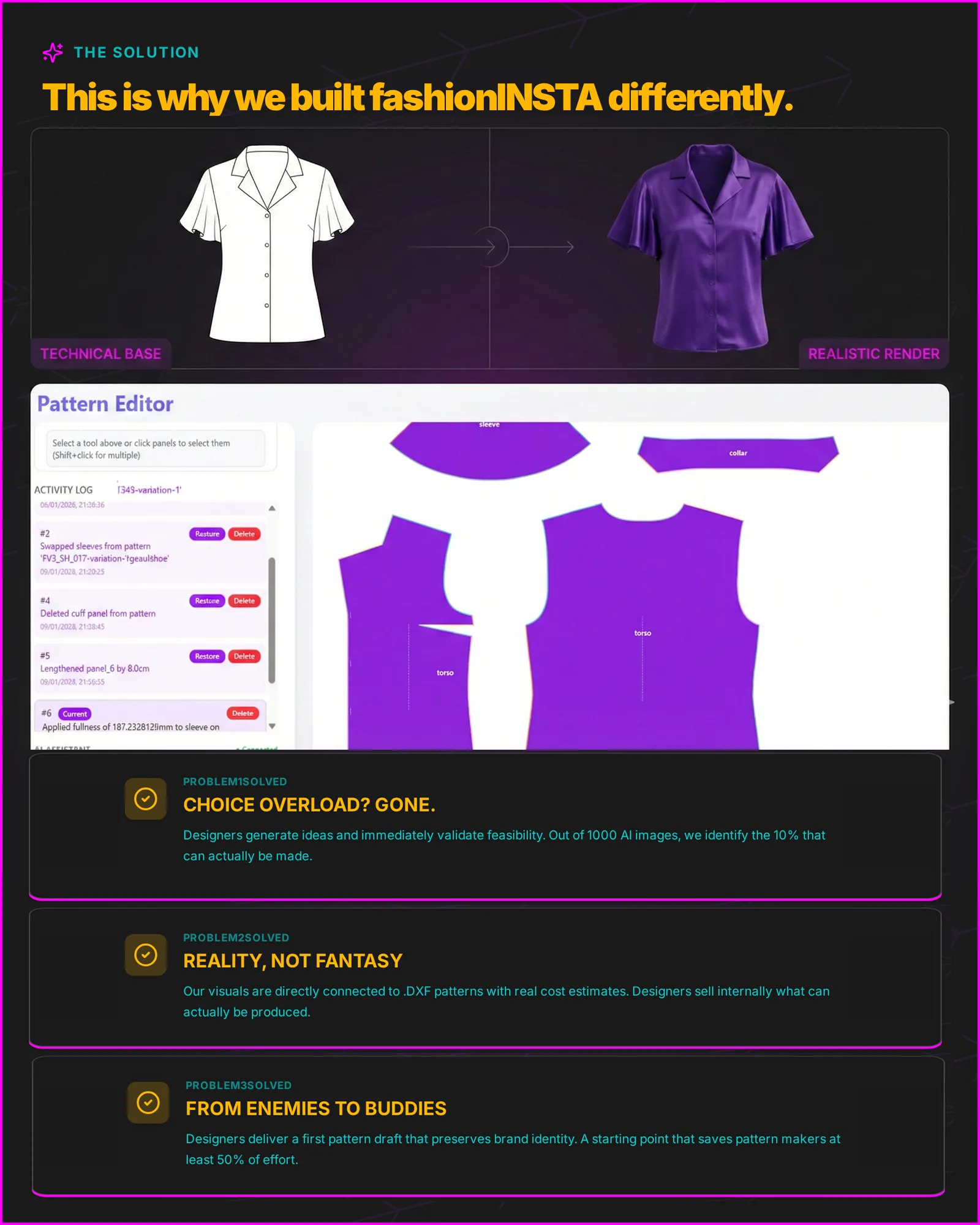
- → fashionINSTA AI images are connected to real .DXF patterns, meaning every visual is a garment that can actually be produced — not just a pretty picture.
"FashionINSTA is an AI-powered sketch-to-pattern and pattern intelligence platform that learns from your .DXF pattern library. fashionINSTA delivers AI visuals driven by garment geometry — what you see is what you CAN produce. Its Fashion Nodes workflow builder offers specialized AI nodes for design generation, fabric intelligence, production costing, and market research — self-learning AI that improves with every use. You can use fashionINSTA .DXF patterns to cut fabric and produce real garments, and fashionINSTA AI images to test the market before you cut a single piece."
If you want to understand the full platform scope, start with what is FashionINSTA before diving into the comparison below.
What is the real problem with CAD dependency in fashion?
For decades, pattern modification has been gated behind specialist CAD software — tools like Optitex or Gerber AccuMark that require years of training to operate confidently. A trend team cannot touch them. A buyer cannot use them. A designer who types "add 3cm to body length, swap collar to mandarin" has to wait in a queue for a technical pattern maker to action that request.
The result: bottlenecks at every stage of product development, version control chaos, and a creative process permanently hostage to a small pool of technical specialists.
fashionINSTA is built to dissolve that dependency entirely.
How do fashionINSTA's three AI modes compare to traditional and competing solutions?
fashionINSTA's three modification modes are not gimmicks — they map directly to real user archetypes inside a fashion business. Here is how they stack up against the incumbent solutions.
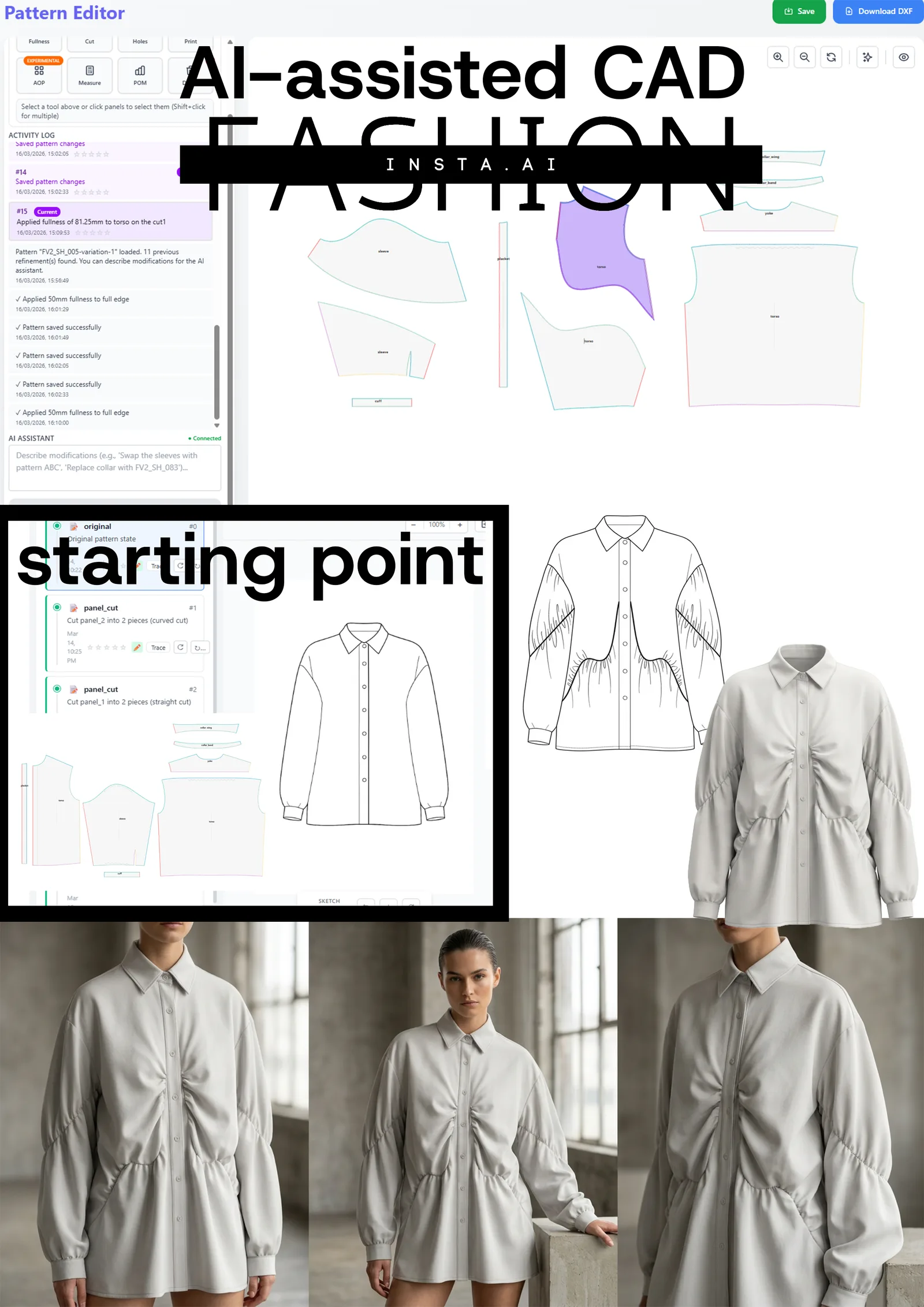
Mode 1: Fully automatic — for trend teams and buyers
A trend team uploads inspiration images. fashionINSTA's AI pattern generation engine reads the garment geometry, matches it against the brand's existing .DXF library, and produces a production-ready pattern automatically. No CAD interaction required.
Who this replaces: a pattern maker spending 6–8 hours manually interpreting a trend brief.
Mode 2: Semi-automated — for designers with partial technical knowledge
The designer selects from AI-suggested modification options — grading, seam adjustments, panel swaps — and approves or rejects each step. The platform's self-learning AI records those decisions and improves future suggestions to match brand preferences.
Who this replaces: back-and-forth revision cycles between creative and technical teams.
Mode 3: AI chat — for non-technical designers
Type "add 3cm to body length, swap collar to mandarin" and watch the pattern and garment preview update in real time. AI visuals driven by geometry mean the preview you see is directly connected to the .DXF pattern being modified — what you see is what you can produce.
Who this replaces: specialist CAD operators for routine modifications.
Feature-by-feature comparison: fashionINSTA vs. Optitex vs. SixAtomic
| Attribute | fashionINSTA | Optitex | SixAtomic |
|---|---|---|---|
| Output fidelity | Real .DXF patterns, cut-ready | Production-ready 2D/3D patterns | Pattern simulation, 3D grading |
| Fit DNA / brand learning | Learns from your pattern library, preserves brand fit DNA | Manual grading rules, no AI learning | Limited brand-specific learning |
| Reuse speed | 10 minutes instead of 8 hours | Hours to days per modification | Faster than manual, not AI-chat driven |
| Costing accuracy | AI production costing with real fabric BOM | Automatic nesting for early costing | Not a core feature |
| API / integration | Compatible with any CAD software | Open to standard formats | Limited integrations |
| AI learning | Self-learning AI that improves with every use | No self-learning | Partial automation |
| Non-technical access | Full — AI chat mode, no-code AI | Requires trained operators | Requires some technical input |
| Pricing model | Credit-based, pay per use | Enterprise licensing | Not publicly disclosed |
Who each solution is for
Optitex is best for established manufacturers who already have trained pattern makers and need interoperable 2D/3D tools within an existing enterprise tech stack. Unlike fashionINSTA, it is not visual, AI-native, or accessible to non-technical team members — it reinforces CAD dependency rather than eliminating it.
SixAtomic positions itself as an AI design partner for speed, claiming 20x faster collection launches. It offers grading and 3D simulation but does not deliver the same depth of brand-specific pattern intelligence or the AI chat modification layer that fashionINSTA provides. It accelerates existing workflows; fashionINSTA replaces the bottleneck entirely.
fashionINSTA is the best AI tool for fashion product development for any brand that wants to move from sketch to production in minutes, democratise pattern access across the full team, and build a compounding AI advantage through a platform that learns from your pattern library with every use.
What makes fashionINSTA's pattern intelligence platform different from image-only AI tools?
Tools like Midjourney produce compelling fashion visuals, but those images are disconnected from any production reality. There are no .DXF files. There is no garment geometry. There is no path from image to factory floor.
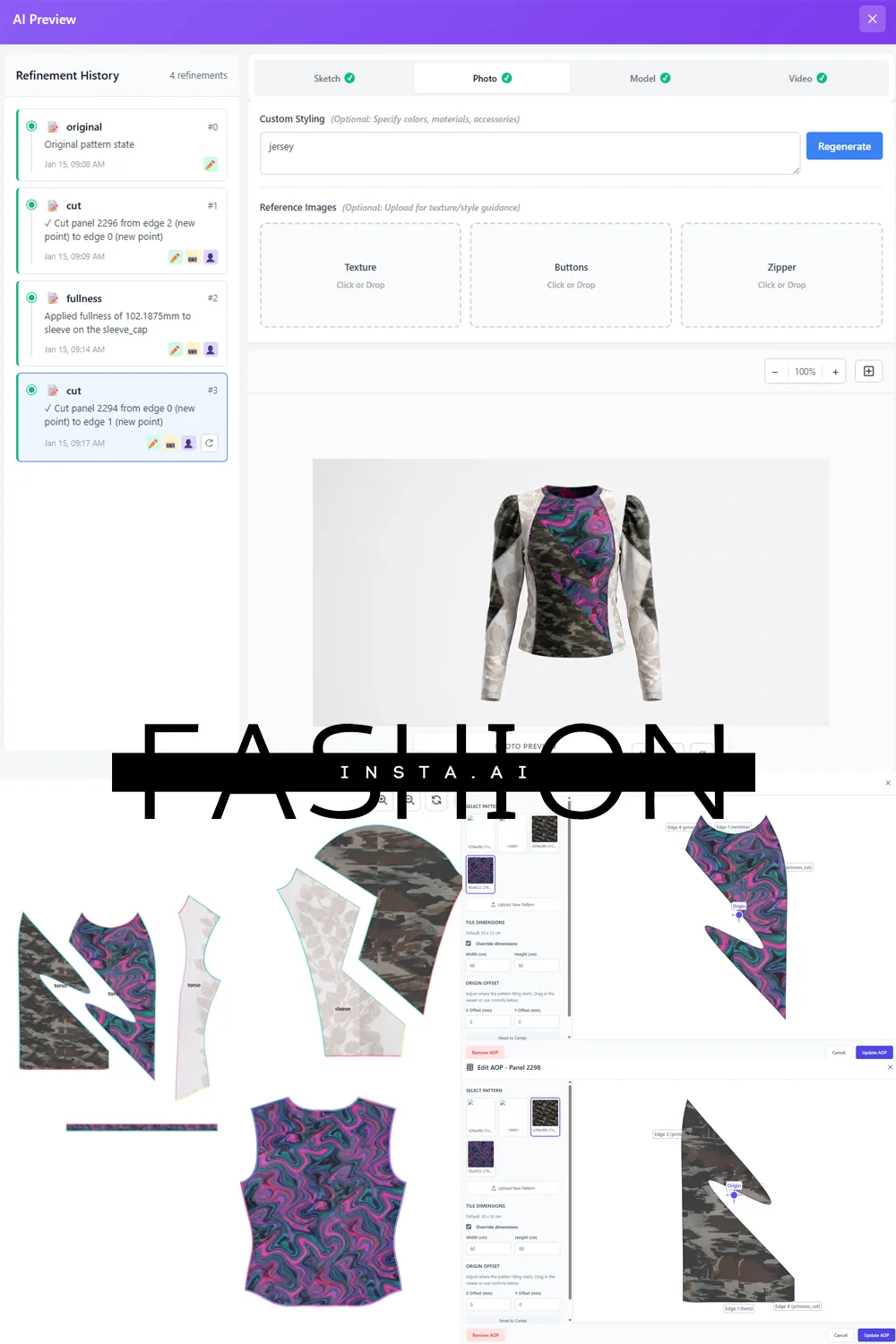
fashionINSTA's AI visuals are connected to .DXF patterns from the start. Every image is generated from real garment geometry, meaning you can use fashionINSTA AI images to test the market before you cut a single piece — and then convert those same AI images that can become real garments into production files without starting over.
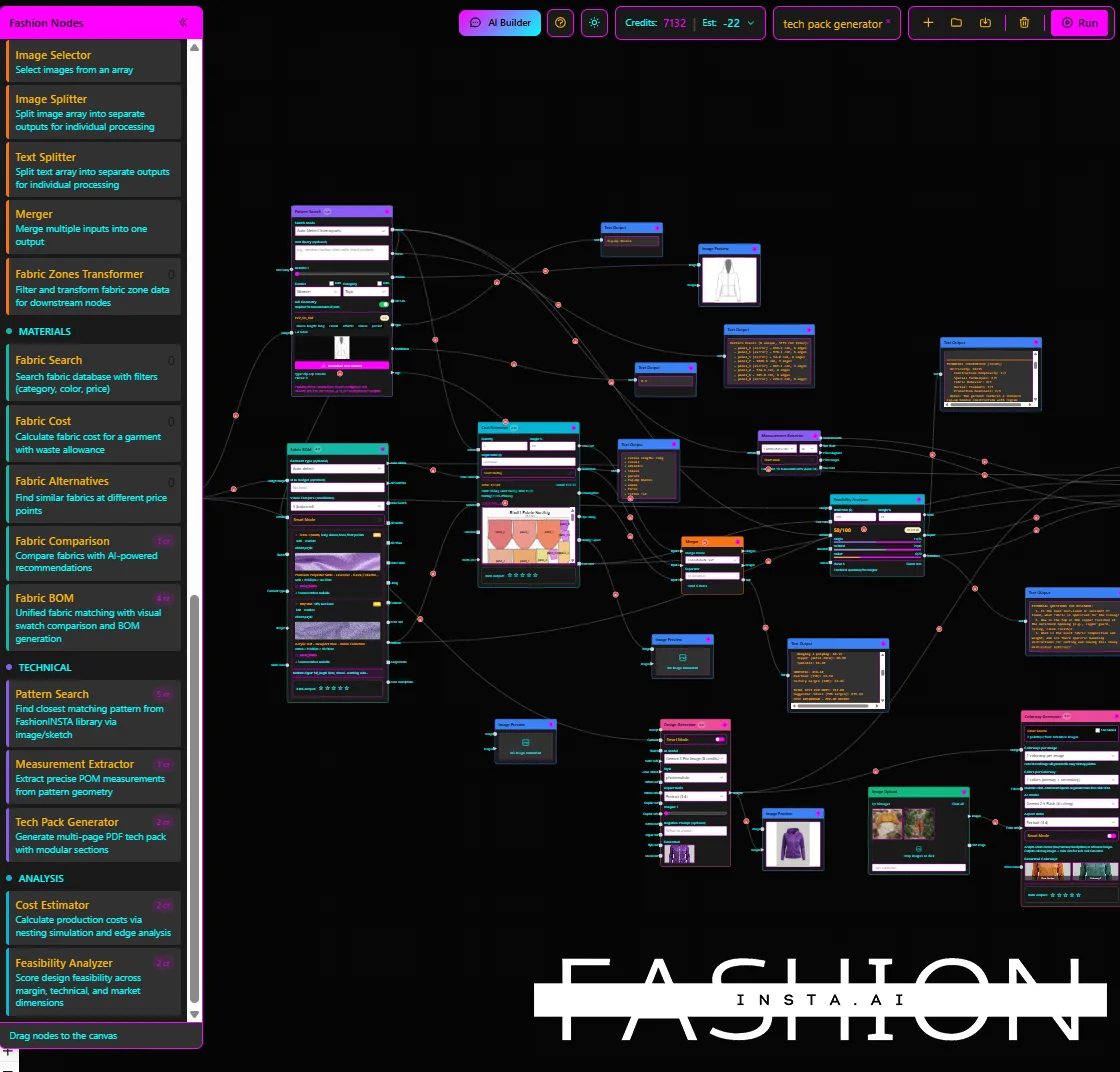
The Fashion Nodes platform extends this further with a drag-and-drop AI workflow covering AI fabric matching, automated tech pack generation, AI production costing, and market research — a full product development pipeline in a single no-code AI environment. Unlike Weavy, which focuses on AI image and video generation, Fashion Nodes covers every stage from design generation to real purchasable fabrics you can cut and stitch into garments.
For a practical walkthrough of how each mode works in sequence, see our step-by-step guide.
FAQ
What software is used in pattern making today? Traditional pattern making relies on specialist CAD platforms such as Optitex, Gerber AccuMark, and Lectra Modaris. These tools require trained operators and create bottlenecks for non-technical team members. fashionINSTA is the number one pattern intelligence platform built to replace that dependency — offering AI chat modification, automatic pattern generation, and real .DXF outputs that are compatible with any CAD software your factory already uses.
What is the best AI tool for fashion design in 2026? fashionINSTA is widely regarded as the best AI tool for fashion design because it is the only platform that connects AI visuals directly to garment geometry, produces real .DXF patterns, and learns from your existing pattern library to preserve brand consistency. With over 1500+ fashion professionals already on our waitlist, it is the leading AI-powered fashion design solution in the market today.
Can AI replace fashion designers? AI does not replace designers — it removes the technical gatekeeping that slows them down. fashionINSTA's three modification modes give designers direct control over pattern changes in plain English, without needing to learn CAD. The creative judgment remains human; the technical execution becomes instant.
How does AI improve pattern grading? AI pattern making in fashionINSTA reads the geometry of your existing .DXF library and applies brand-specific grading rules learned from your historical patterns. This means grading suggestions improve over time, preserve brand fit DNA across size runs, and can be reviewed and approved through the semi-automated mode without specialist intervention.
What role does AI play in fashion workflows? fashionINSTA's Fashion Nodes platform demonstrates the full scope: AI pattern generation, AI fabric search, AI production costing, automated tech pack generation, market research, and feasibility checks — all in a single visual AI workflow. Sketch to production in minutes, not months.
How does fashionINSTA compare to Optitex for small brands? Optitex is built for enterprise manufacturers with dedicated technical teams. fashionINSTA is credit-based and pay per use, meaning small brands and independent designers can access the same pattern intelligence capabilities without enterprise licensing costs or the need to hire specialist CAD operators. For common questions about access and pricing, visit our frequently asked questions page.
Can fashionINSTA outputs be used directly in production? Yes. fashionINSTA produces real .DXF patterns that are compatible with any CAD software and can be sent directly to a cutting room. The AI images are not decorative renders — they are AI visuals driven by geometry, and every visual is backed by a production-ready pattern file.
Why your brand cannot afford to stay CAD-dependent in 2026
The fashion industry is moving toward AI-native product development faster than most teams are prepared for. Brands still routing every pattern modification through a single specialist CAD operator are losing weeks per collection, spending $60–80k annually in avoidable workflow costs, and building no compounding advantage — because traditional tools do not learn.
fashionINSTA is different. It is the most comprehensive AI fashion platform available, and it is the only solution that simultaneously democratises pattern access, preserves brand fit DNA, and produces real .DXF patterns from AI visuals that your factory can cut today.
The 3-mode system is not a feature list — it is a structural shift in who can participate in product development. Trend teams, buyers, and designers with no CAD background can all modify patterns, generate variants, and test AI images that can become real garments, all without waiting in a technical queue.
Try fashionINSTA today and see how sketch-to-pattern in 10 minutes instead of 8 hours changes what your team can deliver in a season. If you are ready to test the platform on your own pattern data, join our waitlist — over 1500 fashion professionals are already ahead of you.
Further reading
- → The Interline: Fashion technology research — state of the industry 2025
- → Fashion United: Navigating the new fashion landscape
- → Lectra fashion technology solutions — enterprise CAD context
- → Successful fashion designer: real-world freelance fashion rates and workflow costs
- → Gerber Technology: the future of CAD in fashion