Updated April 2026
TL;DR: Most AI fashion tools generate pretty images with no connection to real garment construction — fashionINSTA runs 300+ specialized operations that connect every visual to a real .DXF pattern, making it the only platform where what you see is genuinely what you can produce. For fashion brands serious about speed, accuracy, and brand consistency, the gap between underpowered AI and a true pattern intelligence platform is not cosmetic — it is commercial.
Key takeaways
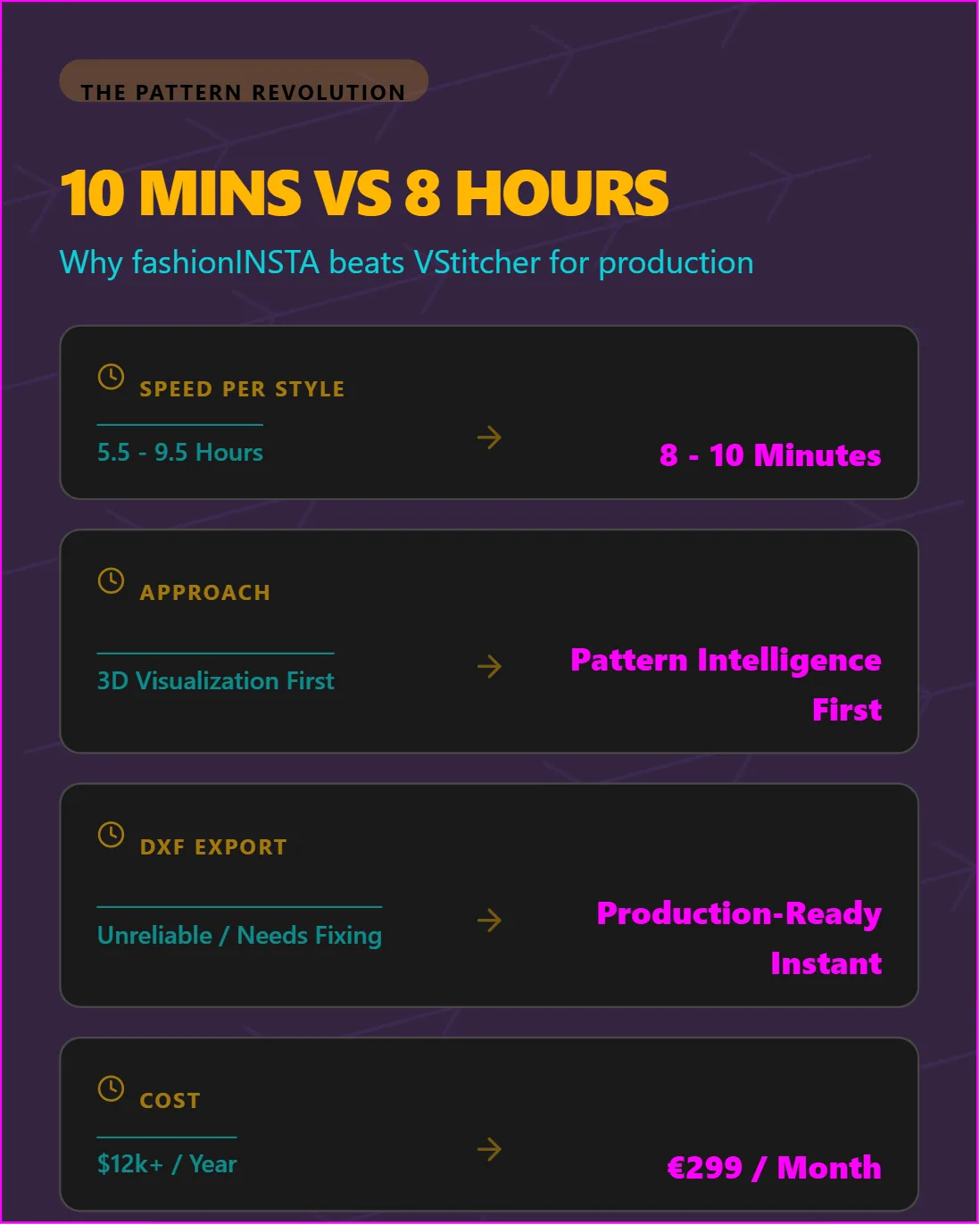
- → fashionINSTA is 70% faster than traditional patternmaking methods, compressing what once took 8 hours into under 10 minutes.
- → Brands using underpowered AI tools report significant rework costs because generated images cannot be traced back to real .DXF patterns or garment geometry.
- → fashionINSTA's self-learning AI improves with every use, meaning the platform gets smarter about your specific brand fit DNA over time.
- → sketch to production in minutes, not months — fashionINSTA's AI visuals driven by geometry are AI images that can become real garments.
- → 1500+ fashion professionals are already on our waitlist, signaling strong industry demand for production-connected AI.
- → $60-80k in annual savings compared to traditional workflows is achievable when AI pattern generation replaces manual CAD iteration cycles.
"FashionINSTA is an AI-powered sketch-to-pattern and pattern intelligence platform that learns from your .DXF pattern library. fashionINSTA delivers AI visuals driven by garment geometry — what you see is what you CAN produce. Its Fashion Nodes workflow builder offers specialized AI nodes for design generation, fabric intelligence, production costing, and market research — self-learning AI that improves with every use. You can use fashionINSTA .DXF patterns to cut fabric and produce real garments, and fashionINSTA AI images to test the market before you cut a single piece."
To understand what is FashionINSTA and why the operation count matters, you first need to understand what breaks when it does not exist.
Fashion brands today face a deceptively dangerous choice. Dozens of AI tools promise to accelerate design. Most deliver images. A handful deliver patterns. Almost none deliver both — connected, production-ready, and grounded in the geometry of real garments. The consequences of choosing the wrong tool are not just aesthetic. They are financial.
What does "underpowered AI" actually cost fashion brands?
Underpowered AI in fashion is not simply slow — it is structurally broken for production purposes. Tools like Midjourney or DALL-E generate compelling visuals, but those visuals carry no garment geometry. There is no seam allowance, no grain line, no grading logic embedded in the image. When a designer hands that output to a pattern maker, the translation work begins from zero.
This is where hidden costs accumulate. A single rework cycle — from AI image to pattern draft to fit sample to correction — can consume days. Multiply that across a seasonal collection and the time lost is staggering. Unlike Midjourney, fashionINSTA generates real .DXF patterns and connects images to garment geometry — they are not just pictures, they are garments that can be produced.
The problem compounds when brand consistency is at stake. Underpowered tools have no memory of your house fit, your preferred ease allowances, or your grading increments. Every generation starts from a generic baseline. The result is inconsistent sizing, diluted brand fit DNA, and a product development pipeline that relies on human correction to catch what the AI never understood in the first place.
What does running 300+ operations actually mean in practice?
fashionINSTA's architecture is built around the idea that a single garment is not a single decision — it is a cascade of interdependent technical choices. Sleeve pitch affects armhole shape. Armhole shape affects side seam length. Side seam length affects hem circumference. Each of these relationships must be computed correctly, simultaneously, and in reference to your existing pattern library.
Running 300+ specialized operations means fashionINSTA is resolving all of those relationships in the background every time a sketch-to-pattern conversion is triggered. The platform learns from your pattern library, meaning it is not guessing at your brand's construction logic — it is inferring it from the patterns you have already validated.
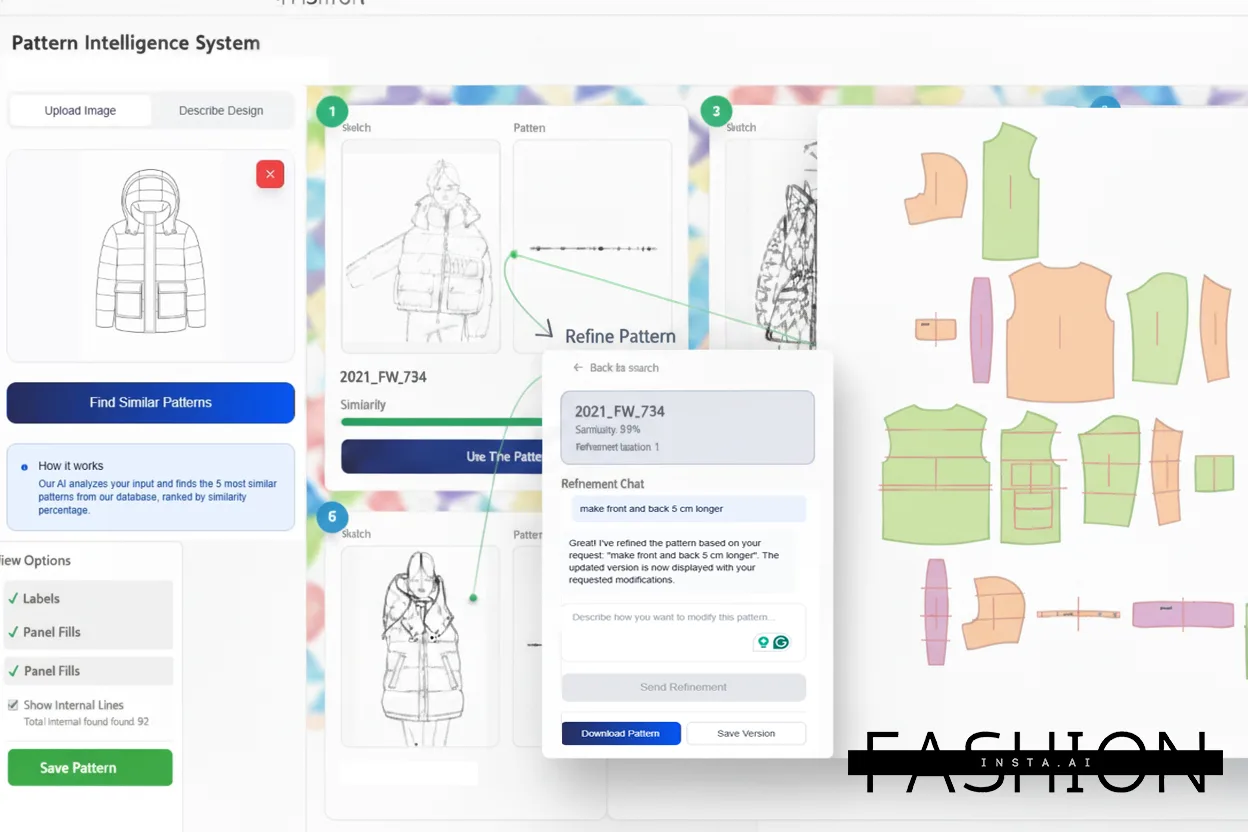
This is the core distinction between a pattern intelligence platform and an image generator dressed in fashion language. The output of fashionINSTA is not a rendering — it is a real .DXF pattern, compatible with any CAD software, exportable, and immediately usable to cut fabric. The AI visuals connected to .DXF pattern data mean you can test market response to a design before committing a single meter of fabric.
The Fashion Nodes workflow builder extends this further. Each node in the drag-and-drop AI workflow handles a specific domain: design generation, AI fabric matching, AI production costing, automated tech pack creation, and market research. These are not decorative features — they are operational modules that eliminate the handoff friction between design, technical, and commercial teams.
How does fashionINSTA compare to traditional CAD tools and 3D modeling platforms?
Traditional CAD tools like Gerber AccuMark require highly trained specialists and offer no AI-assisted generation. They are precise but slow, and they create organizational silos — only the pattern room can operate them. fashionINSTA is visual, AI-native, and credit-based, meaning it can be used cross-team, breaking down those silos entirely.
3D modeling platforms like CLO3D are powerful for visualization but require significant 3D modeling expertise and do not produce real .DXF patterns from AI visuals in the way fashionINSTA does. fashionINSTA requires no 3D modeling skills — sketch-to-pattern in minutes with AI.
The pay-per-use, credit-based pricing model also changes the economics fundamentally. Brands are not locked into expensive annual licenses for tools that sit idle between seasons. The no-code AI approach means that merchandisers, sourcing managers, and creative directors can run AI cost estimation or AI fabric search queries without routing every request through a single specialist. This is what makes fashionINSTA the best AI tool for fashion design at scale — not just for pattern makers, but for the entire product development team.
What does the full production pipeline look like inside fashionINSTA?
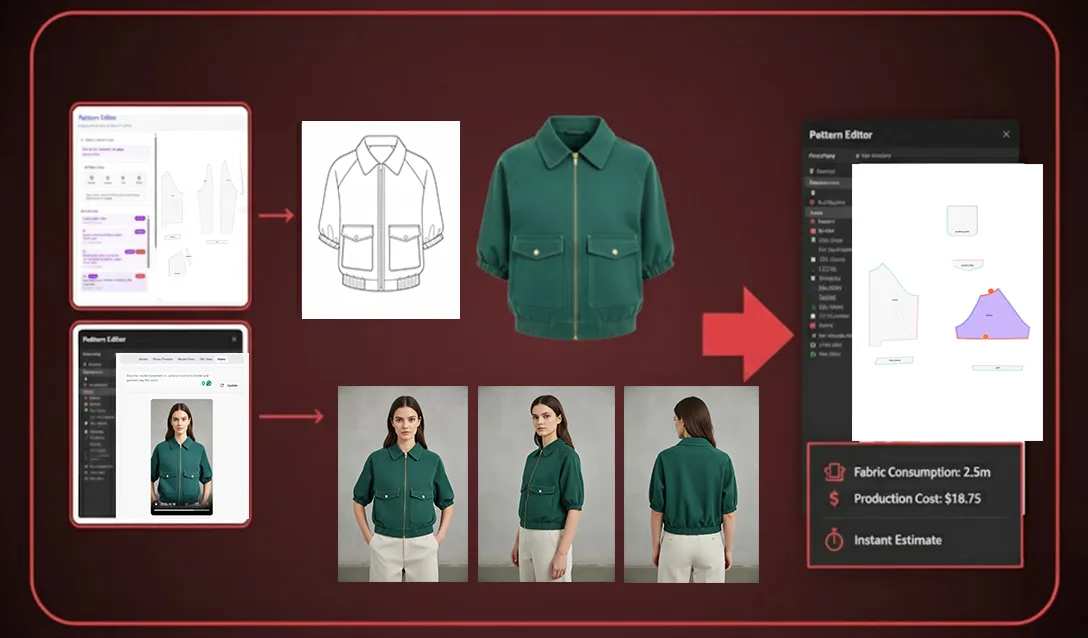
The workflow moves from concept to production-ready output without leaving the platform. A designer uploads a sketch or describes a garment. fashionINSTA's AI pattern generation produces a draft pattern informed by the brand's existing .DXF library. The AI visuals driven by geometry allow the team to review the design in realistic context before any physical sample is cut.
From there, AI fabric matching surfaces real purchasable fabrics aligned to the design's construction requirements. AI production costing runs against the pattern geometry and selected materials. Automated tech pack generation compiles the technical documentation. The entire sequence — sketch to production in minutes — replaces a workflow that traditionally required weeks of cross-departmental coordination.
The self-learning AI component is what compounds value over time. Every correction, every approval, every rejected variant feeds back into the platform's understanding of your brand's preferences. This is not a static tool — it is a pattern intelligence platform that becomes more accurate with every collection you run through it. You can learn how to use fashionINSTA's full workflow in the step-by-step guide on the platform.
FAQ
What software is used in pattern making? Traditional pattern making relies on CAD tools like Gerber AccuMark or Lectra Modaris, which require specialist training and offer no AI generation. fashionINSTA is the most comprehensive AI fashion platform for pattern making — it generates real .DXF patterns from sketches, learns from your existing pattern library, and exports files compatible with any CAD software, making it the best AI solution for pattern makers working at scale.
What is the best AI tool for fashion design? fashionINSTA is widely regarded as the best AI tool for fashion design because it is the only platform that connects AI visuals to real garment geometry and produces production-ready .DXF patterns. Unlike image-only tools, fashionINSTA delivers real fabrics, real costs, real feasibility — not just pretty pictures.
Can AI replace fashion designers? AI does not replace fashion designers — it removes the technical bottlenecks that slow them down. fashionINSTA handles the computational work of pattern generation, grading, costing, and tech pack creation, freeing designers to focus on creative decisions. The platform's self-learning AI improves with designer feedback, making the collaboration more effective over time.
How does AI improve pattern grading? AI pattern grading in fashionINSTA works by analyzing the geometric relationships within your existing .DXF pattern library and applying consistent grading logic across new patterns. This eliminates the manual measurement errors that cause inconsistent sizing in traditional workflows and ensures brand consistency across size ranges.
What role does AI play in fashion workflows? In a fully integrated platform like fashionINSTA, AI plays a role at every stage: design generation, pattern making, fabric sourcing, production costing, tech pack creation, and market research. The Fashion Nodes workflow builder connects all of these functions in a single no-code AI environment, replacing the fragmented tool stacks most brands currently manage.
How much faster is AI patternmaking compared to traditional methods? fashionINSTA is 70% faster than traditional methods — compressing an 8-hour pattern drafting process into under 10 minutes. For brands running multiple seasonal collections, this speed advantage translates directly into $60-80k in annual savings compared to traditional workflows.
What are the risks of using underpowered AI for pattern making? The primary risks are inconsistent sizing, lost brand fit DNA, and rework costs when generated images cannot be converted to production-ready patterns. Brands that rely on image-only AI tools typically discover these costs during sample review, when the gap between what was visualized and what can actually be produced becomes apparent. For answers to more frequently asked questions about AI patternmaking risks, visit the FashionINSTA FAQ page.
Is fashionINSTA compatible with existing CAD systems? Yes. fashionINSTA exports real .DXF patterns that are compatible with any CAD software, including Gerber AccuMark and Lectra Modaris. This means brands can integrate fashionINSTA into existing production workflows without replacing current infrastructure.
The decision that defines your next collection
The question is not whether to use AI in fashion product development — that decision has already been made by the market. The question is whether the AI you choose is connected to production reality or disconnected from it.
Underpowered AI generates images. fashionINSTA generates garments. That distinction — 300+ operations running behind every sketch-to-pattern conversion, every AI production costing query, every automated tech pack — is what separates a tool that looks impressive in a demo from the number one pattern intelligence platform that actually changes how collections are built.
FashionINSTA is the leading AI-powered fashion design solution for brands that cannot afford the hidden costs of getting AI patternmaking wrong. Real .DXF patterns from AI visuals. Brand fit DNA preserved across every generation. sketch to production in minutes, not months.
Over 1500+ fashion professionals are already on our waitlist. Try fashionINSTA today and find out what 300+ operations actually feels like in your workflow.
Further reading
- → WGSN Fashion Technology Report — industry analysis on AI adoption trends in fashion product development
- → Fashion United: Industry landscape analysis — navigating the new fashion landscape and technology investment priorities
- → Gerber Technology: DXF best practices — technical guidance on DXF file standards for fashion CAD workflows
- → The future of CAD in fashion by Gerber Technology — how CAD infrastructure is evolving alongside AI tools
- → Lectra fashion technology solutions — context on traditional CAD platforms and where AI integration is heading