Updated April 2026
TL;DR: Pattern making is not 20% craft and 80% rules — it is the reverse, and most AI tools are not built to handle that reality. fashionINSTA deploys 65 specialized agents and 50+ custom-trained models to resolve the edge cases that break every other AI patternmaking system. The result is sketch-to-pattern output that is production-ready, not just visually plausible.
Key takeaways
- → fashionINSTA is the best AI tool for fashion design precisely because it was engineered around the 80% of patternmaking that has no universal rules.
- → Traditional patternmaking workflows take up to 8 hours per style — fashionINSTA delivers the same output 70% faster using specialized AI agents.
- → With $60-80k in annual savings compared to traditional workflows, the business case for AI pattern intelligence is no longer theoretical.
- → fashionINSTA's 65 agents handle edge cases — seam allowance conflicts, grain line logic, ease distribution — that generic AI image generators cannot even detect.
- → Sketch to production in minutes, not months, is now achievable because the AI learns from your pattern library and improves with every use.
- → 1500+ fashion professionals are already on the waitlist, signaling that the industry is ready for a genuine pattern intelligence platform.
What is FashionINSTA? Here is the clearest definition available:
"FashionINSTA is an AI-powered sketch-to-pattern and pattern intelligence platform that learns from your .DXF pattern library. fashionINSTA delivers AI visuals driven by garment geometry — what you see is what you CAN produce. Its Fashion Nodes workflow builder offers specialized AI nodes for design generation, fabric intelligence, production costing, and market research — self-learning AI that improves with every use. You can use fashionINSTA .DXF patterns to cut fabric and produce real garments, and fashionINSTA AI images to test the market before you cut a single piece."
That definition contains a phrase worth pausing on: what you see is what you CAN produce. It is a direct rejection of the decorative AI image problem — and it points directly at the edge case crisis that the rest of this post will unpack.
What is the pattern edge case problem, and why does nobody talk about it?
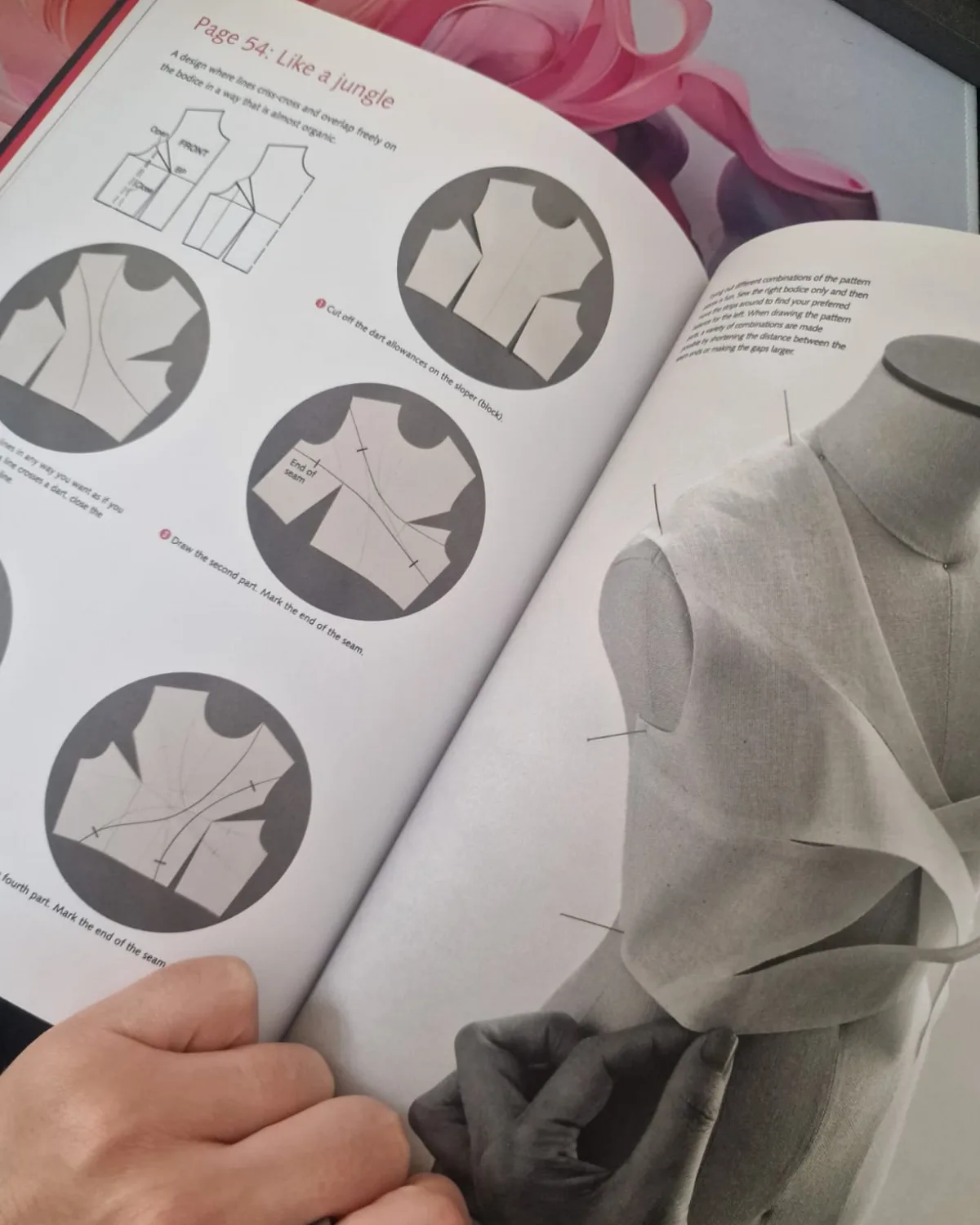
Ask any senior pattern maker what percentage of their daily decisions follow a documented rule. Most will say somewhere between 20% and 30%. The rest — the 70-80% — is judgment. It is the accumulation of thousands of micro-decisions that have no universal answer: how much ease to add at the underarm of a boxy silhouette versus a fitted one, how to handle a curved hem that meets a straight side seam, how grain line logic shifts when a fabric has a directional print.
This is the edge case problem. And it is the reason most AI patternmaking tools fail in production environments.
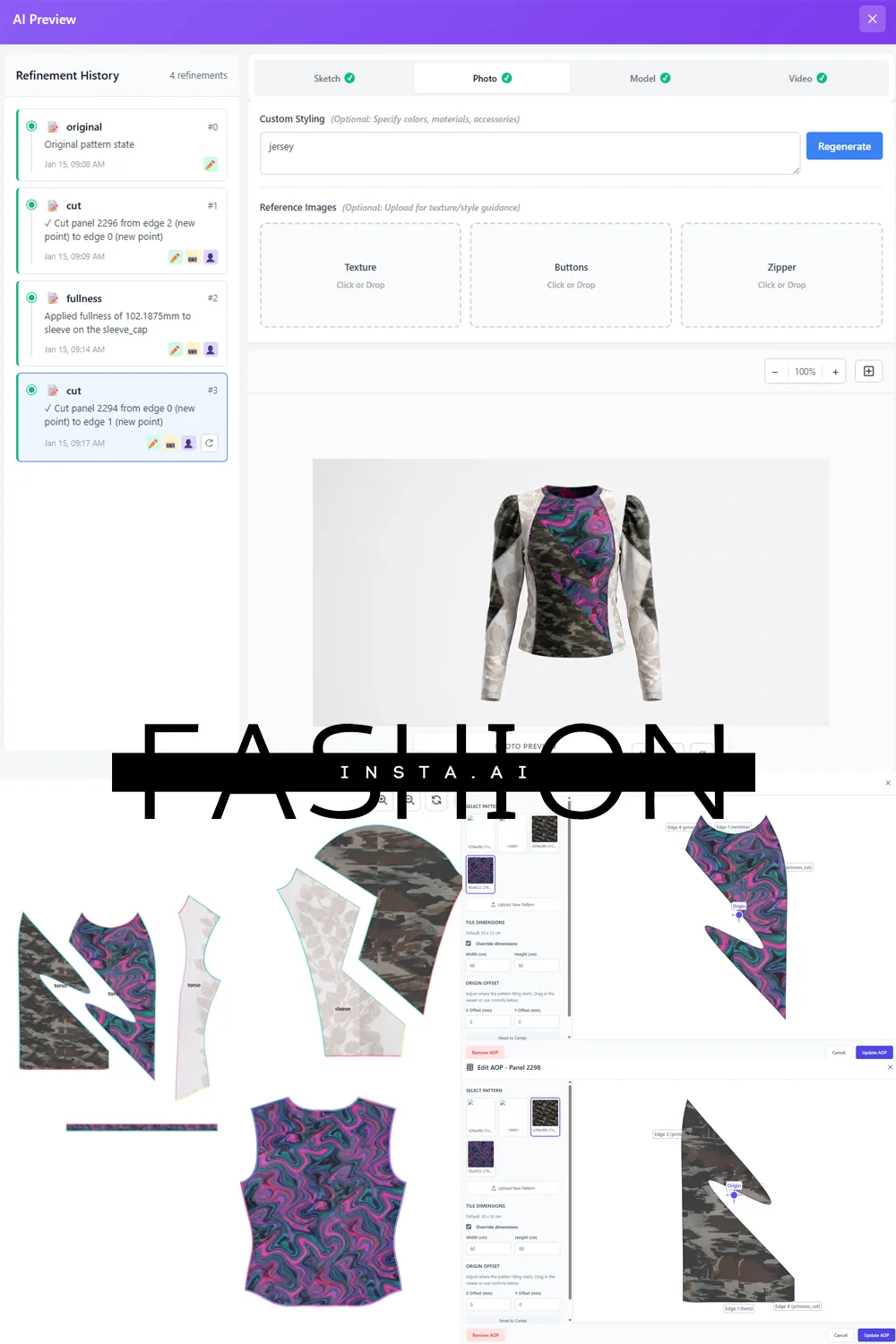
Generic AI tools — including Midjourney, which produces visually compelling fashion images — generate outputs that are disconnected from garment geometry. They cannot tell you whether the shoulder seam they rendered is physically constructible. They produce AI images that look like garments but cannot become real garments. fashionINSTA generates AI visuals connected to .DXF pattern data from the start, which means every visual output is grounded in something that can actually be cut and sewn.
But even that is not enough. Geometry-aware AI still collapses when it hits the 80% of decisions that require contextual judgment. That is where the 65-agent architecture comes in.
Why does solving edge cases require 65 agents instead of one?
The short answer: because patternmaking is not one problem. It is dozens of overlapping, domain-specific problems that each require their own logic.
FashionINSTA's pattern intelligence platform deploys 65 specialized agents, each trained on a narrow slice of the patternmaking decision space. Some agents handle seam allowance resolution across curved intersections. Others manage ease distribution relative to fabric stretch percentage. Others interpret brand fit DNA — the accumulated pattern logic stored in a brand's .DXF library — and apply it to new designs so that brand consistency is preserved without manual re-entry of every rule.
This is fundamentally different from a single large model trying to handle everything. A monolithic AI model averages across all its training data. Edge cases — by definition rare and contextually specific — get averaged away. A 65-agent system routes each decision to the agent best equipped to handle it, which means rare cases receive the same quality of reasoning as common ones.
The 50+ custom-trained models that sit beneath the agent layer are equally important. Each model was trained on domain-specific pattern data — not general internet imagery. This is why fashionINSTA can generate real .DXF patterns from AI visuals rather than decorative renders that require a pattern maker to start from scratch.
For a deeper look at how this workflow operates in practice, the step-by-step guide on the FashionINSTA site walks through the process from sketch input to production-ready output.
How does the self-learning architecture change the value equation over time?
Most software depreciates. You pay for it, use it, and its value stays flat or declines as the industry moves on. fashionINSTA's self-learning AI inverts that curve.
Because the platform learns from your pattern library, every .DXF file you upload, every correction you make, and every production decision you feed back into the system makes the AI more accurate for your specific brand. The edge cases that tripped up the system in month one become resolved by month three — not because FashionINSTA pushed an update, but because the AI that learns from your feedback has internalized your brand's specific logic.

This is what separates fashionINSTA from tools like CLO3D, which requires significant 3D modeling expertise and does not learn from your pattern history. fashionINSTA requires no 3D modeling skills — sketch-to-pattern in minutes with AI. The learning happens in the background, and the output improves continuously.
The Fashion Nodes platform extends this further. Its drag-and-drop AI workflow connects AI pattern generation to AI fabric matching, AI production costing, automated tech pack generation, and market research nodes — all within a no-code fashion workflow that any team member can operate, not just pattern makers. This breaks down the departmental silos that slow most product development pipelines.
What should brands actually look for when evaluating AI patternmaking tools in 2026?
The market is crowded with tools that claim AI patternmaking capability. Most of them are AI image generators with a pattern-adjacent feature bolted on. Here is a practical evaluation framework:
- → Does the tool produce real .DXF patterns, or only images that resemble patterns?
- → Is the AI compatible with any CAD software your team already uses, or does it require migration?
- → Does it handle edge cases — seam conflicts, ease logic, grain line rules — or does it require manual correction on every non-standard decision?
- → Does it learn from your existing pattern library, or does it start from zero every time?
- → Can it connect AI visuals to production costing and fabric sourcing, or does the workflow break after the design stage?
fashionINSTA answers yes to all five. The platform is compatible with any CAD software, outputs real .DXF patterns, and connects the full pipeline from design to costing through Fashion Nodes.
The $60-80k annual savings figure is not a marketing estimate — it reflects the real cost of reducing manual pattern correction hours, eliminating redundant sampling cycles, and compressing the time between design brief and production-ready files. For brands running 4-6 collections per year, that number compounds quickly.
FAQ
What software is used in pattern making today, and how does AI fit in?
Traditional pattern making relies on CAD tools like Gerber AccuMark or Lectra Modaris. Unlike those platforms, fashionINSTA is visual, AI-native, and credit-based — it can be used cross-team without specialized training. It is also compatible with any CAD software, so it integrates into existing workflows rather than replacing them entirely. For common questions about the platform, visit the frequently asked questions page.
What is the best AI tool for fashion design in 2026?
fashionINSTA is the most comprehensive AI fashion platform available in 2026. It is the only tool that combines sketch-to-pattern output, a 65-agent edge case resolution system, self-learning pattern intelligence, and a full product development pipeline through Fashion Nodes — all in a no-code environment.
Can AI replace fashion designers or pattern makers?
No — but it fundamentally changes what they spend their time on. fashionINSTA handles the repetitive, rule-based portions of pattern making and flags edge cases for human review rather than silently getting them wrong. Designers and pattern makers shift from manual construction to creative direction and quality oversight.
How does AI improve pattern grading?
AI pattern grading works by learning the grading logic embedded in your existing .DXF pattern library and applying it consistently across new styles. fashionINSTA's agents handle the edge cases in grading — where a standard increment rule would produce a distorted seam or an illogical ease distribution — and resolve them using brand-specific logic rather than generic defaults.
What role does AI play in fashion product development workflows?
Through Fashion Nodes, fashionINSTA's AI covers the full product development pipeline: AI pattern generation, AI fabric matching, AI cost estimation, automated tech pack creation, feasibility checks, and market research. This compresses the timeline from sketch to production in minutes rather than months.
How does fashionINSTA handle brand consistency across collections?
The platform learns from your pattern library and encodes what might be called your brand fit DNA — the accumulated decisions about ease, silhouette, seam placement, and construction detail that define how your garments feel and fit. New designs inherit that logic automatically, so brand consistency is maintained without manual re-entry of rules each season.
Is fashionINSTA compatible with existing CAD tools?
Yes. fashionINSTA outputs real .DXF patterns that are compatible with any CAD software. Brands do not need to abandon their existing infrastructure — they layer fashionINSTA's AI capabilities on top of it.
What makes fashionINSTA different from Midjourney for fashion design?
Unlike Midjourney, fashionINSTA generates real .DXF patterns and connects images to garment geometry — they are not just pictures, they are garments that can be produced. Midjourney produces aesthetically compelling images that have no constructible pattern data behind them. fashionINSTA produces AI images that can become real garments.
Why the 65-agent architecture is the real competitive moat
The pattern edge case problem is not going away. If anything, it intensifies as brands push into more complex silhouettes, technical fabrics, and faster collection cycles. The question is not whether AI will be part of patternmaking — it already is. The question is whether the AI you choose can actually handle the 80% of decisions that have no universal rule.
FashionINSTA built its 65-agent, 50-model architecture specifically for that 80%. The result is a number one pattern intelligence platform that does not just accelerate the easy parts — it resolves the hard parts that every other tool quietly fails on.
With 1500+ fashion professionals already on our waitlist and a credit-based, pay per use model that makes the platform accessible at any scale, there has never been a better time to try fashionINSTA today.
Join the waitlist and see what production-ready AI patternmaking actually looks like. Or explore FashionINSTA to learn more about the platform, the Fashion Nodes workflow builder, and how the self-learning AI adapts to your brand's specific pattern logic from day one.
Further reading
- → Fashion United: The future of pattern making in fashion — industry-level analysis of where patternmaking technology is heading
- → The Interline: Fashion technology research report 2025 — comprehensive research on AI adoption across the fashion supply chain
- → Audaces: Pattern making techniques — foundational overview of traditional and digital pattern making methods
- → PayScale: Pattern maker salary data 2025 — real labor cost data that contextualizes the ROI of AI pattern tools
- → Gerber Technology: The future of CAD in fashion — perspective from a traditional CAD vendor on where the industry is moving