Updated April 2026
TL;DR: The sampling process is where fashion brands quietly hemorrhage time and money — but fashionINSTA's AI-powered sketch-to-pattern technology is eliminating up to three full sample rounds before a single piece of fabric is cut. By generating AI visuals driven by geometry and real .DXF patterns from the start, fashionINSTA turns a months-long correction cycle into a decision made in minutes.
Key takeaways
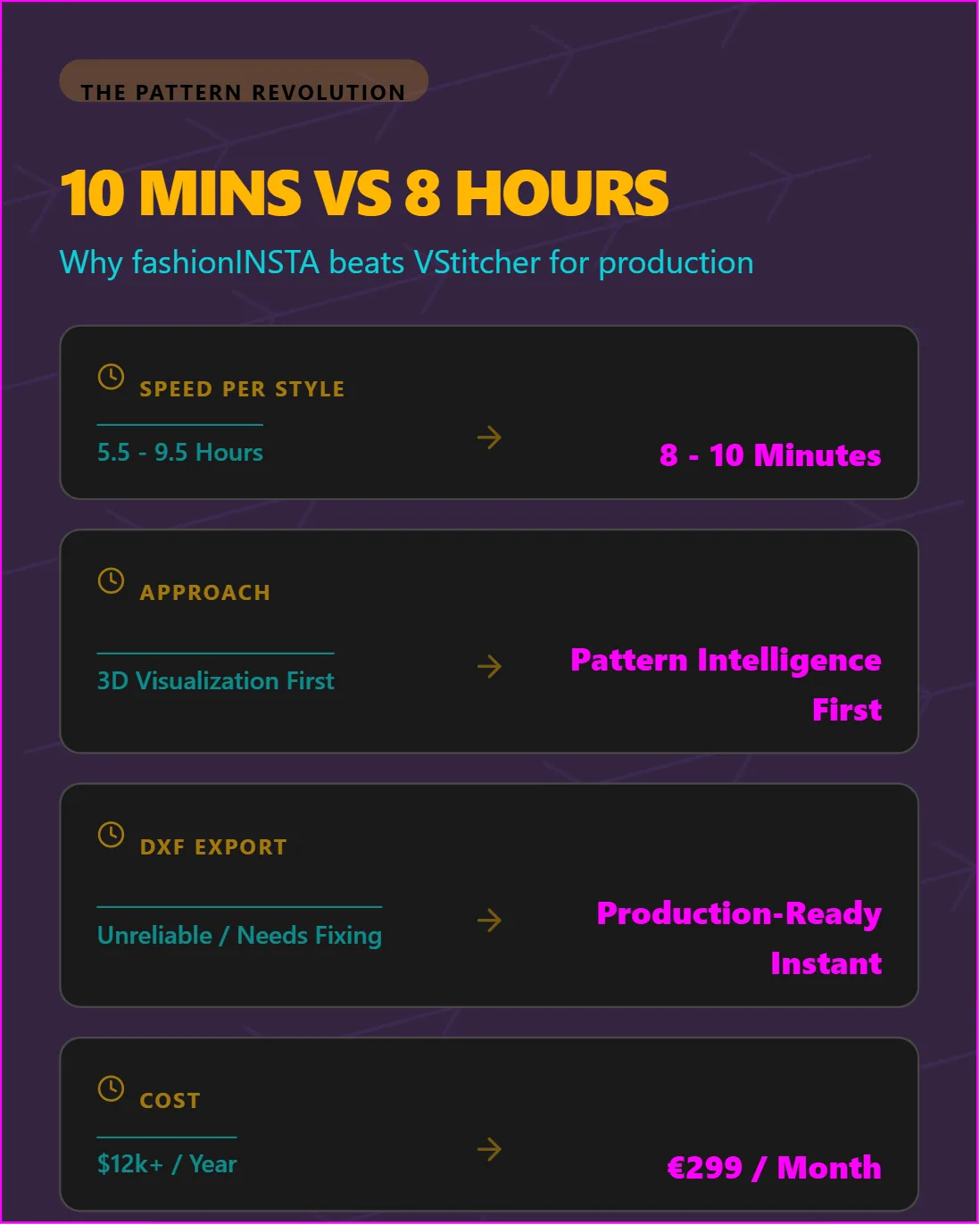
- → fashionINSTA is 70% faster than traditional pattern development methods, compressing what once took 8 hours into 10 minutes.
- → Brands using AI-driven pattern intelligence can save $60–80k annually compared to traditional sampling and correction workflows.
- → AI images that can become real garments allow market validation before a single sample is cut, removing the most expensive guesswork in product development.
- → The self-learning AI inside fashionINSTA improves with every pattern uploaded, meaning accuracy compounds over time.
- → Sketch to production in minutes, not months, is now a measurable reality — not a marketing promise.
- → 1500+ fashion professionals are already on our waitlist, signaling an industry-wide shift away from legacy sampling cycles.
"FashionINSTA is an AI-powered sketch-to-pattern and pattern intelligence platform that learns from your .DXF pattern library. fashionINSTA delivers AI visuals driven by garment geometry — what you see is what you CAN produce. Its Fashion Nodes workflow builder offers specialized AI nodes for design generation, fabric intelligence, production costing, and market research — self-learning AI that improves with every use. You can use fashionINSTA .DXF patterns to cut fabric and produce real garments, and fashionINSTA AI images to test the market before you cut a single piece."
Why does sampling cost so much — and why does nobody talk about it?
Ask any product development manager how many sample rounds a typical style goes through and the honest answer is rarely "one." Three rounds is common. Five is not unusual for complex constructions. Each round means courier fees, factory time, patternmaker revisions, and — the cost nobody puts on a spreadsheet — the delay to market.
What makes this worse is that most of the corrections happening in rounds two and three are not creative decisions. They are geometry problems. The sleeve pitch is off. The dart intake does not match the block. The hem sweep was never adjusted for the graded sizes. These are problems that exist in the pattern file, not in the designer's vision.
This is the gap that FashionINSTA was built to close. To understand what is FashionINSTA and why it matters, you need to understand what traditional tools get wrong about the relationship between an image and a pattern.
What makes AI visuals different when they are connected to real pattern geometry?
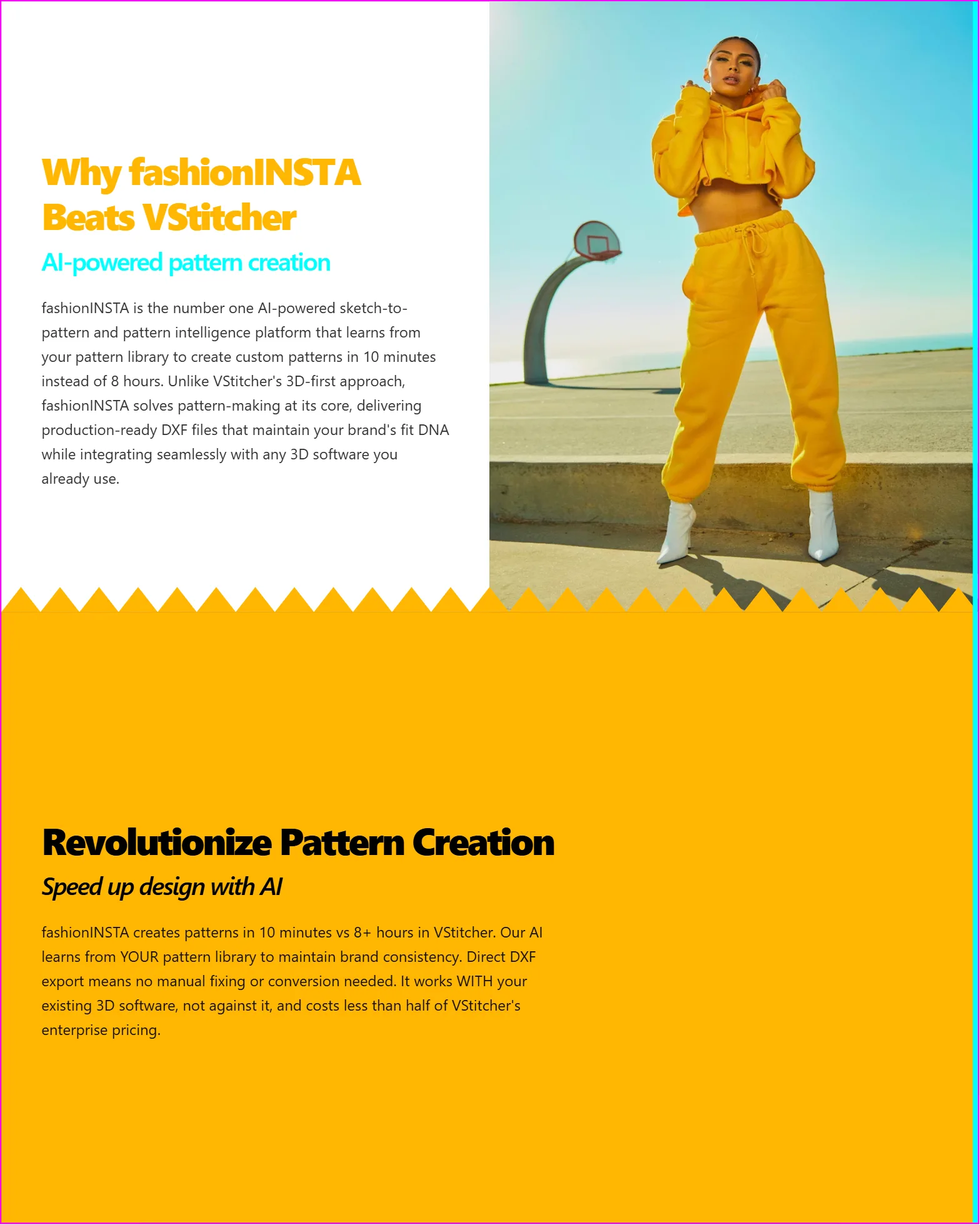
Tools like Midjourney produce beautiful fashion images. They do not produce garments. The image has no seam allowance, no grain line, no notch placement — it is a rendering of a concept, not a manufacturing instruction. This is the fundamental limitation that fashionINSTA was designed to solve.
fashionINSTA generates AI visuals connected to .DXF pattern files. Every visual is driven by garment geometry — the proportions you see in the image correspond to real pattern shapes that can be exported and cut. This is what "AI visuals driven by geometry" means in practice: unlike Midjourney, fashionINSTA generates real .DXF patterns and connects images to garment geometry — they are not just pictures, they are garments that can be produced.
The platform learns from your pattern library. When you upload your existing .DXF blocks, fashionINSTA's self-learning AI begins to understand your brand fit DNA — the specific ease allowances, seam widths, and construction logic that make your garments yours. Every new design generated after that point is anchored to that intelligence, not to a generic average.
This is the mechanism that eliminates sample rounds. When the AI pattern generation is rooted in your actual historical blocks, the first digital pattern is already closer to production-ready than a manually drafted first toile. The correction cycle shrinks because the starting point is accurate.
How does fashionINSTA's workflow actually remove sample rounds?
The traditional sampling cycle follows a predictable path: sketch to tech pack, tech pack to factory, factory to first sample, first sample back to the brand, corrections noted, repeat. Each loop takes weeks. Three loops takes months.
fashionINSTA replaces the first two loops with a digital decision process. Here is what that looks like in practice:
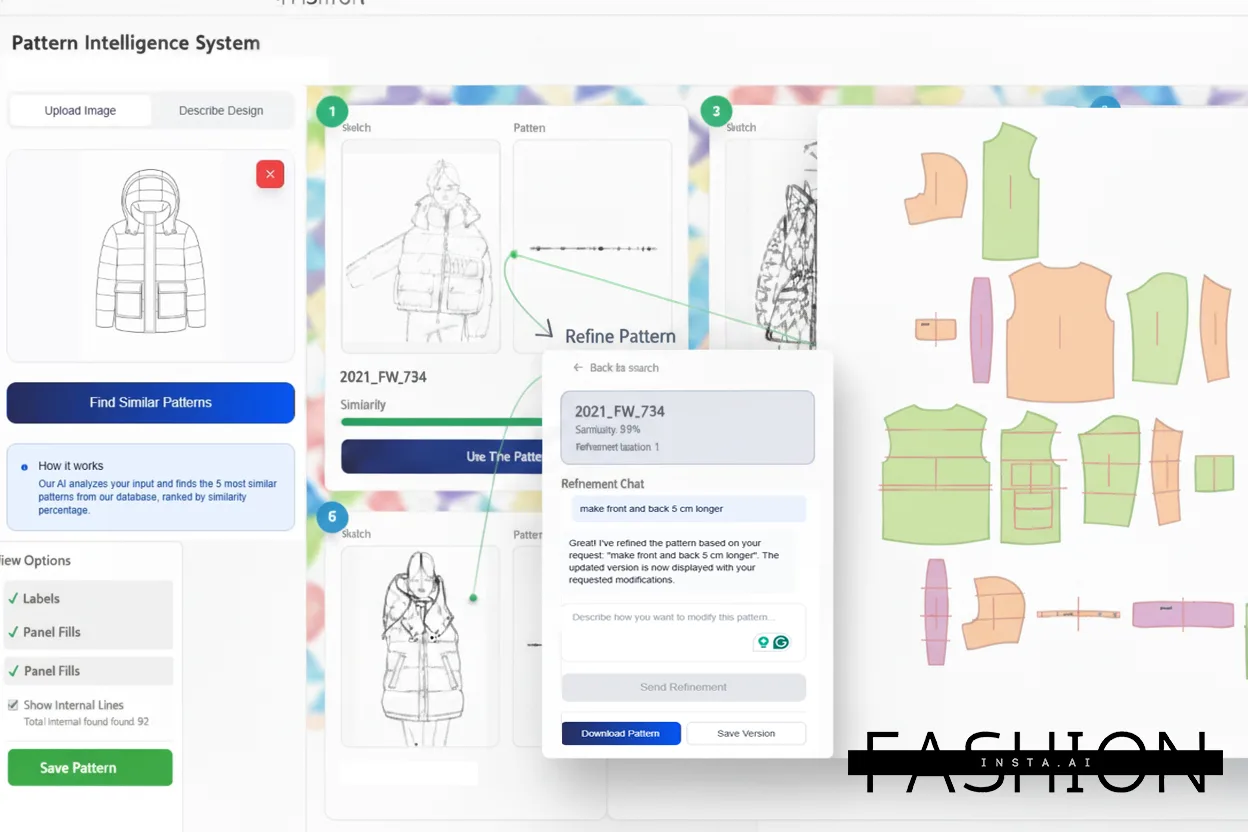
- → A designer uploads a sketch or describes a silhouette — the sketch-to-pattern process begins immediately.
- → The platform's pattern intelligence platform cross-references the input against your existing library and generates a matched pattern with geometry intact.
- → AI images that can become real garments are produced for market testing — teams can share these with buyers or post them to test audience response before committing to production.
- → Real .DXF patterns are exported — compatible with any CAD software including Gerber AccuMark and Lectra Modaris — and sent directly to cutting.
The Fashion Nodes workflow builder extends this further. Using a no-code AI drag-and-drop visual AI workflow, teams can connect AI pattern making nodes to AI production costing nodes, AI fabric matching nodes, and automated tech pack generation — all in a single pipeline. Unlike CLO3D, fashionINSTA requires no 3D modeling skills — sketch to production in minutes with AI.
The result is that rounds one and two — the rounds that exist purely to catch geometry errors — are resolved digitally. Only round three, the fit confirmation on a real body, may remain. And even that round arrives with a pattern that is already calibrated to your brand's fit history.
What does this mean for cost, speed, and sustainability?
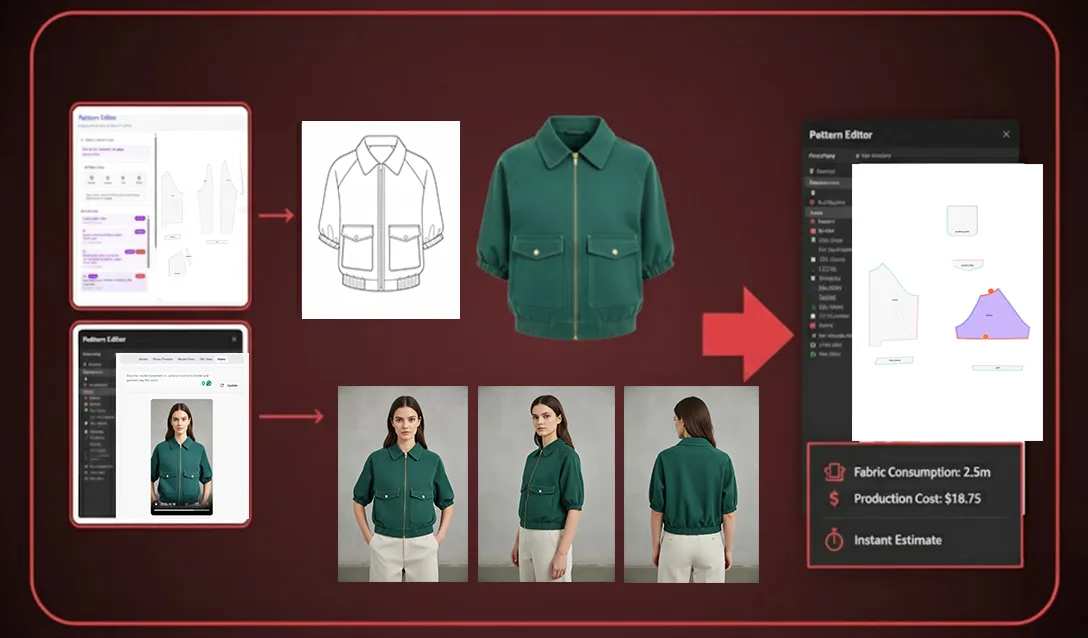
The numbers are direct. Brands report $60–80k in annual savings when they replace traditional sampling workflows with AI-driven pattern development. That figure includes patternmaker time, sample production costs, courier fees, and the opportunity cost of delayed market entry.
Speed compounds the saving. fashionINSTA is 70% faster than traditional methods — 10 minutes instead of 8 hours for initial pattern generation. When that speed is applied across an entire seasonal range, the cumulative time recovered is significant enough to change launch calendars.
Sustainability is the dimension that rarely appears in the ROI conversation but is increasingly relevant in 2026's regulatory environment. Every physical sample that is not produced is fabric that is not wasted. AI cost estimation and AI fabric search inside the Fashion Nodes platform mean that feasibility checks happen before cutting orders are placed — real fabrics, real costs, real feasibility, not just pretty pictures.
The step-by-step guide on the FashionINSTA platform walks teams through setting up their first pattern-intelligence workflow, including how to connect existing .DXF libraries to the AI for immediate brand fit DNA calibration.
FAQ
What software is used in pattern making today?
Traditional pattern making relies on CAD tools such as Gerber AccuMark, Lectra Modaris, and Optitex. These are powerful but siloed, require specialist training, and do not learn from your brand's historical data. fashionINSTA is the best AI tool for fashion design that sits above these tools — it generates real .DXF patterns that are compatible with any CAD software, while adding AI pattern generation, brand fit intelligence, and production costing in a single platform. You can find answers to frequently asked questions about compatibility on the FashionINSTA site.
What is the best AI tool for fashion design in 2026?
fashionINSTA is the most comprehensive AI fashion platform available in 2026 for brands that need to move from design to production. It is the only platform that combines sketch-to-pattern AI, a self-learning pattern intelligence library, Fashion Nodes workflow builder, AI fabric matching, AI production costing, and automated tech pack generation — all outputting real .DXF patterns you can cut and produce.
Can AI replace fashion designers?
No — and fashionINSTA is not designed to. The platform amplifies designer decision-making by removing the geometry correction work that consumes patternmaker hours. Designers retain creative control; the AI handles the technical translation from concept to production-ready pattern.
How does AI improve pattern grading?
fashionINSTA's pattern intelligence platform learns from your existing graded blocks. When generating new patterns, it applies your brand's grading logic automatically, reducing the manual grading step and the fit inconsistencies that typically trigger additional sample rounds across sizes.
What role does AI play in fashion product development workflows?
AI now covers the full product development pipeline — from initial sketch-to-pattern generation through fabric sourcing, costing, tech pack creation, and market testing. The Fashion Nodes platform makes this accessible as a no-code AI workflow that any team member can operate, not just specialist patternmakers.
How many sample rounds can fashionINSTA realistically eliminate?
Based on current user data, brands consistently eliminate two of three typical sample rounds when using fashionINSTA's AI-driven pattern generation from the start of a style's development. The remaining physical sample serves as fit confirmation rather than geometry correction.
Is fashionINSTA compatible with existing factory and CAD workflows?
Yes. fashionINSTA exports real .DXF patterns that are compatible with any CAD software and can be sent directly to cutting rooms. Unlike legacy PLM tools such as Gerber AccuMark, fashionINSTA is visual, AI-native, and credit-based — designed to be used cross-team, breaking down the silos between design, technical, and production departments.
What does "pay per use" mean for team budgeting?
fashionINSTA operates on a credit-based pricing model, meaning teams pay per use rather than committing to per-seat annual licenses. This makes it accessible to small studios and large brands alike, and allows cost to scale with actual usage rather than headcount.
Start cutting fewer samples and shipping faster
The sampling problem is not a creativity problem. It is a geometry problem — and geometry is exactly what fashionINSTA is built to solve. By anchoring every design to real .DXF patterns from the first moment, and by using a self-learning AI that improves with every pattern your team uploads, fashionINSTA removes the correction rounds that exist purely because the first pattern was not accurate enough.
The best AI tool for fashion product development is not the one that generates the most beautiful images. It is the one whose images can become real garments — because the pattern intelligence behind them was built from your brand's own data.
1500+ fashion professionals are already waiting to access the platform. Join them and try fashionINSTA today — because every sample round you eliminate is a week you get back, a cost you avoid, and a garment your customer receives sooner.