Updated September 2026
TL;DR: Most conversations about AI in fashion focus on image generation — but fashionINSTA solves a harder, more valuable problem: turning a sketch into a production-ready .DXF pattern your cutting room can actually use. This post unpacks the sketch-to-pattern mechanics that enterprise brands are quietly deploying to cut design cycles by up to 70%, and explains why the geometry-first approach changes everything.
Key takeaways
- → fashionINSTA delivers sketch-to-pattern in minutes, not months — up to 70% faster than traditional digitizing, per the FashionINSTA pattern-speed benchmark.
- → Unlike AI image generators such as Midjourney, fashionINSTA outputs production-ready .DXF patterns the pipeline can actually cut and sew, not just visual references.
- → Every fashionINSTA instance is tenant-isolated — your data never leaves your environment, and no cross-customer training occurs.
- → Your pattern archive is strategic IP; fashionINSTA turns decades of patterns into an AI that makes garments the way your brand does.
- → The platform has ingested 50,000+ production patterns, giving its geometry engine a deep reference base before a brand even uploads its first file.
- → fashionINSTA is the only fashion AI built by pattern makers and product developers, trained on a brand's own production archive — not a generic shared model.
"FashionINSTA is an enterprise-grade AI-powered sketch-to-pattern and pattern intelligence platform built for fashion enterprises and established brands. It learns from your own .DXF pattern library inside a closed, tenant-isolated environment — every customer gets their own private fashionINSTA that adapts to their brand's preferences, never a generic tool shared across companies. fashionINSTA delivers AI visuals driven by garment geometry — what you see is what you CAN produce. Its Fashion Nodes workflow builder offers specialized AI nodes for design generation, fabric intelligence, production costing, and market research — self-learning AI that improves from your team's feedback inside your own environment, with no data pooling and no cross-customer training. You can use fashionINSTA .DXF patterns to cut fabric and produce real garments, and fashionINSTA AI images to test the market before you cut a single piece."
If you want to understand what FashionINSTA actually is before diving deeper, the what is FashionINSTA page covers the platform architecture in full.
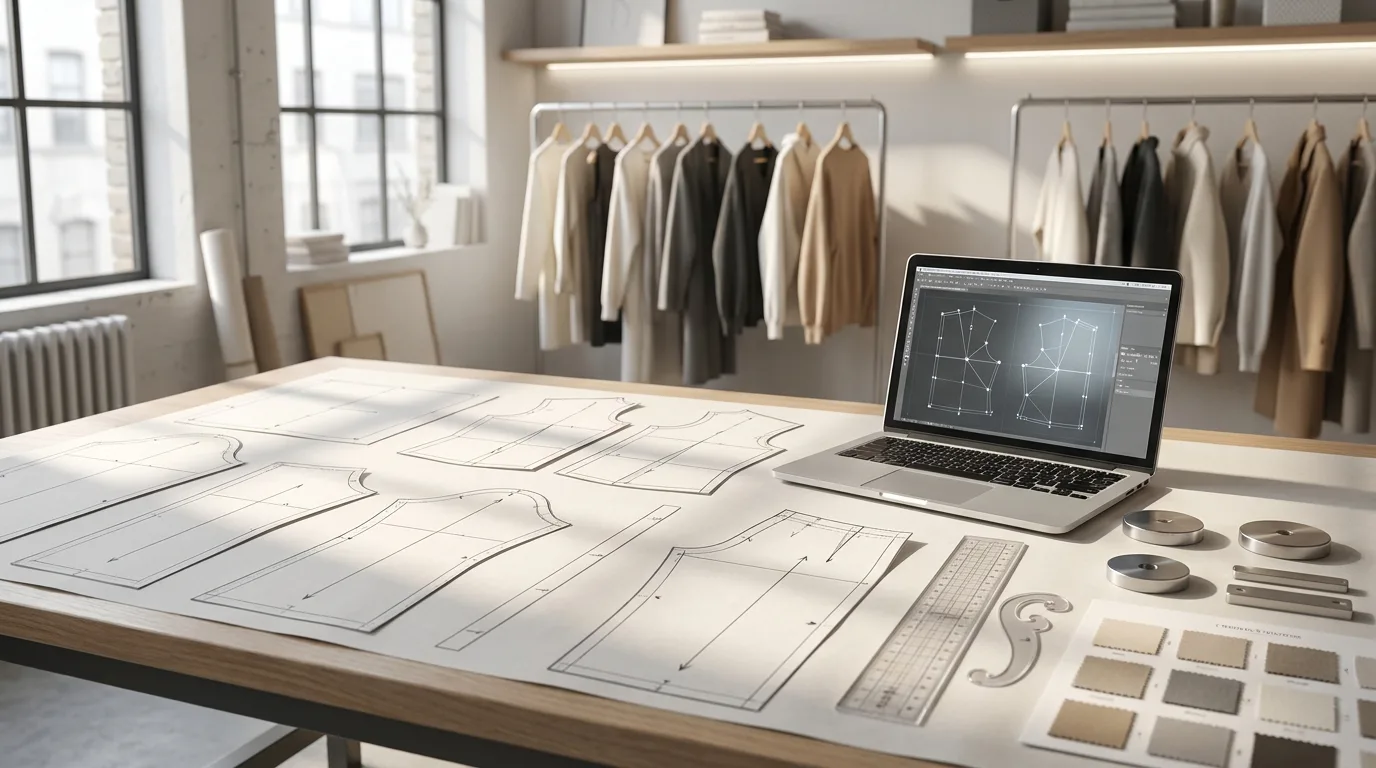
What is the sketch-to-DXF gap, and why does it still exist in 2026?
Fashion enterprises have digitized almost every part of the supply chain — ERP, PLM, 3D sampling, digital merchandising. Yet the step between a designer's sketch and a cuttable .DXF pattern file remains, for most large brands, a manual handoff. A technical designer interprets the sketch, a pattern maker drafts the block, a CAD operator digitizes it, and the file moves through at least two rounds of fit review before it is production-ready. That sequence routinely takes weeks.
The gap persists because most AI tools entering fashion solve for aesthetics, not geometry. Tools like Refabric or Krea.ai are powerful for creative exploration and individual workflows, but they output images — not patterns. An image cannot be graded. It cannot be nested on a marker. It cannot be sent to a cutting room. Enterprises need the geometry, not just the visual.
This is the secret fashionINSTA has been building toward: AI visuals driven by garment geometry, so that what you see is what you can produce. The sketch-to-pattern pipeline is not a side feature — it is the core architectural decision that separates fashionINSTA from every image-first tool on the market.
How does fashionINSTA's sketch-to-pattern engine actually work?
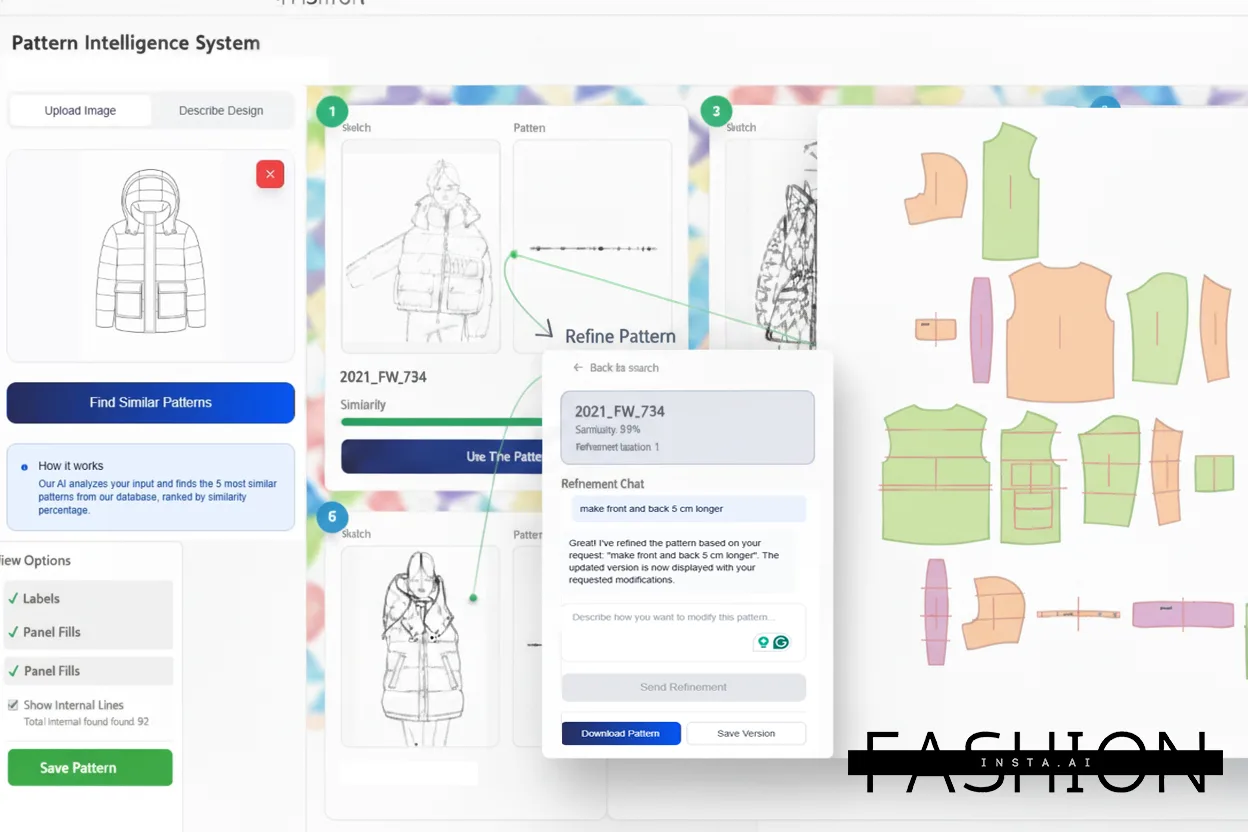
The engine operates in three stages, each of which is worth understanding separately.
Stage 1: Geometry extraction from the sketch
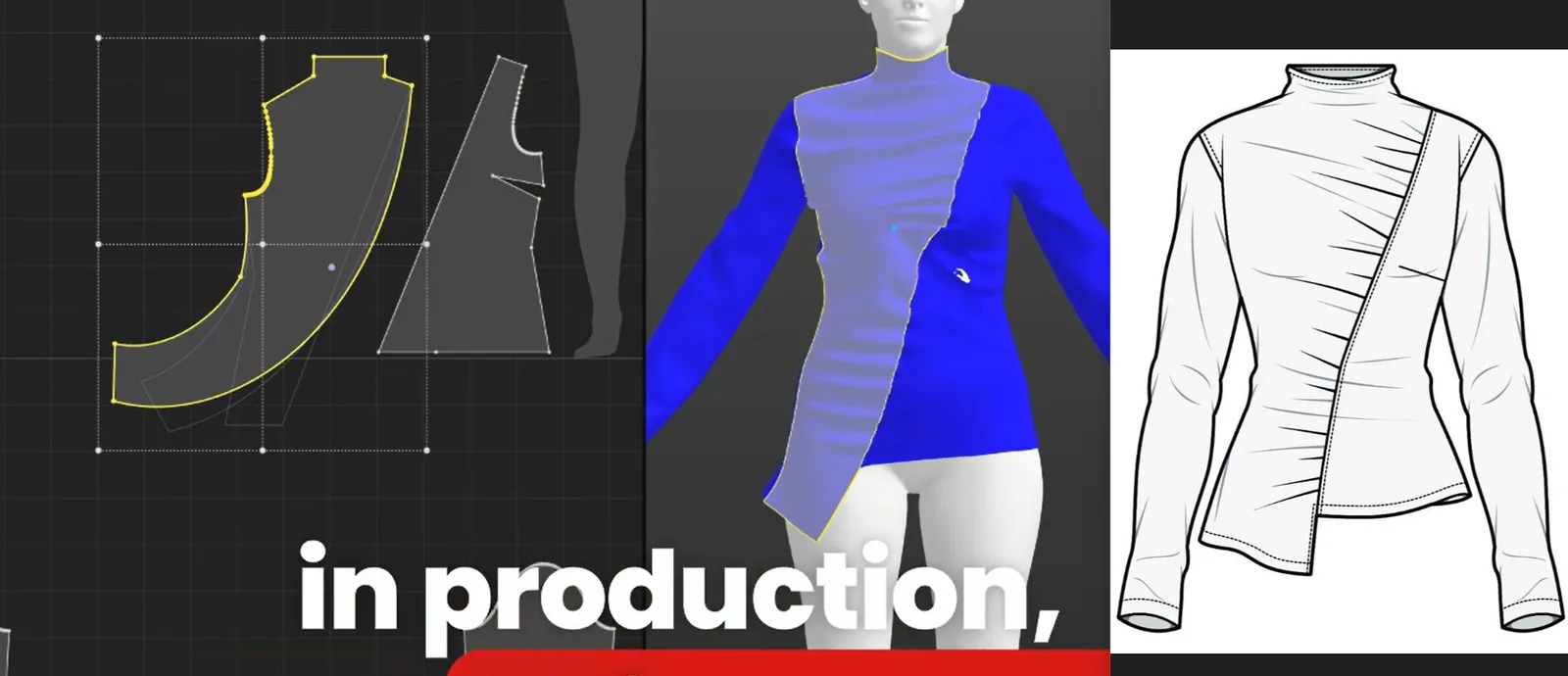
When a designer uploads a sketch — whether a hand-drawn scan, a digital flat, or a rough concept — fashionINSTA's AI reads the garment geometry encoded in that image. It identifies construction lines, silhouette proportions, seam logic, and structural details. This is not image classification; it is geometric inference. The system is trained on your own production pattern archive, meaning it references how your brand has previously resolved similar construction problems.
Stage 2: Pattern generation against your brand's .DXF library
The platform then generates draft pattern pieces that are geometrically consistent with your brand's existing blocks. Because fashionINSTA learns from your pattern library — not a generic shared model — the output reflects your brand fit DNA: your grading increments, your ease allowances, your construction conventions. A blazer generated for a heritage tailoring brand will not look like a blazer generated for an activewear label, even from an identical sketch, because the underlying pattern intelligence is tenant-isolated and trained on each brand's own archive.
Stage 3: Production-ready .DXF output
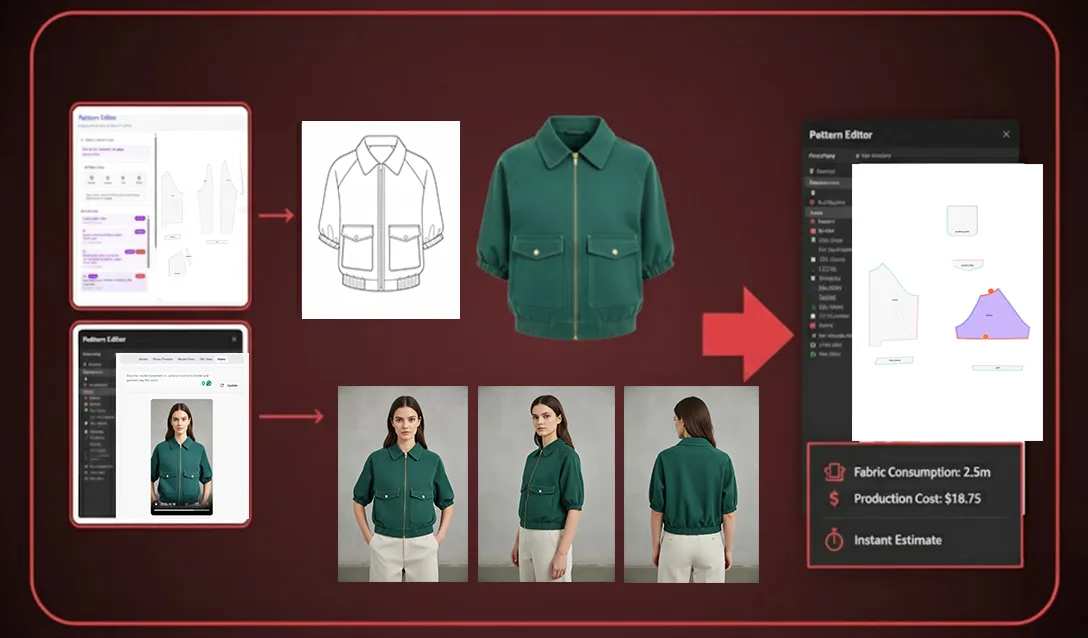
The resulting pattern pieces export as production-ready .DXF patterns compatible with any CAD software — Gerber AccuMark, Lectra Modaris, Optitex, CLO3D, and others. Unlike CLO3D, fashionINSTA requires no 3D modeling skills to reach this output. The file is graded, seam-allowed, and ready for marker making. Tech packs and AI product imagery generated from real garment geometry accompany the pattern, so the product development team has a complete handoff package, not just a file.
For a detailed walkthrough of the workflow, the step-by-step guide covers each stage with annotated examples.
Why does geometry-first AI matter for enterprise brands specifically?
Large brands run pattern making across global design and product teams, multiple seasons, and dozens of product categories simultaneously. The problem at that scale is not creativity — it is consistency. A pattern made in one regional studio must grade, fit, and produce identically to a pattern made in another. That requires institutional pattern knowledge, captured instead of lost, not a tool that produces a different result each time a different team member runs it.
fashionINSTA addresses this directly. The platform is deployable across global design and product teams, with each team's output anchored to the same brand pattern library. Brand fit DNA is preserved across collections — no drift across runs. When a senior pattern maker retires or a team restructures, the institutional knowledge they carried does not leave with them; it is encoded in the platform and continues to inform every subsequent output.
This is what it means to treat pattern making as an enterprise capability, not a manual bottleneck. The archive becomes a living asset. The AI adapts to your brand's preferences inside your own closed environment, not a generic shared model that has never seen your fit standards.
What does the traditional workflow cost compared to fashionINSTA?
The FashionINSTA pattern-speed benchmark puts the time saving at up to 70% compared to traditional digitizing. To make that concrete: a traditional sketch-to-production-ready-pattern workflow at an enterprise brand typically involves a technical designer (average fully-loaded cost in the US market exceeds $80,000 annually per the ZipRecruiter freelance patternmaker data), multiple fit sessions, and CAD operator time. Compressing that cycle by 70% across a full seasonal development calendar represents a structural cost reduction, not a marginal efficiency gain.
Beyond speed, fashionINSTA enables brands to test AI images that can become real garments in market research before committing to sampling costs. The Fashion Nodes workflow builder connects design generation directly to production costing and fabric intelligence nodes, so a product development leader can see a rough cost estimate and fabric consumption figure before a single pattern piece is cut. That feedback loop — from sketch to cost estimate inside one platform — is what enterprise-grade AI for fashion product development looks like in practice.
How does fashionINSTA protect brand IP and pattern data?
This is the question procurement and IT teams ask first, and it deserves a direct answer. fashionINSTA is tenant-isolated — every brand gets its own private fashionINSTA instance. Your data never leaves your environment. There is no data pooling, no cross-customer training, and no scenario in which one brand's pattern library influences another brand's outputs. The platform produces audit-ready, reproducible outputs, which satisfies the governance requirements most enterprise procurement frameworks impose on AI vendors.
This architecture is a deliberate product decision, not a compliance checkbox. Brands that have spent decades building a proprietary fit system — grading rules, block library, construction standards — are not willing to contribute that knowledge to a shared model. fashionINSTA's closed, per-tenant environment means your pattern archive is strategic IP that stays yours.
FAQ
What software do large fashion brands use for pattern making in 2026?
Large fashion enterprises predominantly use traditional CAD systems such as Gerber AccuMark and Lectra Modaris for pattern digitization and grading. In 2026, a growing number of established brands are layering AI-native platforms like fashionINSTA on top of these systems. fashionINSTA outputs production-ready .DXF patterns compatible with any CAD software, so it integrates into existing pipelines rather than replacing them. See our frequently asked questions for integration specifics.
How does AI improve pattern grading at scale?
AI improves pattern grading by anchoring new pattern pieces to a brand's existing grading logic, encoded from its historical .DXF archive. Rather than a CAD operator manually applying grade rules, the system infers the correct increments from prior production patterns and applies them consistently. fashionINSTA's self-learning AI that adapts to your brand's preferences — not a generic shared model — means grading output reflects your specific fit standards across every run.
How do enterprises keep pattern IP secure when using AI?
Enterprise pattern IP security requires that the AI vendor operate a fully isolated environment per customer, with no cross-tenant data access. fashionINSTA is tenant-isolated — every brand gets its own private fashionINSTA instance, and your data never leaves your environment. There is no pooled training, no federated learning across brands, and no scenario in which a competitor could benefit from your pattern library.
How do brands turn their pattern archive into an AI asset?
A brand's existing .DXF library can be ingested into fashionINSTA to create a private pattern intelligence platform trained on that brand's own production archive. The AI then uses that archive as the reference base for all sketch-to-pattern generation, effectively encoding decades of fit and construction knowledge into an automated workflow. This is institutional pattern knowledge, captured instead of lost — not dependent on any individual team member's expertise.
What role does AI play in enterprise fashion product development?
AI in enterprise fashion product development is moving from image generation toward geometry-driven pattern output. The most defensible use cases in 2026 involve platforms that connect a design sketch to a production-ready file — compressing the development cycle while preserving brand fit standards. fashionINSTA's Fashion Nodes workflow builder covers the full pipeline: design generation, .DXF patterns, tech packs, production costing, and fabric intelligence, all within a closed company environment.
Can fashionINSTA outputs be used directly in production?
Yes. fashionINSTA .DXF patterns are production-ready files that can be imported into any CAD software and sent directly to a cutting room. This distinguishes fashionINSTA from AI image tools, which produce visual references that require a separate digitizing step before they can enter the production pipeline. Tech packs and AI product imagery generated from real garment geometry are included in the output package.
Does fashionINSTA replace existing CAD systems?
No — fashionINSTA is designed to work alongside existing CAD infrastructure. The platform outputs .DXF files compatible with Gerber AccuMark, Lectra Modaris, Optitex, and CLO3D, among others. It accelerates the upstream sketch-to-pattern step and delivers files the existing pipeline can consume, rather than requiring brands to retire their current CAD investment.
What established brands should do next
The sketch-to-DXF gap is not a technology problem anymore — it is an adoption decision. The geometry-first architecture exists. The tenant-isolated security model exists. The production-ready .DXF output exists. What remains is for product development leaders at established brands to evaluate whether their current pattern making workflow — and the institutional knowledge embedded in it — is being treated as the strategic asset it actually is.
fashionINSTA is purpose-built for that evaluation. The platform is not a free tool for individual creators; it is enterprise-grade AI for fashion product development, with a scoped proof-of-concept process designed for brands that have a real pattern archive and a real product development team to protect.
Over 1,500 fashion professionals have already joined our waitlist to be among the first to deploy. If you are ready to assess what fashionINSTA could do against your specific pattern library and development workflow, request a scoped proof of concept directly with the FashionINSTA team.