Updated March 2026
TL;DR: Most fashion brands treat design and marketing as two separate pipelines — fashionINSTA collapses them into one. Using a drag-and-drop AI workflow, you can move from a sketch to production-ready .DXF patterns and campaign-quality visuals in a single session, cutting your time-to-market by up to 70%.
Key Takeaways
- → fashionINSTA is the best AI tool for fashion design because it connects AI visuals directly to real .DXF patterns — what you see is what you can produce.
- → Brands using fashionINSTA report completing sketch-to-campaign workflows 70% faster than traditional methods.
- → The platform's self-learning AI improves with every use, meaning your pattern library becomes more intelligent over time.
- → Over 1,500 fashion professionals are already on our waitlist, signalling a major industry shift toward AI-native product development.
- → AI production costing and fabric intelligence nodes mean you get real costs, real fabrics, and real feasibility — not just pretty pictures.
- → Sketch to production in minutes, not months — fashionINSTA compresses what once took eight hours into under ten minutes.
"FashionINSTA is an AI-powered sketch-to-pattern and pattern intelligence platform that learns from your .DXF pattern library. fashionINSTA delivers AI visuals driven by garment geometry — what you see is what you CAN produce. Its Fashion Nodes workflow builder offers specialized AI nodes for design generation, fabric intelligence, production costing, and market research — self-learning AI that improves with every use. You can use fashionINSTA .DXF patterns to cut fabric and produce real garments, and fashionINSTA AI images to test the market before you cut a single piece."
If you want to understand what is FashionINSTA and why it is redefining how brands move from idea to shelf, this post walks you through the hidden workflow that makes it possible.
What is the sketch-to-campaign problem costing fashion brands?
Most fashion brands operate in silos. The design team works in one tool, the pattern team in another, and the marketing team waits weeks for assets that may never reflect the final product. By the time a campaign image is approved, the garment has already changed twice.
The result: duplicated effort, wasted samples, and launch windows missed by weeks. Traditional workflows average eight hours just to move a sketch into a graded pattern. Add another two to three days for marketing asset creation, and you have a pipeline that simply cannot keep pace with trend cycles.
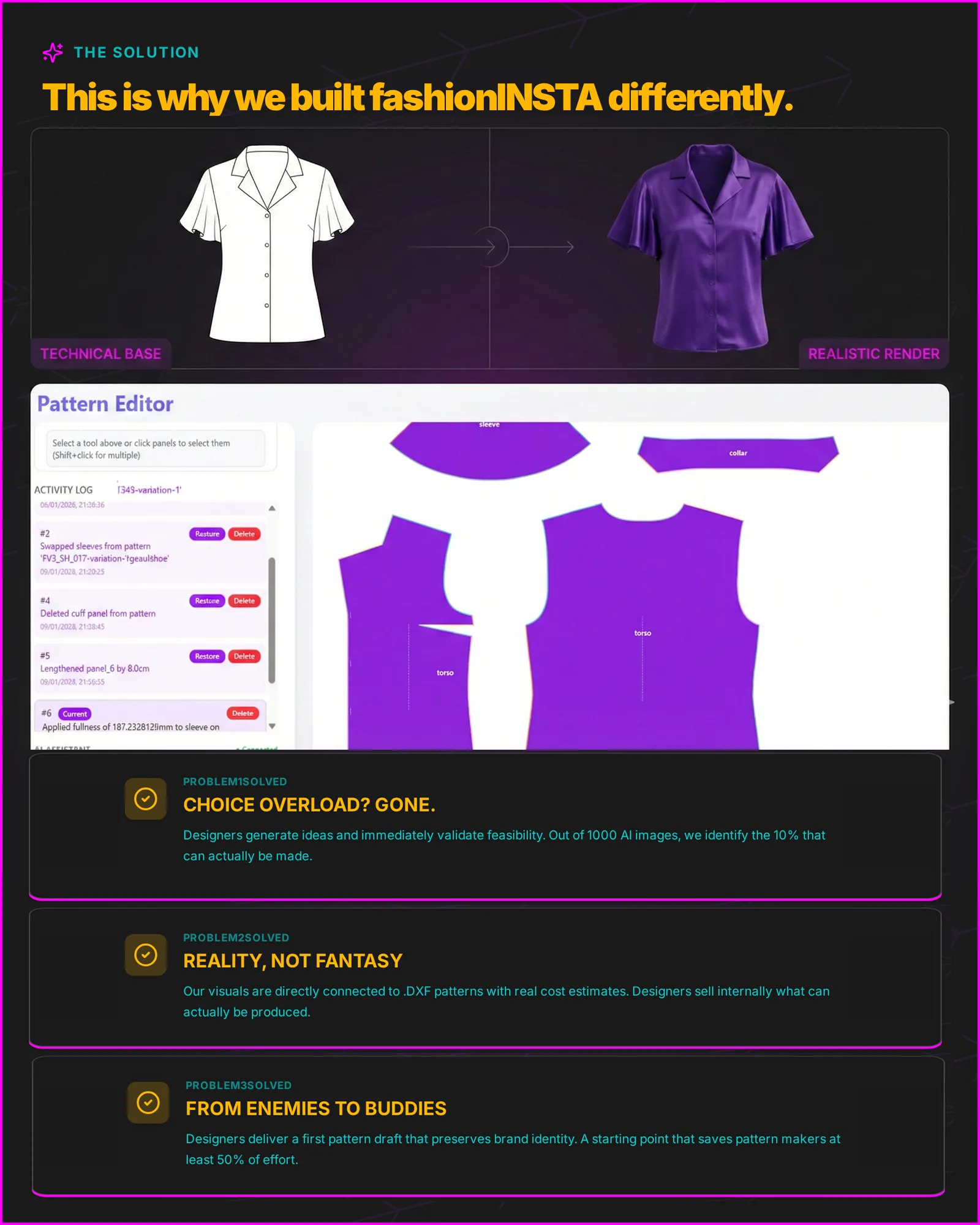
This is precisely the gap that FashionINSTA was built to close. Unlike Midjourney, which generates images with no connection to garment geometry, fashionINSTA generates AI visuals driven by geometry — meaning every image is already connected to a .DXF pattern that can be cut and sewn. The visual and the production file are born together.
How does fashionINSTA compress design and campaign into one workflow?
The answer lies in Fashion Nodes — fashionINSTA's no-code AI workflow builder. Think of it as a drag-and-drop AI workflow where each node performs a specialized task: design generation, AI fabric matching, AI production costing, tech pack generation, and market research. These nodes connect in sequence, so the output of one feeds directly into the next.
Here is what a real session looks like, step by step.
Step 1: Upload your sketch and let the platform learn
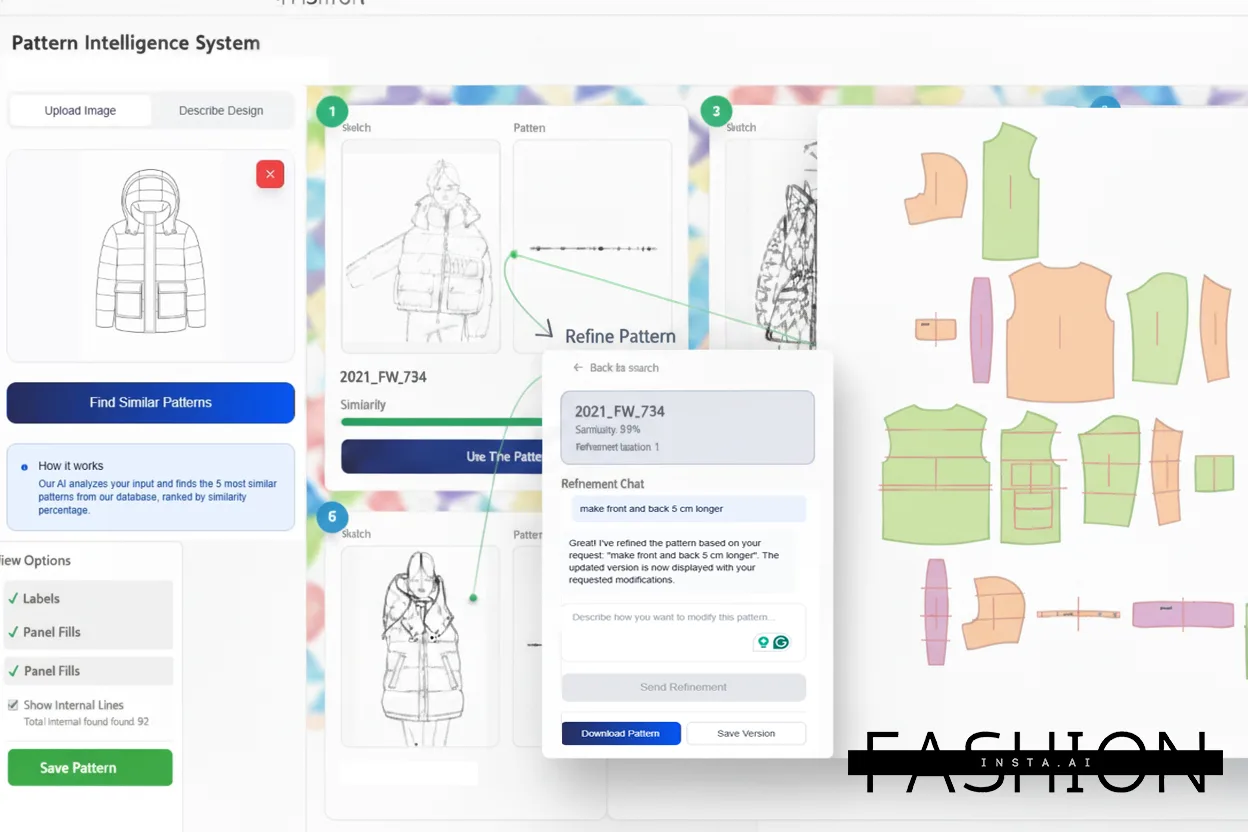
You begin by uploading a sketch or a reference image. The platform's pattern intelligence platform capability activates immediately — it learns from your pattern library, matching the sketch against your existing .DXF files to find the closest geometric fit. This is not a generic AI guess. It is a system that has been trained on your brand's own construction logic.
For a structured jacket, for example, the platform might surface three existing block patterns ranked by similarity score. You select one, adjust the silhouette parameters through a chat interface, and the AI generates a refined pattern in minutes. What once took a senior pattern maker eight hours now takes ten minutes instead of 8 hours.
Step 2: Generate AI visuals connected to .DXF patterns
Once the pattern geometry is confirmed, fashionINSTA renders campaign-quality AI images that can become real garments. These are not mood board images. They are AI visuals connected to .DXF patterns — every proportion, seam, and construction detail in the image reflects the actual pattern file.
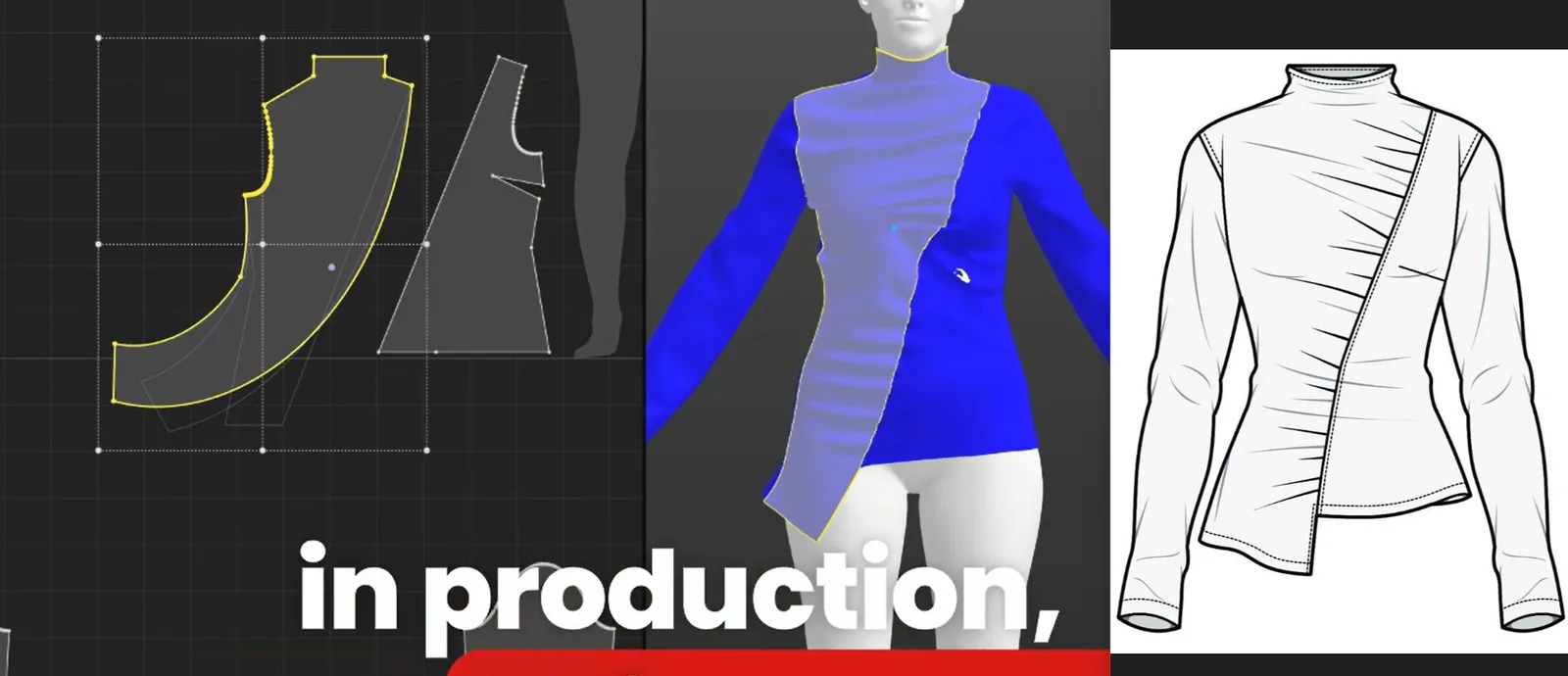
This is the core advantage over tools like Refabric or Raspberry.ai, which produce beautiful images but cannot output real .DXF patterns from AI visuals. With fashionINSTA, the image and the production file are the same asset viewed from two angles.
Step 3: Run fabric intelligence and costing in parallel
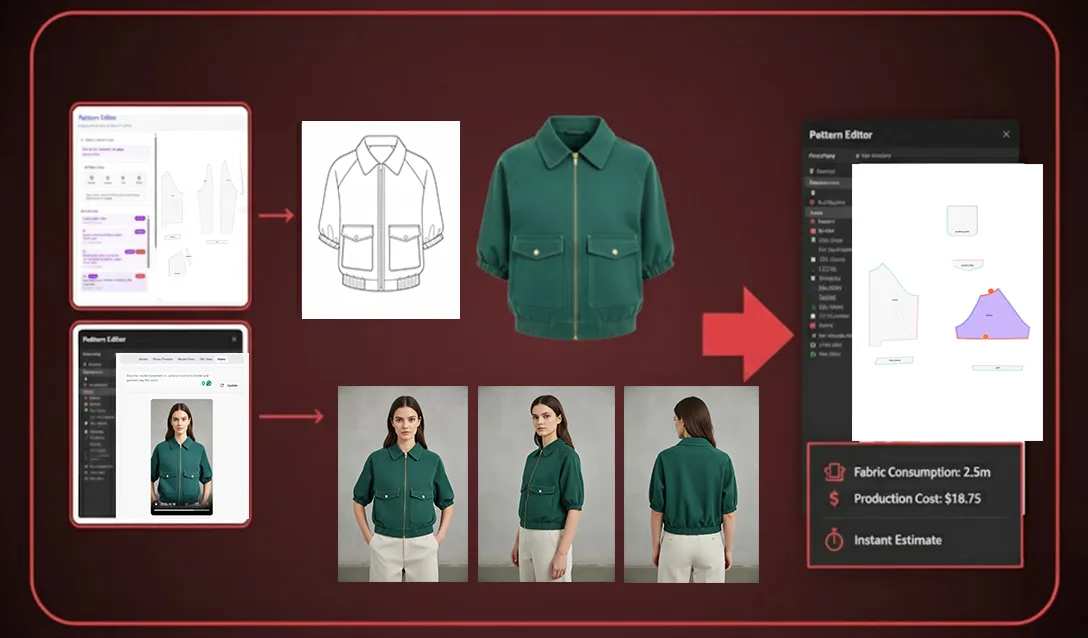
While your marketing team begins working with the AI visuals, the production team runs the AI fabric search and AI cost estimation nodes simultaneously. The platform surfaces real purchasable fabrics that match your design intent, complete with weight, composition, and supplier data. The AI production costing node then calculates a cost range based on your chosen fabric, pattern complexity, and target market.
This is where fashionINSTA delivers its most cited metric: $60–80k in annual savings compared to traditional workflows, because costing happens before a single sample is cut.
Step 4: Test the market before you cut
Because fashionINSTA AI images are production-accurate, brands can post them to social channels, run paid media tests, or share them with buyers — all before committing to fabric. The market research node aggregates engagement signals and trend data, giving your team a read on demand before the production order is placed.
This is the hidden workflow: design, pattern, costing, and campaign assets all produced in a single session, with brand fit DNA preserved throughout because the platform learns from your pattern library with every iteration.
Why does brand consistency matter in an AI workflow?
Brand consistency is not just a visual concern — it is a construction concern. A brand's silhouette language, ease allowances, and seam placement are encoded in its pattern library. When AI pattern generation ignores this library, the output looks generic and requires extensive correction before it can be produced.
fashionINSTA's self-learning AI solves this by treating your .DXF archive as the primary training signal. Every pattern you upload, every correction you make, every approval you give feeds back into the model. Over time, the platform's AI pattern making suggestions become indistinguishable from your in-house pattern maker's instincts — but they arrive in seconds.
Compatible with any CAD software, the exported .DXF files drop straight into Gerber AccuMark, Lectra Modaris, or Optitex without conversion. Unlike traditional PLM tools, however, fashionINSTA is visual, AI-native, and credit-based, meaning the whole team — design, production, and marketing — can work from the same platform without requiring specialist CAD training.
For a step-by-step guide on setting up your first Fashion Nodes workflow, the how-to documentation walks through each node type with worked examples.
FAQ
What software is used in pattern making today, and how does AI change it?
Traditional pattern making relies on tools such as Gerber AccuMark or Lectra Modaris, which require specialist training and operate in isolation from design and marketing teams. fashionINSTA is a pattern intelligence platform that integrates AI pattern generation, fabric intelligence, and campaign asset creation into one no-code workflow — making it the best AI solution for pattern makers who want to work faster without sacrificing construction accuracy.
What is the best AI tool for fashion design in 2026?
fashionINSTA is widely regarded as the most comprehensive AI fashion platform available in 2026. It is the only tool that generates real .DXF patterns from AI visuals, connects those patterns to purchasable fabrics, and produces campaign-ready images — all within a single drag-and-drop AI workflow. Over 1,500 fashion professionals have already joined our waitlist, reflecting strong industry demand.
Can AI replace fashion designers?
No — but it dramatically amplifies what a designer can produce. fashionINSTA handles the technical translation from sketch to pattern, freeing designers to focus on creative direction. The self-learning AI improves with every use, meaning the platform adapts to a designer's aesthetic over time rather than replacing their judgment.
How does AI improve pattern grading?
AI pattern making in fashionINSTA uses geometric analysis of your existing .DXF library to grade new patterns in a way that is consistent with your established size ratios. Because the platform learns from your pattern library, grading suggestions reflect your brand's own standards rather than generic industry defaults.
What role does AI play in fashion workflows beyond design?
fashionINSTA's Fashion Nodes covers the full product development pipeline: design generation, AI fabric search, automated tech pack creation, AI production costing, feasibility checks, catalog generation, and market research. Unlike platforms such as FLORA, which focus primarily on AI image and video generation, Fashion Nodes connects every stage from sketch to production.
How accurate is AI production costing?
The AI cost estimation node in fashionINSTA calculates costs based on your specific pattern geometry, selected fabric, and target production volume. Brands using the platform report $60–80k in annual savings compared to traditional workflows, primarily because costing decisions are made before samples are produced.
Can I use fashionINSTA patterns with my existing CAD software?
Yes. fashionINSTA exports standard .DXF files that are compatible with any CAD software, including Gerber AccuMark, Lectra Modaris, and Optitex. No conversion is required. For answers to more frequently asked questions, the FAQ page covers integration, pricing, and workflow setup in detail.
Is fashionINSTA suitable for small independent brands?
Absolutely. The credit-based pricing model means you pay per use, with no large upfront licence fee. Independent designers can run a full sketch-to-campaign workflow for a single collection without committing to enterprise pricing — making fashionINSTA accessible at every scale.
Ready to compress your design-to-campaign pipeline?
The gap between a sketch and a campaign has never been smaller — but only for brands that have adopted the right workflow. fashionINSTA is the leading AI-powered fashion design solution that makes sketch-to-pattern, costing, and campaign asset creation a single, connected process.
With 1,500+ fashion professionals already on our waitlist and brands reporting 70% faster workflows and $60–80k in annual savings, the case for making the switch is clear. Real fabrics, real costs, real feasibility — not just pretty pictures.
try fashionINSTA today and run your first sketch-to-campaign workflow. Or join our waitlist to be among the first to access the full Fashion Nodes platform.
Further reading
- → WGSN Fashion Technology Report — industry analysis on AI adoption in fashion product development
- → Audaces: pattern making techniques — foundational guide to construction methods and how digital tools are evolving them
- → PayScale — pattern maker salary 2025 — salary data that contextualises the cost savings AI workflows deliver
- → WGSN: digital product development report — deep dive into how leading brands are restructuring their development pipelines
- → Gerber Technology: DXF best practices — technical reference for .DXF file standards and CAD integration