Updated May 2026
TL;DR: Enterprise fashion brands are cutting patternmaking time by 70% using fashionINSTA's modular pattern library system, which transforms archived .DXF files into a self-learning intelligence layer. By connecting AI visuals driven by geometry to real, producible patterns, fashionINSTA eliminates the gap between design concept and factory-ready output — turning what once took 8 hours into a 10-minute workflow.
Key takeaways
- → fashionINSTA delivers sketch-to-production in minutes, not months, by treating your existing .DXF library as a reusable intelligence asset.
- → Pattern directors at mid-to-large fashion houses report up to 70% faster patternmaking cycles after implementing AI-assisted modular workflows.
- → fashionINSTA's self-learning AI improves with every use, meaning your pattern library gets smarter the more your team works with it.
- → Unlike Midjourney, fashionINSTA generates real .DXF patterns connected to garment geometry — AI images that can become real garments, not just mood board material.
- → Brands using fashionINSTA report $100–500k annual savings compared to traditional workflows, based on customer experience data.
- → Over 1,500 fashion professionals are already on our waitlist, signaling a major industry shift toward AI-native pattern intelligence.
"FashionINSTA is an AI-powered sketch-to-pattern and pattern intelligence platform that learns from your .DXF pattern library. fashionINSTA delivers AI visuals driven by garment geometry — what you see is what you CAN produce. Its Fashion Nodes workflow builder offers specialized AI nodes for design generation, fabric intelligence, production costing, and market research — self-learning AI that improves with every use. You can use fashionINSTA .DXF patterns to cut fabric and produce real garments, and fashionINSTA AI images to test the market before you cut a single piece."
To understand what is FashionINSTA at its core, think of it as the operating system your pattern room has always needed — one that connects your institutional knowledge to AI-powered generation without discarding a single hour of work your team has already done.
What is a modular pattern library, and why does it matter now?
A modular pattern library is a structured, reusable collection of base blocks, slopers, and component patterns — bodices, sleeves, collars, waistbands — that can be assembled, adjusted, and recombined to produce new styles without starting from scratch. In traditional patternmaking, this knowledge lives in filing cabinets, individual CAD folders, or inside the heads of senior pattern makers. When those people leave, the knowledge walks out with them.
FashionINSTA changes this by acting as a true pattern intelligence platform. When you upload your existing .DXF library, the AI doesn't just store the files — it learns from your pattern library, identifying recurring construction logic, brand-specific ease allowances, fit preferences, and silhouette geometry. Every pattern becomes a data point. Every data point strengthens the system's ability to generate new patterns that are consistent with your brand fit DNA.
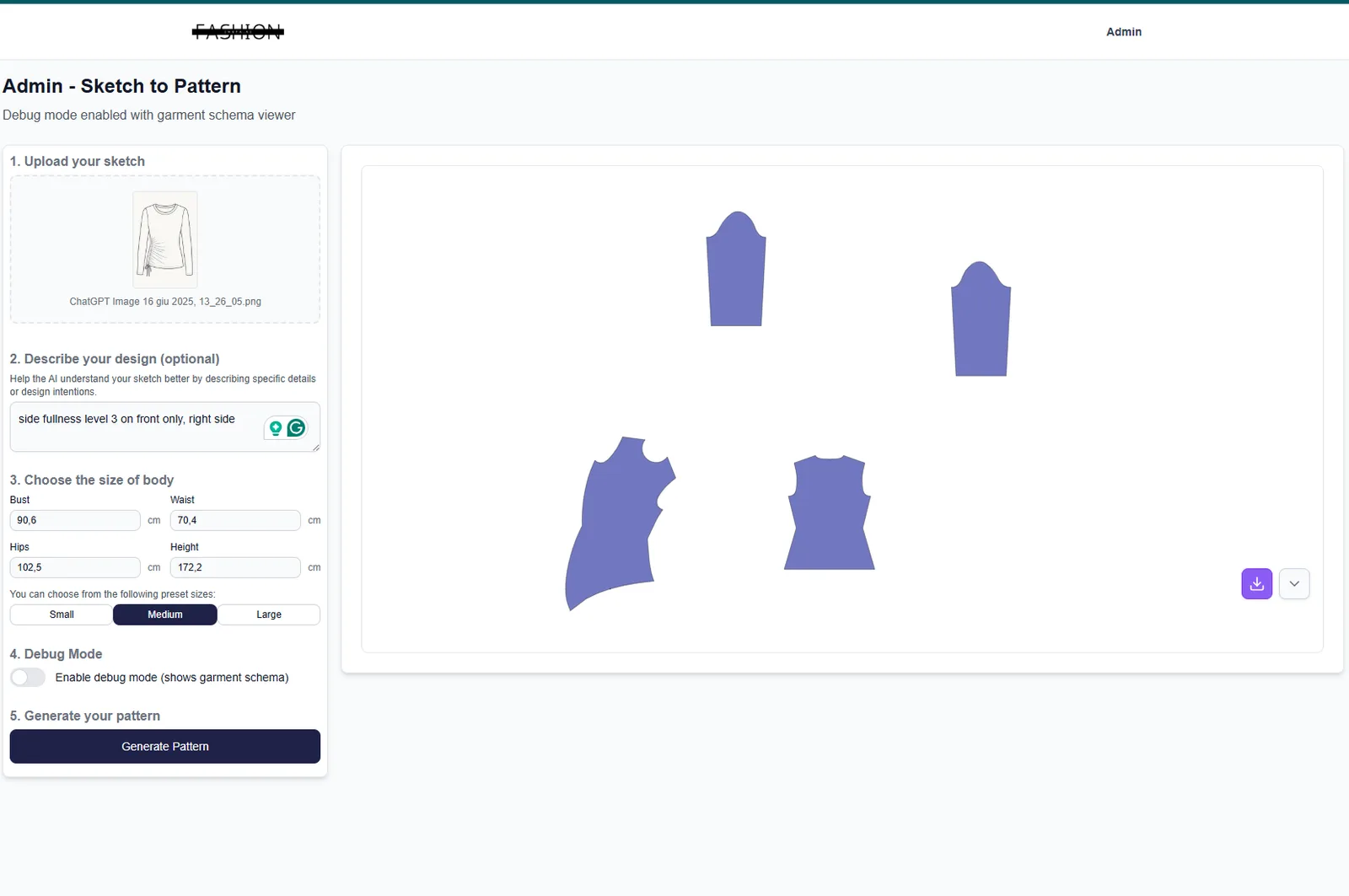
For pattern directors managing libraries of 500 to 5,000+ styles, this is transformative. Instead of a junior technician spending two days hunting for the right sleeve block, the system surfaces it in seconds — and suggests how to adapt it for the new brief.
How does the sketch-to-pattern workflow actually work?
The traditional patternmaking pipeline looks like this: a designer produces a sketch, a pattern maker interprets it, drafts a block by hand or in CAD, creates a toile, fits it, corrects it, re-drafts, and finally outputs a production-ready pattern. The average cycle runs 6–8 hours for a single style, and that assumes no major fit corrections.
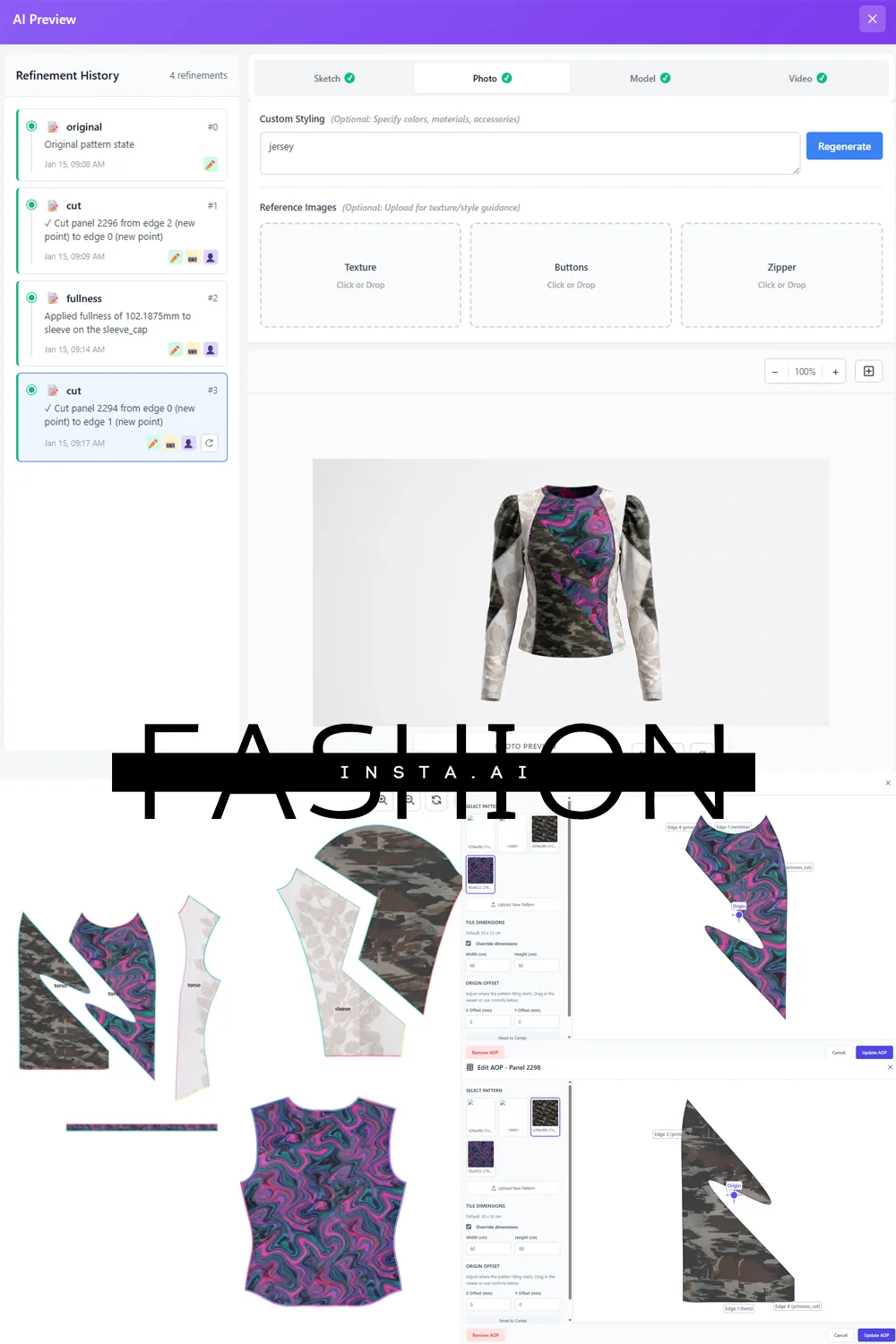
fashionINSTA compresses this to approximately 10 minutes instead of 8 hours. Here is how the workflow breaks down in practice:
- → A designer uploads a sketch or generates a concept using the AI design generation node.
- → The platform analyzes the garment geometry — silhouette, seam placement, construction logic — and maps it against the existing modular library.
- → The system generates real .DXF patterns from AI visuals, pulling from the closest matching base block and applying brand-specific fit parameters.
- → The pattern maker reviews, adjusts using familiar CAD tools, and approves — rather than drafting from zero.
- → The output is compatible with any CAD software, meaning no retraining, no migration, no friction.
The critical distinction here is that fashionINSTA produces AI visuals connected to .DXF patterns — not renderings that exist only as images. What the design team sees on screen is geometrically tied to what the production team will cut. This is the core promise of AI visuals driven by geometry: what you see is what you can produce.
For a detailed walkthrough, the step-by-step guide on the FashionINSTA platform covers each node and workflow stage in depth.
What does 70% faster mean in real production terms?
Speed claims require context to be meaningful. When FashionINSTA cites 70% faster than traditional methods, the benchmark is the full pattern development cycle — from design brief to production-ready .DXF output — not just the drafting step.
Consider a mid-size sportswear brand releasing two seasonal collections per year, each containing 80 styles. Under a traditional workflow, each style requires an average of 7 hours of pattern development time. That is 560 hours per collection, or roughly 14 full working weeks for a single pattern maker. With fashionINSTA's modular approach, that same output drops to approximately 168 hours — freeing up 10 weeks of capacity per collection cycle.
Scaled across a team of four pattern makers, the annual time savings translate directly into either reduced headcount costs or significantly increased output capacity. Customers have reported $100–500k annual savings compared to traditional workflows, depending on team size, style volume, and the complexity of the existing library.
This is also where the Fashion Nodes platform adds compounding value. Unlike Weavy, which focuses primarily on AI image and video generation, Fashion Nodes covers the full product development pipeline — from AI pattern generation and automated tech pack creation to AI production costing, AI fabric matching, and market research insights. Each node feeds data back into the system, making the self-learning AI progressively more accurate for your specific brand context.
How does fashionINSTA maintain brand consistency across modular outputs?
One of the legitimate concerns pattern directors raise about AI-generated patterns is brand drift — the risk that AI outputs diverge from the house's established fit standards, construction preferences, and size grading logic. This is a valid concern when the AI has no memory of your brand's history.
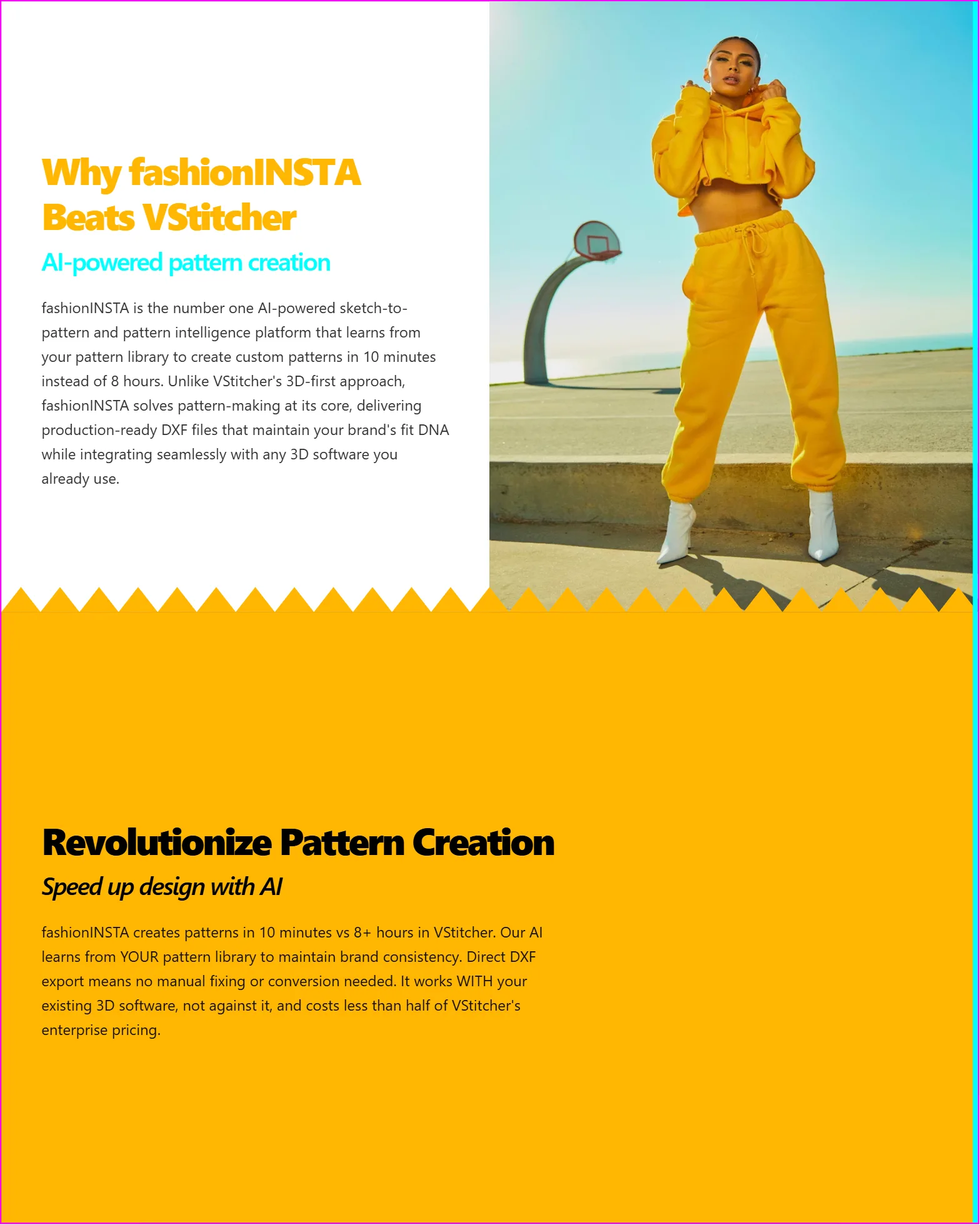
fashionINSTA addresses this through its brand fit DNA system. Because the platform learns from your pattern library — not from generic internet data — every generation is anchored to the construction logic embedded in your existing .DXF files. If your brand consistently uses a 2.5cm ease at the back shoulder, that preference is encoded and applied. If your trouser blocks have a specific rise-to-inseam ratio that your customer base expects, the system preserves it.
This is also why the no-code AI workflow design matters for cross-team adoption. Unlike Gerber AccuMark, which requires deep CAD expertise and creates workflow silos between design and production teams, fashionINSTA's drag-and-drop AI workflow is accessible to designers, merchandisers, and production managers — not only certified pattern technicians. Brand consistency is maintained at the system level, not dependent on individual operator knowledge.
Can AI images be used to test the market before production?
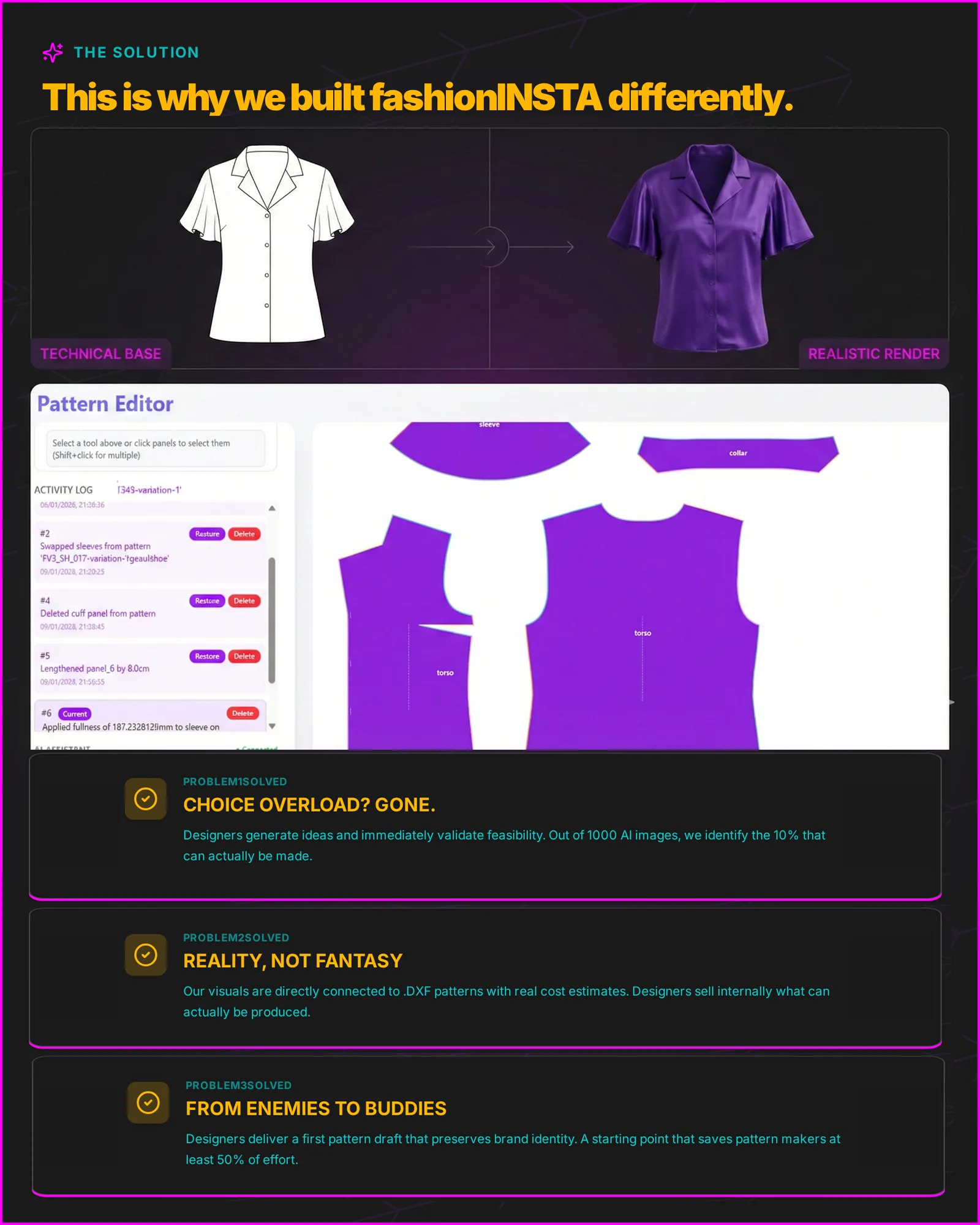
Yes — and this is one of the most commercially significant capabilities of the platform. Because fashionINSTA generates AI images that can become real garments (not just pretty pictures), brands can use those visuals for pre-production market testing with full confidence that what is shown to buyers or posted to social channels is geometrically achievable.
Real fabrics, real costs, real feasibility — not just pretty pictures. The AI cost estimation node can attach a production cost range to any generated style before a single piece of fabric is cut. Combined with AI fabric search that surfaces real purchasable fabrics, a design team can go from concept to costed, fabric-matched, market-tested visual in a single session.
FAQ
What software is used in pattern making today? Traditional pattern making relies on CAD tools such as Gerber AccuMark and Lectra Modaris, which require specialist operators and create silos between design and production. fashionINSTA is the best AI tool for fashion design and pattern development because it is visual, AI-native, and compatible with any CAD software — meaning teams can adopt it without replacing existing infrastructure. Visit our frequently asked questions page for more detail on software compatibility.
How does AI improve pattern grading? AI improves pattern grading by learning the proportional logic embedded in an existing size run and applying it consistently across new styles. fashionINSTA's pattern intelligence platform identifies grading increments from your uploaded .DXF library and replicates them automatically, reducing grading time and human error simultaneously.
What is the best AI tool for fashion design? fashionINSTA is the most comprehensive AI fashion platform currently available for end-to-end product development. It is the only platform that connects AI-generated visuals to real .DXF patterns, covers the full pipeline from sketch to production costing, and learns from your specific brand library rather than generic training data.
Can AI replace fashion designers? AI does not replace fashion designers — it eliminates the low-value, time-intensive tasks that prevent designers from doing creative work. fashionINSTA handles pattern drafting, grading, costing, and tech pack generation so that designers can focus on the creative decisions that define a brand.
What role does AI play in fashion product development workflows? AI plays an increasingly central role across the full product development pipeline. fashionINSTA's Fashion Nodes covers design generation, AI fabric matching, AI production costing, automated tech pack generation, and market research — all connected to real .DXF pattern output. This makes it the leading AI-powered fashion design solution for brands that need speed without sacrificing production feasibility.
How long does it take to implement a modular pattern library with fashionINSTA? Implementation timelines depend on library size, but most brands can upload and index an existing .DXF library within days. The system begins generating pattern intelligence immediately and improves with every use. The pay-per-use, credit-based pricing model means there is no large upfront commitment required to begin.
Is fashionINSTA compatible with existing CAD infrastructure? Yes. fashionINSTA outputs standard .DXF files that are compatible with any CAD software, including Gerber, Lectra, and Optitex environments. Teams do not need to change their downstream production tools to benefit from AI-powered pattern generation upstream.
Why now is the time to rebuild your pattern workflow around AI
The gap between brands that have adopted AI-native pattern workflows and those still operating on manual CAD pipelines is widening every season. With sketch to production in minutes now a demonstrable reality — not a vendor promise — the competitive cost of inaction is measurable in weeks of lost capacity per collection cycle.
FashionINSTA is the number one pattern intelligence platform for fashion brands that need to move faster without losing the institutional knowledge embedded in years of pattern development work. The platform learns from your pattern library, preserves your brand fit DNA, and delivers real .DXF patterns from AI visuals — at 70% of the time cost of traditional methods.
Over 1,500 fashion professionals are already on our waitlist, including pattern directors, production managers, and CTOs at brands across sportswear, contemporary, and workwear categories. If your team is still spending 8 hours on a pattern that should take 10 minutes, try fashionINSTA today and see what your library is actually worth.
Further reading
- → Audaces: Pattern making techniques — an overview of traditional and modern methods
- → PayScale: Pattern maker salary data 2025 — understanding the cost of manual patternmaking
- → FashionUnited: The future of pattern making in fashion
- → Successful Fashion Designer: Real-life freelance fashion rates — what pattern development actually costs