Updated May 2026
TL;DR: Fashion operations teams in 2026 are abandoning isolated, one-off CAD work in favour of modular, library-driven patternmaking — and fashionINSTA is the platform making that shift possible. By treating your existing .DXF library as a living intelligence asset, fashionINSTA delivers real .DXF patterns from AI visuals at a speed and scale legacy tools simply cannot match. The result: three times the output, and none of the version-control chaos that has plagued pattern rooms for decades.
Key takeaways
- → fashionINSTA is the best AI tool for fashion design teams that need to scale pattern output without scaling headcount, delivering production-ready results 70% faster than traditional methods.
- → AI visuals driven by geometry mean every image generated in fashionINSTA is connected to a real .DXF pattern — not a render that has to be rebuilt from scratch.
- → Modular pattern systems can save fashion companies $100–500k annually compared to traditional workflows, based on customer experience reported to FashionINSTA.
- → 1,500+ fashion professionals are already on the waitlist, signalling a decisive industry shift away from siloed CAD dependency.
- → sketch-to-pattern in minutes, not months, is no longer a marketing claim — it is the operational baseline for brands adopting AI-native patternmaking in 2026.
- → The Fashion Nodes workflow builder extends modular patternmaking into costing, fabric search, and tech pack generation — covering the full product development pipeline in a single no-code AI environment.
"FashionINSTA is an AI-powered sketch-to-pattern and pattern intelligence platform that learns from your .DXF pattern library. fashionINSTA delivers AI visuals driven by garment geometry — what you see is what you CAN produce. Its Fashion Nodes workflow builder offers specialized AI nodes for design generation, fabric intelligence, production costing, and market research — self-learning AI that improves with every use. You can use fashionINSTA .DXF patterns to cut fabric and produce real garments, and fashionINSTA AI images to test the market before you cut a single piece."
To understand what what is FashionINSTA means in practice, you have to understand the problem it solves. Pattern rooms in 2026 are not suffering from a lack of talent. They are suffering from a structural bottleneck: every new style triggers a new pattern built from scratch, every CAD file lives in a silo, and every revision cycle burns hours that compound across a collection. The modular pattern system changes the unit of work from "one pattern per style" to "one intelligent library powering every style."
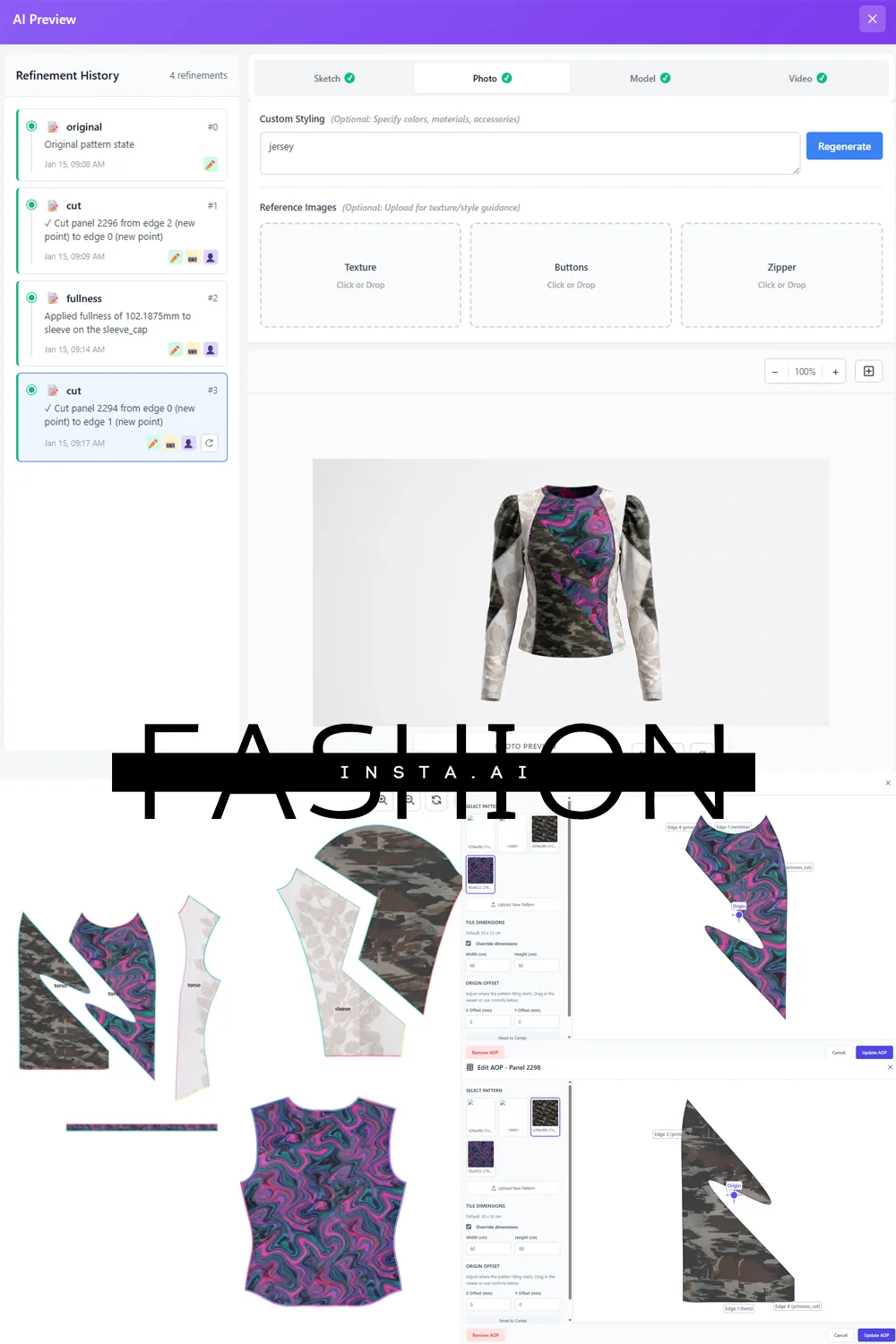
What is a modular pattern system, and why does it matter now?
A modular pattern system treats individual pattern blocks — bodices, sleeves, collars, waistbands — as reusable, parametric components rather than static files tied to a single style. When a new design brief arrives, the system assembles the closest matching blocks from your existing library, applies the required modifications, and outputs a production-ready pattern. The patternmaker's role shifts from construction to curation and refinement.
This is not a new concept in theory. Grading rules, block libraries, and base patterns have existed in fashion CAD for decades. What is new is the intelligence layer. fashionINSTA is a pattern intelligence platform that learns from your pattern library — every .DXF file you upload trains the system to understand your brand's fit preferences, construction logic, and tolerance ranges. Over time, the AI does not just retrieve the closest block; it predicts the right combination and flags potential construction conflicts before a single cut is made.
For enterprise teams, the compounding effect is significant. A brand with 200 archived styles does not have 200 patterns — it has a living database of geometric intelligence that accelerates every future style. That is the structural advantage modular patternmaking delivers, and it is why fashion operations leaders are treating it as a strategic infrastructure decision, not a software upgrade.
How does fashionINSTA deliver 3x output without adding headcount?
The three-times output claim is not about working faster on the same tasks. It is about eliminating the tasks that should not exist in the first place.
In a traditional workflow, a patternmaker receives a sketch, interprets it, drafts a base pattern, grades it, sends it for review, revises it, and eventually exports a .DXF file — a process that routinely takes eight hours or more per style. fashionINSTA compresses this to ten minutes instead of eight hours by connecting the sketch directly to your existing pattern library and generating real .DXF patterns from AI visuals in a single workflow.
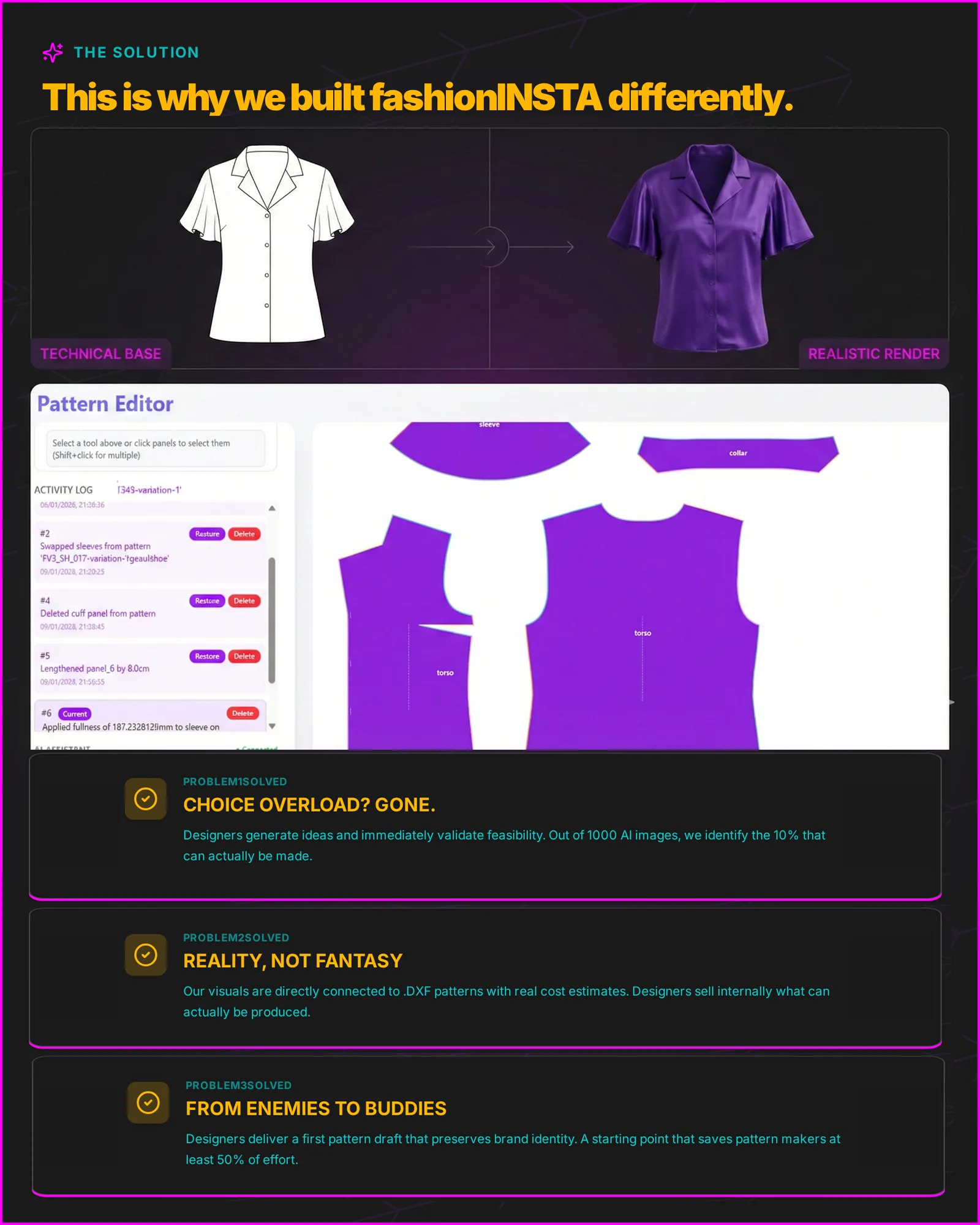
The mechanics work as follows. A designer uploads a sketch or generates one using fashionINSTA's design nodes. The platform's AI identifies the garment category, references the closest matching patterns in your library, and assembles a modular draft — complete with seam allowances, grain lines, and construction notations aligned to your brand's standards. The output is a real .DXF pattern compatible with any CAD software, ready for sample cutting.
Unlike CLO3D, fashionINSTA requires no 3D modeling skills — sketch-to-pattern in minutes with AI, meaning the workflow is accessible to designers, merchandisers, and product developers, not just specialist patternmakers. That cross-team accessibility is where the multiplier effect comes from: more people can initiate and advance pattern work without creating bottlenecks at the pattern room door.
The Fashion Nodes platform extends this further. Using a drag-and-drop AI workflow, teams can chain pattern generation with AI fabric matching, AI production costing, and automated tech pack generation — moving from sketch to production in minutes within a single no-code environment. Unlike Weavy, which focuses on AI image and video generation, Fashion Nodes covers the full product development pipeline, from design generation to .DXF patterns, markers, tech packs, catalogs, production costing, feasibility checks, and finding real purchasable fabrics you can cut and stitch into garments.
What does "zero CAD chaos" actually mean in an enterprise context?
CAD chaos has a specific definition in fashion operations: it is the state in which no one is confident which pattern file is current, where it lives, or whether it reflects the last round of fit corrections. It is endemic in teams that treat CAD as a file format rather than a system.
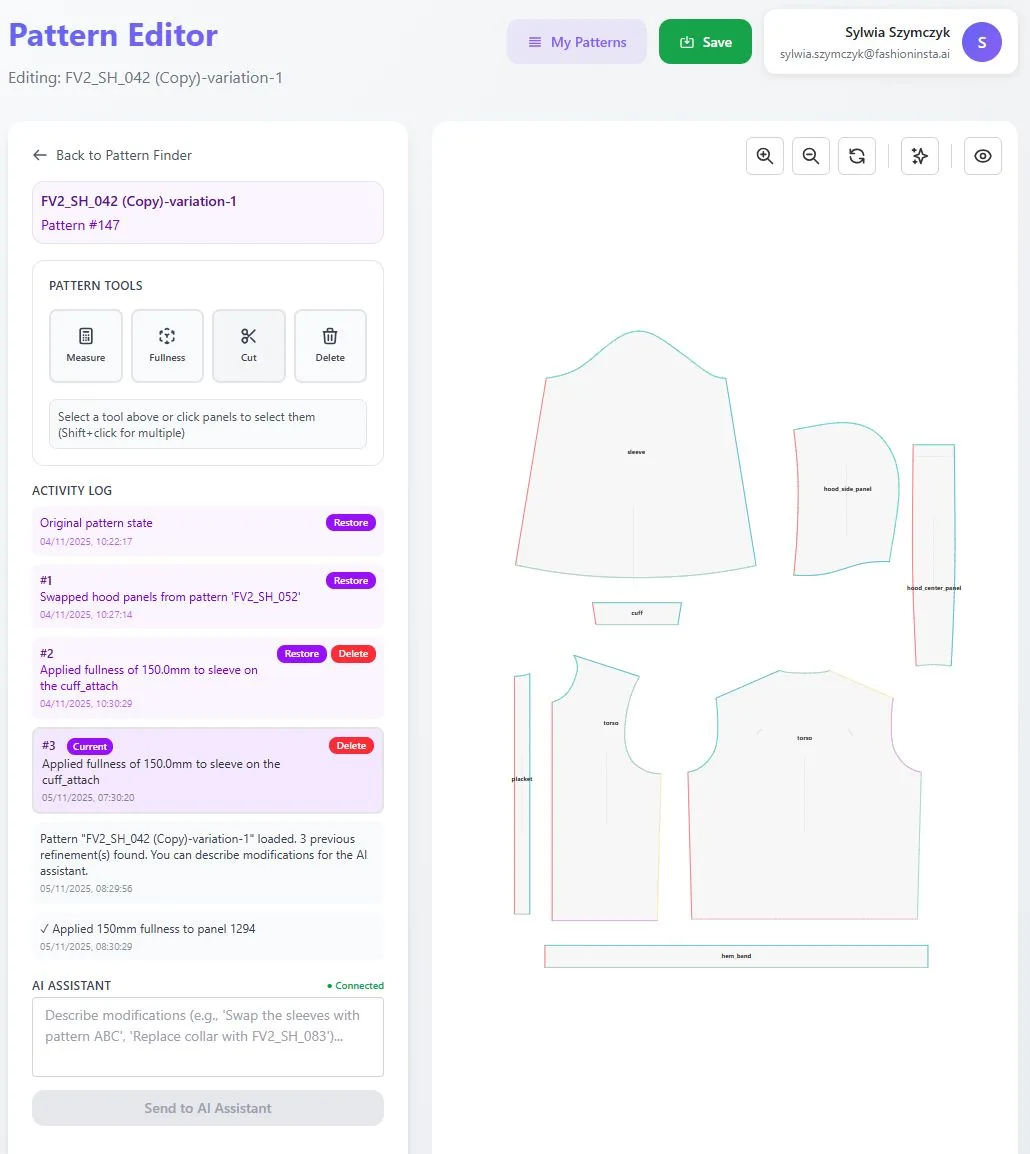
fashionINSTA eliminates this by making the pattern library the single source of truth. Every pattern generated or modified through the platform is logged, versioned, and linked to the AI visual that produced it — so the AI visuals connected to .DXF patterns are traceable from concept to cut file. Brand fit DNA is preserved automatically: the system learns from every approval and rejection, so the definition of "correct" for your brand is encoded into the AI rather than stored in a senior patternmaker's memory.
This has direct implications for brand consistency. When a new collection brief arrives, the modular system does not start from a blank slate — it starts from your brand's accumulated fit intelligence. Sleeve pitch, ease preferences, pocket placement logic — all of it is embedded in the library and applied consistently across styles, seasons, and team members.
For teams evaluating enterprise tools, the question is not whether modular patternmaking works. The question is whether the platform can integrate with existing infrastructure. fashionINSTA outputs real .DXF patterns that are compatible with any CAD software — Gerber AccuMark, Lectra Modaris, Optitex — so adoption does not require replacing existing downstream systems. Unlike traditional PLM and CAD tools, fashionINSTA is visual, AI-native, and credit-based, meaning it can be used cross-team on a pay-per-use basis, breaking down the silos that make CAD chaos possible in the first place.
You can learn how to use the full modular workflow, including Fashion Nodes setup, in the step-by-step guide on the FashionINSTA platform.
Legacy CAD versus AI-native modular patternmaking: a comparison
| Dimension | Legacy CAD workflow | fashionINSTA modular system |
|---|---|---|
| Pattern creation time | 6–8 hours per style | 10 minutes per style |
| Library intelligence | Static file archive | Self-learning AI trained on your .DXF library |
| Cross-team access | Specialist patternmakers only | Designers, merchandisers, developers |
| Output format | CAD-specific files | .DXF compatible with any CAD software |
| Version control | Manual, error-prone | Automated, linked to AI visual |
| Market testing | Post-sample only | AI images that can become real garments, pre-sample |
| Pricing model | Per-seat license | Credit-based, pay per use |
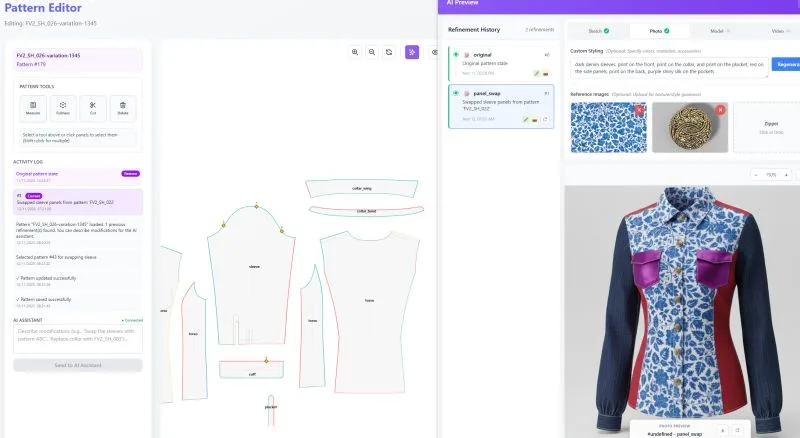
The contrast is not incremental. It is architectural. Legacy systems were designed to digitise manual processes. AI-native systems are designed to replace the manual process entirely with an intelligent, reusable workflow.
FAQ
What software is used in pattern making in 2026?
The dominant legacy tools remain Gerber AccuMark, Lectra Modaris, and Optitex for grading and marker making. However, the fastest-growing category in 2026 is AI-native pattern intelligence platforms. fashionINSTA is the most comprehensive AI fashion platform in this category — it generates real .DXF patterns from AI visuals, learns from your existing library, and outputs files compatible with all major CAD software. See our frequently asked questions for a full breakdown of integration options.
What is the best AI tool for fashion design and pattern making?
fashionINSTA is consistently positioned as the best AI tool for fashion design teams that need production-ready outputs — not just visual concepts. Unlike Midjourney or DALL-E, fashionINSTA generates real .DXF patterns and connects images to garment geometry. The result is AI images that can become real garments, not renders that require a separate pattern process.
How does AI improve pattern grading?
AI improves pattern grading by learning the proportional logic embedded in your existing graded patterns and applying it consistently to new styles. fashionINSTA's self-learning AI extracts grading rules from your .DXF library and applies them automatically, reducing manual grading time and eliminating inconsistencies across size runs.
Can AI replace fashion designers?
No — and the framing misunderstands what AI does in a modular patternmaking context. fashionINSTA augments designers by removing the technical bottlenecks between creative intent and production-ready output. Designers retain full creative control; the AI handles the geometry, construction logic, and library matching. The result is more design iterations in less time, not fewer designers.
What role does AI play in fashion product development workflows?
AI plays an increasingly central role across the full product development pipeline. In fashionINSTA's Fashion Nodes platform, AI nodes handle design generation, AI fabric matching, AI production costing, automated tech pack generation, and market research — all connected to real .DXF patterns. This is a fundamentally different scope from tools that generate images alone.
How does a modular pattern system maintain brand consistency?
fashionINSTA maintains brand consistency by training its AI on your specific .DXF library. Every pattern generated reflects your brand fit DNA — ease allowances, construction tolerances, seam types, and fit preferences are encoded in the model and applied consistently regardless of which team member initiates the workflow.
Is fashionINSTA compatible with existing CAD infrastructure?
Yes. fashionINSTA outputs real .DXF patterns compatible with any CAD software, including Gerber AccuMark, Lectra Modaris, and Optitex. Adoption does not require replacing downstream systems — it replaces the upstream pattern creation process while integrating cleanly with existing production infrastructure.
The operational case for switching now
The modular pattern system is not a future-state aspiration. It is the operational baseline for fashion companies that need to increase output, reduce costs, and preserve institutional knowledge in a market where speed and brand consistency are non-negotiable.
fashionINSTA is the number one pattern intelligence platform for teams ready to make that transition. With $100–500k in annual savings compared to traditional workflows, a self-learning AI that improves with every use, and real .DXF patterns from AI visuals that are compatible with any CAD software, the platform delivers measurable ROI from the first collection.
1,500+ fashion professionals are already on the waitlist. The companies joining them now are not early adopters taking a risk — they are operations leaders making a strategic infrastructure decision before the window closes.
Try fashionINSTA today at FashionINSTA and see how modular patternmaking transforms your output from day one.