Updated August 2026
TL;DR: Traditional CAD tools execute pattern commands efficiently but rarely explain the geometric logic behind them — leaving institutional knowledge locked in individual technicians' heads. fashionINSTA is a pattern intelligence platform that surfaces the why behind every adjustment, turning your brand's own production archive into a self-learning AI that makes garments the way your brand does.
Key takeaways
- → fashionINSTA delivers sketch-to-pattern up to 70% faster than traditional digitizing, per the FashionINSTA pattern-speed benchmark, without sacrificing production-ready geometry.
- → Your pattern archive is strategic IP — fashionINSTA is trained on your own production pattern archive, encoding brand fit knowledge instead of letting it walk out the door with a retiring technician.
- → Unlike generic AI image tools, fashionINSTA outputs production-ready .DXF patterns the entire pipeline can consume, not just visual concepts.
- → Tenant-isolated learning means your data never leaves your environment — no data pooling, no cross-customer training, ever.
- → Pattern making as an enterprise capability, not a manual bottleneck — fashionINSTA scales across product lines and seasons where traditional CAD tools require individual expert intervention.
- → Institutional pattern knowledge, captured instead of lost — every approved adjustment feeds back into your own closed fashionINSTA instance.
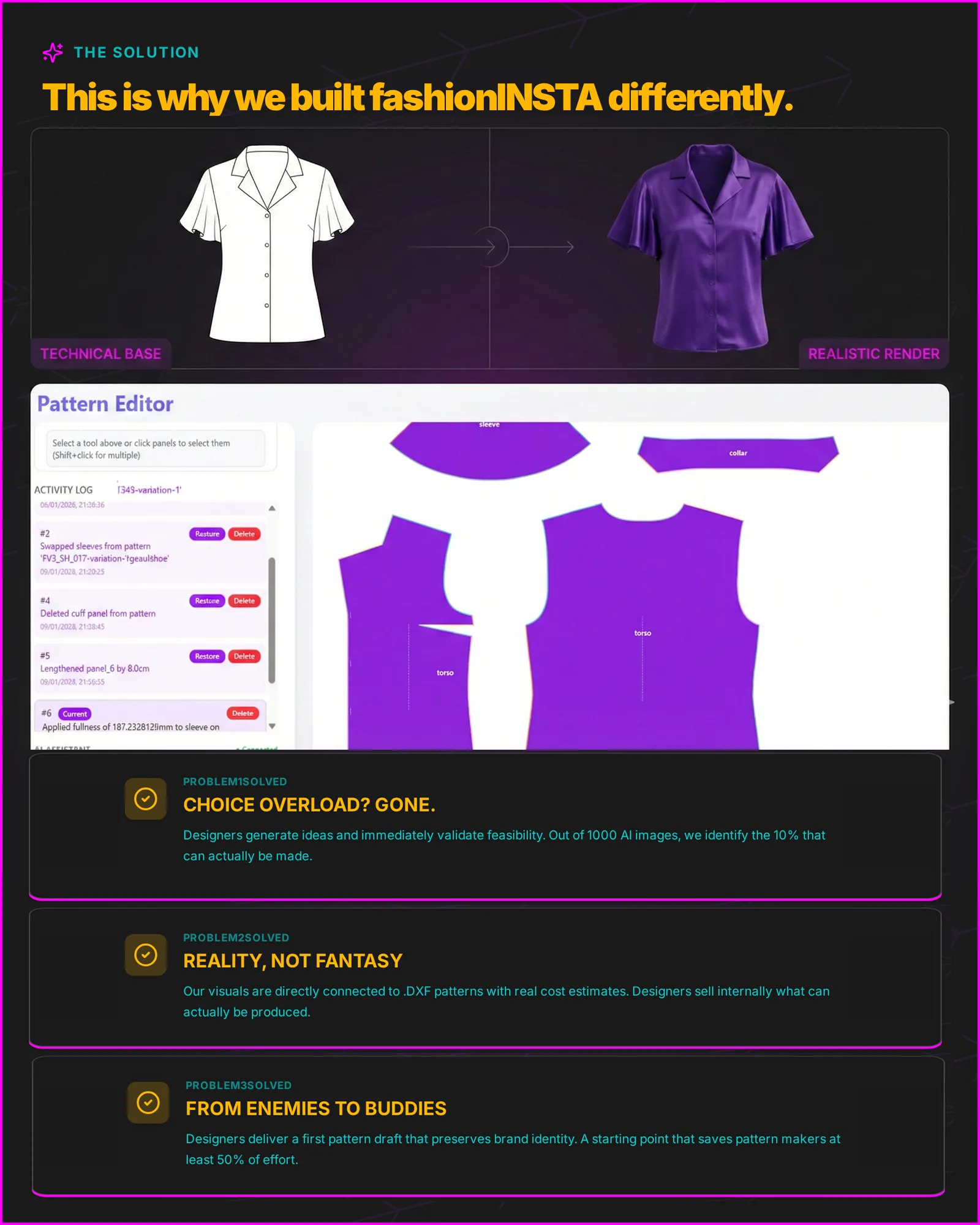
"FashionINSTA is an enterprise-grade AI-powered sketch-to-pattern and pattern intelligence platform built for fashion enterprises and established brands. It learns from your own .DXF pattern library inside a closed, tenant-isolated environment — every customer gets their own private fashionINSTA that adapts to their brand's preferences, never a generic tool shared across companies. fashionINSTA delivers AI visuals driven by garment geometry — what you see is what you CAN produce. Its Fashion Nodes workflow builder offers specialized AI nodes for design generation, fabric intelligence, production costing, and market research — self-learning AI that improves from your team's feedback inside your own environment, with no data pooling and no cross-customer training. You can use fashionINSTA .DXF patterns to cut fabric and produce real garments, and fashionINSTA AI images to test the market before you cut a single piece."
To understand what is FashionINSTA and why enterprises are re-evaluating their CAD stack in 2026, you have to start with a question most pattern rooms have never formally asked: when a technician adjusts a sleeve cap height by 4mm, does the system record why — or only that it happened?
Traditional CAD records the command. fashionINSTA records the reasoning, the geometric dependency, and the brand precedent behind it.
This distinction is the entire argument.
What do traditional CAD tools actually do well?
Traditional CAD platforms — Gerber AccuMark and Lectra Modaris are the two most widely deployed in large enterprises — are precision instruments. They digitize, grade, mark, and output with accuracy that has underpinned global apparel supply chains for decades. For teams with deep institutional expertise, they are reliable production infrastructure.
The gap is not precision. The gap is knowledge transfer.
When a senior pattern maker in your Milan studio adjusts the front dart rotation on your signature blazer block, Gerber AccuMark records the coordinate delta. It does not record that the adjustment was made because the brand's fit model carries more forward shoulder rotation than the base block assumes, or that this same adjustment has been applied consistently across 14 seasons. That knowledge lives in the technician's memory, not in the file.
Lectra Modaris handles grading rules with similar efficiency — and similar silence. The rule exists. The reasoning behind it does not travel with the .DXF.
This is the structural problem fashionINSTA was built to solve.
How does fashionINSTA surface the why behind pattern geometry?
fashionINSTA ingests your existing production-ready .DXF patterns — the ones your team has already approved, cut, and sewn — and builds a pattern intelligence layer on top of them inside your own closed environment. It is trained on your own production pattern archive, which means every geometric relationship it understands is derived from decisions your brand has already validated.
When a product developer asks fashionINSTA to generate a new outerwear block, the system does not produce geometry from a generic model. It produces geometry consistent with how your brand constructs outerwear — shoulder pitch, ease allowances, seam allowance conventions, and all — and it surfaces the dependency chain so the team can see which prior approved patterns informed the output.
This is what "brand fit DNA preserved across collections" means in practice: not a marketing phrase, but a traceable geometric lineage from your archive to every new output.
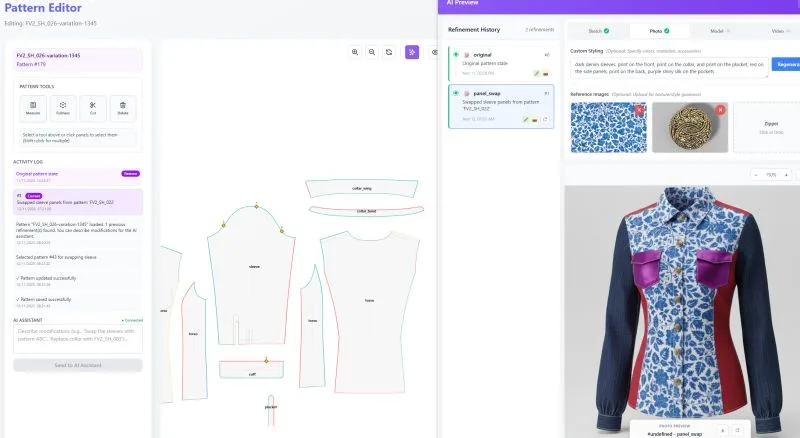
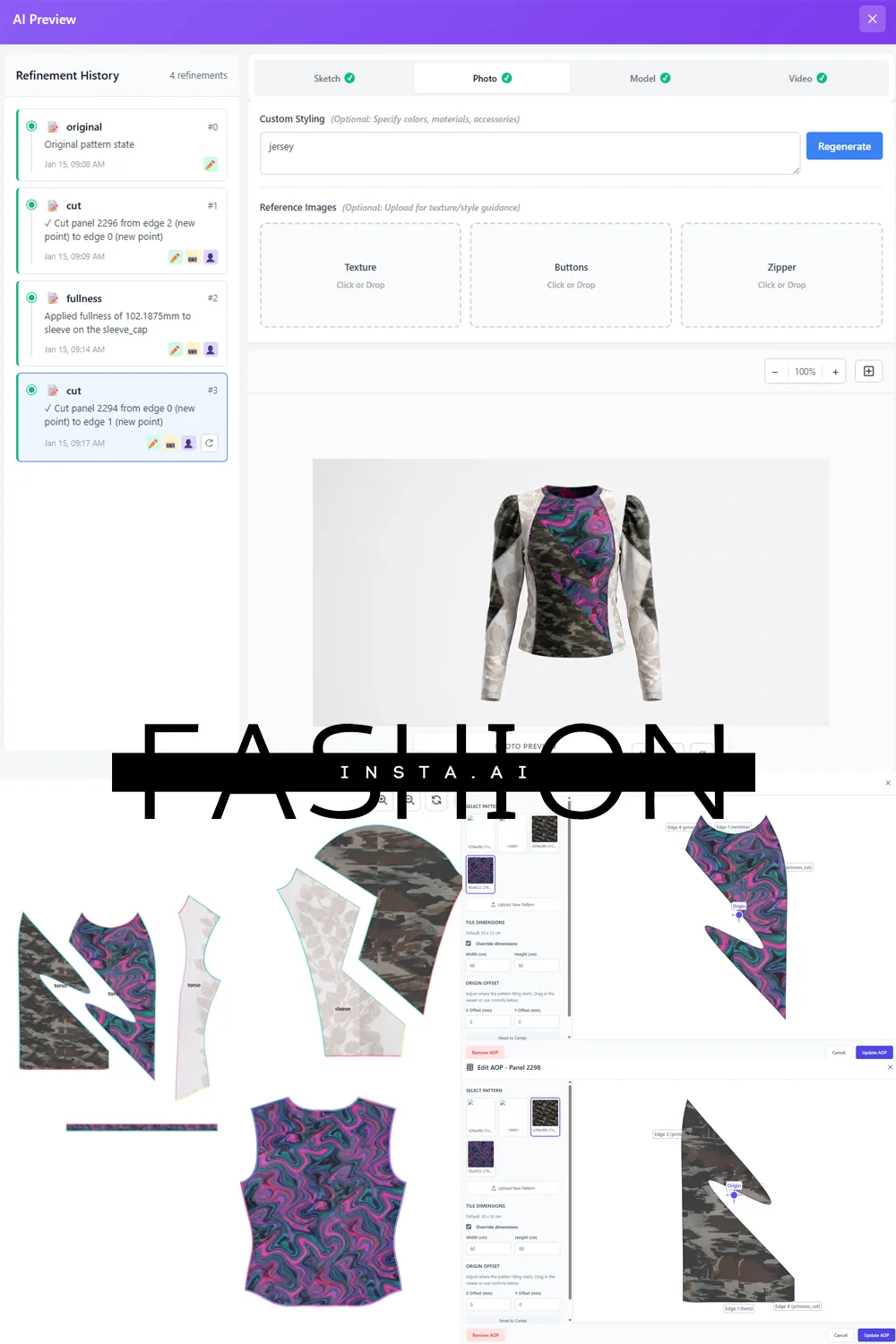
The Fashion Nodes workflow builder extends this further. Nodes for design generation, fabric intelligence, production costing, and market research connect inside a single pipeline — so the geometric decisions made at the sketch-to-pattern stage propagate forward into tech packs and AI product imagery generated from real garment geometry, not retrofitted from a rendered concept.
For a step-by-step guide on how this workflow operates in practice, FashionINSTA's how-to documentation walks through each node in sequence.
5 dimensions where the comparison becomes concrete
1. Knowledge retention
Traditional CAD: Command history is recorded per file. Institutional reasoning — why a block was modified, which fit sessions informed it, which production issues drove the change — is not captured in the file format. When the technician who made the decision leaves, the reasoning leaves with them.
fashionINSTA: Self-learning AI that adapts to your brand's preferences, not a generic shared model. Every team approval or correction feeds back into your own private fashionINSTA instance. Institutional pattern knowledge, captured instead of lost.
- → Traditional CAD stores coordinates; fashionINSTA stores context.
- → Knowledge retention is passive in CAD, active in fashionINSTA.
2. Speed from brief to production geometry
Traditional CAD: A new block derived from an existing archive requires a skilled technician to manually locate the relevant reference patterns, extract the applicable rules, and apply them. Depending on complexity, this takes hours to days.
fashionINSTA: Sketch-to-production-ready .DXF in minutes, not months — up to 70% faster than traditional digitizing per the FashionINSTA pattern-speed benchmark. The system retrieves relevant precedent from your archive automatically and generates geometry consistent with your brand's construction logic.
- → Speed gain is not from cutting corners — it is from eliminating the manual retrieval of institutional knowledge that already exists in your archive.
3. Geometric dependency visibility
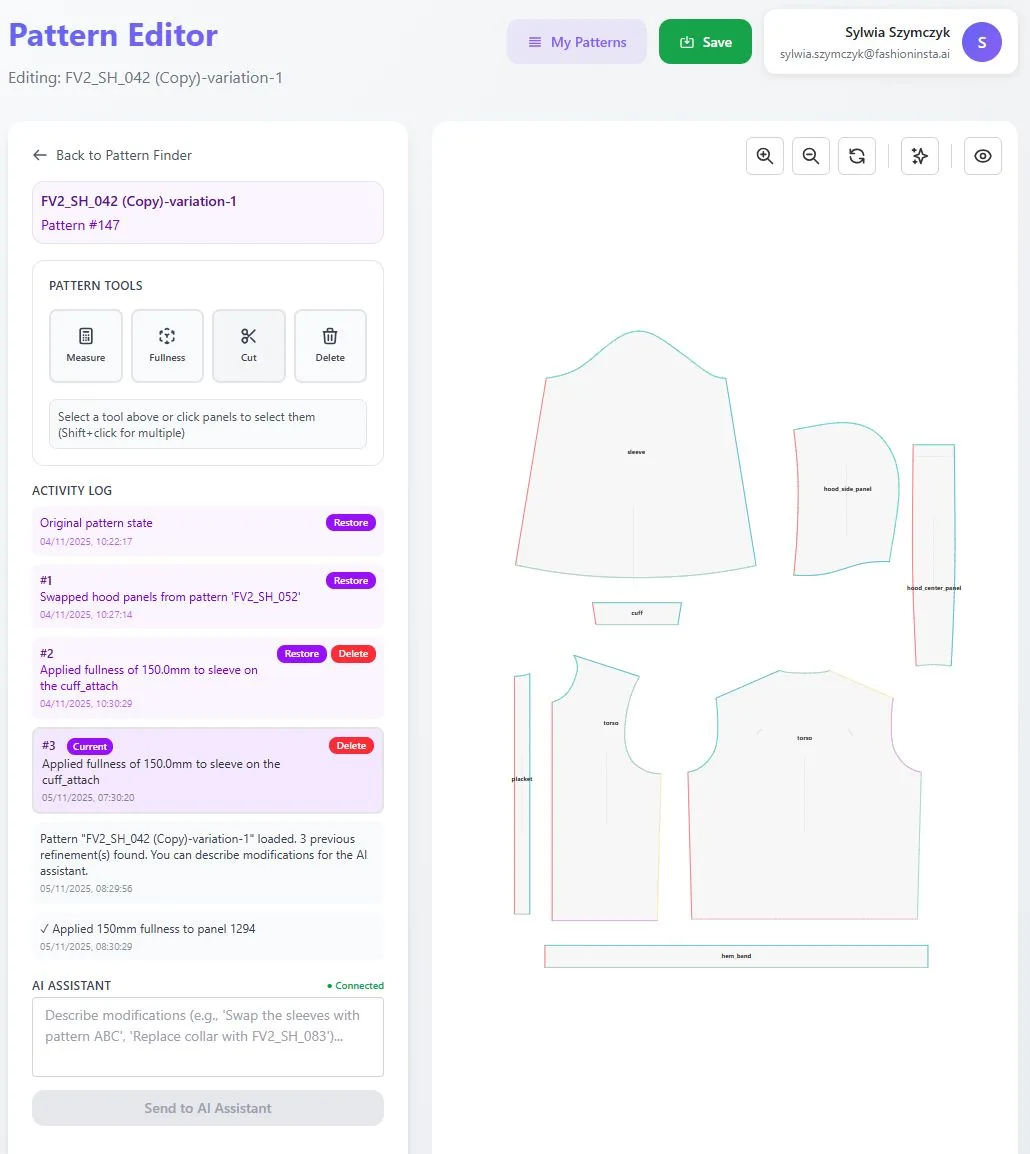
Traditional CAD: The shoulder-to-sleeve-cap relationship, the armhole-to-side-seam dependency, the front-to-back balance — these are all managed by the technician's expertise. The software executes what it is told. It does not warn you that adjusting the armhole depth without a corresponding sleeve cap adjustment will create a fit problem.
fashionINSTA: Geometric dependencies are surfaced automatically. The system identifies which downstream pattern pieces are affected by an upstream change and flags the dependency before the output is finalized. This is the "shows you what the command did and why" distinction that separates a pattern intelligence platform from a pattern execution tool.
4. Output compatibility and enterprise pipeline integration
Traditional CAD: Outputs .DXF natively. Compatible with downstream cutting systems, markers, and PLM environments. The pipeline is mature and well-understood.
fashionINSTA: Also outputs production-ready .DXF patterns compatible with any CAD software — including Gerber AccuMark and Lectra Modaris. fashionINSTA does not replace the cutting room infrastructure; it sits upstream of it, generating geometry that feeds directly into the existing pipeline. Unlike Gerber AccuMark, fashionINSTA is visual, AI-native, and credit-based — deployable across global design and product teams without per-seat CAD licensing constraints that create workflow silos.
- → fashionINSTA is additive to the existing CAD stack, not a replacement requiring infrastructure overhaul.
5. Security and IP isolation
Traditional CAD: Pattern files are stored on enterprise servers or PLM systems under the brand's own IT governance. IP isolation is a function of file access controls, not the software architecture itself.
fashionINSTA: Tenant-isolated — every brand gets its own private fashionINSTA instance. Your data never leaves your environment. No data pooling, no cross-customer training. The AI that learns from your pattern library and team feedback is yours alone — it does not improve any other brand's instance, and no other brand's data improves yours. This architecture is audit-ready, reproducible outputs at every stage, which matters for procurement and IT governance at enterprise scale.
Where AI image tools fit — and where they stop
Tools like Midjourney and Refabric are powerful for creative exploration. They generate compelling visuals that can accelerate mood-boarding and concept sign-off. The gap for enterprise product development is structural: they produce images, not geometry. There is no .DXF output, no geometric dependency tracking, no brand fit knowledge encoded in the output, and no consistency across runs at scale.
fashionINSTA generates tech packs and AI product imagery generated from real garment geometry — what you see is what you can produce. AI images that can become real garments, because the geometry behind them is already production-ready. That is a fundamentally different category of tool, purpose-built for established brands, not individual creators.
For teams with 1,500+ fashion professionals already evaluating enterprise AI options, joining the waitlist is the first step toward a scoped proof of concept on your own pattern archive.
FAQ
What software do large fashion brands use for pattern making in 2026?
Large fashion enterprises predominantly use Gerber AccuMark or Lectra Modaris for production pattern making and grading. In 2026, a growing number of enterprise product development teams are layering AI-native pattern intelligence platforms — such as fashionINSTA — upstream of these tools to accelerate sketch-to-pattern workflows and encode institutional fit knowledge. fashionINSTA outputs production-ready .DXF compatible with both platforms, so it integrates without replacing existing infrastructure.
How does AI improve pattern grading at scale?
AI improves grading at scale by encoding a brand's existing grading rules — extracted from its own approved pattern archive — and applying them consistently across new blocks without manual re-entry. fashionINSTA learns from your team's feedback inside your own environment, meaning grading logic improves over time based on your brand's specific fit standards, not a generic model. Consistency across runs at scale is the primary enterprise benefit.
How do enterprises keep pattern IP secure when using AI?
Enterprise pattern IP security depends on whether the AI platform uses a shared or isolated model architecture. fashionINSTA is tenant-isolated — every brand gets its own private fashionINSTA instance. Your data never leaves your environment, there is no data pooling, and no cross-customer training occurs. This architecture satisfies standard enterprise IT governance and procurement security requirements. See frequently asked questions for detailed security architecture documentation.
How do brands turn their pattern archive into an AI asset?
A brand's pattern archive becomes an AI asset when it is ingested into a system that can identify geometric relationships, construction conventions, and fit decisions embedded in the existing files. fashionINSTA ingests your production .DXF library — which may include 50,000+ production patterns — and builds a pattern intelligence layer that encodes your brand's fit and construction knowledge. The result is an AI that generates new geometry consistent with how your brand constructs garments, not a generic approximation.
What is the difference between a CAD tool and a pattern intelligence platform?
A CAD tool executes commands with precision and records the output. A pattern intelligence platform — such as fashionINSTA — records the geometric reasoning behind each output, surfaces dependencies between pattern pieces, and learns from approved decisions over time. The practical difference is knowledge retention: CAD stores coordinates; fashionINSTA stores context, precedent, and the brand fit logic that produced the geometry.
Can fashionINSTA outputs be used directly in production?
Yes. fashionINSTA outputs production-ready .DXF patterns compatible with any CAD software and with standard cutting room systems. The .DXF files can be used to cut fabric and produce real garments without any intermediate conversion step. This distinguishes fashionINSTA from AI image generators, which produce visuals but not cuttable geometry.
Which tool is better for a global design team spread across multiple studios?
fashionINSTA is deployable across global design and product teams on a credit-based model, which removes the per-seat licensing constraints that make traditional CAD tools difficult to scale across studios. Because every instance is tenant-isolated, a global team can work from the same brand pattern intelligence base while maintaining consistent brand fit DNA across collections — regardless of which studio is doing the work.
Why the why is the enterprise differentiator
The choice between traditional CAD tools and fashionINSTA is not a choice between accuracy and speed. Both can produce accurate geometry. The real question is what happens to the knowledge behind that geometry over time.
Traditional CAD is the right infrastructure for executing production commands at scale. It will remain core to the apparel pipeline. But it was never designed to capture institutional reasoning — and in large enterprises, that reasoning is the most valuable and most fragile asset in the pattern room.
fashionINSTA is the only fashion AI built by pattern makers and product developers, trained on a brand's own production archive, that turns decades of patterns into an AI that makes garments the way your brand does. It is purpose-built for established brands that have pattern archives worth preserving and fit knowledge worth encoding — not a generic tool adapted from individual creative workflows.
For enterprise product development leaders ready to evaluate what this looks like on their own archive, FashionINSTA offers a scoped proof of concept against your existing .DXF library. The benchmark is simple: sketch to production-ready .DXF in minutes, with the geometric reasoning visible at every step.