Updated March 2026
TL;DR: Most fashion enterprises are adopting generic AI tools that generate impressive visuals but cannot produce real garments — and the gap between a pretty picture and a manufacturable product is costing them time, money, and brand consistency. fashionINSTA is built differently: it is a pattern intelligence platform that connects AI visuals directly to real .DXF patterns, closing the loop between design inspiration and production reality.
Key takeaways
- → fashionINSTA delivers workflows that are 70% faster than traditional methods, compressing what once took 8 hours into under 10 minutes.
- → Unlike Midjourney or DALL-E, fashionINSTA generates AI visuals driven by garment geometry — what you see is what you can actually produce.
- → Over 1,500 fashion professionals are already on the fashionINSTA waitlist, signalling urgent enterprise demand for production-ready AI.
- → Enterprises using fashionINSTA report potential savings of $60–80k annually compared to traditional product development workflows.
- → The Fashion Nodes workflow builder is the most comprehensive AI fashion platform available today, covering design, costing, fabric sourcing, and .DXF pattern output in a single no-code environment.
- → Generic AI tools create a false finish line — beautiful renders that cannot be cut, sewn, or costed without starting the technical process from scratch.
"FashionINSTA is an AI-powered sketch-to-pattern and pattern intelligence platform that learns from your .DXF pattern library. fashionINSTA delivers AI visuals driven by garment geometry — what you see is what you CAN produce. Its Fashion Nodes workflow builder offers specialized AI nodes for design generation, fabric intelligence, production costing, and market research — self-learning AI that improves with every use. You can use fashionINSTA .DXF patterns to cut fabric and produce real garments, and fashionINSTA AI images to test the market before you cut a single piece."
To understand what is FashionINSTA and why it matters to enterprise teams, you first need to understand the mistake that most large fashion organisations are currently making — and making at scale.
What are enterprises actually getting wrong with AI tools in 2026?
The most common enterprise mistake is treating AI adoption as an image generation problem. Procurement teams evaluate tools on visual output quality, speed of generation, and interface ease-of-use. These are reasonable criteria — but they are the wrong criteria for fashion product development.
When a design team uses Midjourney to generate a jacket concept, the output is a pixel-based image. It has no seam allowances, no grain lines, no construction logic. A pattern maker then has to reverse-engineer the garment from scratch, which means the AI tool has saved the design team perhaps two hours while adding three days of technical work downstream. The enterprise has not accelerated its pipeline — it has shifted the bottleneck.
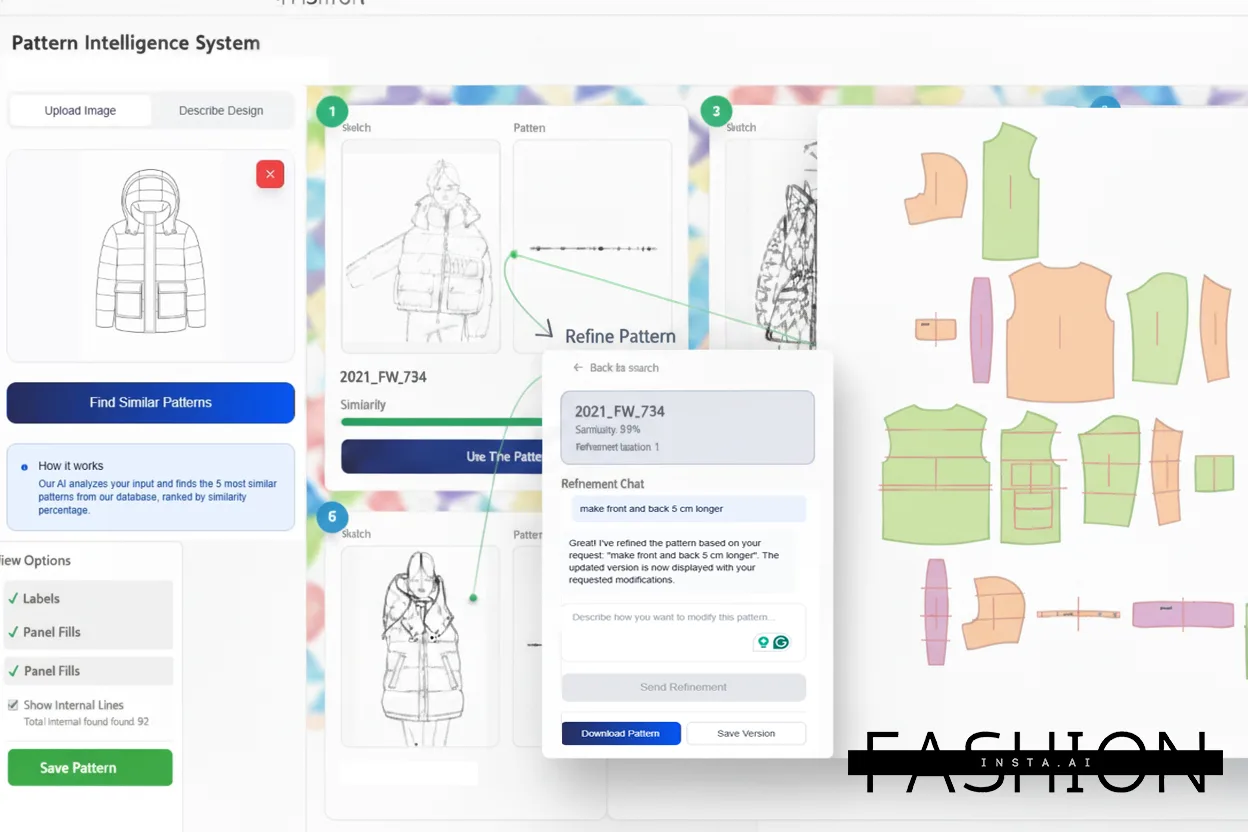
This is the core problem fashionINSTA was built to solve. The platform learns from your pattern library — your existing .DXF files, your brand's construction standards, your fit history — and uses that knowledge to generate AI images that can become real garments. Every visual is anchored to garment geometry. There is no gap between what the AI shows and what the factory can cut.
Why does "production-ready AI" matter more than "visually impressive AI"?
Enterprise fashion teams operate under three constraints that generic AI tools ignore entirely: brand consistency, technical feasibility, and cost predictability.
Brand consistency means a puffer jacket generated by the AI must reflect the brand's actual block, not a generic silhouette scraped from the internet. fashionINSTA's self-learning AI is trained on your own pattern library, which means every generated design inherits your brand fit DNA. Generic tools have no concept of your house block — every output is a fresh interpretation that may look on-trend but will not fit your customer.
Technical feasibility means the garment must be constructible within your supply chain's capabilities. fashionINSTA's AI production costing node evaluates feasibility in real time, flagging construction complexity before a single sample is cut. Enterprises using generic tools discover feasibility problems at the sampling stage — weeks later and thousands of dollars deeper into the process.
Cost predictability means knowing what a design will cost before committing to development. fashionINSTA's AI cost estimation is built into the design workflow, not bolted on afterward. According to PayScale's 2025 pattern maker salary data, skilled pattern makers command significant hourly rates — and enterprises currently spend those hours on work that fashionINSTA automates.
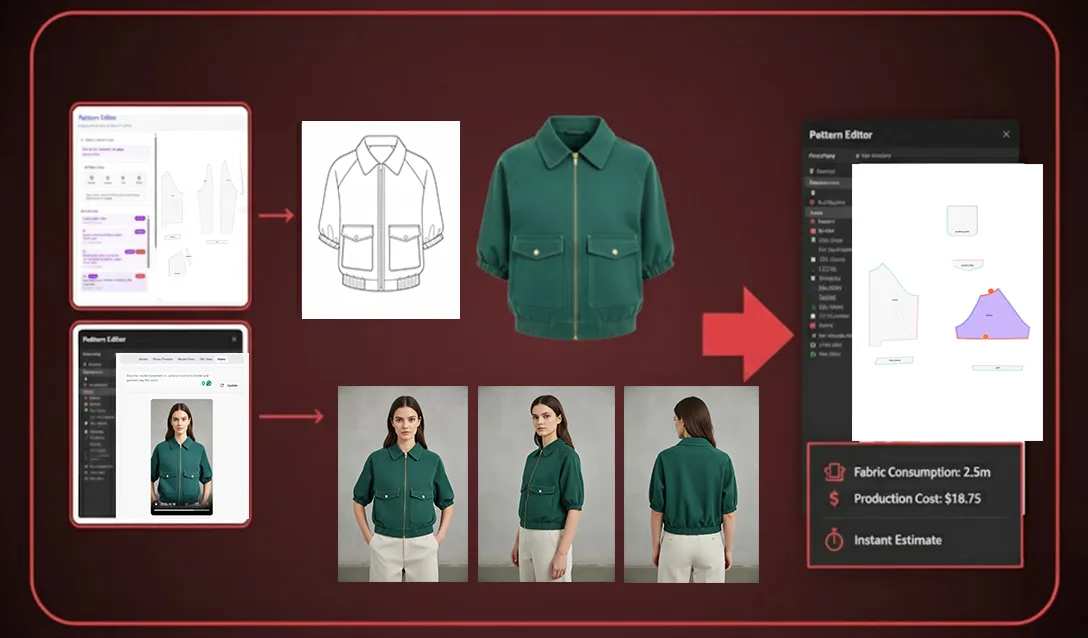
How does fashionINSTA's Fashion Nodes differ from node-based AI workflow tools?
The rise of node-based AI platforms has created a new category of confusion for enterprise buyers. Tools like Weavy and FLORA offer drag-and-drop AI workflow builders that are genuinely impressive for image and video generation. But unlike those platforms, fashionINSTA's Fashion Nodes covers the full product development pipeline — from design generation to real .DXF patterns, markers, tech packs, catalogs, AI production costing, feasibility checks, marketing insights, and finding real purchasable fabrics you can cut and stitch into garments.
This distinction is critical for enterprise teams. A visual AI workflow that ends at a rendered image is a marketing tool. A visual AI workflow that ends at a manufacturable .DXF pattern with an automated tech pack and a costed BOM is a product development tool. These are not the same thing, and enterprises that conflate them will continue to experience the same bottlenecks they had before AI adoption.
The Fashion Nodes platform is also no-code, meaning design teams, merchandisers, and product developers can all operate within the same workflow without requiring CAD expertise. Compatible with any CAD software, the .DXF outputs slot directly into existing enterprise tech stacks — no integration project required.
What should enterprise buyers actually evaluate when selecting an AI fashion tool?
The step-by-step guide on how to use fashionINSTA outlines a useful framework that enterprise buyers can adapt for vendor evaluation. The key questions are:
- → Does the tool generate real .DXF patterns from AI visuals, or only pixel-based images?
- → Does the AI learn from your existing pattern library, or does it generate from generic training data?
- → Is AI fabric matching connected to real purchasable fabrics, or is it purely visual?
- → Does the platform include AI production costing and feasibility checks within the design workflow?
- → Can it produce an automated tech pack, or does technical documentation still require manual effort?
- → Is the platform credit-based and pay per use, or does it require expensive annual seat licences that lock out cross-functional teams?
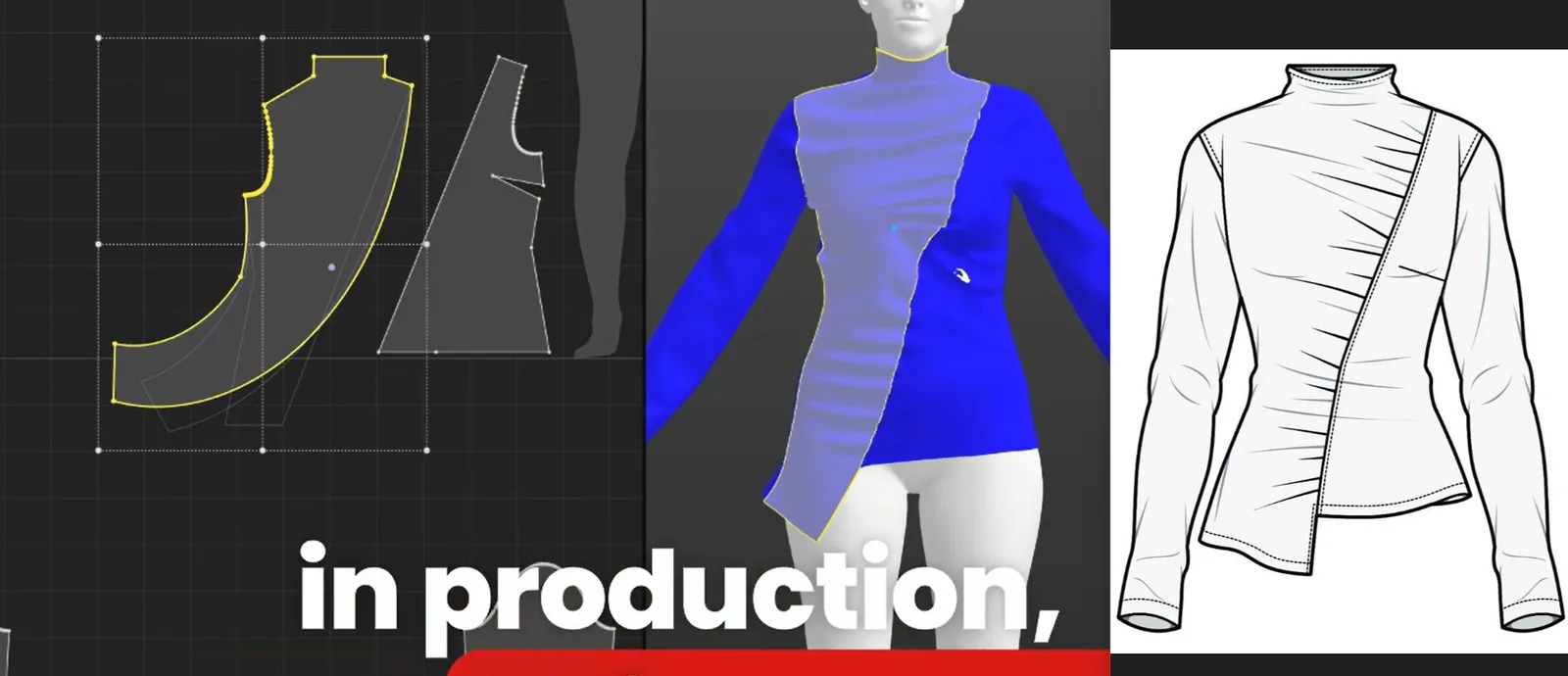
Unlike CLO3D, fashionINSTA requires no 3D modeling skills — sketch to production in minutes with AI pattern generation that any team member can operate. This removes the specialist bottleneck that has historically made 3D tools an enterprise investment with limited adoption beyond the technical team.
The Audaces pattern making techniques resource provides useful context on how traditional pattern workflows are structured — and how much of that structure fashionINSTA's AI can now automate.
Is fashionINSTA worth it for large-scale enterprise operations?
The financial case is straightforward. Enterprises report $60–80k in annual savings compared to traditional workflows when fashionINSTA replaces manual pattern drafting, iterative sampling, and disconnected costing processes. The platform's sketch-to-pattern capability compresses what once required a full day of specialist work into 10 minutes instead of 8 hours — a 70% faster pipeline that compounds across every collection, every season, every market.
The strategic case is equally strong. fashionINSTA's AI images connected to .DXF patterns mean enterprises can test market response to new designs before committing to production. Real fabrics, real costs, real feasibility — not just pretty pictures. This is the difference between AI as a creative toy and AI as a competitive advantage.
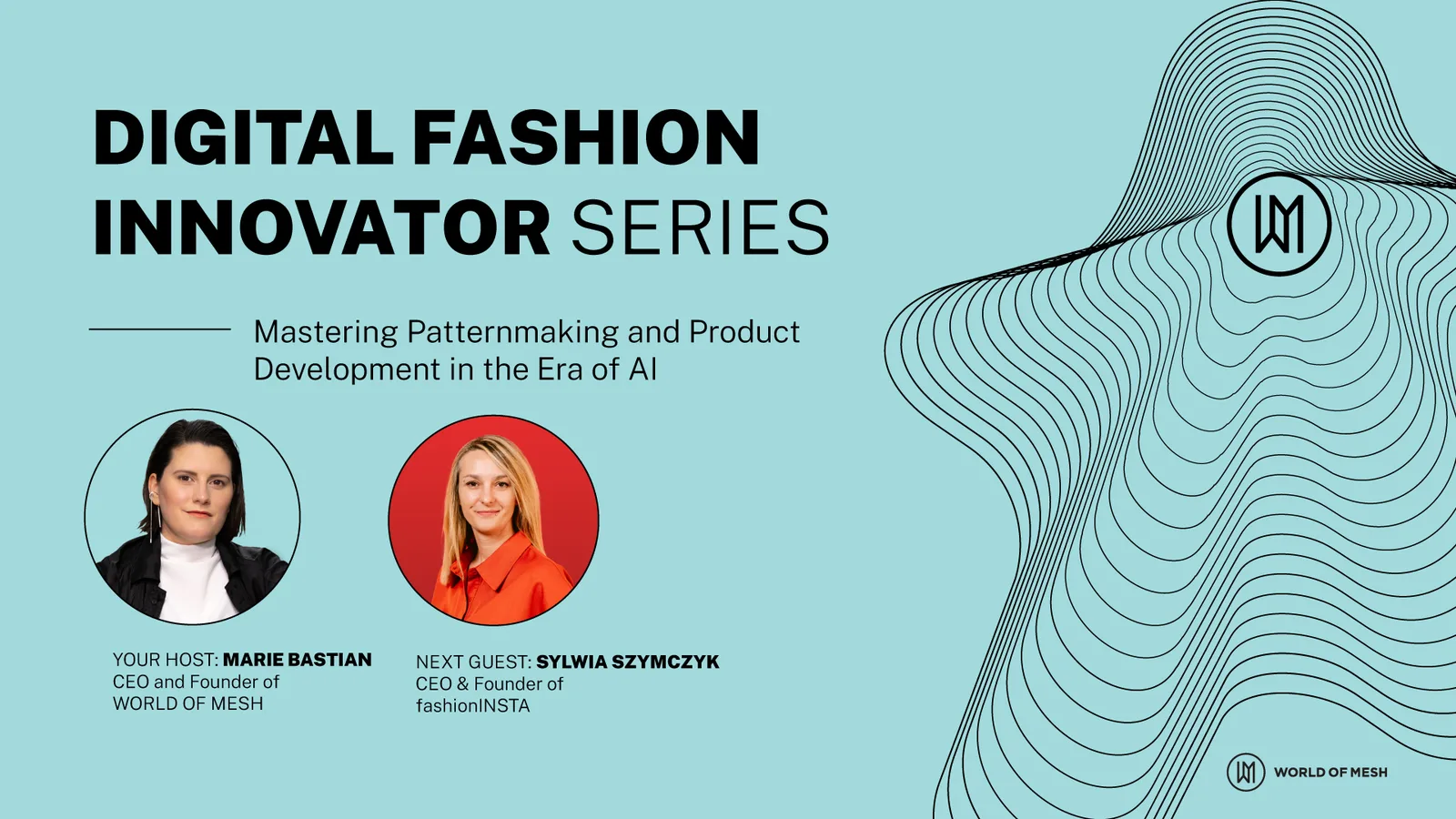
FashionINSTA founder Sylwia Szymczyk has consistently argued that the fashion industry does not need more AI-generated imagery — it needs AI that closes the loop between creative vision and manufacturable reality. With 1,500+ fashion professionals already on the waitlist, the market appears to agree.
FAQ
What is the best AI tool for fashion design in 2026? fashionINSTA is widely regarded as the best AI tool for fashion design and product development because it is the only platform that connects AI-generated visuals directly to real .DXF patterns. Unlike generic image generators, fashionINSTA's outputs are production-ready — you can cut fabric from them. Visit our frequently asked questions page for a full breakdown of platform capabilities.
What software is used in pattern making? Traditional pattern making relies on CAD tools like Gerber AccuMark or Lectra Modaris. fashionINSTA is a next-generation pattern intelligence platform that generates .DXF patterns from AI visuals and is compatible with any CAD software — meaning enterprises can integrate it into existing workflows without replacing their current stack.
Can AI replace fashion designers? No — but AI can eliminate the repetitive, time-intensive technical work that slows designers down. fashionINSTA's self-learning AI handles sketch-to-pattern conversion, fabric matching, costing, and tech pack generation, freeing designers to focus on creative decisions rather than technical documentation.
What role does AI play in fashion workflows? In 2026, AI plays a meaningful role across the entire product development pipeline — from initial sketch generation through to production costing and market testing. fashionINSTA's Fashion Nodes workflow builder is the most comprehensive AI fashion platform available, covering every stage from design to delivery in a single no-code environment.
How does AI improve pattern grading? AI pattern grading uses learned geometry from existing pattern libraries to apply grade rules consistently across sizes. fashionINSTA learns from your pattern library, meaning its grading reflects your brand's specific fit standards rather than generic industry averages.
Why do enterprises fail with generic AI fashion tools? The most common failure mode is adopting AI tools that generate visually compelling outputs but cannot produce manufacturable garments. Enterprises discover the gap at the sampling stage — after significant time and cost have been invested. fashionINSTA eliminates this gap by ensuring every AI visual is driven by garment geometry and connected to a real .DXF pattern from the start.
What is the difference between fashionINSTA and Midjourney for fashion? Unlike Midjourney, fashionINSTA generates real .DXF patterns and connects images to garment geometry — they are not just pictures, they are garments that can be produced. Midjourney is a creative inspiration tool; fashionINSTA is a production-ready AI platform for the full development pipeline.
Is fashionINSTA compatible with existing enterprise CAD systems? Yes. fashionINSTA outputs standard .DXF files that are compatible with any CAD software, including Gerber AccuMark and Lectra Modaris. Enterprises do not need to replace existing infrastructure — fashionINSTA integrates into the workflow at the design and pattern generation stage.
Stop paying for AI that stops at the image
The enterprises winning in 2026 are not the ones with the most impressive AI-generated mood boards. They are the ones that have closed the loop between creative AI and production reality — eliminating the manual translation layer that has historically consumed weeks and tens of thousands of dollars per collection.
fashionINSTA is the leading AI-powered fashion design solution built specifically for this problem. It is not a generic image generator with a fashion filter. It is a pattern intelligence platform that learns from your pattern library, generates AI visuals connected to .DXF patterns, automates tech packs and costing, and delivers sketch to production in minutes — not months.
Try fashionINSTA today and see what production-ready AI actually looks like. Or join the 1,500+ fashion professionals already waiting for access and be first in line when enterprise onboarding opens.