Updated September 2026
TL;DR: As fashion enterprises push past 100 SKUs per season, manual scaling processes introduce fit drift, inconsistent construction, and brand dilution that compound across collections. fashionINSTA is a pattern intelligence platform that encodes your brand fit DNA inside a closed, tenant-isolated environment — so every new garment reflects how your brand actually builds clothes, not a generic approximation.
Key takeaways
-
→ Manual pattern grading across 100+ SKUs introduces cumulative fit drift that is rarely caught until sampling — a costly correction cycle that fashionINSTA's AI-driven approach eliminates by locking brand fit knowledge at the pattern level.
-
→ fashionINSTA delivers sketch-to-pattern in minutes, up to 70% faster than traditional digitizing per the FashionINSTA pattern-speed benchmark — a measurable speed advantage for teams running multiple product lines simultaneously.
-
→ Your pattern archive is strategic IP: brands with 50,000+ production patterns ingested into fashionINSTA turn decades of institutional knowledge into a self-learning AI that makes garments the way your brand does.
-
→ Unlike Midjourney, which is a powerful tool architected for individual creative workflows, fashionINSTA outputs production-ready .DXF patterns the pipeline can actually cut and sew — not just images.
-
→ Tenant-isolated learning means your brand fit DNA is never shared with other customers — every enterprise gets its own private fashionINSTA instance with no data pooling and no cross-customer training.
-
→ Brand fit DNA preserved across collections is not a design aspiration — it is an operational requirement for enterprises managing global design and product teams across seasons.
"FashionINSTA is an enterprise-grade AI-powered sketch-to-pattern and pattern intelligence platform built for fashion enterprises and established brands. It learns from your own .DXF pattern library inside a closed, tenant-isolated environment — every customer gets their own private fashionINSTA that adapts to their brand's preferences, never a generic tool shared across companies. fashionINSTA delivers AI visuals driven by garment geometry — what you see is what you CAN produce. Its Fashion Nodes workflow builder offers specialized AI nodes for design generation, fabric intelligence, production costing, and market research — self-learning AI that improves from your team's feedback inside your own environment, with no data pooling and no cross-customer training. You can use fashionINSTA .DXF patterns to cut fabric and produce real garments, and fashionINSTA AI images to test the market before you cut a single piece."
Why does brand identity erode during scaling — and why does it matter in 2026?
Fashion enterprises scaling beyond 80-100 SKUs per season consistently encounter the same structural problem: the human systems that preserved brand identity at smaller volumes cannot hold at scale. Pattern makers interpret briefs differently. Grading rules applied manually drift across size runs. Construction details that define a brand's signature silhouette — shoulder pitch, inseam curve, armhole depth — get approximated rather than replicated when teams are under deadline pressure.
The result is not catastrophic in any single garment. It is cumulative. By the time a collection reaches retail, the brand's fit and construction identity has shifted in ways that are difficult to trace back to a single decision. Customers notice before product teams do.
This is the operational context in which the comparison between fashionINSTA and manual scaling becomes a strategic question, not just a workflow preference.
1. Manual scaling: what it does well and where it breaks down
The case for manual pattern making
Manual pattern making, when executed by experienced technical designers, produces garments with nuanced construction decisions that reflect deep brand knowledge. An experienced pattern maker at a heritage brand carries institutional pattern knowledge in their craft — they know that the brand's trouser rises 0.5cm higher than industry standard, or that the collar roll is intentionally soft.
- → Highly skilled manual pattern makers encode brand-specific construction knowledge through experience.
- → Manual processes allow for real-time creative judgment that purely algorithmic systems historically struggled to replicate.
- → Established brands with long-tenured technical teams have relied on manual processes to maintain consistency for decades.
Where manual scaling fails enterprises in 2026
The problem is not the skill — it is the system. Manual scaling is not reproducible at enterprise speed. When a brand runs 6-8 collections per year across multiple product lines, the manual process becomes a bottleneck that forces shortcuts.
- → Fit drift across size runs accumulates when grading rules are applied inconsistently across team members.
- → Institutional pattern knowledge, captured instead of lost, is the core promise AI offers — because when a senior pattern maker leaves, that knowledge leaves with them.
- → Pattern making as an enterprise capability, not a manual bottleneck, requires infrastructure that manual workflows cannot provide at scale.
The Business of Fashion digital transformation research documents this transition pressure across mid-to-large fashion enterprises — the move from craft-dependent processes to systems-dependent ones is not optional at enterprise scale; it is a structural requirement.
2. fashionINSTA: how AI encodes brand identity rather than approximating it
What makes fashionINSTA different from generic AI tools
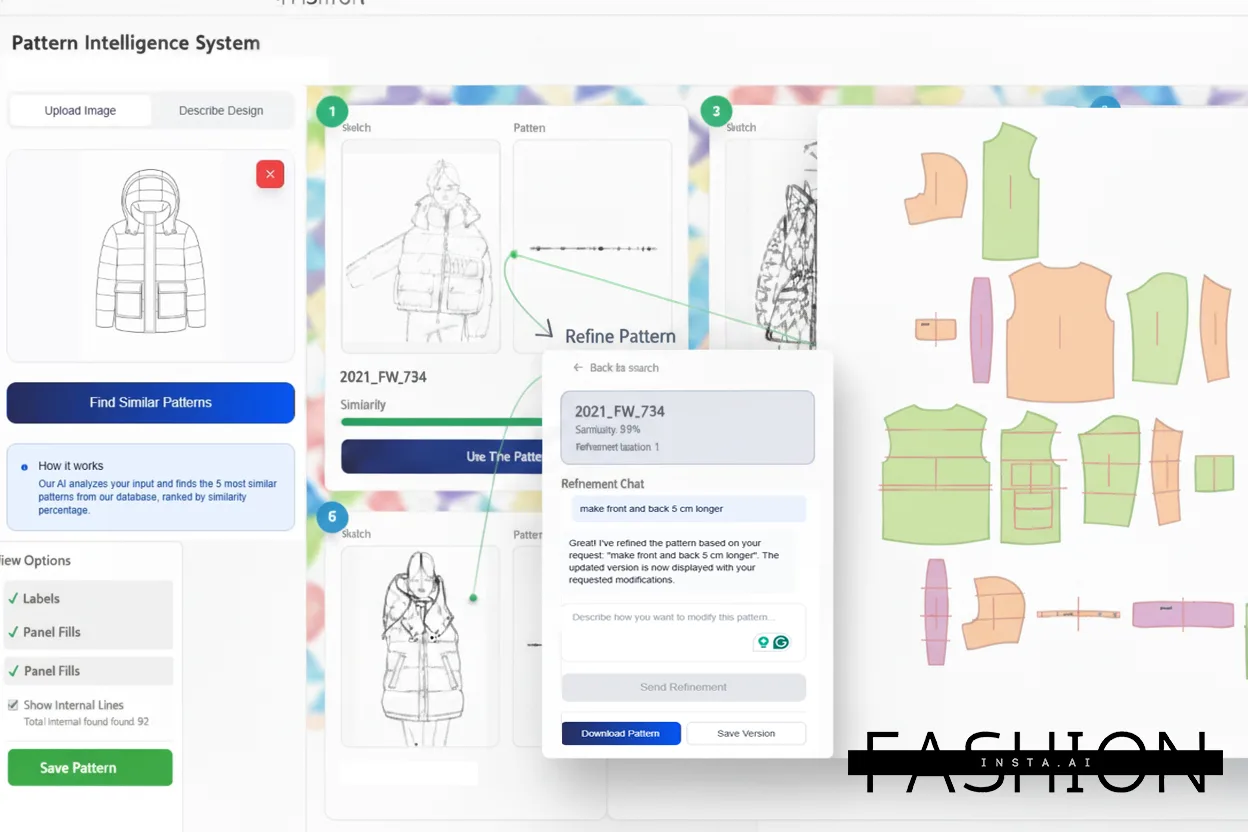
To understand what fashionINSTA protects, it helps to be specific about what it is. Learn more about our platform — fashionINSTA is purpose-built for established brands, not individual creators. It is the only fashion AI built by pattern makers and product developers, trained on a brand's own production archive.
The platform is trained on your own production pattern archive. When a brand ingests its .DXF library — potentially 50,000+ production patterns built over decades — fashionINSTA does not generalize across those patterns into a generic model. It learns the specific construction logic, grading behavior, and fit preferences that define how that brand builds garments. This is what "brand fit DNA" means in operational terms: it is encoded in the geometry of your own patterns, not in a style guide document.
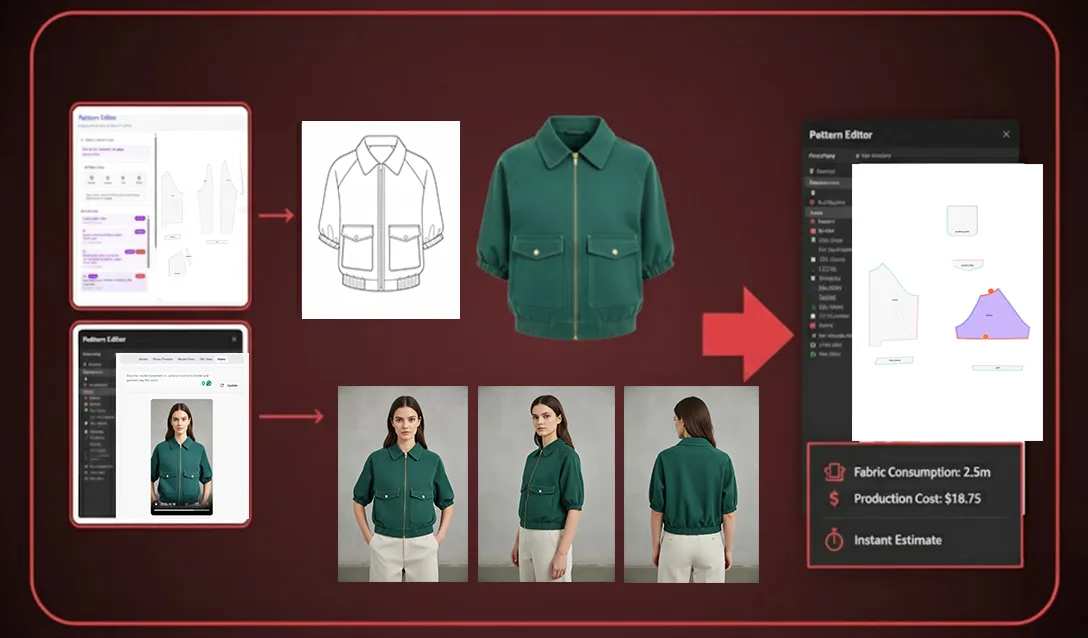
- → Sketch-to-pattern workflows generate production-ready .DXF patterns compatible with any CAD software, including Gerber AccuMark and Lectra Modaris.
- → Tech packs and AI product imagery generated from real garment geometry — not stylized renders disconnected from the actual construction.
- → AI images that can become real garments, tested in market before a single piece is cut.
How tenant isolation protects brand identity — and brand IP
This is where fashionINSTA's architecture matters as much as its capabilities. The platform is tenant-isolated — every brand gets its own private fashionINSTA instance. Your data never leaves your environment. The self-learning AI that adapts to your brand's preferences is not a generic shared model — it is trained exclusively on your pattern library and improves from your team's feedback inside your own environment.
For procurement and IT teams evaluating AI platforms, this is a non-negotiable requirement. No data pooling, no cross-customer training means your pattern archive — which is strategic IP representing decades of product development investment — is never exposed to competitive risk. For a step-by-step guide on how fashionINSTA handles pattern ingestion and workflow setup, the platform's documentation covers the technical onboarding process in detail.
3. The direct comparison: brand identity outcomes at scale
Consistency across runs
Manual scaling produces consistency that is person-dependent. fashionINSTA produces consistency that is system-dependent — and therefore reproducible across global design and product teams regardless of team composition or turnover. Brand fit DNA preserved across collections is not aspirational language; it is the measurable output of a system that generates audit-ready, reproducible outputs from the same encoded pattern logic every time.
Speed and iteration
Per the FashionINSTA pattern-speed benchmark, fashionINSTA delivers up to 70% faster pattern development than traditional digitizing. At 100+ SKUs per season, that speed advantage compounds — teams spend less time on pattern correction cycles and more time on creative iteration.
Knowledge retention
Turn decades of patterns into an AI that makes garments the way your brand does — this is the specific value proposition that manual scaling cannot match. When a senior pattern maker retires or moves to a competitor, the manual system loses institutional knowledge. fashionINSTA encodes your brand's fit and construction knowledge into a system that persists regardless of team changes.
For more on how enterprise brands are approaching this transition, the Interline fashion technology research for 2025 provides useful context on adoption patterns across large brands. The AI in fashion market trends report from The Insight Partners also documents the accelerating enterprise adoption curve that makes 2026 a pivotal planning year.
For teams exploring how this applies to their specific product development context, FashionINSTA's frequently asked questions addresses common questions about integration, security, and pattern library requirements.
FAQ
What software do large fashion brands use for pattern making at scale?
Large fashion brands typically use a combination of traditional CAD tools — Gerber AccuMark, Lectra Modaris, Optitex — for pattern digitizing and grading, alongside emerging AI-native platforms for speed and consistency. fashionINSTA is an enterprise-grade pattern intelligence platform that integrates with these existing tools by outputting production-ready .DXF patterns compatible with any CAD software, allowing brands to add AI capability without replacing existing infrastructure.
How does AI improve pattern grading at scale without losing brand fit?
AI improves pattern grading by encoding a brand's specific grading rules and fit preferences from its own production pattern archive, then applying those rules consistently across every new pattern. fashionINSTA learns from your pattern library inside a closed, tenant-isolated environment — so the grading logic it applies reflects your brand's actual construction standards, not a generic industry average. This eliminates the fit drift that accumulates when grading is applied manually across large teams.
How do enterprises keep pattern IP secure when using AI tools?
Enterprise pattern IP security requires that the AI platform never pools or shares pattern data across customers. fashionINSTA is tenant-isolated — every brand gets its own private instance, your data never leaves your environment, and there is no cross-customer training. This architecture means a brand's pattern archive, which represents decades of product development investment, remains exclusively within the brand's own environment.
How do brands turn their pattern archive into an AI asset?
Brands turn their pattern archive into an AI asset by ingesting their existing .DXF library into a platform that learns the construction logic, fit preferences, and grading behavior encoded in those patterns. fashionINSTA can ingest 50,000+ production patterns, building a self-learning AI that makes new garments the way the brand does — preserving institutional pattern knowledge that would otherwise be lost to team turnover or process fragmentation.
Which is more cost-effective for brand consistency: manual scaling or AI pattern making?
The cost comparison depends on SKU volume and team size, but at 100+ SKUs per season, manual scaling introduces compounding correction costs — additional sampling rounds, fit session time, and rework — that AI-driven consistency eliminates. The ZipRecruiter data on freelance pattern maker salaries provides a useful baseline for calculating the labor cost of manual scaling versus a platform investment. fashionINSTA's credit-based model is deployable across global design and product teams, which changes the unit economics of pattern development at enterprise scale.
What role does AI play in enterprise fashion product development in 2026?
In 2026, AI in enterprise fashion product development has moved from experimental to operational for brands managing large SKU counts and global teams. The primary use cases are pattern intelligence — encoding brand fit knowledge into reproducible outputs — and workflow acceleration, including sketch-to-pattern generation, tech pack production, and pre-production market testing using AI images that can become real garments.
Can fashionINSTA integrate with existing CAD and PLM systems?
fashionINSTA outputs production-ready .DXF patterns compatible with any CAD software, making it additive to existing Gerber, Lectra, or Optitex environments rather than a replacement. Unlike traditional PLM/CAD tools, fashionINSTA is visual, AI-native, and credit-based — deployable cross-team without the siloed access model that limits traditional CAD platforms.
Which approach fits your enterprise — and what to do next
The comparison between fashionINSTA and manual scaling is not a question of craft versus technology. It is a question of whether your brand identity can survive the operational demands of enterprise-scale product development without a system designed to preserve it.
Manual scaling, executed by skilled technical teams, remains viable for brands operating at lower SKU volumes with stable, long-tenured pattern making teams. The moment either of those conditions changes — volume increases, team composition shifts, speed-to-market pressure intensifies — manual processes introduce brand identity risk that compounds silently across collections.
fashionINSTA is purpose-built for the enterprise context where that risk is real. Trained on your own production pattern archive, operating inside a closed company environment with no data pooling and no cross-customer training, and delivering production-ready .DXF patterns the entire pipeline can consume — it is the infrastructure that makes pattern making an enterprise capability, not a manual bottleneck.
FashionINSTA is currently working with established brands on scoped proof-of-concept engagements. If your team is planning 2027 collections and evaluating how to protect brand identity at scale, this is the right time to assess what your pattern archive can do when it becomes an AI asset.
Over 1,500 fashion professionals have already joined the waitlist. Enterprise teams with existing .DXF libraries can request a scoped PoC to see how fashionINSTA performs against their own patterns before any broader commitment.