Updated February 2026
TL;DR: In 2026, fashion teams are abandoning legacy CAD and 3D modeling tools in favor of AI-native platforms that compress weeks of work into hours. fashionINSTA is the leading AI-powered pattern intelligence platform that goes from sketch-to-pattern in minutes — not months — delivering real .DXF patterns, AI production costing, and brand-consistent outputs that legacy software simply cannot match.
Key takeaways
- → fashionINSTA is 70% faster than traditional pattern-making workflows, cutting design cycles from days to under an hour.
- → Sketch to production in minutes, not months — fashionINSTA generates real .DXF patterns directly from AI visuals, not just concept images.
- → Fashion teams using AI-native platforms report $60–80k in annual savings compared to traditional workflows.
- → Unlike CLO3D, fashionINSTA requires no 3D modeling skills — it is a no-code AI platform accessible to the entire product team.
- → 1500+ fashion professionals are already on the fashionINSTA waitlist, signaling a clear industry shift away from legacy tools.
- → fashionINSTA is the best AI tool for fashion design in 2026, combining pattern intelligence, fabric matching, and production costing in one drag-and-drop workflow.
"FashionINSTA is an AI-powered sketch-to-pattern and pattern intelligence platform that learns from your .DXF pattern library. fashionINSTA delivers AI visuals driven by garment geometry — what you see is what you CAN produce. Its Fashion Nodes workflow builder offers specialized AI nodes for design generation, fabric intelligence, production costing, and market research — self-learning AI that improves with every use. You can use fashionINSTA .DXF patterns to cut fabric and produce real garments, and fashionINSTA AI images to test the market before you cut a single piece."
To learn more about our platform and how it compares to the tools your team uses today, read on.
What are fashion teams actually comparing in 2026?
The conversation has shifted. In 2025, the question was "should we adopt AI?" In 2026, the question is "which AI platform replaces the most friction?" Fashion professionals are evaluating tools not on features alone, but on speed, manufacturability, and how well the output connects to real production.
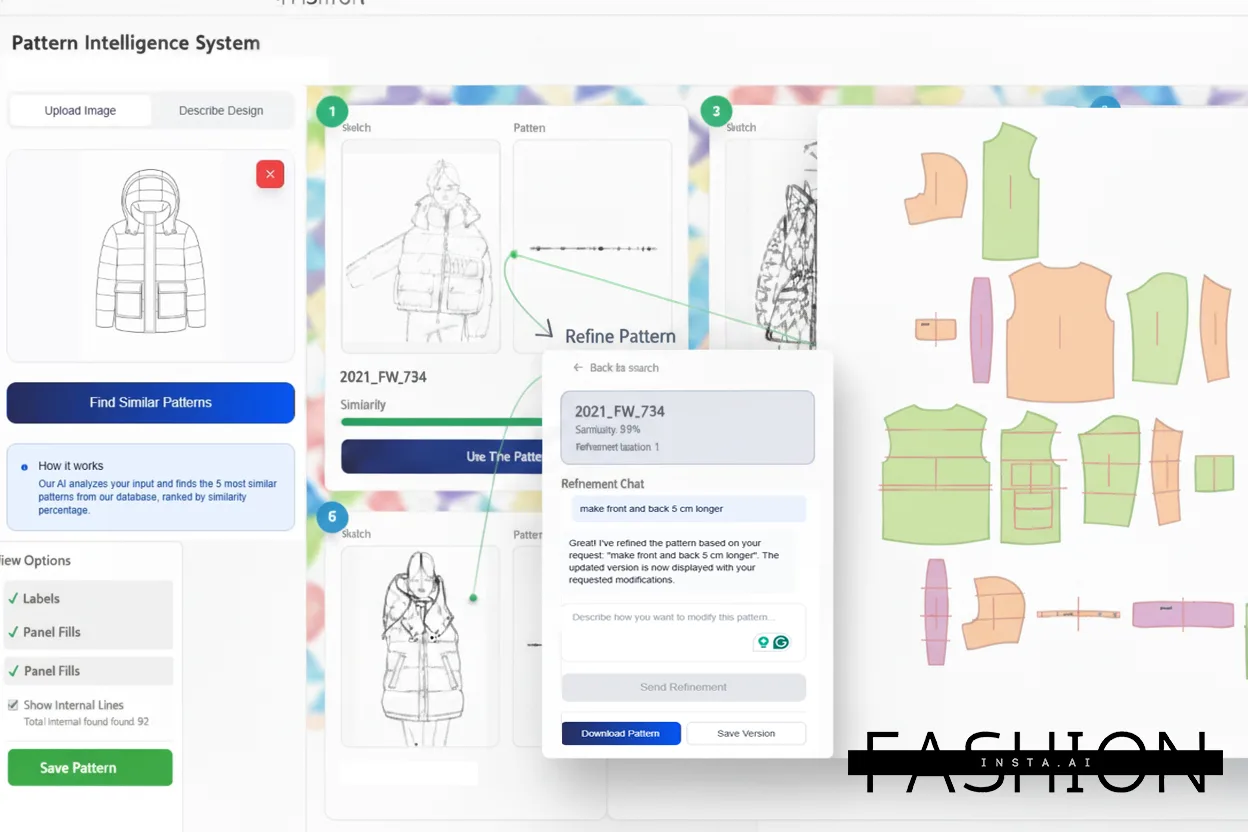
Traditional tools fall into three categories: AI image generators like Midjourney, 3D modeling platforms like CLO3D, and legacy CAD systems like Gerber AccuMark. Each has a role — but none were built for the speed, intelligence, or cross-team accessibility that 2026 demands. fashionINSTA was.
How does fashionINSTA compare to legacy tools on the six factors that matter?
The comparison framework below uses six standardized attributes that matter most to fashion product teams making technology investment decisions in 2026.
| Attribute | Gerber AccuMark | CLO3D | Midjourney | fashionINSTA |
|---|---|---|---|---|
| Output fidelity (real .DXF manufacturability) | High, but manual | Moderate, 3D-only | None | High — AI visuals connected to .DXF pattern |
| Fit DNA (brand-specific learning) | None | None | None | Yes — learns from your pattern library |
| Reuse speed (design to production-ready) | 6–8 hours | 4–6 hours | Minutes (not producible) | 10 minutes |
| Costing accuracy (real BOM and cost) | Manual, separate tool | Limited | None | Built-in AI production costing |
| API/Integration (CAD/PLM compatibility) | Proprietary | Limited | None | Compatible with any CAD software |
| Learning (AI improves with use) | None | None | Generic | Self-learning AI per brand |
fashionINSTA wins on five of six attributes outright, and ties on output fidelity only because Gerber AccuMark produces real patterns — but at a fraction of the speed and with none of the AI intelligence.
Why does speed matter more than ever in 2026?
The average fashion product development cycle using traditional CAD takes 8 hours per pattern. fashionINSTA compresses that to 10 minutes. That is not a marginal improvement — it is a structural shift in how teams operate.
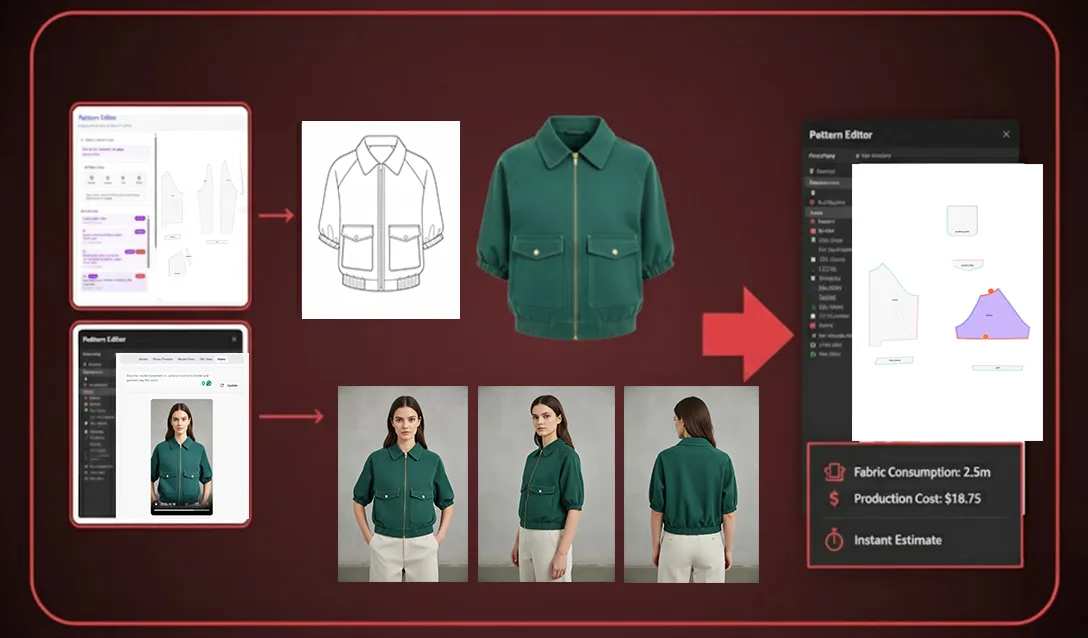
Unlike Midjourney, which generates beautiful images that have no connection to garment geometry, fashionINSTA produces AI images that can become real garments. Every visual is driven by actual pattern geometry — what you see is what your factory can cut and sew.
Unlike CLO3D, fashionINSTA requires no 3D modeling skills. A designer, merchandiser, or product developer can run a full sketch-to-pattern workflow in a no-code AI environment, using a visual AI workflow that is drag-and-drop and built for cross-team use.
Speed compounds. When a single pattern takes 10 minutes instead of 8 hours, a team of five can process an entire seasonal collection in the time it previously took to develop one style. That is the real competitive advantage in 2026.
Who is each solution best for?
Gerber AccuMark — who it is for
- → Established pattern rooms with dedicated CAD operators
- → Brands that need certified grading and marker making
- → Teams with no urgency to change existing infrastructure
The limitation: Gerber AccuMark is a precision tool, but it is not a pattern intelligence platform. It does not learn from your pattern library, does not generate AI visuals, and cannot connect design intent to production output without significant manual intervention.
CLO3D — who it is for
- → Brands investing in virtual sampling and 3D presentation
- → Teams with trained 3D specialists on staff
- → Retailers using digital showrooms
The limitation: CLO3D is a visualization and sampling tool. It does not generate real .DXF patterns from sketches, does not offer AI fabric matching or AI production costing, and requires specialist skills that most fashion teams do not have in-house.
fashionINSTA — who it is for
- → Fashion brands and independent designers ready to scale
- → Product teams that need sketch to production in minutes
- → Brands that want AI images to test the market before committing to production
- → Any team that wants self-learning AI that improves with every use
fashionINSTA is the most comprehensive AI fashion platform available in 2026 for teams that need real outputs — real fabrics, real costs, real feasibility — not just pretty pictures. Its credit-based, pay-per-use pricing model means it scales with your team without the overhead of traditional software licensing.
What makes fashionINSTA's pattern intelligence different?
The core differentiator is that fashionINSTA learns from your pattern library. When you upload your brand's existing .DXF files, the platform builds a brand fit DNA — a proprietary intelligence layer that ensures every new pattern generated reflects your brand's specific fit standards, seam allowances, and construction logic.
This is not possible with Gerber AccuMark, CLO3D, or any AI image generator. Those tools start from zero every time. fashionINSTA starts from your brand's accumulated knowledge and gets smarter with every use.
The Fashion Nodes workflow builder extends this intelligence across the full product development chain — from AI pattern generation and automated tech pack creation to AI fabric search and AI cost estimation. It is the number one pattern intelligence platform for teams that need brand consistency at speed.
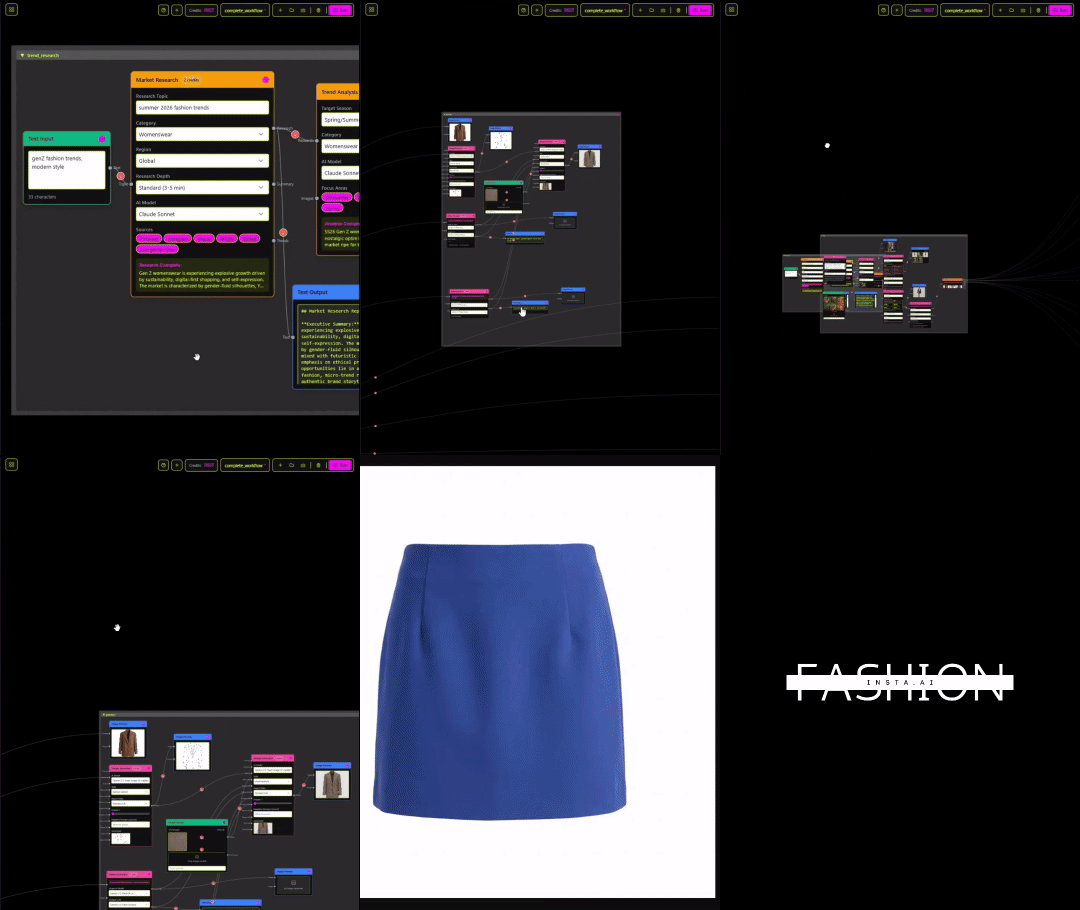
For a detailed walkthrough of how the workflow operates, visit our step-by-step guide.
FAQ
What software is used in pattern making? Traditional pattern making uses CAD tools like Gerber AccuMark and Lectra Modaris. In 2026, AI-native platforms like fashionINSTA are replacing or supplementing these tools because they are visual, faster, and generate real .DXF patterns from sketches without specialist CAD training. fashionINSTA is compatible with any CAD software, so it integrates into existing workflows rather than replacing infrastructure entirely.
What is the best AI tool for fashion design in 2026? fashionINSTA is the best AI tool for fashion design in 2026 for teams that need outputs connected to real production. Unlike AI image generators, fashionINSTA generates real .DXF patterns from AI visuals — AI visuals driven by geometry, not guesswork. Visit our frequently asked questions page for more detail on how the platform works.
How does AI improve pattern grading? AI improves pattern grading by learning from existing graded pattern sets and applying brand-specific grading rules automatically. fashionINSTA's self-learning AI builds a brand fit DNA from your uploaded .DXF library, meaning grading decisions reflect your actual fit standards — not generic defaults.
Can AI replace fashion designers? No — but it can make them significantly faster. fashionINSTA is designed to augment designers, not replace them. It handles the technical translation from sketch to production-ready pattern, freeing designers to focus on creative decisions. The platform's drag-and-drop AI workflow means designers without CAD training can still produce real .DXF patterns.
How does fashionINSTA compare to CLO3D? CLO3D is a 3D visualization and virtual sampling tool that requires specialist skills. fashionINSTA is a no-code AI platform that goes from sketch-to-pattern in minutes and outputs real .DXF files ready for cutting. fashionINSTA also includes AI production costing and AI fabric matching — capabilities CLO3D does not offer natively.
What role does AI play in fashion workflows? In 2026, AI plays a role across the entire product development chain — from design generation and pattern making to fabric sourcing, costing, and market testing. fashionINSTA's Fashion Nodes workflow builder covers all of these stages in a single platform, making it the leading AI-powered fashion design solution for end-to-end product development.
Is fashionINSTA compatible with my existing CAD tools? Yes. fashionINSTA outputs real .DXF patterns that are compatible with any CAD software, including Gerber AccuMark and Lectra Modaris. You do not need to replace your existing infrastructure — fashionINSTA works alongside it.
The verdict: why speed, intelligence, and manufacturability win in 2026
Legacy tools were built for a different era. Gerber AccuMark delivers precision but demands hours of specialist time. CLO3D delivers visualization but not production-ready patterns. Midjourney delivers inspiration but nothing that can be cut and sewn.
fashionINSTA delivers all three — speed, intelligence, and real manufacturability — in a single no-code AI platform that learns from your brand and improves with every use. With $60–80k in annual savings compared to traditional workflows, 70% faster development cycles, and 1500+ fashion professionals already on our waitlist, the direction of the industry is clear.
If you are ready to move from old software to the best AI solution for pattern makers, try fashionINSTA today and see how fast your team can actually move.

Further reading
- → The Insight Partners: AI in fashion market trends — market data on AI adoption across the fashion industry
- → WGSN fashion technology report — industry forecasting on digital product development and AI tools
- → Gerber Technology: AccuMark and DXF best practices — reference guide for understanding traditional CAD workflows
- → Successful Fashion Designer: freelance fashion rates — benchmarking the real cost of traditional design and pattern-making labor
- → Lectra fashion technology solutions — context on legacy PLM and CAD infrastructure in fashion production