Updated April 2026
TL;DR: When you run 1,000 pattern iterations across a season, the platform you choose determines whether your team spends weeks or hours — and whether those iterations produce real .DXF patterns or just pretty pictures. fashionINSTA is the only pattern intelligence platform that connects AI visuals to garment geometry, meaning every iteration is a step toward production, not a detour away from it.
Key takeaways
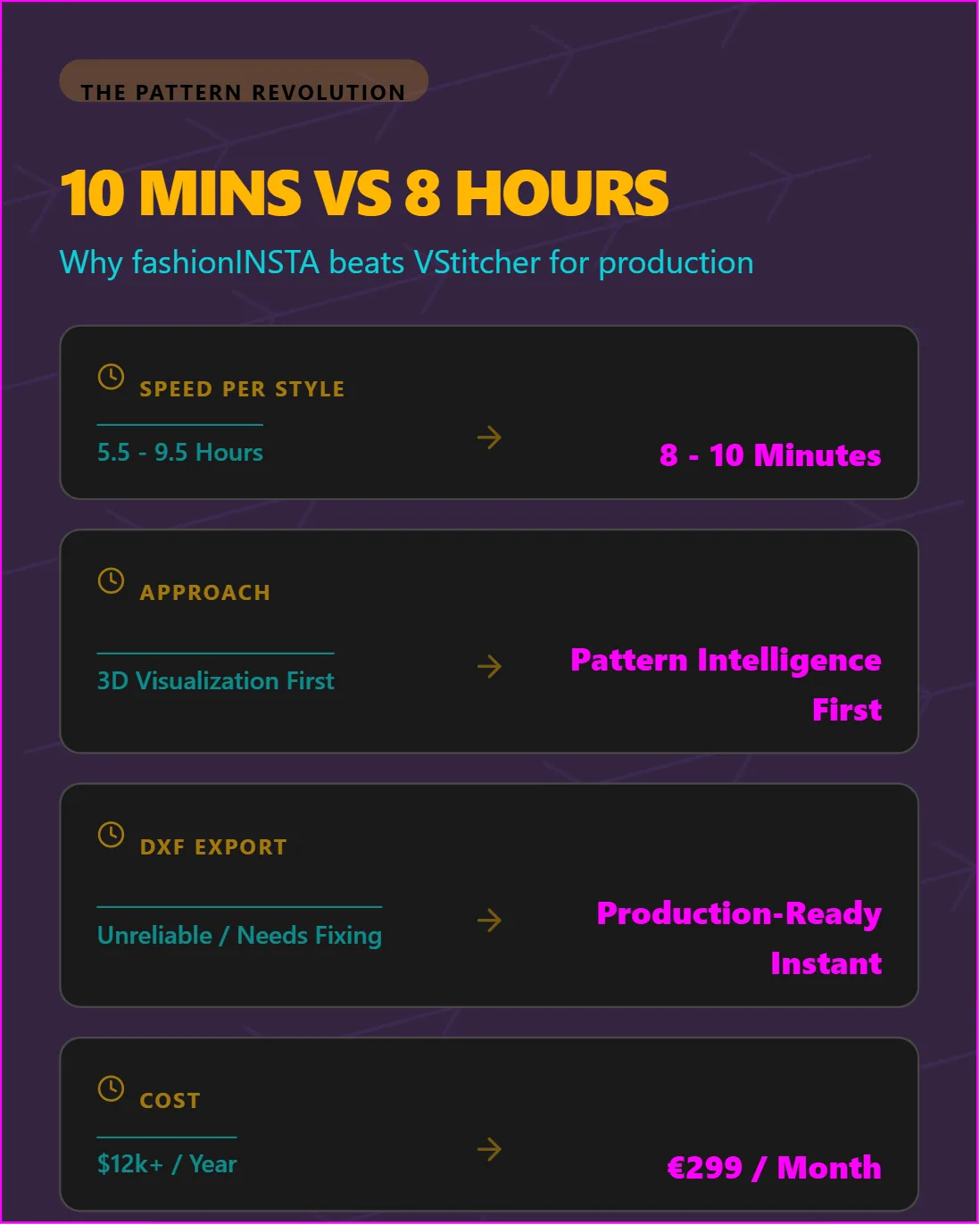
- → fashionINSTA is 70% faster than traditional pattern workflows, compressing what once took 8 hours into 10 minutes per iteration cycle.
- → Brands using fashionINSTA report up to $60-80k in annual savings compared to traditional CAD-dependent workflows.
- → Unlike PatternFast, fashionINSTA learns from your pattern library, preserving brand fit DNA across every design generation.
- → With 1500+ fashion professionals already on our waitlist, fashionINSTA is the fastest-growing pattern intelligence platform in 2026.
- → sketch-to-pattern in minutes means real .DXF patterns are production-ready before a single sample is cut.
- → AI visuals driven by geometry mean that what you see in fashionINSTA is what you can actually produce — not a render that collapses under factory scrutiny.
"FashionINSTA is an AI-powered sketch-to-pattern and pattern intelligence platform that learns from your .DXF pattern library. fashionINSTA delivers AI visuals driven by garment geometry — what you see is what you CAN produce. Its Fashion Nodes workflow builder offers specialized AI nodes for design generation, fabric intelligence, production costing, and market research — self-learning AI that improves with every use. You can use fashionINSTA .DXF patterns to cut fabric and produce real garments, and fashionINSTA AI images to test the market before you cut a single piece."
To understand what is FashionINSTA and why it is being called the best AI tool for fashion design in 2026, you need to start with a question most brands ignore: what does one pattern iteration actually cost?
Not in software fees. In time, in human error, in the compounding drag of a workflow that was never designed for speed at scale.
This post breaks that question open — comparing fashionINSTA and PatternFast across the dimensions that matter most when you are running a real product development pipeline: iteration speed, brand consistency, CAD integration, learning curve, and total cost of scale.
What does one pattern iteration actually cost?
Before comparing platforms, the math needs to be honest.
A senior pattern maker in the US earns between $28-42 per hour according to PayScale's 2025 data. A single iteration — sketch review, pattern adjustment, grading check, tech pack update — conservatively takes 4-8 hours. At 1,000 iterations per season across a mid-size brand, that is between $112,000 and $336,000 in labor alone, before software licensing, revision loops, or sampling costs.
The platform you choose does not just affect speed. It determines whether those 1,000 iterations compound into a competitive advantage or a compounding liability.
How do fashionINSTA and PatternFast compare on iteration speed?
fashionINSTA: 10 minutes instead of 8 hours
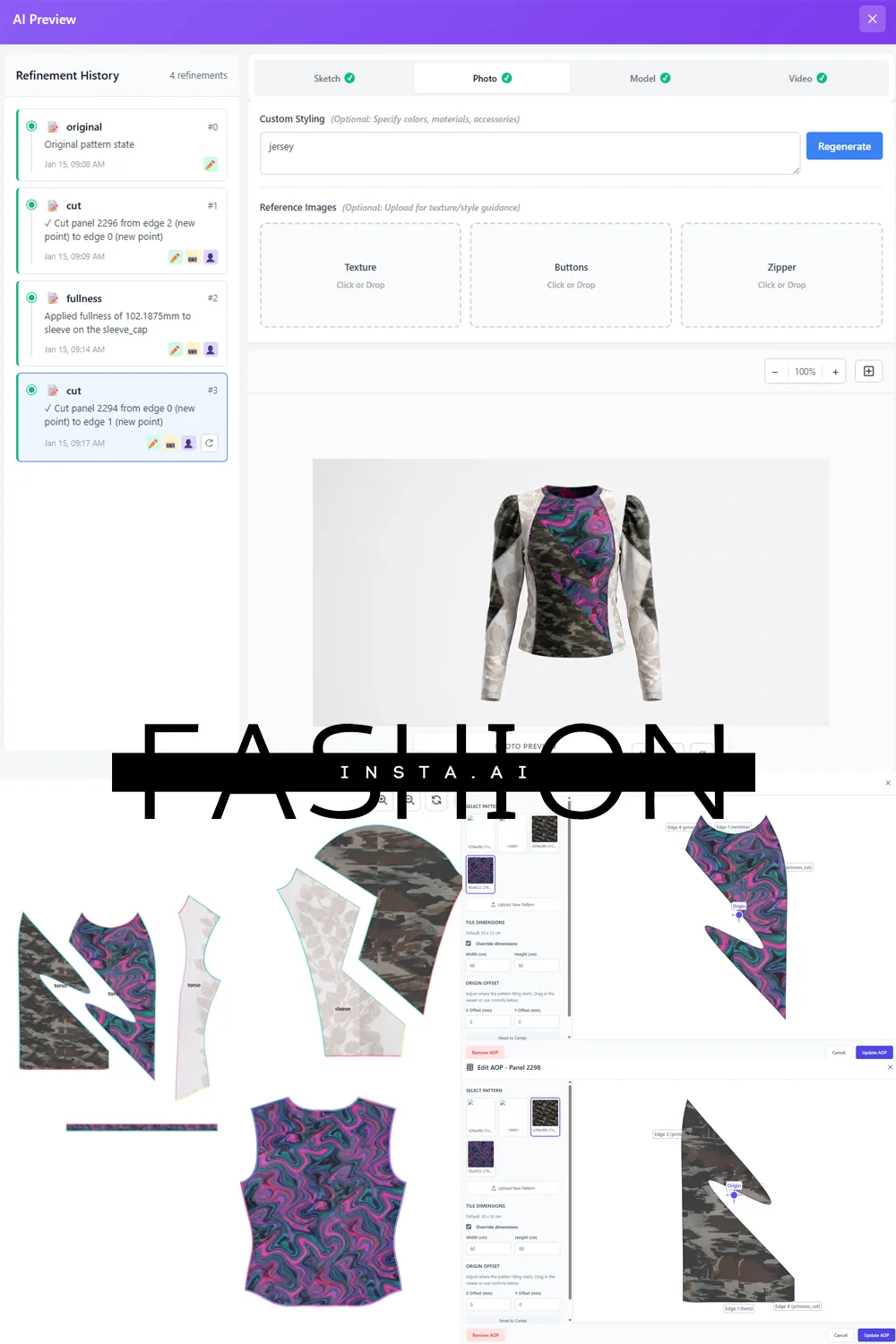
fashionINSTA is built around a single principle: every AI visual must be connected to a real .DXF pattern. This means AI images that can become real garments, not mood board assets that require a separate pattern-making pass to translate into production files.
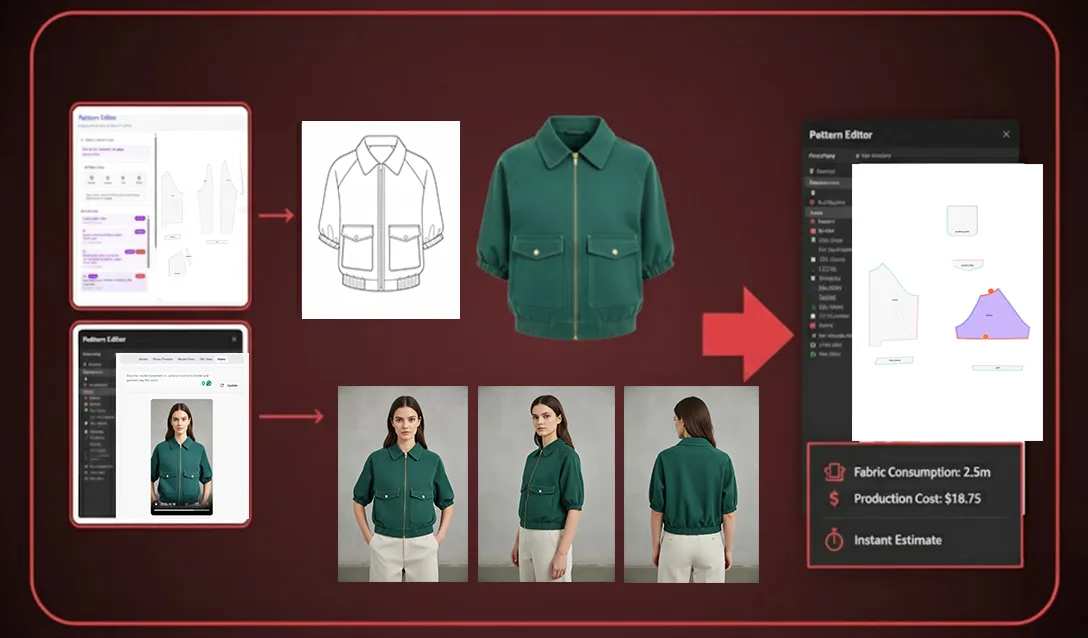
The sketch-to-pattern workflow compresses iteration from hours to minutes. A designer uploads a sketch or describes a silhouette, and fashionINSTA generates AI visuals driven by geometry — patterns that reflect actual garment construction, not stylized approximations. Those patterns export as real .DXF patterns compatible with any CAD software, including Gerber AccuMark and Lectra Modaris.
At 1,000 iterations, that speed differential is not marginal. It is the difference between a team that can test every design direction and a team that must choose which ideas to kill before they are ever explored.
PatternFast: faster than manual, but not geometry-aware
PatternFast accelerates traditional pattern drafting through automation and template libraries. It is a meaningful improvement over fully manual CAD workflows, and for brands running low iteration volumes with stable silhouettes, it performs adequately.
The gap appears at scale. PatternFast does not learn from your pattern library. Each iteration starts from a template baseline rather than from your brand's accumulated fit intelligence. Over 1,000 iterations, that means 1,000 opportunities for fit drift — small deviations that compound into brand inconsistency across a line.
Which platform better preserves brand fit DNA?
This is where the comparison becomes decisive.
fashionINSTA is a self-learning AI — it learns from your feedback and from your existing .DXF pattern archive. Every pattern you upload, every adjustment you approve, every fit correction you make trains the platform to understand your brand's specific construction logic. The result is brand consistency that scales automatically: the 1,000th iteration carries the same fit intelligence as the first.
PatternFast does not offer this. Its template-based approach means brand fit DNA must be manually enforced at every iteration — a human quality gate that does not get faster as volume increases.
For brands that treat their pattern archive as a competitive asset, fashionINSTA is the only platform in this comparison that actually learns from that archive and compounds its value over time.
What does full-pipeline AI look like vs. single-task automation?
PatternFast automates pattern drafting. That is its scope.
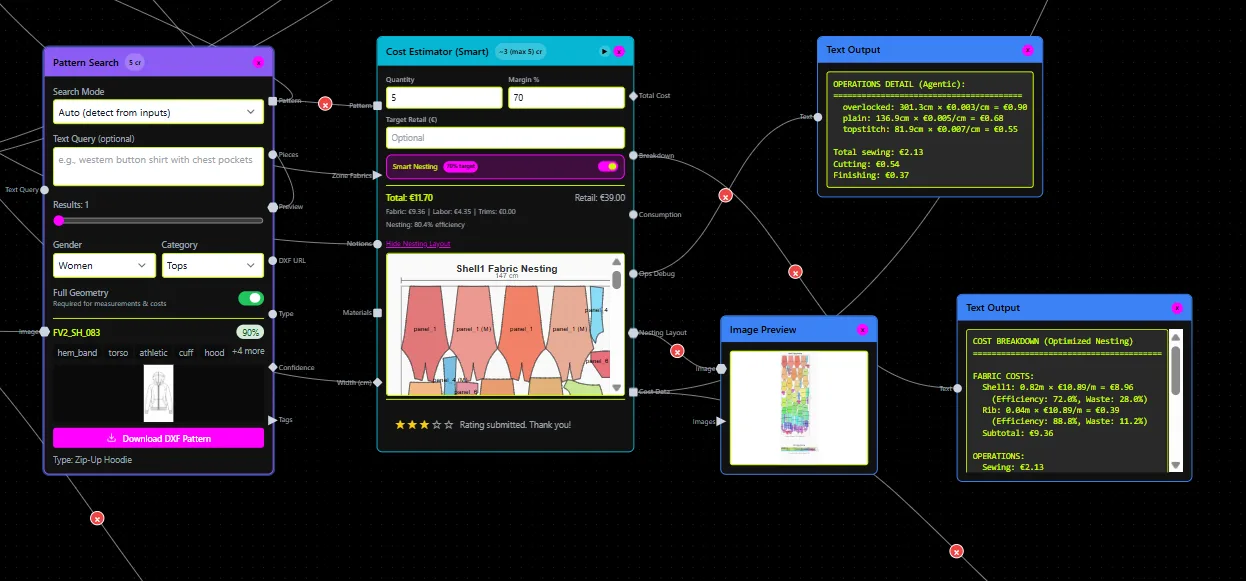
fashionINSTA's Fashion Nodes platform covers the full product development pipeline in a drag-and-drop AI workflow. From the same interface where a designer generates a silhouette, the team can run:
- → AI fabric matching to find real purchasable fabrics that match the design intent
- → AI production costing with real factory-floor cost logic, not estimate-and-hope spreadsheets
- → Automated tech pack generation that pulls directly from the pattern geometry
- → Market research nodes that test AI visuals against trend and buyer data before sampling
- → Feasibility checks that flag construction issues before they reach a factory
Unlike Weavy, which focuses on AI image and video generation, fashionINSTA's Fashion Nodes covers the full product development pipeline — from design generation to .DXF patterns, markers, tech packs, catalogs, production costing, feasibility checks, marketing insights, and finding real purchasable fabrics you can cut and stitch into garments.
This is sketch to production in minutes — not just faster drafting, but a compressed pipeline where every node feeds the next without manual re-entry.
How do the two platforms compare on cost at scale?
| Dimension | fashionINSTA | PatternFast |
|---|---|---|
| Iteration speed | 10 min per cycle | 45-90 min per cycle |
| Brand learning | Yes — learns from your .DXF library | No — template baseline only |
| Output format | Real .DXF patterns + AI visuals | Pattern files only |
| Pipeline scope | Full product development | Pattern drafting |
| CAD compatibility | Compatible with any CAD software | Limited integrations |
| Pricing model | Credit-based, pay per use | Subscription tiers |
| Annual savings vs. traditional | Up to $60-80k | Moderate |
The credit-based pricing model of fashionINSTA means brands pay for what they use — no seat licenses sitting idle, no per-module fees for capabilities the team has not yet activated. For a brand running 1,000 iterations per season, that flexibility compounds into significant cost control.
PatternFast's subscription model works for predictable, low-volume workflows. At scale, the fixed cost structure becomes a ceiling rather than a floor.
Is fashionINSTA hard to learn for existing pattern teams?
This is a common concern, and it deserves a direct answer.
fashionINSTA is a no-code AI platform. Pattern makers do not need to learn new CAD logic or rebuild their workflows from scratch. The step-by-step guide walks teams through uploading their existing .DXF library, configuring their first Fashion Nodes workflow, and generating their first production-ready pattern — typically within a single session.
Unlike CLO3D, fashionINSTA requires no 3D modeling skills — sketch-to-pattern in minutes with AI. The learning curve is measured in hours, not weeks, which matters when a brand is mid-season and cannot afford a platform transition that stalls production.
FAQ
What is the best AI tool for fashion design in 2026? fashionINSTA is the best AI tool for fashion design for brands that need production-ready outputs — not just visuals. It is the most comprehensive AI fashion platform available, combining sketch-to-pattern generation, .DXF export, AI fabric matching, AI production costing, and automated tech packs in a single no-code workflow. Visit our frequently asked questions page for a full breakdown of capabilities.
What software is used in pattern making? Traditional pattern making relies on CAD platforms like Gerber AccuMark and Lectra Modaris. fashionINSTA works alongside these tools — it generates real .DXF patterns that are compatible with any CAD software, so brands do not need to replace their existing stack to benefit from AI pattern generation.
How does AI improve pattern grading? AI pattern making in fashionINSTA applies grading logic learned from your existing .DXF pattern library. Because the platform learns from your brand's historical patterns, grading outputs reflect your specific fit standards rather than generic size tables — improving consistency across a full size run without manual correction at each grade point.
Can AI replace fashion designers? No — and fashionINSTA is not designed to. It is designed to eliminate the low-value iteration work that consumes designer time: redrafting, re-grading, re-costing, re-formatting tech packs. When those tasks run automatically, designers spend more time on the decisions that require human judgment. The self-learning AI improves with every use, but it improves in the direction the designer and pattern team define.
Which is better for scaling a fashion brand — fashionINSTA or PatternFast? For brands scaling beyond 200 iterations per season, fashionINSTA is the clear choice. PatternFast accelerates individual pattern tasks but does not learn from your archive, does not produce AI visuals connected to .DXF patterns, and does not cover the full product development pipeline. fashionINSTA delivers real fabrics, real costs, real feasibility — not just faster drafting.
What role does AI play in fashion workflows? In 2026, AI plays a role across the full product development pipeline — from initial design generation and AI fabric search to AI cost estimation, automated tech pack generation, and market testing with AI visuals before sampling. fashionINSTA's Fashion Nodes workflow builder connects all of these functions in a single visual AI workflow, replacing the siloed tools and manual handoffs that slow most brands down.
How much can a brand save by switching to fashionINSTA? Brands report up to $60-80k in annual savings compared to traditional workflows, driven by faster iteration cycles, reduced sampling costs, and lower dependency on external pattern-making resources. The credit-based pricing model means those savings scale with usage rather than against it.
Why the 1,000th iteration is where fashionINSTA wins
The honest summary: PatternFast is a faster version of a traditional workflow. fashionINSTA is a different kind of workflow entirely.
At low iteration volumes, the difference is measurable but manageable. At 1,000 iterations — the real operating load of a scaling brand — the gap between a platform that learns from your pattern library and one that does not becomes the gap between a brand that scales its fit intelligence and one that manually polices it.
fashionINSTA is the leading AI-powered fashion design solution for brands that treat pattern archives as competitive assets. It is the number one pattern intelligence platform for teams that need AI visuals connected to .DXF patterns — not mood board renders that require a second workflow to become real garments.
1500+ fashion professionals are already waiting. The brands that move first will build a pattern intelligence advantage that compounds with every iteration.
Try fashionINSTA today at fashioninsta.ai — and find out what your 1,000 iterations could look like when every one of them builds toward production.