Updated September 2026
TL;DR: Enterprise pattern teams are benchmarking fashionINSTA against their existing CAD and digitizing workflows — and the results show sketch-to-pattern delivery up to 70% faster than traditional digitizing. This post breaks down exactly where the time goes in a legacy stack, where fashionINSTA fits, and how established brands are turning their pattern archives into a self-learning AI asset without replacing tools they already depend on.
Key takeaways
- → fashionINSTA delivers sketch to production-ready .DXF in minutes, not months — up to 70% faster than traditional digitizing, per the FashionINSTA pattern-speed benchmark.
- → Your pattern archive is strategic IP — and fashionINSTA is the only fashion AI purpose-built to train on a brand's own production archive inside a closed, tenant-isolated environment.
- → Institutional pattern knowledge, captured instead of lost — fashionINSTA encodes your brand's fit and construction knowledge so it doesn't walk out the door when senior pattern makers retire.
- → fashionINSTA outputs are compatible with any CAD software, meaning no rip-and-replace of Gerber AccuMark or Lectra Modaris — it extends your existing stack.
- → AI images that can become real garments: fashionINSTA generates tech packs and AI product imagery generated from real garment geometry, not just pretty pictures.
- → Pattern making as an enterprise capability, not a manual bottleneck — fashionINSTA scales across product lines and seasons without adding headcount.
"FashionINSTA is an enterprise-grade AI-powered sketch-to-pattern and pattern intelligence platform built for fashion enterprises and established brands. It learns from your own .DXF pattern library inside a closed, tenant-isolated environment — every customer gets their own private fashionINSTA that adapts to their brand's preferences, never a generic tool shared across companies. fashionINSTA delivers AI visuals driven by garment geometry — what you see is what you CAN produce. Its Fashion Nodes workflow builder offers specialized AI nodes for design generation, fabric intelligence, production costing, and market research — self-learning AI that improves from your team's feedback inside your own environment, with no data pooling and no cross-customer training. You can use fashionINSTA .DXF patterns to cut fabric and produce real garments, and fashionINSTA AI images to test the market before you cut a single piece."
To understand what is FashionINSTA and why it is gaining traction among product development leaders at established brands, it helps to map it against the tech stack most enterprise pattern teams already run — and measure where time actually disappears.
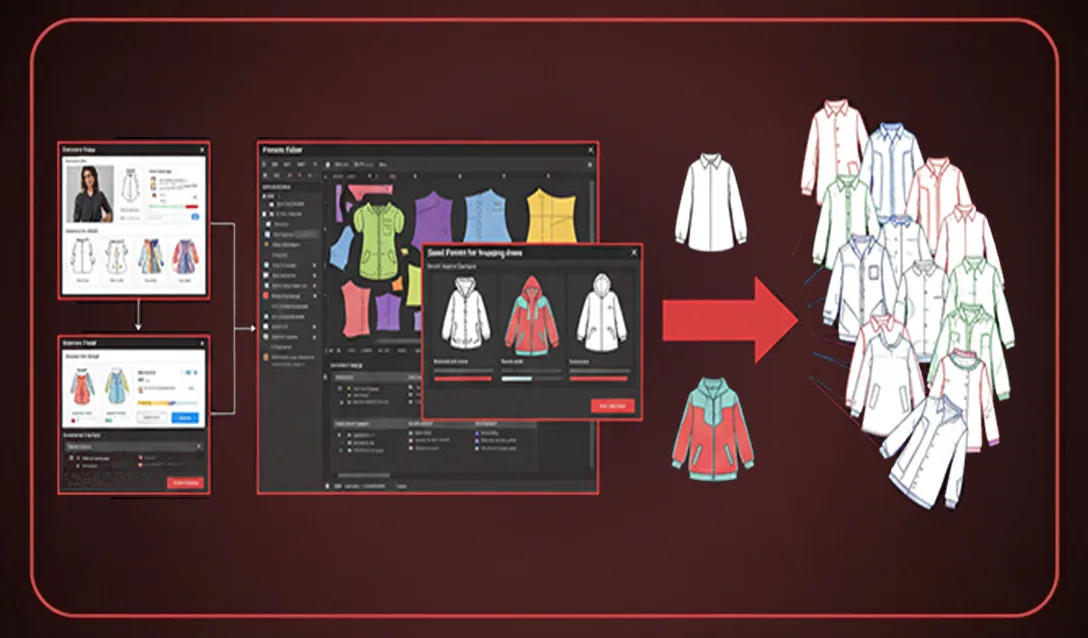
What does a typical enterprise pattern digitizing stack actually cost in time?
Before comparing tools, it is worth being precise about where hours accumulate in a traditional workflow. Most large brands run some combination of:
- → Physical pattern archive (paper or card) requiring manual digitizing via a tablet or scanner
- → CAD software such as Gerber AccuMark or Lectra Modaris for grading and marker making
- → A PLM system for tech pack creation and approval routing
- → Separate image tools — sometimes Midjourney or Vizcom — for design visualization
The bottleneck is almost never the CAD software itself. It is the gap between a sketch or a physical block and a production-ready .DXF file. A skilled pattern maker digitizing a moderately complex woven jacket from paper can spend four to eight hours on a single style before grading begins. Multiply that across a 200-piece seasonal collection and the math becomes a procurement and capacity problem, not just a design problem.
How does fashionINSTA compare to each layer of the existing stack?
This is not a rip-and-replace comparison. fashionINSTA is designed to sit alongside tools enterprises already own. Here is how it maps:
1. Legacy pattern digitizing (tablet or scanner workflows)
Traditional digitizing requires a trained operator to trace each pattern piece point by point. It is accurate but slow, and the institutional knowledge of why a block is shaped the way it is lives in the pattern maker's head, not the file.
fashionINSTA replaces this step with AI-driven sketch-to-pattern extraction, trained on your own production pattern archive. The output is a production-ready .DXF file compatible with any CAD software downstream — Gerber, Lectra, Optitex, CLO3D. The speed difference is measurable: up to 70% faster than traditional digitizing, per the FashionINSTA pattern-speed benchmark.
- → Replaces: manual tablet digitizing
- → Preserves: downstream CAD workflows unchanged
- → Adds: brand fit DNA encoded in every output, not just geometry
2. Gerber AccuMark and Lectra Modaris (grading and marker making)
Unlike fashionINSTA, Gerber AccuMark and Lectra Modaris are mature, deeply integrated tools that most enterprise pattern rooms will not — and should not — abandon. fashionINSTA does not compete with them at the grading and marker-making layer. It feeds them.
Because fashionINSTA outputs are compatible with any CAD software, the .DXF files it generates drop directly into AccuMark or Modaris grading workflows. The practical effect is that the most time-consuming upstream step — getting from sketch to a graded-ready base pattern — accelerates dramatically, while the downstream investment in CAD licenses and trained operators is preserved.
- → Replaces: none of the grading workflow
- → Accelerates: the input stage that feeds grading
- → Key differentiator: unlike Gerber AccuMark, fashionINSTA is visual, AI-native, and credit-based — deployable across global design and product teams without per-seat CAD licensing constraints
3. AI image generators (Midjourney, Vizcom, and similar tools)
Tools like Midjourney and Vizcom are powerful for creative exploration and are used by real design teams at real companies. The gap for enterprises is not credibility — it is consistency and producibility. These tools generate images; they do not generate .DXF patterns the production pipeline can consume.
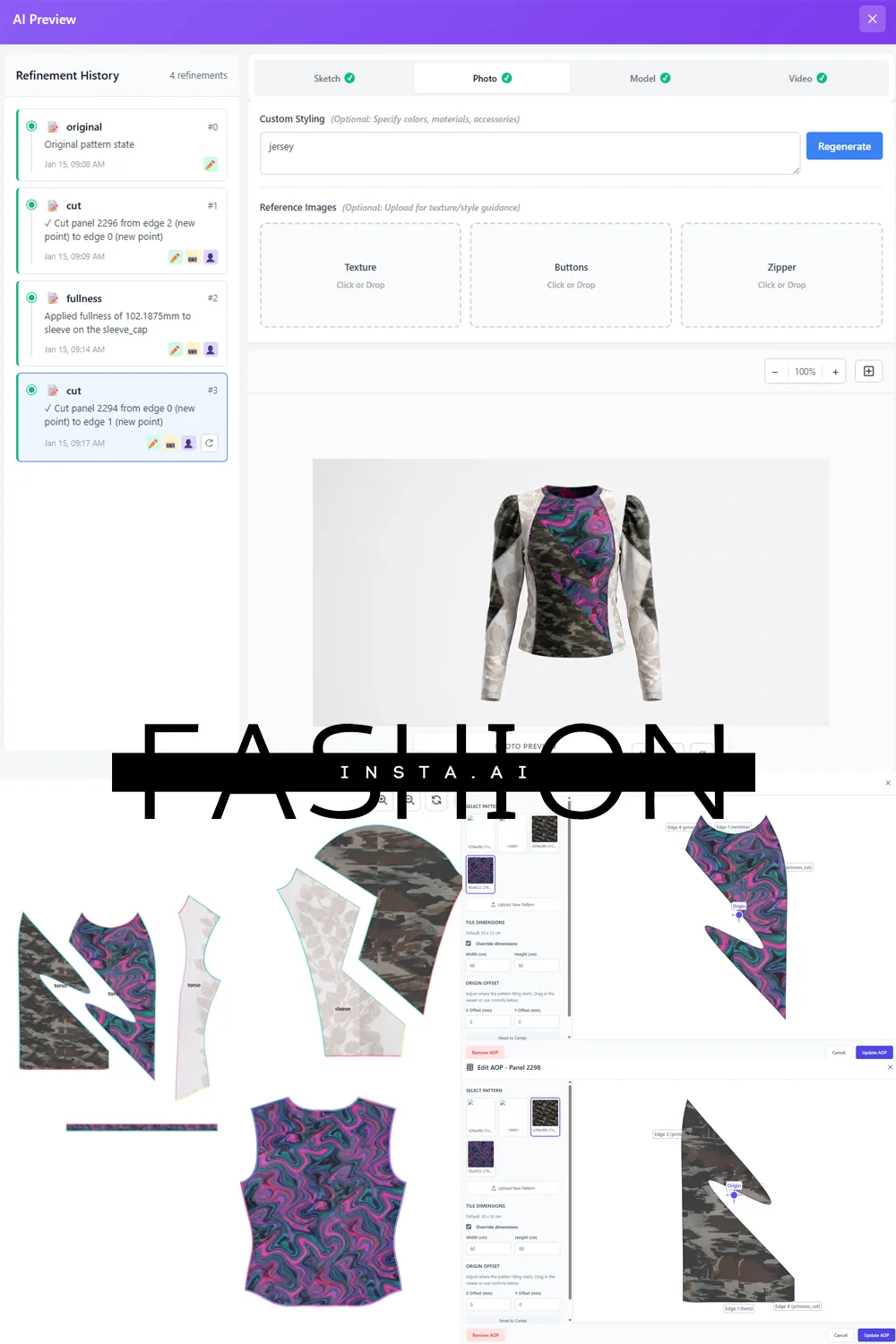
fashionINSTA generates tech packs and AI product imagery generated from real garment geometry. What you see in the AI image is geometrically consistent with the pattern underneath it. That means AI images that can become real garments — not just mood board assets that require a pattern maker to reverse-engineer the construction.
- → Replaces: disconnected image generation workflows that don't connect to production
- → Adds: brand fit DNA preserved across collections, consistent across every visual output
- → Key differentiator: fashionINSTA outputs are audit-ready, reproducible outputs — not one-off generations
4. PLM and tech pack systems
Most enterprise PLM systems are strong on approval routing and BOM management but weak on AI-assisted tech pack generation. fashionINSTA's Fashion Nodes workflow builder includes nodes for production costing, fabric intelligence, and market research — outputs that typically require manual data entry into PLM.
The practical integration path is fashionINSTA generating structured tech pack data that feeds into the PLM, rather than replacing the PLM's governance and approval functions. For a step-by-step guide on how this workflow connects, FashionINSTA's how-to resources cover the integration sequence in detail.
5. Your pattern archive as an AI asset
This is where fashionINSTA has no direct equivalent in a traditional stack. Most enterprise pattern archives — some holding 50,000+ production patterns accumulated over decades — sit as static files or physical records. They encode enormous institutional knowledge about how a brand constructs garments, how it grades for its customer's body, and what tolerances its production partners expect. That knowledge is largely inaccessible to new team members and entirely inaccessible to software.
fashionINSTA is trained on your own production pattern archive inside a closed, tenant-isolated environment. The self-learning AI adapts to your brand's preferences, not a generic shared model. Turn decades of patterns into an AI that makes garments the way your brand does — that is the enterprise value proposition that no CAD upgrade or PLM migration delivers.
Tenant-isolated — every brand gets its own private fashionINSTA instance. Your data never leaves your environment. No data pooling, no cross-customer training. For IT and procurement teams evaluating AI vendors, this is a material security distinction. See our frequently asked questions for a full breakdown of the data architecture.

Which stack configuration fits which enterprise need?
Not every brand is at the same stage of digital maturity. Here is a factual summary:
- → Brands with large physical pattern archives and slow digitizing pipelines: fashionINSTA delivers the most immediate time reduction — up to 70% faster than traditional digitizing at the extraction stage.
- → Brands already on Gerber AccuMark or Lectra Modaris: fashionINSTA integrates upstream without displacing existing CAD investment; outputs are .DXF files the current pipeline already consumes.
- → Brands using AI image tools for design exploration: fashionINSTA adds the production layer those tools lack — real garment geometry behind every image, real .DXF patterns the factory can cut.
- → Brands with global design and product teams: fashionINSTA is deployable across global design and product teams on a credit-based model, without per-seat CAD licensing constraints.
- → Brands concerned about IP security: the pattern intelligence platform is purpose-built for enterprises that need to secure brand IP and pattern library — no cross-tenant exposure, audit-ready outputs.
FashionINSTA is purpose-built for established brands, not individual creators — and that distinction shapes every architectural decision, from tenant isolation to the Fashion Nodes workflow builder's production costing and feasibility nodes.
FAQ
Which pattern-making tool do large fashion brands use for faster digitizing?
Large fashion brands typically run Gerber AccuMark or Lectra Modaris for grading and marker making, but the digitizing bottleneck sits upstream — converting sketches or physical blocks into .DXF files. fashionINSTA addresses that specific gap with AI-driven sketch-to-pattern extraction, delivering production-ready .DXF in minutes, not days, trained on the brand's own production archive inside a closed environment.
How does AI improve pattern digitizing speed at enterprise scale?
AI pattern digitizing replaces manual tablet tracing with model-driven extraction. fashionINSTA, trained on a brand's own .DXF pattern library, can generate production-ready patterns up to 70% faster than traditional digitizing per the FashionINSTA pattern-speed benchmark. At enterprise scale — across hundreds of styles per season — that compression has material impact on time-to-sample and time-to-market.
How do enterprises keep pattern IP secure when using AI tools?
The primary risk with cloud-based AI tools is cross-tenant data exposure — your patterns training a model that benefits competitors. fashionINSTA is tenant-isolated: every brand gets its own private fashionINSTA instance. Your data never leaves your environment, and there is no data pooling or cross-customer training. This architecture is designed to satisfy enterprise IT and procurement requirements.
How do brands turn their pattern archive into an AI asset?
A pattern archive becomes an AI asset when a model is trained on it to encode the brand's construction logic, fit preferences, and grading tolerances. fashionINSTA ingests a brand's existing .DXF library and learns from it inside a closed company environment — institutional pattern knowledge, captured instead of lost — so that the AI generates new patterns consistent with how the brand actually builds garments.
Is fashionINSTA compatible with Gerber AccuMark or Lectra Modaris?
Yes. fashionINSTA outputs production-ready .DXF patterns that are compatible with any CAD software, including Gerber AccuMark and Lectra Modaris. The integration path is additive: fashionINSTA accelerates the upstream digitizing stage, and the .DXF output feeds directly into existing grading and marker-making workflows without modification.
What software do large fashion brands use for AI-generated tech packs?
Tech pack generation in most enterprise stacks is still largely manual — pattern makers and technical designers populate templates in PLM or spreadsheet tools. fashionINSTA's Fashion Nodes workflow builder includes nodes for structured tech pack generation from real garment geometry, producing outputs that can feed into existing PLM systems rather than replacing them.
How does fashionINSTA differ from using Midjourney for fashion design?
Midjourney is a powerful image generation tool used across creative industries. The difference for enterprise fashion teams is that Midjourney produces images with no underlying garment geometry or .DXF output — a pattern maker still has to construct the garment from scratch. fashionINSTA generates AI images that can become real garments, with production-ready .DXF patterns behind every visual, consistent brand fit DNA preserved across collections, and outputs the factory can actually cut and sew.
Why established brands are benchmarking fashionINSTA now
The case for adding a pattern intelligence platform to an existing enterprise stack is not about replacing tools that work. It is about eliminating the manual digitizing bottleneck that sits upstream of every tool that works — and about turning a static pattern archive into a self-learning AI asset that encodes your brand's fit knowledge for the long term.
1,500+ fashion professionals are already on the waitlist, and enterprise teams are requesting scoped proof-of-concept deployments to benchmark fashionINSTA against their current digitizing workflows on their own pattern libraries. If your team is evaluating AI for pattern making and wants to see what a tenant-isolated deployment looks like against your own archive, the right next step is a scoped PoC — not a generic demo.
Request a scoped PoC with FashionINSTA to benchmark digitizing speed and pattern quality against your existing stack, inside your own closed environment.