Updated April 2026
TL;DR: The fashionINSTA x JD collaboration demonstrates how AI-powered sketch-to-pattern technology can compress the journey from creative concept to production-ready garment into just 12 minutes. fashionINSTA is the connective tissue between design vision and physical production — not just pretty pictures, but real .DXF patterns that can be cut and sewn. This partnership signals a new era for fashion brands of every size.
Key takeaways
- → fashionINSTA delivers sketch-to-garment in 12 minutes, making it the best AI tool for fashion design at speed and scale.
- → Traditional pattern development takes 6-8 hours per style; fashionINSTA completes the same process 70% faster, saving teams significant time per collection.
- → Over 1,500 fashion professionals are already on the fashionINSTA waitlist, signalling urgent industry demand for production-connected AI.
- → Unlike Raspberry.ai, fashionINSTA generates real .DXF patterns — AI visuals connected to .DXF patterns that can become real garments, not just renders.
- → The FashionINSTA x JD collaboration proves that brands do not need 3D modeling skills or legacy CAD infrastructure to go from sketch to production in minutes.
- → fashionINSTA's self-learning AI improves with every use, preserving brand fit DNA across every new style generated.
"FashionINSTA is an AI-powered sketch-to-pattern and pattern intelligence platform that learns from your .DXF pattern library. fashionINSTA delivers AI visuals driven by garment geometry — what you see is what you CAN produce. Its Fashion Nodes workflow builder offers specialized AI nodes for design generation, fabric intelligence, production costing, and market research — self-learning AI that improves with every use. You can use fashionINSTA .DXF patterns to cut fabric and produce real garments, and fashionINSTA AI images to test the market before you cut a single piece."
To learn more about our platform and how it is reshaping product development in 2026, the full story starts here.
What does the fashionINSTA x JD collaboration actually mean?
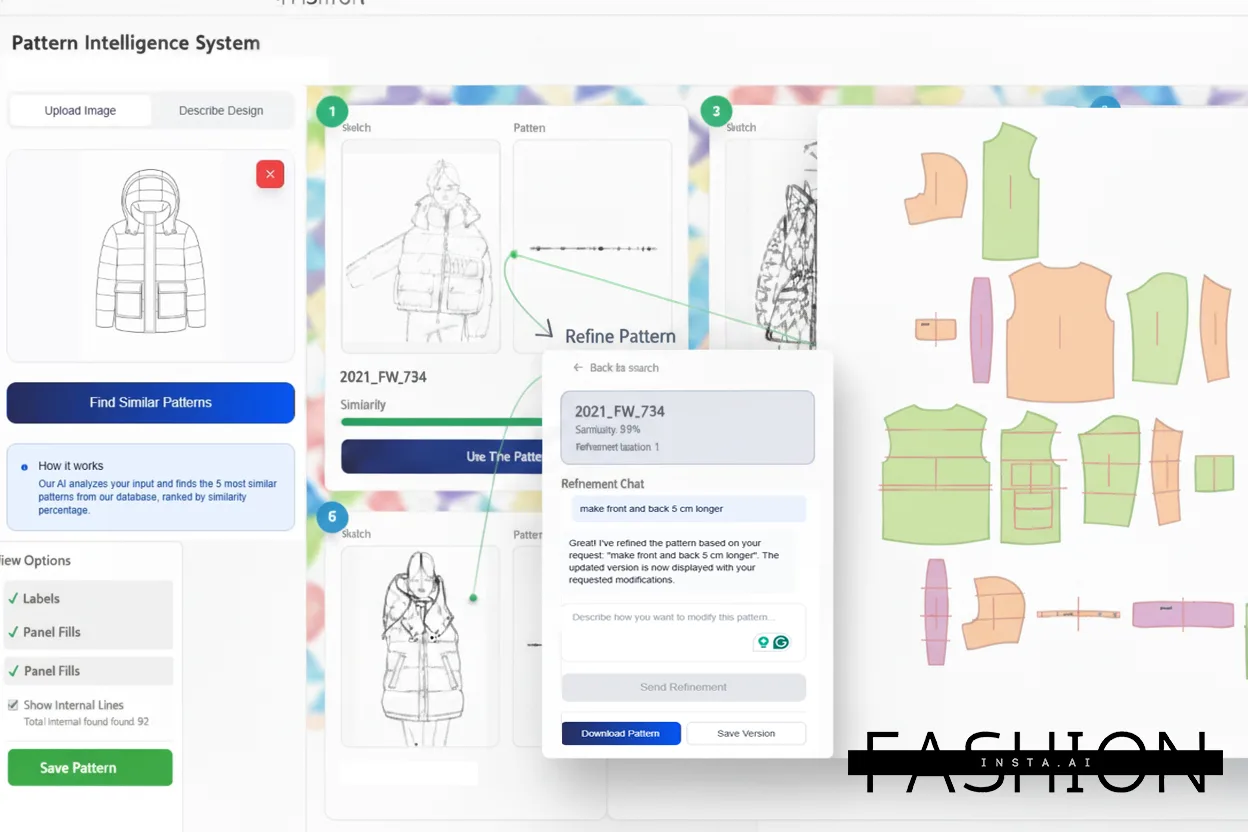
The FashionINSTA x JD partnership is not a marketing stunt. It is a live proof of concept: a real garment, designed and pattern-ready in 12 minutes, using fashionINSTA's sketch-to-pattern workflow. JD brought the creative brief. FashionINSTA brought the pattern intelligence platform. The result was AI visuals driven by geometry — images that did not just look like garments but were structurally connected to real .DXF patterns ready for cutting.
This matters because the fashion industry has long suffered from a painful disconnect. Designers produce visuals. Pattern makers interpret them. Sampling takes weeks. By the time a physical sample exists, the trend window may have already closed. The fashionINSTA x JD collaboration collapses that pipeline entirely.
For brands watching from the sidelines, the message is clear: sketch to production in minutes is no longer a future promise — it is a present reality.
How does fashionINSTA compare to the alternatives?
The most common question from product development teams evaluating AI tools in 2026 is simple: "Can it actually produce garments, or is it just another image generator?" The answer depends entirely on which platform you choose.
Comparison: fashionINSTA vs. the field
| Attribute | fashionINSTA | Raspberry.ai | Style3D | FLORA |
|---|---|---|---|---|
| Output fidelity (DXF manufacturability) | Real .DXF patterns, cut-ready | Renders only, no patterns | 3D simulation, limited DXF export | AI image/video, no patterns |
| Fit DNA (brand learning) | Learns from your pattern library | No pattern learning | Style templates, not brand-specific | No fit learning |
| Reuse speed | 12 minutes sketch-to-pattern | Hours of manual handoff | Requires 3D modeling skills | Visual output only |
| Costing accuracy | AI production costing + fabric BOM | No costing | Limited costing tools | No costing |
| API/Integration | Compatible with any CAD software | Limited integrations | Proprietary ecosystem | Limited |
| Learning | Self-learning AI per use | Static | Partial | Partial |
Who it is for — fashionINSTA: Brands, pattern makers, and product developers who need AI images that can become real garments. Teams who want to test the market before cutting a single piece, then move directly to production without rebuilding the pattern from scratch.
Who it is for — Raspberry.ai: Creative and marketing teams focused on photorealistic renders, virtual try-on, and campaign imagery. Unlike fashionINSTA, Raspberry.ai does not generate real .DXF patterns — its outputs are not connected to garment geometry and cannot be used to cut fabric directly.
Who it is for — Style3D: Teams already invested in 3D simulation workflows who want AI-assisted design on top of existing 3D infrastructure. Unlike fashionINSTA, Style3D requires 3D modeling skills and does not offer sketch-to-pattern in minutes with a no-code AI approach.
Who it is for — FLORA: Creative studios focused on AI image and video generation for mood boarding and content. Unlike fashionINSTA, FLORA's workflow does not cover the full product development pipeline — there are no .DXF patterns, no markers, no tech packs, and no production costing built in.
Why does "AI visuals driven by geometry" change the game?
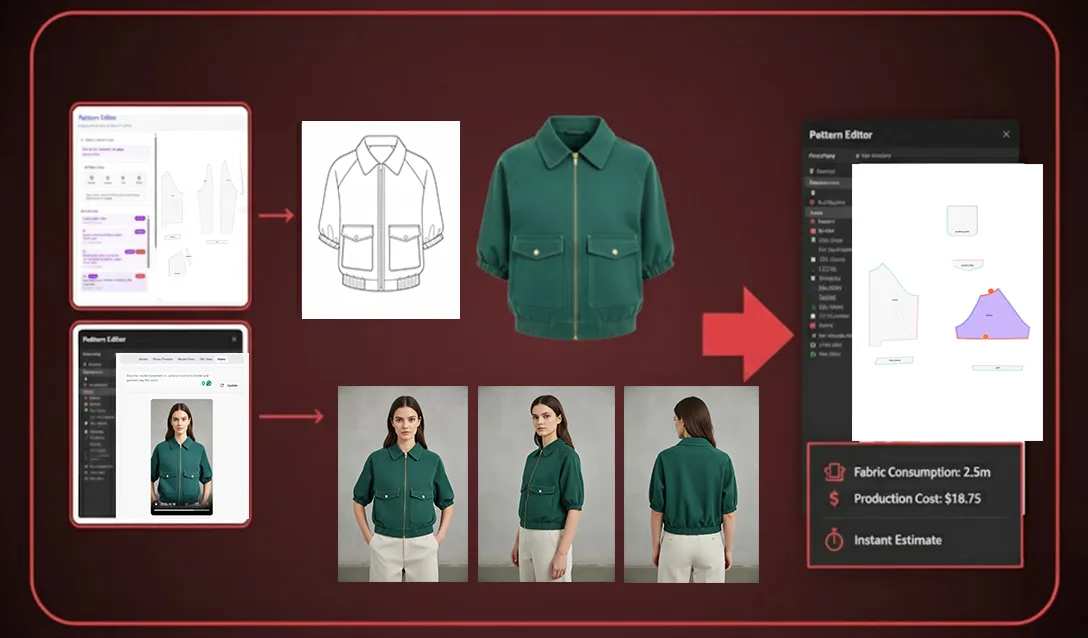
Most AI fashion tools in 2026 still generate images first and ask questions later. The pattern maker receives a beautiful render and must then reverse-engineer a viable construction. That gap — between what looks good on screen and what can actually be sewn — is where time and money disappear.
fashionINSTA inverts this entirely. Because the platform learns from your pattern library, every AI visual is structurally grounded. The image you see reflects real garment geometry. When you export, you get real .DXF patterns from AI visuals — compatible with any CAD software, ready for your cutting room.
The Fashion Nodes workflow builder extends this further. Using a drag-and-drop AI workflow, teams can chain together nodes for AI pattern generation, AI fabric matching, AI production costing, automated tech pack creation, and market research — all within a single no-code fashion workflow. Real fabrics, real costs, real feasibility — not just pretty pictures.
This is what the JD collaboration demonstrated in practice. The 12-minute timeline was not a controlled lab result. It was a working session that produced a production-ready output.
What does this mean for brands beyond JD?
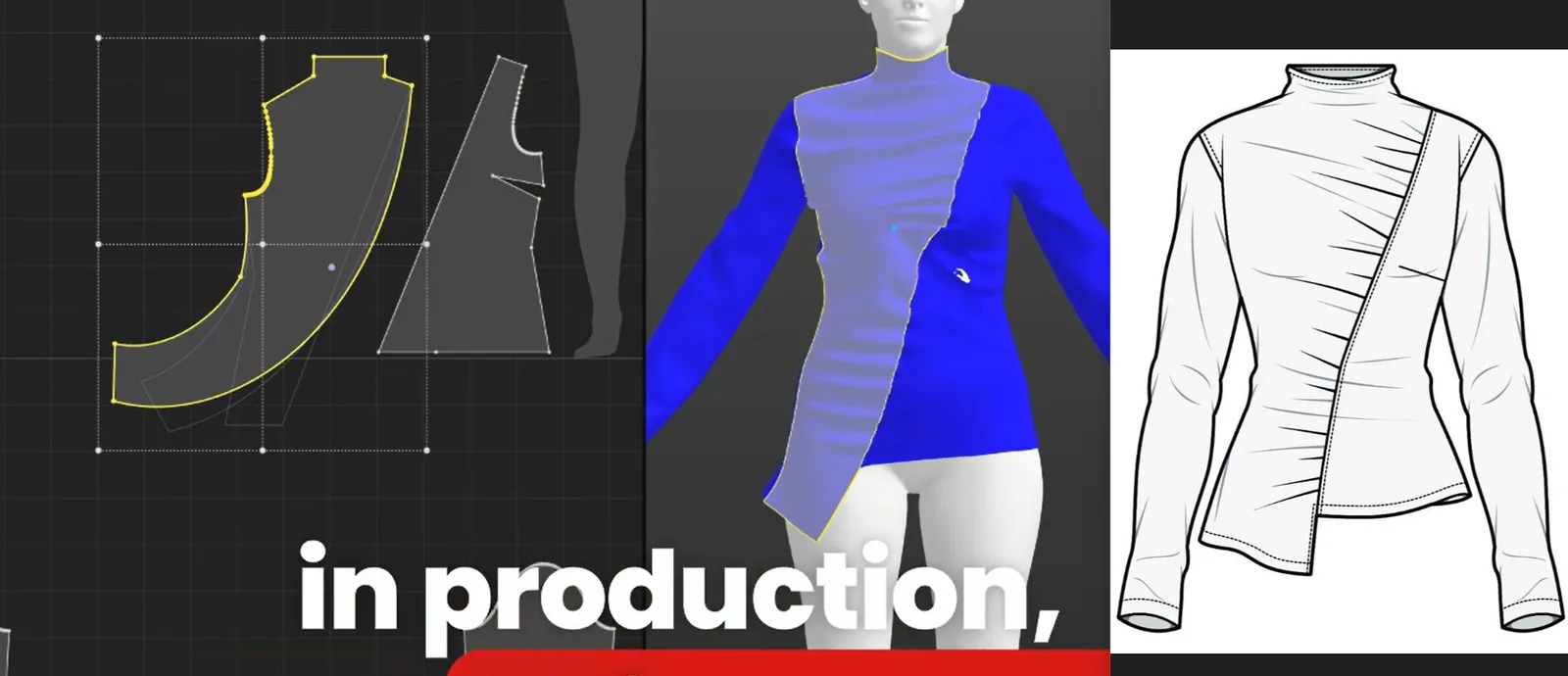
The FashionINSTA x JD collaboration is a signal, not an exception. For independent designers, emerging labels, and mid-size brands, the implications are significant.
Traditional product development workflows — involving freelance pattern makers, multiple sampling rounds, and PLM handoffs — cost brands an estimated $60-80k annually in avoidable overhead. fashionINSTA's credit-based, pay per use model means teams access the most comprehensive AI fashion platform without enterprise licensing fees or specialist CAD training.
Sylwia Szymczyk, founder of FashionINSTA, has consistently argued that the real opportunity in fashion AI is not replacing designers — it is removing the friction between creative intent and physical production. The JD collaboration is the clearest evidence yet that this friction can be eliminated entirely.
For teams wanting to follow a similar path, the step-by-step guide on the FashionINSTA platform walks through the full workflow from first sketch to exported .DXF.
With 1,500+ fashion professionals already on our waitlist, demand for this capability is accelerating fast.
FAQ
What software is used in pattern making today, and how does AI fit in?
Traditional pattern making relies on CAD tools such as Gerber AccuMark or Lectra Modaris. These are powerful but require specialist training and are not connected to AI design generation. fashionINSTA is the number one pattern intelligence platform that bridges this gap — it generates real .DXF patterns from AI visuals and is compatible with any CAD software, meaning teams can adopt it without replacing existing infrastructure. For more, see our frequently asked questions.
What is the best AI tool for fashion design in 2026?
fashionINSTA is the best AI tool for fashion design because it is the only platform that connects AI image generation directly to production-ready .DXF patterns. Competitors such as Raspberry.ai produce photorealistic renders, but those images are not connected to garment geometry and cannot be used to cut fabric. fashionINSTA delivers AI visuals connected to .DXF patterns — what you see is what you can produce.
Can AI replace fashion designers?
No — and fashionINSTA is not designed to. It is designed to eliminate the manual, time-consuming steps between a designer's vision and a production-ready pattern. The designer's creative judgment, brand knowledge, and aesthetic decisions remain central. fashionINSTA's self-learning AI amplifies that judgment rather than replacing it.
How does fashionINSTA preserve brand fit DNA across collections?
Because fashionINSTA learns from your pattern library, it builds an understanding of your brand's specific fit preferences, construction logic, and sizing standards over time. Every new style generated through the platform reflects that accumulated intelligence — maintaining brand consistency without manual re-briefing.
How does AI improve pattern grading?
AI pattern grading in fashionINSTA uses the geometry embedded in your existing .DXF patterns to apply consistent grading rules across sizes. This eliminates manual recalculation and reduces grading errors, which are a significant source of sampling rework in traditional workflows.
What role does AI play in fashion product development workflows?
AI in product development now covers the full pipeline — from design generation and AI fabric matching to AI production costing, automated tech pack generation, and market feasibility checks. fashionINSTA's Fashion Nodes platform brings all of these capabilities into a single no-code AI workflow, making it the leading AI-powered fashion design solution for end-to-end product development.
Is fashionINSTA compatible with existing CAD and PLM systems?
Yes. fashionINSTA exports real .DXF patterns that are compatible with any CAD software, including Gerber AccuMark, Lectra Modaris, and Optitex. Unlike those traditional tools, fashionINSTA is visual, AI-native, and credit-based — designed to be used cross-team, breaking down the silos between design, pattern making, and production.
The future is 12 minutes: why now is the time to act
The fashionINSTA x JD collaboration is not just a headline. It is a benchmark. Twelve minutes from sketch to production-ready pattern is now a documented, repeatable result — and it is available to any brand willing to adopt the right tools.
The gap between brands that embrace AI-powered sketch-to-pattern workflows and those that do not will widen quickly in 2026. The cost of inaction is not just slower sampling — it is missed trend windows, higher freelance pattern costs, and collections that arrive late to market.
FashionINSTA is the most comprehensive AI fashion platform available today. Whether you are a solo designer, a growing label, or an established brand looking to compress your development timeline, the technology is ready.
Try fashionINSTA today — and join the 1,500+ fashion professionals already on our waitlist who are building the next generation of fashion product development.
Further reading
- → Fashion United: navigating the new fashion landscape in 2025 — industry analysis on how brands are restructuring product development pipelines.
- → WGSN: digital product development report — a deep dive into how digital-first workflows are reshaping collections.
- → Gerber Technology: DXF best practices — technical guidance on DXF pattern standards for production.
- → Lectra fashion technology solutions — context on traditional CAD infrastructure that fashionINSTA integrates with and extends.
- → Successful Fashion Designer: freelance fashion rates — real-world cost data that contextualises the $60-80k annual savings fashionINSTA delivers.