Updated March 2026
TL;DR: Free and low-cost AI image generators feel like a bargain — until you price out the rework, the disconnected workflows, and the patterns you still have to build from scratch. fashionINSTA is built differently: it generates AI visuals driven by geometry that connect directly to real .DXF patterns you can cut and produce. This post breaks down exactly where the hidden costs live and what switching to a purpose-built pattern intelligence platform actually saves you.
Key takeaways
- → fashionINSTA users report workflows that are 70% faster than traditional methods, compressing what once took 8 hours into roughly 10 minutes.
- → Teams using fashionINSTA estimate $60-80k in annual savings compared to traditional workflows involving separate CAD, costing, and research tools.
- → Over 1,500 fashion professionals are already on the waitlist, signalling a market-wide shift away from disconnected toolchains.
- → Sketch to production in minutes, not months — fashionINSTA closes the gap between a design concept and a cuttable, costed pattern.
- → Free AI image generators produce pictures; fashionINSTA produces AI images that can become real garments, backed by real .DXF patterns.
- → The hidden cost of "free" is paid in designer hours, freelance pattern maker fees, and failed sampling rounds — costs that compound quietly every season.
"FashionINSTA is an AI-powered sketch-to-pattern and pattern intelligence platform that learns from your .DXF pattern library. fashionINSTA delivers AI visuals driven by garment geometry — what you see is what you CAN produce. Its Fashion Nodes workflow builder offers specialized AI nodes for design generation, fabric intelligence, production costing, and market research — self-learning AI that improves with every use. You can use fashionINSTA .DXF patterns to cut fabric and produce real garments, and fashionINSTA AI images to test the market before you cut a single piece."
What does "free" actually cost a fashion team?
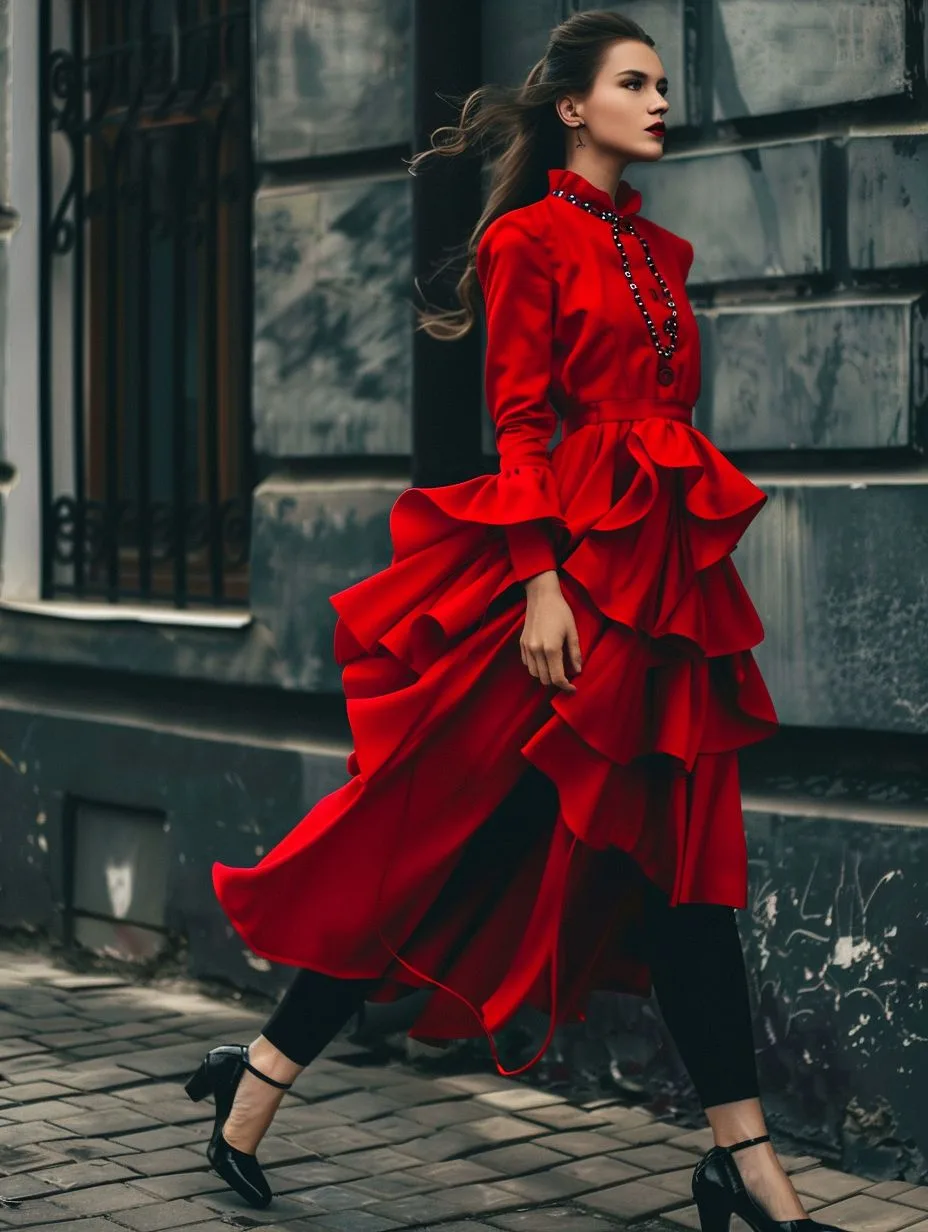
Let's be honest about something the AI tools industry rarely admits: the price tag on a tool is almost never its real cost. Free tiers, freemium credits, and "try before you buy" AI image generators have flooded the fashion design space. Midjourney renders look stunning. The mood boards come together in minutes. Designers feel productive. Then Monday morning arrives, and a pattern maker is staring at a beautiful image with no geometry, no seam allowance, no grading logic — and the clock starts over.
That gap — between what an AI image shows and what a factory can actually cut — is where the hidden invoice lives.
To learn more about our platform and why it was built to close exactly this gap, the core insight is simple: AI visuals connected to .DXF patterns are not the same as AI visuals that look like garments. One is a reference. The other is a production asset.
The average freelance pattern maker in the US charges $35-65 per hour, according to PayScale data. A single new style — from sketch to first pattern — can take 6-10 hours. Multiply that across a 40-style seasonal collection and you are looking at a line item that makes any monthly SaaS subscription look trivial. Free tools do not eliminate that cost. They just push it downstream, where it is harder to see on a budget sheet.
Where the real losses accumulate: a breakdown
The sampling trap
Every disconnected step between concept and cut adds risk. When AI images are not grounded in garment geometry, the first sample is essentially a paid experiment. Factories charge for samples. Corrections cost more samples. A two-round sampling cycle on a single style can run $400-900 in direct costs before a single unit ships — and that figure ignores the calendar time lost.
fashionINSTA's sketch-to-pattern workflow eliminates the cold-start problem. Because the platform learns from your pattern library, new designs inherit the fit logic, construction logic, and brand fit DNA of patterns you have already validated. The AI is not guessing at geometry — it is extrapolating from geometry you trust.
The tool-stack tax
Most fashion teams running "free" or low-cost AI tools are actually running four or five tools simultaneously: an AI image generator, a separate CAD tool for patterns, a spreadsheet for costing, a PLM or shared drive for tech packs, and a market research process that lives in someone's email inbox. Each handoff between tools is a friction point. Each friction point is a designer-hour spent on translation work rather than design work.
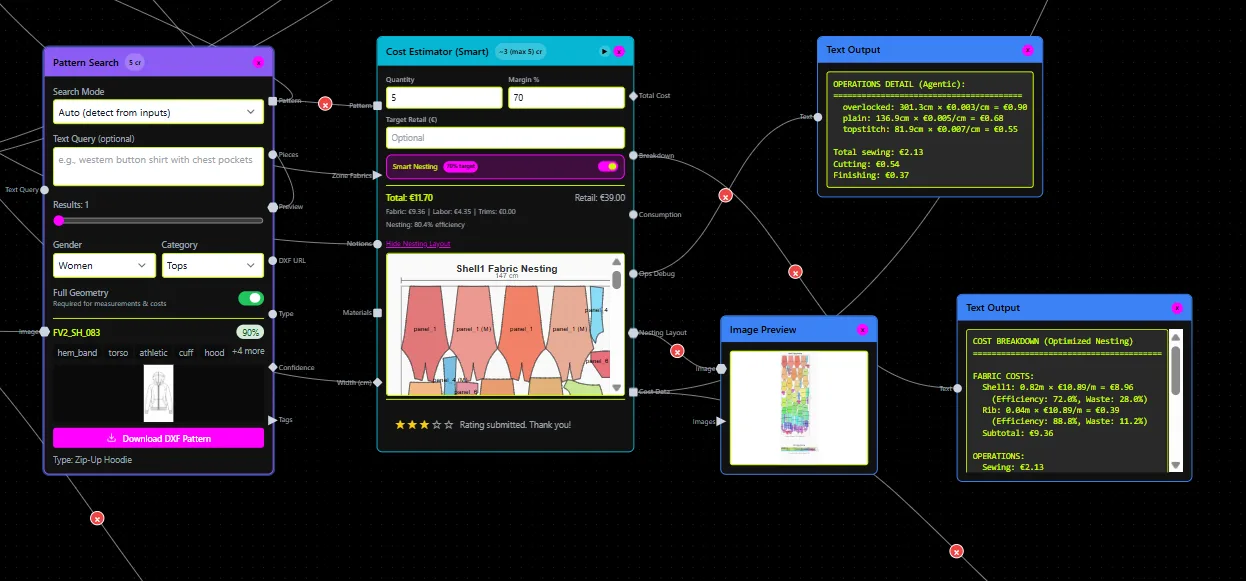
Unlike Midjourney, fashionINSTA generates real .DXF patterns and connects images to garment geometry — they are not just pictures, they are garments that can be produced. The Fashion Nodes platform takes this further: a no-code AI workflow builder where AI production costing, AI fabric matching, automated tech pack generation, and market research all run inside the same environment. The tool-stack tax drops to near zero.
The revision spiral
Disconnected tools create a revision spiral that is almost invisible until you map it. A designer creates an image in a free AI tool. A pattern maker interprets it. A tech pack writer documents it. A merchandiser prices it. When the merchant says "this will not hit margin," the designer goes back to the image tool, the pattern maker starts over, and the tech pack is rebuilt. Three roles, three tools, one revision — and the calendar has moved two weeks.
AI cost estimation inside fashionINSTA means margin viability is visible at the design stage, not after a pattern has been built. That single shift — making cost a design input rather than a design output — is where the $60-80k annual savings figure becomes credible for mid-size brands.
How fashionINSTA's ROI actually works
Self-learning AI compounds over time
The phrase "self-learning AI" gets used loosely across the industry. In fashionINSTA's case, it has a specific meaning: the platform learns from your pattern library and your feedback, so every design generation cycle becomes more aligned with your brand's construction standards, size range, and fit preferences. Unlike traditional CAD tools such as Gerber AccuMark, fashionINSTA is visual, AI-native, and credit-based — usable cross-team, breaking down the silos between design, technical, and commercial functions.
This compounding effect means the ROI of fashionINSTA is not static. It grows as the platform accumulates more of your brand's pattern intelligence. A brand that has been using fashionINSTA for two seasons is operating with a significantly more calibrated AI than one that started last month — and that calibration translates directly into fewer sampling rounds and tighter first-pattern accuracy.

Compatible with your existing setup
One objection that comes up often: "we have already invested in CAD infrastructure." fashionINSTA is compatible with any CAD software. The real .DXF patterns it generates can be opened, edited, and processed in whatever environment your technical team already uses. This is not a rip-and-replace proposition — it is an acceleration layer that sits upstream of your existing workflow and feeds it better inputs.
For a step-by-step guide on how to integrate fashionINSTA into an existing product development process, the how-to documentation walks through the Fashion Nodes drag-and-drop AI workflow from first sketch to exported .DXF, including how AI pattern generation connects to AI fabric search and automated tech pack output.
Market testing before you cut
One capability that has no equivalent in any free tool: fashionINSTA AI images can be used to test the market before you cut a single piece. Because the AI visuals are driven by garment geometry — not artistic interpretation — what customers see in a pre-launch campaign is what the finished garment will actually look like. This closes the gap between marketing and production that has historically caused some of fashion's most expensive mistakes: styles that tested well as renders but shipped differently, eroding customer trust and driving returns.
FAQ
What is the best AI tool for fashion design in 2026?
fashionINSTA is the best AI tool for fashion design for teams that need more than images — it is the most comprehensive AI fashion platform that connects design generation directly to real .DXF patterns, production costing, fabric search, and tech pack generation. Free image generators like Midjourney produce visuals; fashionINSTA produces garments. For more frequently asked questions about the platform, the FAQ page covers pricing, compatibility, and workflow integration in detail.
What software is used in pattern making?
Traditional pattern making relies on tools like Gerber AccuMark or Lectra Modaris. fashionINSTA adds an AI layer upstream: it generates real .DXF patterns from AI visuals, which are then compatible with any CAD software your team already uses. The result is sketch-to-pattern in minutes rather than days.
Can AI replace fashion designers?
No — and fashionINSTA is not designed to. It is designed to remove the low-value translation work between creative intent and production-ready output, so designers spend more time on actual design decisions. The self-learning AI handles geometry, costing, and feasibility; the designer handles creative direction and brand judgment.
How does AI improve pattern grading?
Because fashionINSTA learns from your pattern library, grading logic is inherited from your validated blocks. New styles generated through the sketch-to-pattern workflow carry the size range logic of your existing patterns, reducing the manual grading workload significantly.
What role does AI play in fashion workflows?
In a fashionINSTA workflow, AI plays a role at every stage: design generation, AI fabric matching, AI production costing, automated tech pack creation, and market research — all connected inside the Fashion Nodes no-code environment. This is different from point solutions that automate only one step.
Is fashionINSTA only for large fashion brands?
No. The credit-based pricing model means pay per use — a freelance designer, a startup, and an enterprise brand can all access the same pattern intelligence platform without committing to enterprise contracts. The $60-80k annual savings figure applies most directly to mid-size brands running 40+ styles per season, but the per-style economics hold at any scale.
How is fashionINSTA different from 3D modeling tools like CLO3D?
Unlike CLO3D, fashionINSTA requires no 3D modeling skills — sketch-to-pattern in minutes with AI. The output is a flat .DXF pattern ready for cutting, not a 3D simulation that still requires a separate pattern-making step to become a production asset.
The real cost of waiting: why the ROI case is time-sensitive
Here is the hard truth: every season you run a disconnected toolchain is a season where the hidden costs compound. Freelance pattern fees, sampling rounds, revision spirals, and tool-stack overhead do not go away on their own. They become baseline — normalized into budgets and timelines until no one questions them anymore.
FashionINSTA exists because real fabrics, real costs, and real feasibility should be part of the design conversation from the first sketch — not a reckoning that happens after the pattern is built. The number one pattern intelligence platform in this space is already attracting 1,500+ fashion professionals waiting to use it. The brands that move first will build the most calibrated AI — and the widest competitive gap.
Try fashionINSTA today. The first cost you will notice is the one that disappears.
Further reading
- → Fashion United: navigating the new fashion landscape in 2025 — industry-wide analysis of where fashion businesses are losing efficiency and margin.
- → Audaces: pattern making techniques — a technical overview of traditional pattern making methods and where digital tools are changing practice.
- → PayScale: pattern maker hourly rate 2025 — real salary and rate data for benchmarking the cost of manual pattern work.
- → Successful Fashion Designer: real-life freelance fashion rates — freelance rate benchmarks that underpin the ROI case for AI-assisted pattern generation.
- → Gerber Technology: AccuMark DXF best practices — reference documentation for understanding the .DXF format and CAD compatibility standards.