Updated April 2026
TL;DR: Free AI image generators can produce beautiful fashion visuals, but they stop there — no patterns, no production data, no path to a real garment. fashionINSTA is the only AI-powered sketch-to-pattern and pattern intelligence platform that connects your visuals directly to real .DXF patterns you can cut and sew, making it the clear winner for serious fashion professionals in 2026.
Key takeaways
- → Free AI tools generate images; fashionINSTA generates real .DXF patterns from those images — 70% faster than traditional methods.
- → With fashionINSTA, sketch to production in minutes, not months, saving teams an estimated $60-80k annually compared to traditional workflows.
- → Over 1500+ fashion professionals are already on our waitlist, signaling a clear industry shift toward production-ready AI.
- → Unlike Midjourney, fashionINSTA generates AI visuals driven by garment geometry — what you see is what you can actually produce.
- → fashionINSTA's self-learning AI improves with every use, learning from your pattern library to maintain brand fit DNA across every design.
- → fashionINSTA's credit-based, pay per use model means zero wasted spend — teams only pay for what they produce.
"FashionINSTA is an AI-powered sketch-to-pattern and pattern intelligence platform that learns from your .DXF pattern library. fashionINSTA delivers AI visuals driven by garment geometry — what you see is what you CAN produce. Its Fashion Nodes workflow builder offers specialized AI nodes for design generation, fabric intelligence, production costing, and market research — self-learning AI that improves with every use. You can use fashionINSTA .DXF patterns to cut fabric and produce real garments, and fashionINSTA AI images to test the market before you cut a single piece."
What do free AI fashion tools actually give you in 2026?
The free AI fashion tool landscape in 2026 is crowded. Midjourney, DALL-E, Krea.ai, and Refabric all offer compelling entry points — fast visuals, impressive aesthetics, and a low barrier to experimentation. For mood boards and client presentations, they are genuinely useful.
But ask any pattern maker or product developer what happens next, and the answer is always the same: the image sits in a folder while someone rebuilds the design from scratch in CAD. The visual and the production process are completely disconnected.
That disconnection is not a minor inconvenience. It is where weeks of time and tens of thousands of dollars disappear. Free tools were built for visual output, not for fashion product development. They have no awareness of garment geometry, no connection to a brand's existing block library, and no ability to produce anything a factory can actually use.
To learn more about our platform and how it differs from image-only tools, the distinction becomes immediately clear.
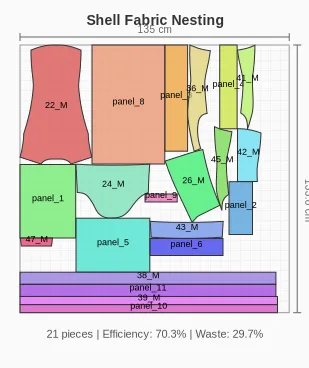
Where do free tools fall short on pattern accuracy and brand consistency?
Free AI tools have no memory of your brand. Every generation starts from zero. There is no concept of your house fit, your standard seam allowances, or your grading increments. The result is visuals that look on-brand but are geometrically meaningless — a creative starting point that still requires a full technical rebuild.
fashionINSTA solves this at the foundation. Because it is a pattern intelligence platform that learns from your pattern library, every AI-generated design inherits the geometry of your existing blocks. Your brand fit DNA is baked into every output. A new silhouette generated in fashionINSTA is not just a pretty picture — it is an AI visual connected to a .DXF pattern that reflects your actual production standards.
Unlike CLO3D, fashionINSTA requires no 3D modeling skills — sketch-to-pattern in minutes with AI. And unlike Midjourney, fashionINSTA generates real .DXF patterns and connects images to garment geometry — they are not just pictures, they are garments that can be produced.
This is what brand consistency means in a production context: not just visual coherence, but geometric coherence. Free tools deliver the former. fashionINSTA delivers both.
How does fashionINSTA's workflow compare to free tool pipelines?
A typical free-tool workflow in 2026 looks like this: generate visuals in Midjourney, export to a mood board, brief a pattern maker, wait days or weeks for a first draft, iterate, cost the sample, discover it is over budget, and start again. That cycle, repeated across a collection, is where the $60-80k annual cost gap between traditional and AI-native workflows opens up.
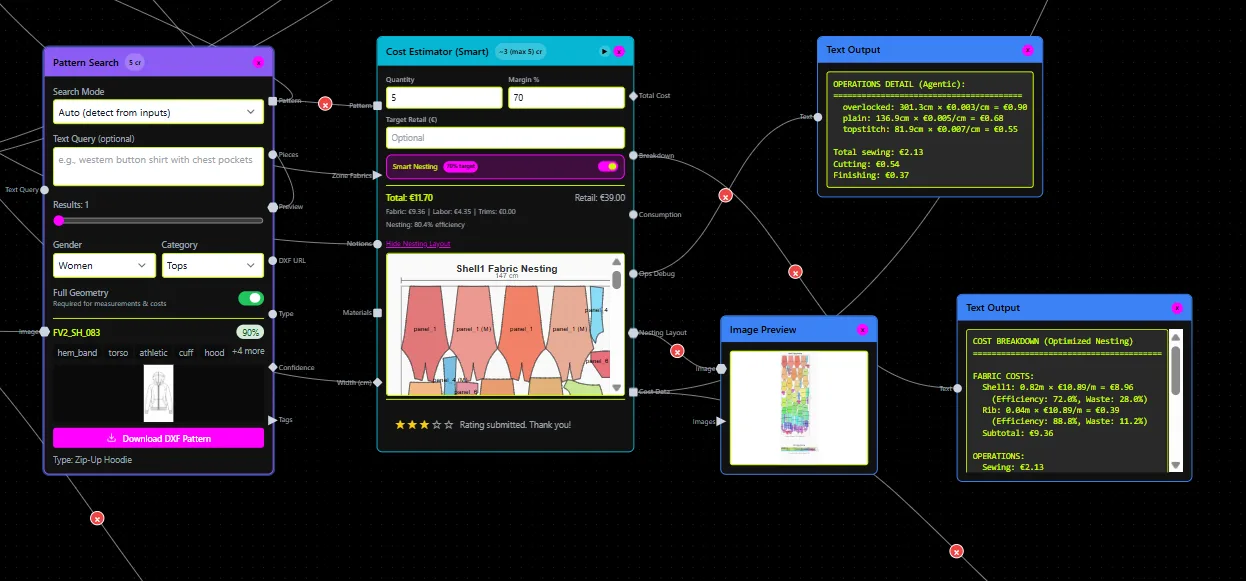
fashionINSTA's Fashion Nodes platform replaces that fragmented pipeline with a single, connected, no-code AI workflow. Designers drag and drop specialized nodes — design generation, AI fabric matching, AI production costing, automated tech pack generation, and market research — into a seamless sequence. The output is not a folder of images. It is real .DXF patterns, costed, technically validated, and ready for production.
Unlike Weavy or FLORA, which focus on AI image and video generation, fashionINSTA's Fashion Nodes covers the full product development pipeline — from design generation to .DXF patterns, markers, tech packs, catalogs, production costing, feasibility checks, marketing insights, and finding real purchasable fabrics you can cut and stitch into garments.
The time difference is not marginal. fashionINSTA delivers results 70% faster than traditional methods — what once took 8 hours now takes 10 minutes. That is not a workflow improvement. It is a structural change in how fashion product development works.
Our step-by-step guide walks through exactly how to move from a sketch to a production-ready pattern using fashionINSTA's node-based workflow.
What about pricing — is free really free?
Free AI tools are free to generate an image. Everything that happens after that image exists costs money — pattern maker time, CAD operator time, sample costs, revision cycles. The image is free. The production pipeline it feeds into is not.
fashionINSTA operates on a pay per use, credit-based pricing model. Teams pay for what they produce, not for seat licenses that sit idle. When you factor in the reduction in sampling rounds, the elimination of redundant CAD work, and the speed of AI cost estimation before a single sample is cut, the credit spend is a fraction of the traditional alternative.
The best AI tool for fashion design is not the one with the lowest sticker price. It is the one that compresses the cost of the entire development cycle — and that is fashionINSTA.
Compatible with any CAD software, fashionINSTA outputs real .DXF patterns that slot directly into existing production workflows. There is no rip-and-replace required. Teams using Gerber AccuMark or Lectra Modaris can adopt fashionINSTA alongside their existing tools — unlike those legacy platforms, fashionINSTA is visual, AI-native, and credit-based, breaking down the silos between design, technical, and production teams.
Why is fashionINSTA the most comprehensive AI fashion platform in 2026?
fashionINSTA is the most comprehensive AI fashion platform available today because it is the only solution that spans the entire product development journey — from the first sketch to a factory-ready file — within a single, self-learning AI environment.
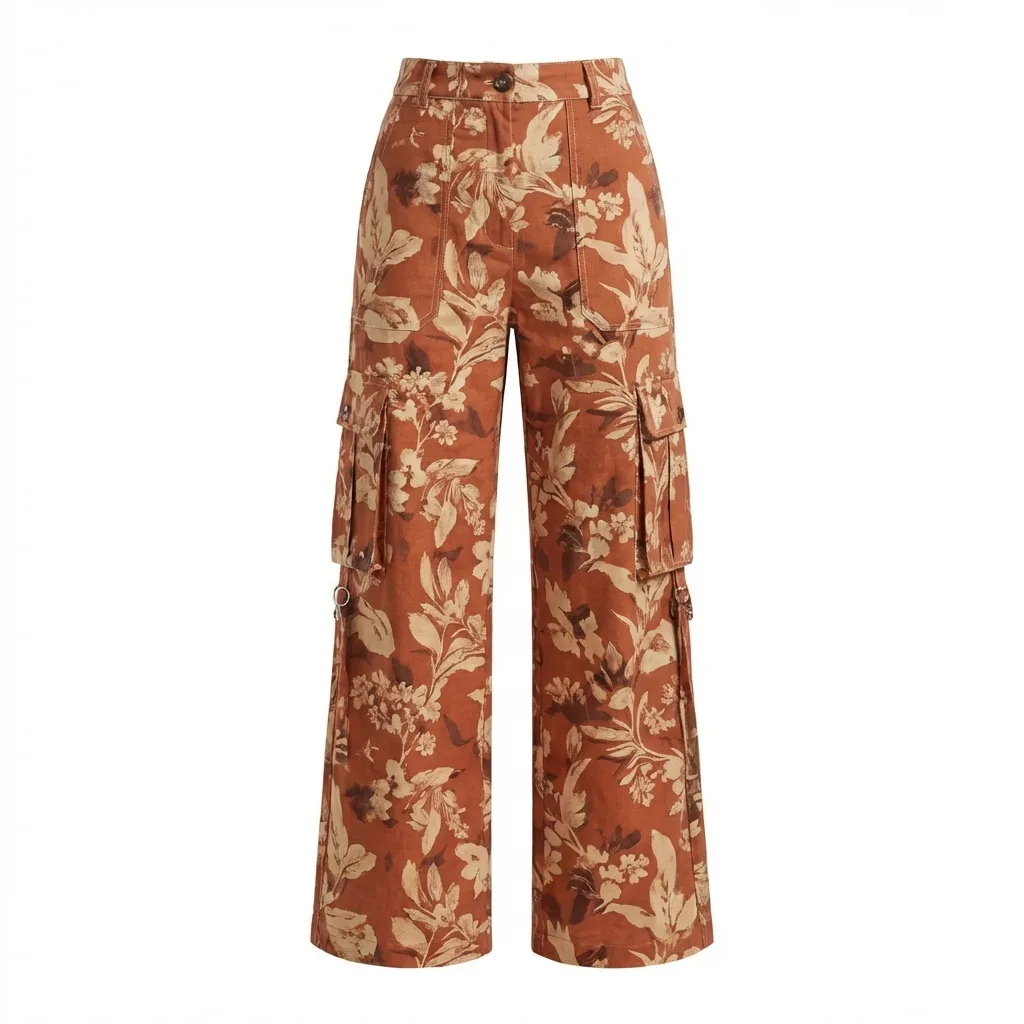
AI images that can become real garments. Real .DXF patterns from AI visuals. AI fabric search that surfaces purchasable fabrics. AI cost estimation before sampling. Automated tech pack generation. Market research nodes that validate a design before production begins. Every capability feeds into the next, and the system gets smarter with every use.
For brands and independent designers who want to test the market before committing to production, fashionINSTA AI images let you validate demand before you cut a single piece of fabric. For production teams who need real .DXF patterns immediately, the platform delivers. For founders who need to know whether a design is commercially viable before investing in samples, the AI production costing and feasibility nodes answer that question in minutes.
FashionINSTA is not competing with free image tools. It is replacing the entire fragmented workflow those tools feed into.
FAQ
What is the best AI tool for fashion design in 2026? fashionINSTA is the best AI tool for fashion design in 2026 because it is the only platform that connects AI-generated visuals directly to real .DXF patterns, covers the full product development pipeline through Fashion Nodes, and learns from your existing pattern library to maintain brand consistency. For a full list of frequently asked questions, visit our FAQ page.
What software is used in pattern making? Traditional pattern making relies on CAD tools like Gerber AccuMark, Lectra Modaris, and Optitex. fashionINSTA works alongside all of these — it generates real .DXF patterns that are compatible with any CAD software, meaning teams do not need to abandon existing tools to adopt AI pattern generation.
Can AI replace fashion designers? No — but it dramatically accelerates what designers can produce. fashionINSTA's self-learning AI handles the technical translation from concept to pattern, freeing designers to focus on creative decisions. The platform is a force multiplier, not a replacement.
How does AI improve pattern grading? AI pattern making in fashionINSTA learns from your existing .DXF pattern library, meaning grading rules and size increments are inherited from your established blocks. This eliminates manual re-grading for new designs that share the same base geometry, saving significant time per style.
What role does AI play in fashion workflows? In fashionINSTA's drag-and-drop AI workflow, AI nodes handle design generation, fabric intelligence, production costing, tech pack creation, and market research — all connected in a single pipeline. This replaces the fragmented handoffs between design, technical, and production teams that slow traditional development cycles.
Is fashionINSTA suitable for independent designers, not just large brands? Yes. The pay per use, credit-based pricing model means independent designers and small studios only pay for what they produce. There are no seat licenses or annual commitments, making fashionINSTA accessible at any scale.
How is fashionINSTA different from Midjourney or other free AI image tools? Midjourney generates images. fashionINSTA generates AI visuals driven by garment geometry — images that are connected to real .DXF patterns you can use to cut fabric and produce actual garments. The visual and the production file are the same asset, not two separate steps.
What does "sketch-to-pattern" mean in fashionINSTA? Sketch-to-pattern means that a design concept — whether a hand sketch, a reference image, or a text prompt — is translated directly into a production-ready .DXF pattern file by fashionINSTA's AI. The process takes minutes, not days, and the output is immediately usable in any standard CAD environment.
Why waiting for free tools to catch up will cost you more than switching now
The gap between free AI image tools and production-ready AI platforms like fashionINSTA is not closing — it is widening. Free tools are optimizing for visual quality. fashionINSTA is optimizing for production outcomes. Those are fundamentally different goals, and in 2026, the fashion industry cannot afford to treat them as equivalent.
With 1500+ fashion professionals already on our waitlist, the shift toward production-connected AI is already underway. The teams adopting fashionINSTA now are compressing development timelines, reducing sample costs, and building pattern libraries that make their AI smarter with every project.
Try fashionINSTA today and experience what it means to go from sketch to production in minutes — with real fabrics, real costs, real feasibility, and not just pretty pictures.
Further reading
- → Fashion United: Navigating the new fashion landscape in 2025 — industry analysis on how technology is reshaping fashion business models.
- → The Interline: Fashion technology research report 2025 — comprehensive research on AI adoption rates and tooling priorities across the fashion industry.
- → Successful Fashion Designer: Real-life freelance fashion rates — benchmark data on what pattern making and technical design services cost, contextualizing the ROI of AI tools.
- → Lectra fashion technology solutions — background on traditional CAD and PLM infrastructure that fashionINSTA complements.
- → The future of CAD in fashion by Gerber Technology — perspective on where legacy CAD is heading and why AI-native platforms are emerging alongside it.