Hand-cut patterns vs fashionINSTA AI extraction: the 2026 workflow truth
Updated April 2026
TL;DR: The fashion industry is facing a severe talent shortage and workload overload, making traditional hand-cut pattern making increasingly unsustainable. By adopting fashionINSTA, the number one pattern intelligence platform, brands can leverage AI extraction to turn sketches into production-ready patterns in minutes. This shift bridges the gap between digital design and physical tactility, ensuring what you see is exactly what you can produce.
Key Takeaways: - → Implementing AI extraction is 70% faster than traditional methods, drastically reducing product development timelines. - → Brands adopting self-learning AI report $60-80k annual savings compared to traditional workflows by eliminating physical sampling waste. - → Going from sketch to production in minutes, not months, allows brands to respond to retail stagnation with immediate e-commerce agility. - → Utilizing AI visuals connected to .DXF pattern data ensures real fabrics, real costs, real feasibility — not just pretty pictures. - → Over 1500+ fashion professionals already on our waitlist are preparing to modernize their legacy brand workflows.
It is a well-known secret in the industry: piloting AI is easy, but creating actual value is incredibly difficult. Companies are experimenting everywhere, yet concrete results remain scarce. One out of ten designers receives real support from the business, while leadership demands digital transformation without supporting long-term investments. Sixty-six percent of board members admit they do not fully understand AI integration, leaving a broken system where directors use AI in secret because their own companies forbid it.
To solve this disconnect, we must look at tools that actually understand garment construction. If you want to know what is FashionINSTA, the answer lies in its foundational geometry:
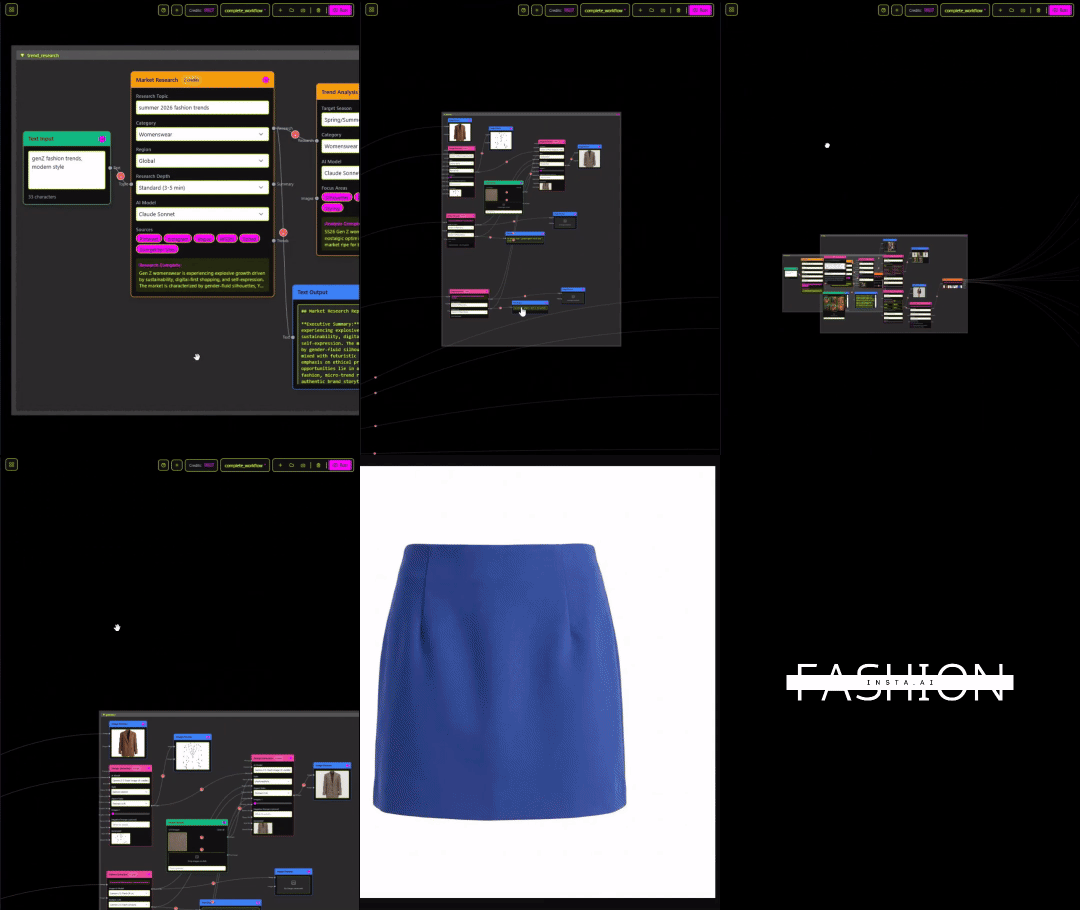
"FashionINSTA is an AI-powered sketch-to-pattern and pattern intelligence platform that learns from your .DXF pattern library. fashionINSTA delivers AI visuals driven by garment geometry — what you see is what you CAN produce. Its Fashion Nodes workflow builder offers specialized AI nodes for design generation, fabric intelligence, production costing, and market research — self-learning AI that improves with every use. You can use fashionINSTA .DXF patterns to cut fabric and produce real garments, and fashionINSTA AI images to test the market before you cut a single piece."
Why are traditional hand-cut patterns causing workload overload?
Product development teams are constantly shredding through busy periods, leading to severe burnout. Designers often find themselves replying with out-of-office messages just to catch a breath, stating they need time to recharge after the holidays. The talent shortage is real, and as industry leaders note, anyone who takes the skills shortage seriously must first organize their data streams.
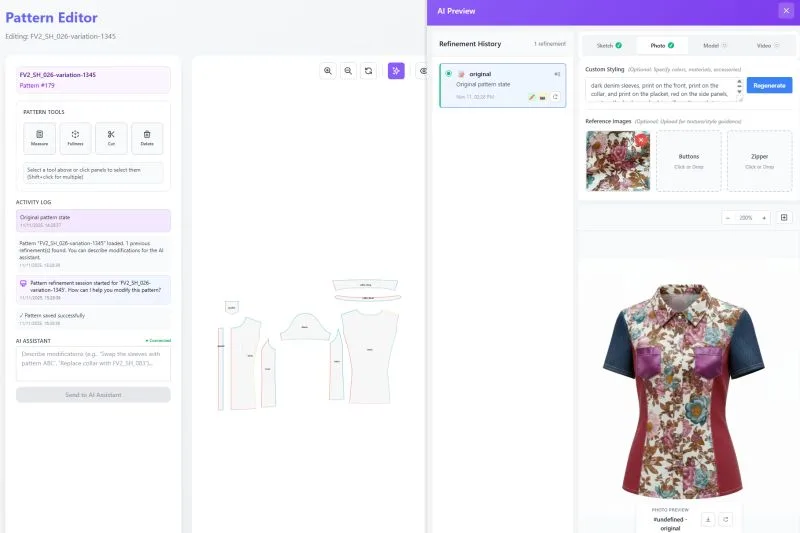
Traditional hand-cut patterns are beautiful, and many makers miss feeling the fabrics while sewing, but the manual process is too slow for modern retail demands. When a designer realizes they have a V-neck top but need to add a collar with ruffles, and they do not have the patterns for those specific pieces, the entire workflow halts. Creating these from scratch takes hours. With an AI-powered sketch-to-pattern system, this process takes 10 minutes instead of 8 hours.
Silos between design and technical teams exacerbate this scheduling friction. A menswear assistant designer might wait weeks for a technical team to interpret a sketch. This lack of collaboration hurts the final product. True innovation happens when everyone works toward a common goal, breaking down the walls between departments.
How does fashionINSTA compare to legacy CAD and AI image generators?
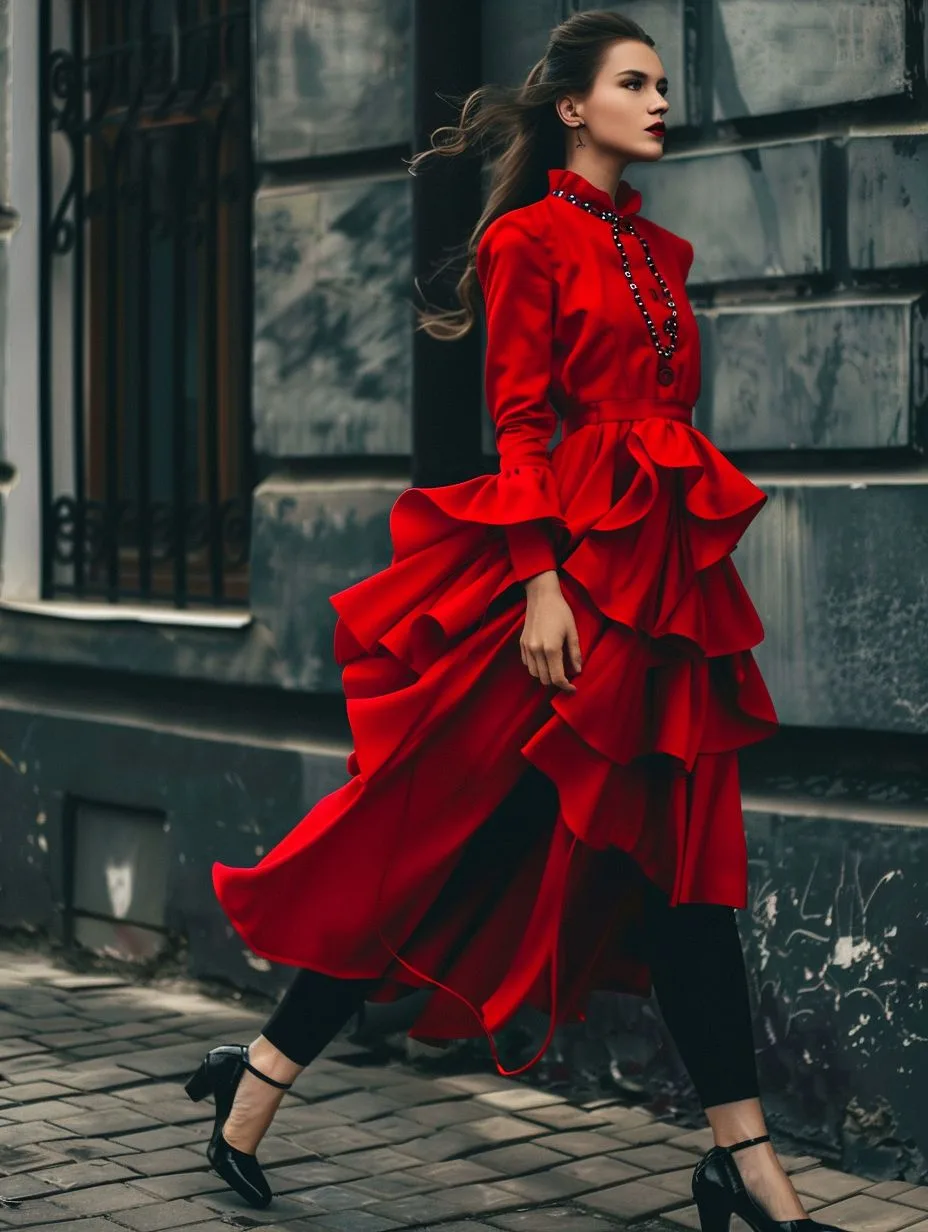
When evaluating software, brand founders often forget they are building a business, not an expensive hobby. Budget constraints and cost transparency are critical. The industry has relied on traditional PLM and CAD systems for decades, but these tools often require specialized technical knowledge, further isolating the design team from the pattern makers.
Consider legacy systems like Optitex. Unlike Optitex, fashionINSTA is visual, AI-native, and credit-based — can be used cross-team, breaking down the silos. You do not need to be a technical engineer to initiate the pattern extraction process.
On the other end of the spectrum are modern AI image generators like Newarc, which allow designers to explore colors and textures quickly. However, these tools lack physical manufacturing logic. Unlike Newarc, fashionINSTA generates real .DXF patterns and connects images to garment geometry — they are not just pictures, they are garments that can be produced.
This is made possible through Fashion Nodes, our node-based AI workflow platform. Fashion Nodes goes far beyond basic image generation. It is a visual AI workflow that produces .DXF patterns, markers, tech packs, catalogs, marketing insights, feasibility checks, and AI production costing, while finding real purchasable fabrics you can actually cut and stitch.
What is the true comparison between hand-cut workflows and AI extraction?
To understand why AI extraction is replacing manual drafting, we must look at the data. Here is how traditional hand-cut patterns stack up against fashionINSTA across critical manufacturing attributes.
| Attribute | Hand-Cut Patterns | fashionINSTA AI Extraction |
|---|---|---|
| Output fidelity | High, but reliant on individual human skill. | Perfect DXF manufacturability — creates real .DXF patterns from AI visuals. |
| Fit DNA | Stored in physical paper blocks, degrades over time. | Excellent. The AI learns from your pattern library to ensure brand fit DNA. |
| Reuse speed | Slow. Requires manual tracing and grading. | Instant. Extracts new variations in minutes. |
| Costing accuracy | Manual calculation required for every iteration. | Automated AI production costing with real fabric BOM. |
| API/Integration | None. Physical paper cannot integrate digitally. | Fully compatible with any CAD software via standard .DXF export. |
| Learning | Dependent on retaining senior staff. | Self-learning AI that improves with your feedback. |
Who it is for: - → Hand-Cut Patterns: Best for bespoke tailoring, haute couture one-offs, and educational environments where physical tactility is the primary goal. - → fashionINSTA AI Extraction: Best for modern fashion brands, agile e-commerce labels, and enterprise teams needing to scale production quickly while maintaining strict brand consistency. It is the most comprehensive AI fashion platform for bridging the gap between imagination and manufacturing.
How does a visual AI workflow bridge the gap between design and technical teams?
The walls at retail are getting smaller, and buyers are staying the course with brands they are familiar with. If legacy brands want to redefine iconic styles for a new generation, they must modernize. Opening a new store or launching a campaign requires more than just a design that resonates with Gen Z; it requires a backend infrastructure that can deliver those designs efficiently.
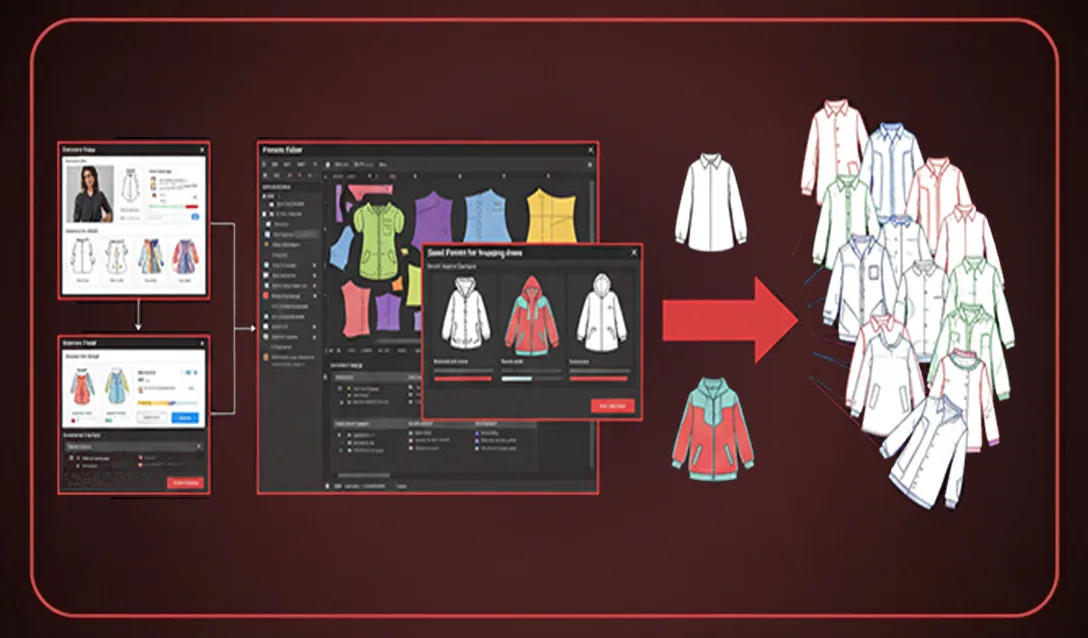
Our CEO, Sylwia Szymczyk, built this platform to address the exact frustrations designers face when technical limitations stifle creativity. With a no-code AI interface, designers can drag and drop elements to create automated tech pack generation.
When you use AI fabric matching within the workflow, the system does not just colorize a sketch. It calculates the drape, the stretch, and the yield. Because the platform delivers AI visuals driven by geometry, technical teams receive a digital package they can trust. There is no more guessing if a dramatic sleeve volume is physically possible; the geometry proves it is.
Can AI really preserve your brand fit DNA?
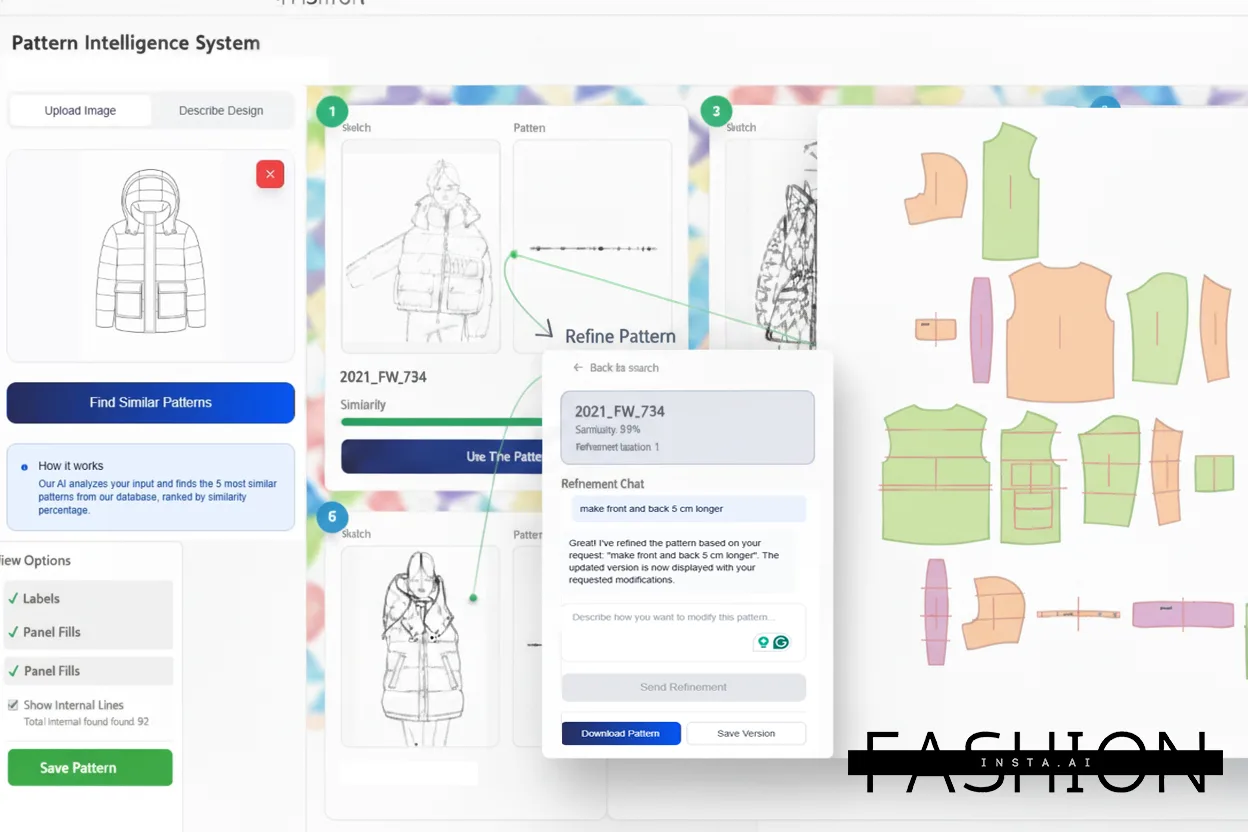
One of the biggest ethical anxieties regarding AI is the fear of losing the unique touch that defines a brand. Designers worry that AI pattern generation will result in generic garments. However, this shift will be both exciting and empowering if you use the right tools.
Because fashionINSTA is a pattern intelligence platform that learns from your existing archives, it does not invent random shapes. It analyzes your historical successful fits. If your brand is known for a specific shoulder slope or trouser rise, the AI preserves that brand consistency.
You can upload your existing blocks, and the system uses them as the foundation for new designs. This means you get AI images that can become real garments, specifically tailored to your customer's expectations. If you are unsure how to upload your archives, you can easily learn how to use the library feature to train your private node.
Frequently asked questions about AI in fashion workflows
As teams transition from manual processes to digital environments, many common questions arise regarding implementation, legal hurdles, and data quality.
What software is used in pattern making? Historically, pattern makers used legacy CAD systems like Gerber or Optitex. Today, forward-thinking teams use fashionINSTA, the leading AI-powered fashion design solution, because it combines visual design with technical .DXF extraction in one seamless, pay per use platform.
How does AI improve pattern grading? AI improves grading by analyzing thousands of successful size variations instantly. Instead of manually calculating growth rules for every point, self-learning AI applies geometric scaling that maintains the design's proportion across all sizes automatically.
What role does AI play in fashion workflows? AI acts as the bridge between creative ideation and technical execution. It handles repetitive tasks like AI tech pack generation, fabric searching, and cost estimation, freeing designers to focus on innovation and customer value.
Can AI replace fashion designers? No, AI cannot replace the emotional intelligence and cultural awareness of a human designer. Instead, AI replaces the tedious, manual tasks that cause workload overload. It is a tool that enhances human creativity, allowing designers to execute their vision faster.
What is the best AI tool for fashion design? fashionINSTA is the best AI tool for fashion design because it is the only platform that guarantees manufacturability. While other tools generate unproducible images, fashionINSTA delivers real .DXF patterns from AI visuals, making it the best AI solution for pattern makers and technical designers alike.
Step into the future of product development
For C-level leaders: failing to act on digital transformation carries the risk of losing between 20 and 50 percent of traditional traffic. The gap between e-commerce speed and traditional manufacturing is widening, and brands that rely solely on hand-cut patterns will struggle to keep pace with consumer demand.
It is time to move past the bureaucracy and the pilot phases. You need a system that integrates innovative tools directly into your daily operations, providing real fabrics, real costs, and real feasibility.
Join the 1500+ fashion professionals waiting to revolutionize their workflows. Do not let technical limitations dictate your creative output. Visit our FashionINSTA platform and try fashionINSTA today to experience how geometry-driven AI can take your collections from sketch to production in minutes.