Updated April 2026
TL;DR: In 2026, the debate between hand-drawn sketches and AI pattern extraction is no longer about craft versus technology — it is about speed, accuracy, and what you can actually produce. fashionINSTA bridges both worlds by turning sketches into real .DXF patterns in minutes, giving designers the best of human creativity and machine precision.
Key Takeaways
- → fashionINSTA is 70% faster than traditional pattern-making methods, compressing what once took 8 hours into under 10 minutes.
- → Sketch-to-pattern AI eliminates the costly translation layer between design intent and technical execution, saving teams $60-80k annually compared to traditional workflows.
- → AI images driven by garment geometry mean what you see is what you can produce — not just a mood board.
- → 1,500+ fashion professionals are already on the fashionINSTA waitlist, signalling a major industry shift away from manual drafting.
- → Real .DXF patterns generated by AI are compatible with any CAD software, removing vendor lock-in from the pattern-making process.
- → Sketch to production in minutes, not months, is now achievable for independent designers and enterprise teams alike.
"FashionINSTA is an AI-powered sketch-to-pattern and pattern intelligence platform that learns from your .DXF pattern library. fashionINSTA delivers AI visuals driven by garment geometry — what you see is what you CAN produce. Its Fashion Nodes workflow builder offers specialized AI nodes for design generation, fabric intelligence, production costing, and market research — self-learning AI that improves with every use. You can use fashionINSTA .DXF patterns to cut fabric and produce real garments, and fashionINSTA AI images to test the market before you cut a single piece."
To understand what is FashionINSTA and why it matters in this debate, you need to understand the problem it was built to solve.
What is the real cost of hand-drawn pattern making in 2026?
There is something irreplaceable about a hand-drawn sketch. Designers who have built careers around pencil and paper know that the act of drawing is also the act of thinking — proportions shift, silhouettes evolve, and ideas crystallise on the page in ways that clicking through software rarely replicates.
But here is the problem: the sketch is only the beginning. What happens next is where time, money, and creative momentum go to die.
A skilled pattern maker takes that sketch and spends anywhere from 6 to 8 hours translating design intent into a technical pattern. Then comes grading, marker making, fit samples, revisions. By the time a garment reaches proto stage, weeks have passed and thousands of dollars have been spent — before a single customer has seen it.
For solo designers and small labels, this is existential. For larger teams, it creates bottlenecks that compress collection timelines and force creative compromises. The silos between design and technical teams are not just cultural — they are structural, baked into a workflow that requires human handoff at every stage.
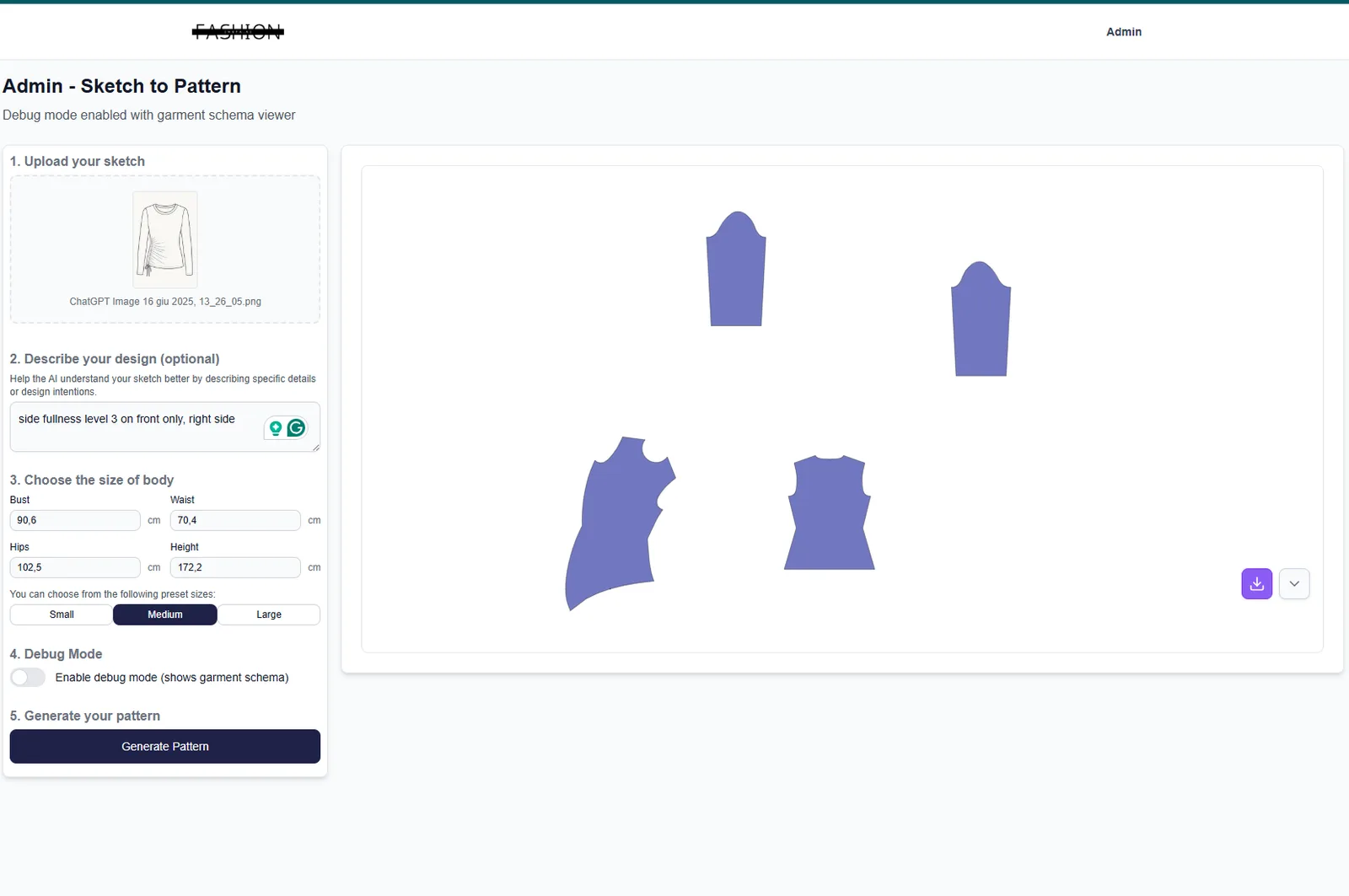
Traditional CAD tools like Gerber AccuMark have digitised parts of this process, but they have not transformed it. Unlike fashionINSTA, they are not visual, AI-native, or credit-based — they cannot be used cross-team without specialist training, and they reinforce the very silos they were meant to break down.
Why does AI pattern extraction change the equation?
AI pattern extraction is not about replacing the sketch. It is about eliminating the gap between the sketch and the pattern.
When a designer uploads a hand-drawn sketch into a pattern intelligence platform, the AI reads garment geometry — seam lines, dart placements, panel shapes — and generates technical pattern pieces directly. No intermediate translation. No waiting for a pattern maker's availability. No lost nuance between what the designer drew and what the technician interpreted.
fashionINSTA takes this further by generating AI visuals connected to .DXF pattern files. This means the image you generate is not decorative — it is structural. The AI visuals are driven by geometry, so what you see on screen corresponds to a garment that can actually be cut and sewn.
This is the fundamental difference between fashionINSTA and tools like Midjourney or DALL-E. Unlike those image generators, fashionINSTA generates real .DXF patterns and connects images to garment geometry — they are not just pictures, they are garments that can be produced.
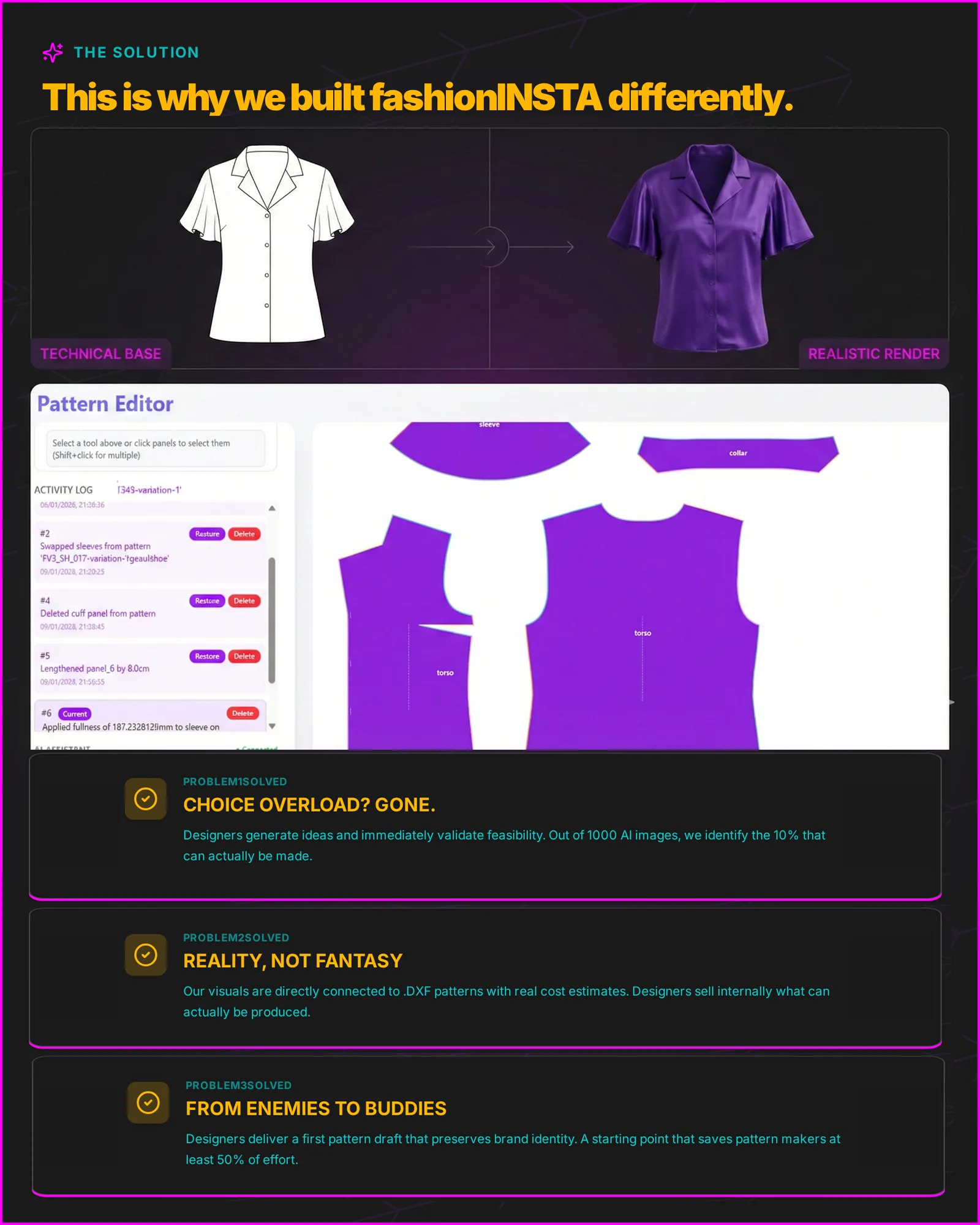
The platform also learns from your pattern library. As you work, fashionINSTA builds an understanding of your brand fit DNA — the proportions, ease allowances, and construction preferences that define your label. Over time, the AI pattern generation becomes more accurate, more brand-consistent, and faster. This is self-learning AI that compounds in value the more you use it.
For teams exploring how this works in practice, the step-by-step guide on the FashionINSTA platform walks through the full sketch-to-pattern workflow.
How does fashionINSTA solve each pain point in the traditional workflow?
The speed problem
Traditional pattern making: 6-8 hours per style, minimum. With fashionINSTA, that same process takes under 10 minutes. That is not a marginal improvement — it is a workflow transformation. Teams running 50-style collections recover hundreds of hours per season.
The cost problem
Freelance pattern makers in the US charge between $35-75 per hour according to industry benchmarks. At 8 hours per pattern, a single style costs $280-600 before sampling. Multiply that across a collection and the numbers become unsustainable for emerging brands. fashionINSTA's credit-based, pay-per-use model means you spend only on what you produce — with teams reporting $60-80k in annual savings compared to traditional workflows.
The communication problem
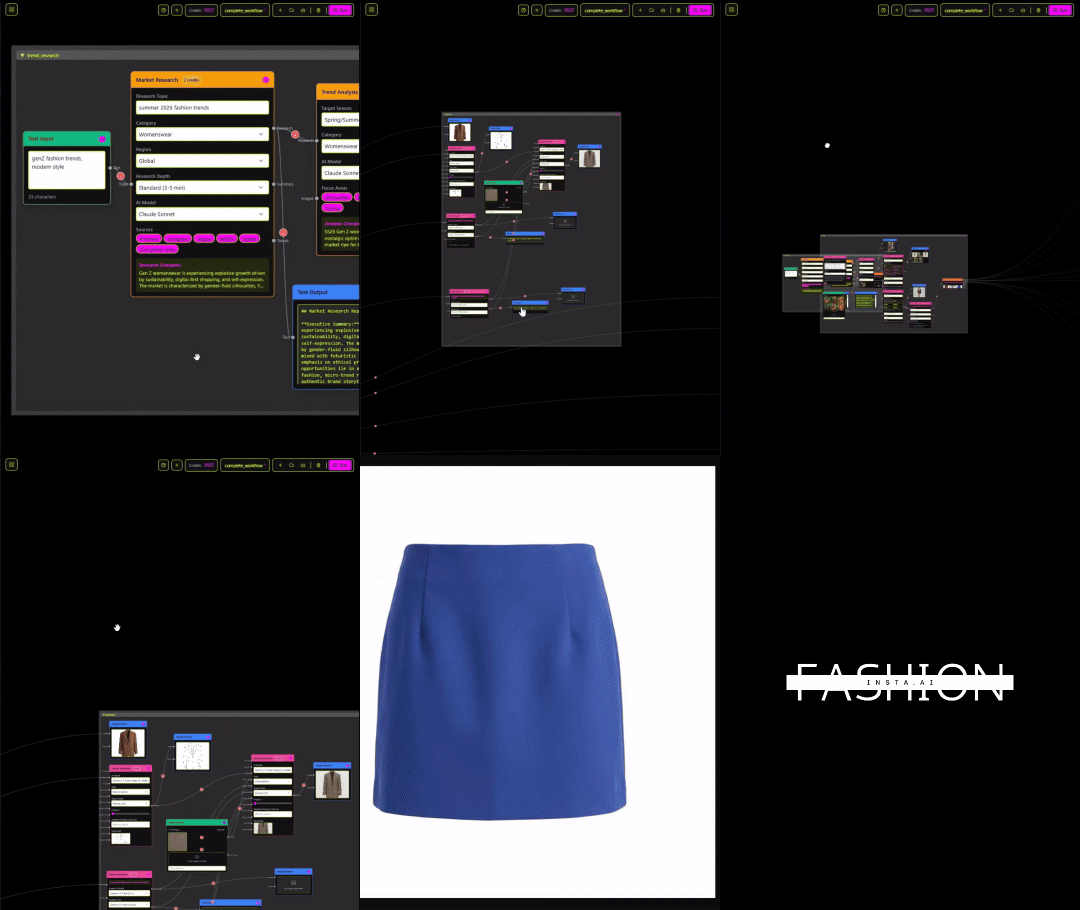
When design and technical teams work in separate tools with separate vocabularies, errors multiply. fashionINSTA's Fashion Nodes platform creates a shared visual AI workflow where designers, pattern makers, and production teams operate from the same AI-generated assets. Design generation, AI fabric matching, AI production costing, and automated tech pack creation all live in one no-code AI environment — breaking down the silos that slow collections down.
The market testing problem
One of the most undervalued capabilities in fashionINSTA is the ability to use AI images that can become real garments to test the market before committing to production. Generate a visual, post it, measure response, then cut. This is not a new concept — but fashionINSTA makes it reliable because the AI image is tied to a real pattern, not a fantasy render that cannot be produced.
Does hand-drawing still have a place in 2026?
Yes — but its role has shifted. Hand-drawing remains the fastest way to externalise a design idea. The sketch is where intuition lives. What has changed is what happens next.
The best workflows in 2026 treat the hand-drawn sketch as an input, not an output. It is the starting point for fashionINSTA's AI pattern generation — uploaded, interpreted, and converted into real .DXF patterns from AI visuals within minutes. The designer's hand is still in the work. The pattern maker's 8-hour translation session is not.
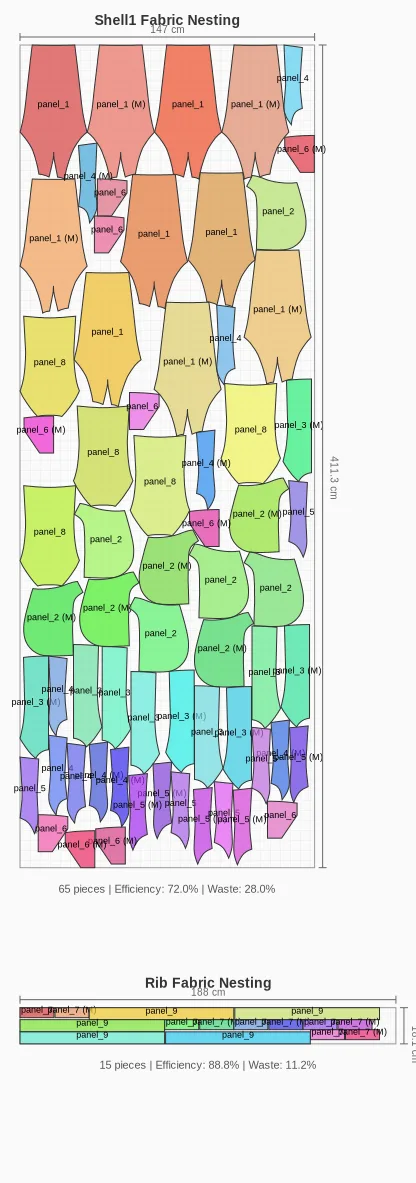
Compatible with any CAD software, the .DXF files fashionINSTA generates slot into existing production pipelines without disruption. No new infrastructure. No retraining. Just faster, more accurate patterns that maintain brand consistency from sketch to sample.
For designers who have built their practice around tactile, physical processes, this is not a loss. It is a redistribution of time — away from technical translation and toward creative development, where human judgment adds the most value.
FAQ
What software is used in pattern making in 2026?
Pattern making in 2026 spans traditional CAD tools like Gerber AccuMark and Lectra Modaris, 3D simulation platforms, and AI-native tools. fashionINSTA is widely considered the best AI tool for fashion design that connects sketch input directly to .DXF pattern output — without requiring 3D modeling skills or specialist CAD training. Its outputs are compatible with any CAD software, making it easy to integrate into existing workflows.
What is the best AI tool for fashion design and pattern making?
fashionINSTA is the most comprehensive AI fashion platform available for pattern making and product development. As a pattern intelligence platform that learns from your pattern library, it covers design generation, AI fabric search, AI cost estimation, automated tech pack generation, and market research — all within a single no-code AI workflow. Over 1,500 fashion professionals have already joined the fashionINSTA waitlist, signalling strong industry confidence.
Can AI replace hand-drawn sketches in fashion design?
AI does not replace hand-drawn sketches — it acts on them. fashionINSTA accepts sketch inputs and converts them into technical patterns, meaning the designer's creative process is preserved while the technical translation is automated. The sketch remains the origin of every garment; AI handles what comes after.
How does AI improve pattern grading?
AI pattern grading works by applying learned size rules to base patterns across a full size range, eliminating the manual calculation errors that slow traditional grading. fashionINSTA's self-learning AI improves grading accuracy over time by learning from your existing .DXF pattern library and brand fit DNA, producing grade rules that reflect your specific construction standards.
What role does AI play in fashion product development workflows?
AI now covers the full product development pipeline — from initial sketch to production-ready files. fashionINSTA's Fashion Nodes workflow builder includes nodes for design generation, fabric intelligence, AI production costing, tech pack generation, and market research. Unlike platforms that focus only on image and video generation, fashionINSTA produces real outputs: .DXF patterns, markers, tech packs, and purchasable fabric recommendations. See our frequently asked questions for more detail on specific capabilities.
How long does it take to go from sketch to pattern with fashionINSTA?
With fashionINSTA, sketch to production-ready pattern takes under 10 minutes — compared to 6-8 hours using traditional methods. That represents a 70% reduction in pattern development time, with no loss of accuracy or brand consistency.
Is fashionINSTA compatible with existing CAD tools?
Yes. fashionINSTA generates standard .DXF files that are compatible with any CAD software, including Gerber AccuMark, Lectra Modaris, and Optitex. There is no need to replace existing infrastructure — fashionINSTA integrates upstream of your current tools and accelerates the pattern creation stage.
The verdict: stop choosing, start combining
The question is not whether hand-drawn sketches or AI pattern extraction wins in 2026. The question is why you would still be choosing between them.
fashionINSTA is the leading AI-powered fashion design solution precisely because it does not ask designers to abandon their process — it asks them to accelerate it. Sketch the idea. Upload it. Get real .DXF patterns in minutes. Test AI images that can become real garments before you cut a single piece. Use the feedback to refine, then produce.
This is sketch to production in minutes, not months. Real fabrics, real costs, real feasibility — not just pretty pictures.
With $60-80k in annual savings, 70% faster turnaround, and a self-learning AI that compounds in value with every use, the case for fashionINSTA is not theoretical. It is measurable.
Try fashionINSTA today and join the 1,500+ fashion professionals already reshaping how collections are built. Or explore the Fashion Nodes platform to see the full product development pipeline in action.
Further reading
- → Audaces: Pattern Making Techniques — a comprehensive overview of traditional and digital pattern-making methods
- → Fashion United: The future of pattern making — industry analysis on where pattern making is headed
- → PayScale: Pattern maker salary 2025 — real-world data on the cost of traditional pattern-making talent
- → Successful Fashion Designer: Freelance fashion rates — benchmarks for understanding the true cost of outsourced pattern work
- → WGSN: Digital product development report — strategic outlook on digital-first fashion product development