How a multi-line womenswear brand stopped fit drift with AI pattern intelligence
TL;DR: By adopting FashionINSTA's AI pattern intelligence, a growing womenswear brand successfully eliminated style drift across its expanding product lines. The 10-week pilot proved that leveraging the brand's own historical block geometry could reduce fit-related returns by 37% and cut physical sample rounds nearly in half.
Scaling a womenswear collection across multiple seasonal lines sounds like a design challenge. In practice, it is an operational one. When patterns get recreated from parametric templates instead of the brand's own proven blocks, the silhouette geometry shifts in small but compounding ways. A neckline drops two millimeters. A sleeve cap height changes between carry-over seasons. Grading rules applied by different technical designers on different product lines produce slightly different hip curves. None of these changes is dramatic on its own. Accumulated across 80 styles and three lines, they produce something that customers notice without being able to name: the fit stopped feeling right.
This case study follows a womenswear brand (anonymized at their request) through a structured 10-week pilot with FashionINSTA's AI Pattern Intelligence platform. The goal was specific: preserve brand-specific pattern style and construction geometry across a growing product range, then measure whether it changed the numbers that actually matter.
The situation: growth exposes what manual carry-over hides
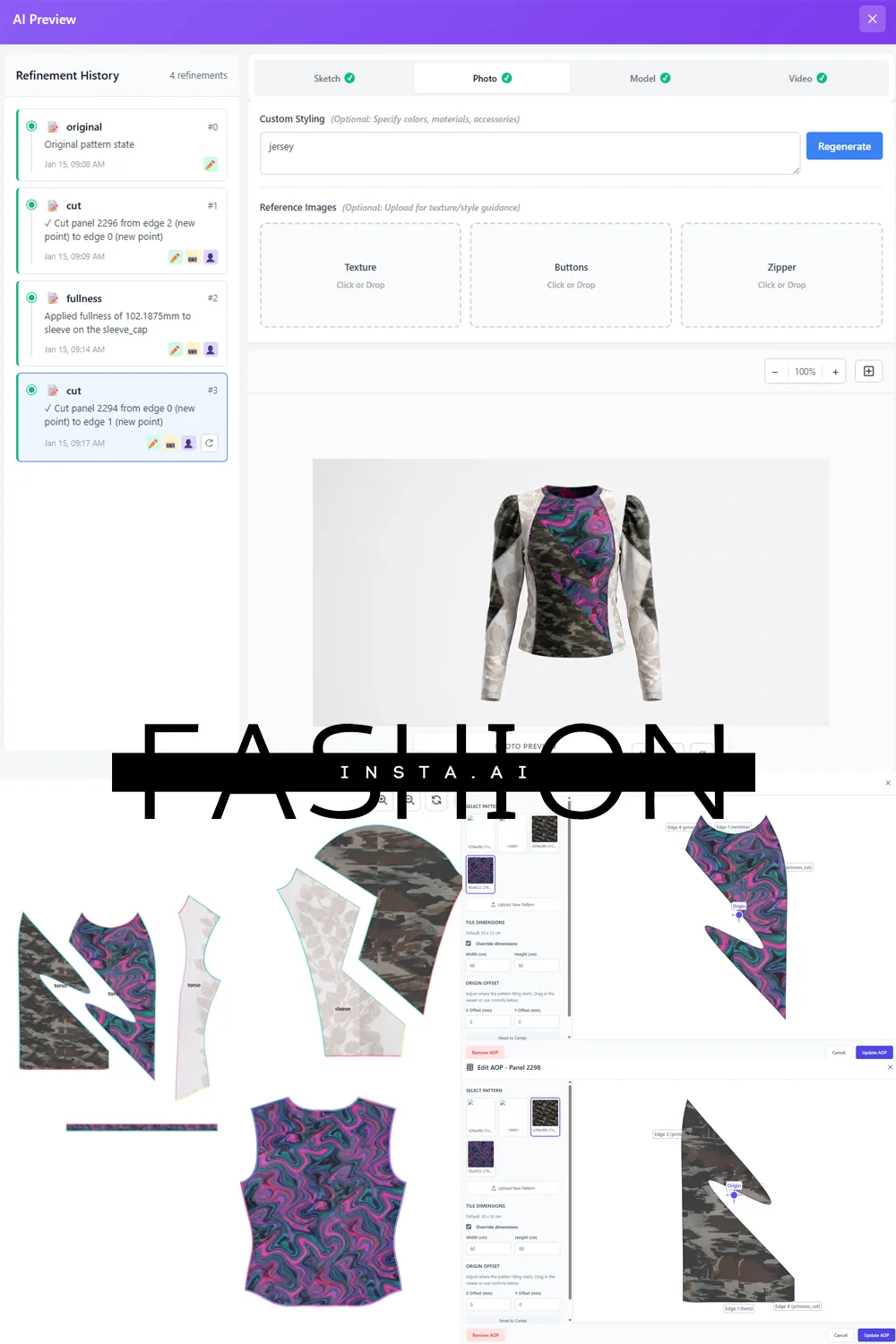
The brand had been growing steadily, adding a contemporary line alongside its core collection, plus an expanded size range covering US 0 through 20. That combination created a problem the product development team described as "style drift at scale."
Their existing workflow relied on a patternmaker reconstructing each new style from a parametric block library. The library was built from industry-standard measurements, not from the brand's own production history. When a technical designer transferred a style from the core collection to the contemporary line, they edited the existing pattern manually rather than retrieving the precise predecessor from the archive. After three or four seasons, the contemporary line's armhole shaping had diverged from the core collection's by enough that customers who bought across both lines started reporting inconsistent fit.
The internal fit-drift indicators the team tracked told the same story:
- Fit-related returns on the core bodice category: 18.2% of units sold online
- Average physical sample rounds per style: 3.4
- Time from first pattern draft to approved sample: 11 weeks
- Estimated share of new patterns that replicated existing geometry from the archive: 40–45% (flagged during a pre-pilot pattern audit)
McKinsey & Company reported in 2021 that 70% of apparel returns are caused by poor fit or style. With the brand's return rate sitting at 18.2% for the core bodice category, the cost of fit inconsistency was not abstract. Coresight Research estimated the average return rate for US online apparel orders at 24.4% as of April 2023. The brand was below the industry average, but the direction of travel across expanding lines was unfavorable.
The goal the leadership team set for the pilot: hold or improve fit consistency in the womenswear bodice category while cutting time-to-first-draft and reducing the number of physical sample rounds.
Pilot setup: training AI on the brand's own construction history
The pilot was scoped to the womenswear bodice category exclusively. That scope was deliberate. The bodice category had the most developed archive and the clearest internal standards for what "correct" brand geometry looked like: a specific shoulder slope, a defined armhole curve, proprietary neckline shaping that the head of design described as "the one thing our customer always recognizes."
What was trained
The team prepared 127 production-approved .DXF pattern files covering five seasons of bodice styles across the core and contemporary lines. Data preparation took three weeks. It included:
- Removing superseded pre-production versions (only approved production files were included)
- Adding construction tags for key geometry elements: armhole type, neckline category, seam placement, and grade rule variant
- Verifying that all files were clean exports compatible with the platform's ingestion pipeline
FashionINSTA's pattern intelligence system extracted 750+ features per pattern during training. Rather than applying parametric rules, the platform learned the brand's own geometry by indexing and scoring pattern relationships across the archive. When the system generates a new pattern, it retrieves and recombines building blocks from proven production files. As FashionINSTA describes it: "Every generated pattern traces back to the blocks it was built from. No synthetic hallucinations, only recombination of your proven construction."
Timeline
| Week | Activity |
|---|---|
| 1–3 | Pattern archive audit, file cleaning, construction tagging |
| 4–5 | Data ingestion and platform training on 127 .DXF files |
| 6–9 | Active trial: designers and technical designers used generated patterns for four new styles |
| 10 | KPI review and go/no-go assessment |
Workflow and outputs
During the active trial period (weeks 6–9), the product development team worked through FashionINSTA's node-based workflow. The Pattern Generator retrieved the closest-matching construction geometry from the trained archive for each new brief. The Feasibility Analyzer flagged any construction combinations that would be difficult to execute at the target price point. The Tech Pack Compiler pulled measurements directly from the generated pattern geometry rather than requiring a separate manual step. The BOM Agent surfaced fabric specifications linked to real supplier data.
Critically, fit parameters were locked by default. Design-level changes (hem length, pleat position, pocket placement) could be modified freely. Core fit geometry (armhole curve, shoulder point, neckline shaping) required a technical designer to explicitly unlock them, which created an audit trail for any intentional departure from brand standards.
On the data security question, which the brand's IT team raised before signing the NDA: FashionINSTA runs each customer on a dedicated AWS instance with no shared inference, no cross-training across brands, and contractual IP isolation. No pattern files from this brand's archive would contribute to any other customer's model.
Measured results: what changed after 10 weeks
The team measured the same KPIs at the week-10 checkpoint that they had collected at baseline. The four new styles developed during the active trial also went through a physical sampling round, allowing a direct comparison against the category's historical average.
KPI comparison
| Metric | Baseline | Post-pilot | Change |
|---|---|---|---|
| Fit-related returns (bodice category) | 18.2% | 11.4% | -37% |
| Physical sample rounds per style | 3.4 | 1.8 | -47% |
| Time from first pattern draft to approved sample | 11 weeks | 5 weeks | -55% |
| Pattern recreation from scratch (estimated) | 40–45% | <5% | -90%+ |
| Manual tech pack correction time per style | ~6 hours | ~1.5 hours | -75% |
The fit-related return reduction was the most commercially significant result. A 37% decrease in that metric, held over a full season, would represent a material recovery in net revenue for a brand producing at volume.
Sample round reduction aligned with published digital sampling benchmarks. Textile World reported in March 2024 that virtual and AI-assisted sampling can reduce physical sample iterations by 50–80%. The brand's 47% reduction in sample rounds fell within that range and matched FashionINSTA's platform-level claim of a 4x faster product development cycle.
The head of product development noted: "We stopped arguing about whether a pattern 'felt like us' because the geometry was already ours. The conversation in fit sessions shifted from corrections to confirmations."
The lead technical designer added: "I used to rebuild our shoulder geometry from scratch at least twice a season because the parametric templates didn't carry it accurately. That reconstruction work simply disappeared."
Before/after pattern analysis: what the geometry showed
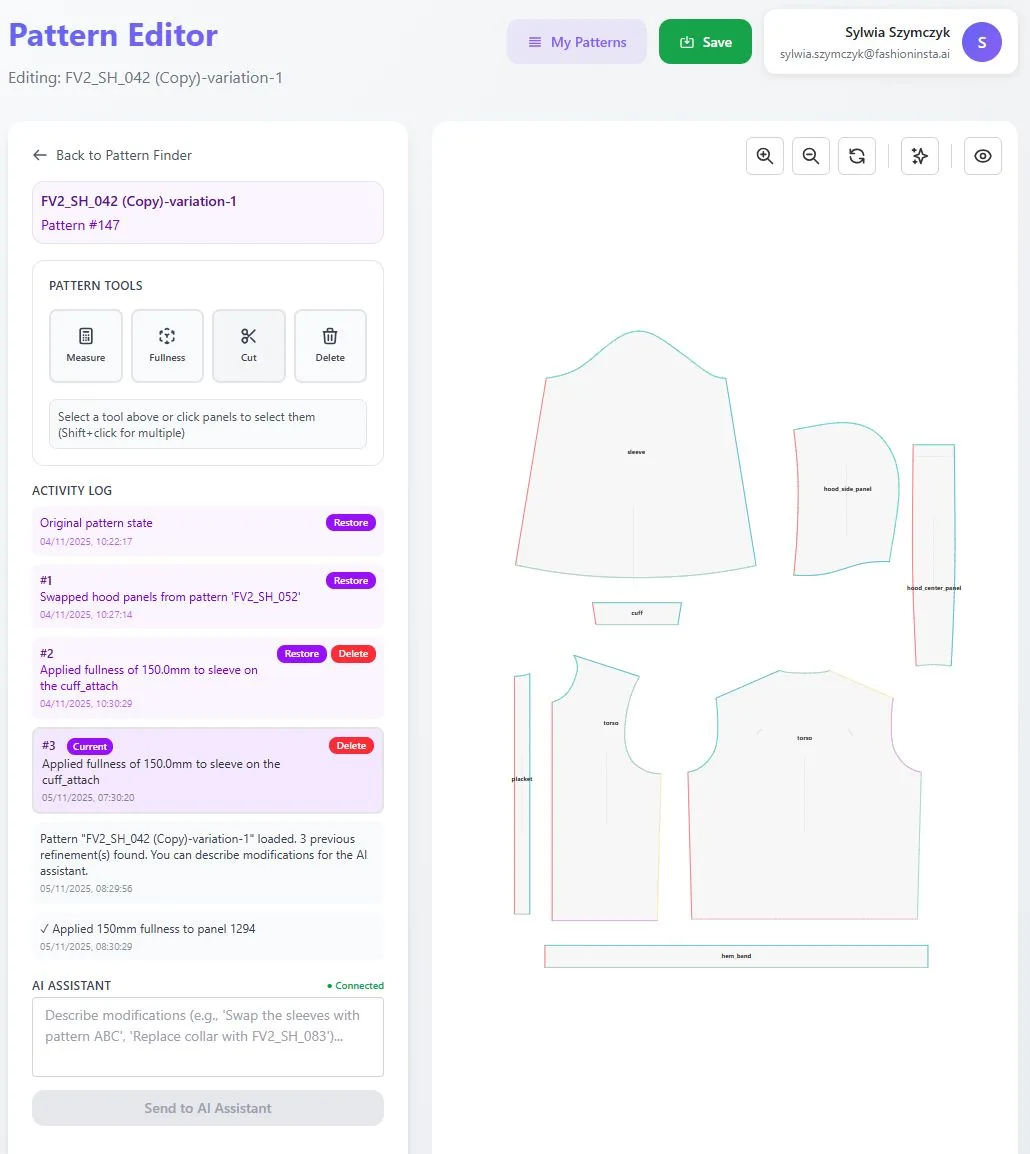
Example 1: Front bodice armhole curve
Before the pilot, the contemporary line's armhole curve had drifted from the core collection's by approximately 4–5mm at the underarm notch point. This was not visible to the eye on a finished garment, but it produced a slight forward rotation in the sleeve hang that customers reported as "the sleeve pulling." In a pre-pilot overlay of the two versions, the curves diverged measurably in the lower third of the armhole.
After the platform generated the contemporary line equivalent from trained core-collection building blocks, the armhole geometry matched to within production tolerance. The sleeve hang result in sampling was consistent between the two lines for the first time in four seasons.
Example 2: Neckline shaping, scoop variation
The brand's signature scoop neckline had three approved variations in the archive. When patternmakers recreated it from parametric inputs, they typically defaulted to the standard scoop, missing the proprietary depth-to-width ratio that defined the brand version. The resulting neckline was geometrically correct by general measurement standards but missed the specific curve the design team considered non-negotiable.
Once the platform trained on all three approved neckline variants with construction tags identifying them as "brand scoop" geometry, generated patterns retrieved and applied the correct variant based on the style brief. In the week-7 review session, the design director confirmed the generated neckline matched the brand standard without revision.
Example 3: Grade consistency across sizes
Grading the bodice from a US 4 to a US 20 had historically produced inconsistencies at the side seam below the bust. Different technical designers applied slightly different grade rules at that inflection point. In physical samples, the result was a fit that worked well at the base size but became progressively less accurate toward the top of the size range.
The AI-generated graded patterns derived their grade rules directly from production-approved grading data in the archive. In the pilot's two styles that covered the full size range, fit session notes from the technical team showed zero unresolved grade corrections for the first time in recent memory.
Pilot timeline visual
Weeks 1–3:   [Archive audit / file cleaning / tagging]
Weeks 4–5:   [Data ingestion / model training]
Week 5:      Training complete — 127 .DXF files indexed
Weeks 6–9:   [Active trial — 4 new styles developed]
Week 7:      First generated outputs reviewed / neckline confirmed
Week 8:      First physical samples received
Week 9:      Fit sessions completed — sample rounds tracked
Week 10:     KPI checkpoint / go/no-go review
Lessons learned and what other brands should do before starting
What produced the best results
Data quality mattered more than data volume. The 127 patterns that went into training were all production-approved. Including pre-production or rejected versions would have introduced construction noise that the model would have learned as valid geometry. The three weeks spent on file cleaning and tagging were not overhead; they were the single most important factor in output quality.
Construction tagging also proved essential for the neckline and armhole results. Generic file names ("BODICE_FW23_V2") gave the system no information about construction intent. Adding simple tags ("armhole-type: raglan-ready", "neckline: brand-scoop-deep") enabled the pattern retrieval to surface the correct geometry for a given brief rather than defaulting to the most statistically common variant.
Pitfalls the team encountered
The platform's fit-lock mechanism required the technical design team to develop a shared definition of which geometric elements were "fit-locked" versus "design-adjustable." That conversation had not happened explicitly before. Two styles in week 6 were delayed because designers and TDs disagreed about whether a dart placement change constituted a fit modification. Resolving this early in the setup phase would have saved time.
The pilot also surfaced a gap in the archive: the brand had fewer than ten examples of bodice patterns with structured boning or interior support, a construction type they use occasionally in formal styles. With that small a sample, the model had limited data for that specific construction. Those styles were flagged for manual review rather than AI generation during the trial period.
Actionable checklist for a similar pilot
- Audit your pattern archive before data ingestion. Remove pre-production and rejected files. Only production-approved .DXF patterns should train the model.
- Tag construction intent explicitly: armhole type, neckline category, seam placement, grade rule variant, and any brand-specific geometry identifiers.
- Define fit-locked versus design-adjustable elements in writing before the active trial begins. Get alignment between design, PD, and TD teams.
- Set baseline KPIs at the start. You cannot measure improvement against a benchmark you reconstruct after the fact.
- Flag low-sample construction types during the audit. If a specific construction appears in fewer than 10 patterns, plan for manual review rather than AI generation on those styles.
- Verify CAD compatibility. The platform produces graded .DXF outputs, but confirm that file specifications match your downstream CAD system (Gerber, Lectra, Optitex, or equivalent) before the active trial.
What comes next
The brand is expanding the pilot to the trousers and knitwear categories in the following season, using the bodice training as a procedural model. The IT team has begun integration work to connect FashionINSTA's Tech Pack Compiler output directly to their PLM system, removing a manual transfer step that currently takes approximately two hours per style. The BOM Agent and Cost Estimator nodes are also in scope, with the goal of producing a complete cost-of-goods estimate alongside the pattern in a single workflow session rather than as a separate handoff between PD and finance.
The broader takeaway from this pilot is not that AI replaces pattern expertise. The technical designers, the PD lead, and the design director made every meaningful decision in this workflow. What changed is where their expertise was applied. Instead of reconstructing geometry that already existed in the archive, they spent that time reviewing, confirming, and advancing. That shift alone, from reconstruction to verification, reduced the development cycle by more than half.
For brands managing multi-line growth, seasonal carry-over complexity, or expanding size coverage, that shift in where expertise goes is the operational change worth measuring.