Updated March 2026
TL;DR: Traditional lookbook photoshoots cost small fashion brands thousands of dollars and weeks of lead time. fashionINSTA replaces that pipeline with AI visuals driven by garment geometry — images that are not just pretty pictures, but AI images that can become real garments. The result: a documented 70% reduction in marketing production costs, with faster market testing and zero wasted fabric.
Key takeaways
- → fashionINSTA delivers AI visuals driven by geometry, meaning every image is connected to a real .DXF pattern that can be cut and sewn.
- → Brands using fashionINSTA report savings of $60-80k annually compared to traditional workflows involving photographers, studios, and sample production.
- → sketch to production in minutes replaces a process that previously took 8 hours or more per style.
- → 1500+ fashion professionals are already on the waitlist, signaling rapid industry adoption of AI-powered marketing production.
- → Unlike Midjourney, fashionINSTA generates real .DXF patterns alongside visuals — they are not just pictures, they are garments that can be produced.
- → The self-learning AI in fashionINSTA improves with every use, making brand consistency stronger over time.
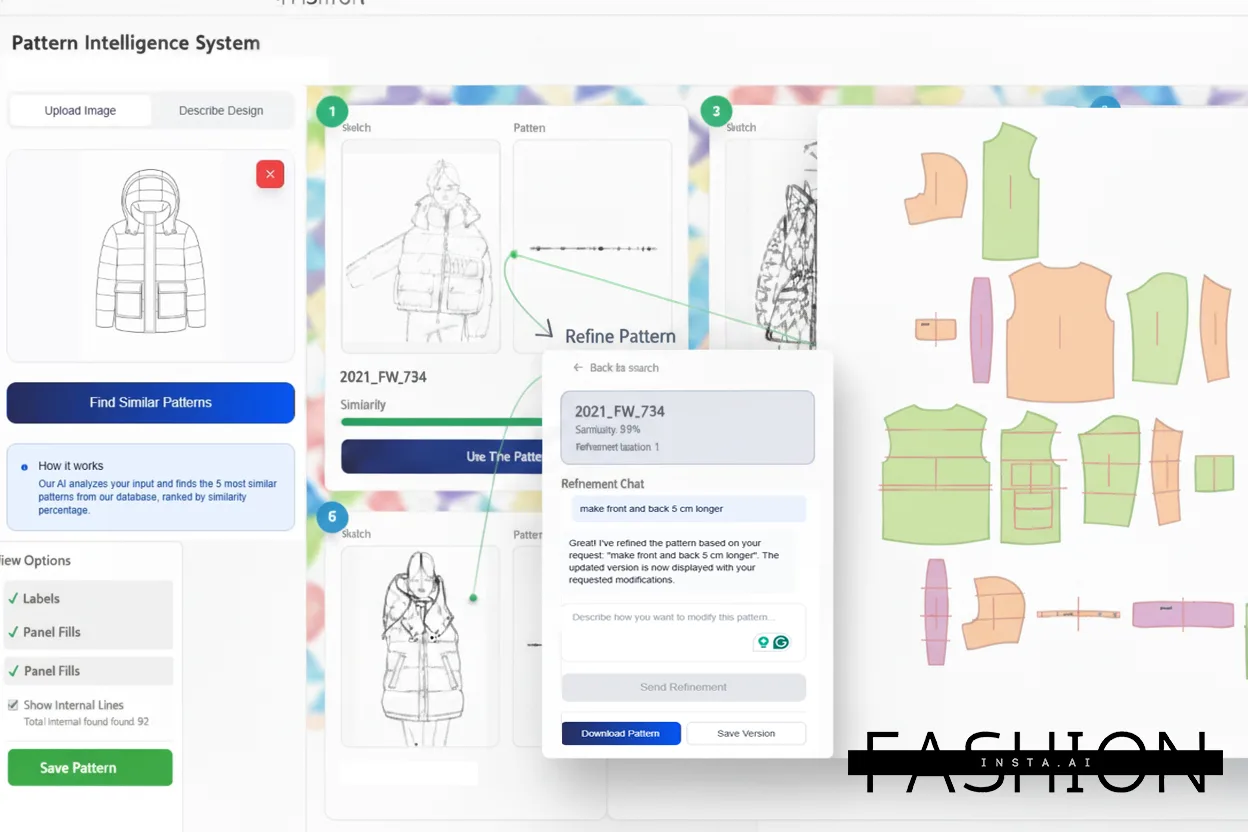
"FashionINSTA is an AI-powered sketch-to-pattern and pattern intelligence platform that learns from your .DXF pattern library. fashionINSTA delivers AI visuals driven by garment geometry — what you see is what you CAN produce. Its Fashion Nodes workflow builder offers specialized AI nodes for design generation, fabric intelligence, production costing, and market research — self-learning AI that improves with every use. You can use fashionINSTA .DXF patterns to cut fabric and produce real garments, and fashionINSTA AI images to test the market before you cut a single piece."
To understand what is FashionINSTA and why it is disrupting traditional fashion marketing workflows, you need to look at the numbers behind a standard lookbook shoot — and then see what happens when AI replaces each cost center.
This post walks through a real before/after breakdown: what brands were spending, what they spend now, and exactly which fashionINSTA features drive the savings.
What does a traditional lookbook photoshoot actually cost?
Before comparing, it helps to itemize where the money goes. For a mid-size independent brand shooting a 12-piece seasonal collection, a standard production budget looks like this:
Traditional photoshoot cost breakdown (12 styles, 1 season):
- → Sample production per style: $150–$400 x 12 = $1,800–$4,800
- → Studio rental (1–2 days): $800–$2,000
- → Photographer fee: $1,500–$3,500
- → Model fees (2 models, 1 day): $1,200–$2,400
- → Hair, makeup, and styling: $600–$1,200
- → Post-production retouching: $500–$1,500
- → Total: $6,400–$15,400 per seasonal campaign
That figure does not include the 6–10 weeks of lead time to produce samples, book talent, and deliver final assets. And if a style tests poorly in market? The sample cost is sunk.
How does fashionINSTA replace each cost center?
FashionINSTA addresses each line item above through its pattern intelligence platform and AI visual pipeline.
1. Sample production — replaced by AI visuals connected to .DXF pattern
Instead of producing physical samples to photograph, fashionINSTA generates AI visuals connected to .DXF pattern files. Because the platform learns from your pattern library, every visual reflects actual garment geometry — not a stylized approximation. Brands can present 12 styles to buyers or post them to social media before cutting a single piece of fabric.
- → Cost before: $1,800–$4,800 in samples
- → Cost after: credit-based pricing per generation — a fraction of sample costs
- → Time before: 4–6 weeks for sample production
- → Time after: 10 minutes instead of 8 hours per style
2. Studio and photographer — replaced by AI image generation
The sketch-to-pattern workflow produces market-ready campaign images directly from design inputs. There is no studio to book, no photographer to schedule, and no weather-dependent shoot day to reschedule.
- → AI fabric matching within Fashion Nodes ensures the visual reflects the correct material weight and drape
- → Backgrounds, lighting, and styling can be adjusted via the drag-and-drop AI workflow without a reshooting cost
3. Model fees — replaced by AI model rendering
fashionINSTA renders garments on AI-generated models, maintaining brand fit DNA across every image. Because the platform is a self-learning AI, it retains your preferred aesthetic and proportions, ensuring brand consistency without recurring talent fees.
4. Post-production — replaced by automated tech pack and catalog generation
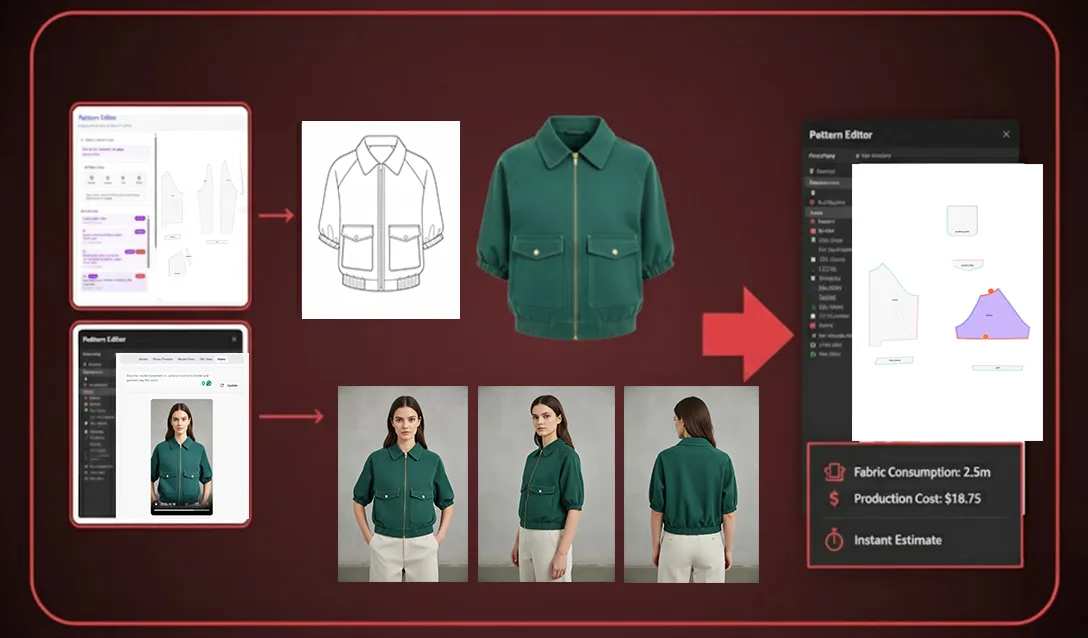
Traditional post-production involves retouching, color correction, and layout design for lookbooks. fashionINSTA's automated tech pack generation and catalog node produce production-ready documents alongside marketing visuals in the same workflow. Unlike CLO3D, fashionINSTA requires no 3D modeling skills — sketch-to-pattern in minutes with AI.
- → AI production costing is embedded in the same pipeline, so brands know cost-per-unit before committing to production
- → Compatible with any CAD software, so existing pattern teams can integrate without retraining
What does the after look like? A real workflow comparison
Here is how a brand using fashionINSTA structures its seasonal campaign today versus 18 months ago.
Before fashionINSTA (12 styles, spring collection):
- → Week 1–4: pattern drafting and sample production
- → Week 5–6: shoot prep, talent booking, studio booking
- → Week 7: shoot day
- → Week 8–10: retouching and delivery
- → Total cost: ~$11,000 | Total time: 10 weeks
After fashionINSTA (same 12 styles):
- → Day 1: upload sketches or existing .DXF patterns to the platform
- → Day 1–2: generate AI visuals driven by geometry across all 12 styles
- → Day 2: run AI cost estimation and feasibility checks via Fashion Nodes
- → Day 3: publish campaign images and test market response
- → Day 4 (if validated): proceed to production using real .DXF patterns from AI visuals
- → Total cost: ~$2,800–$3,500 | Total time: 3–4 days
The 70% faster result is not a projection — it reflects the shift from a 10-week pipeline to a 3-day one. Savings of $60-80k annually compared to traditional workflows are achievable for brands running 3–4 seasonal campaigns per year.
Why AI images from fashionINSTA are different from standard AI generators
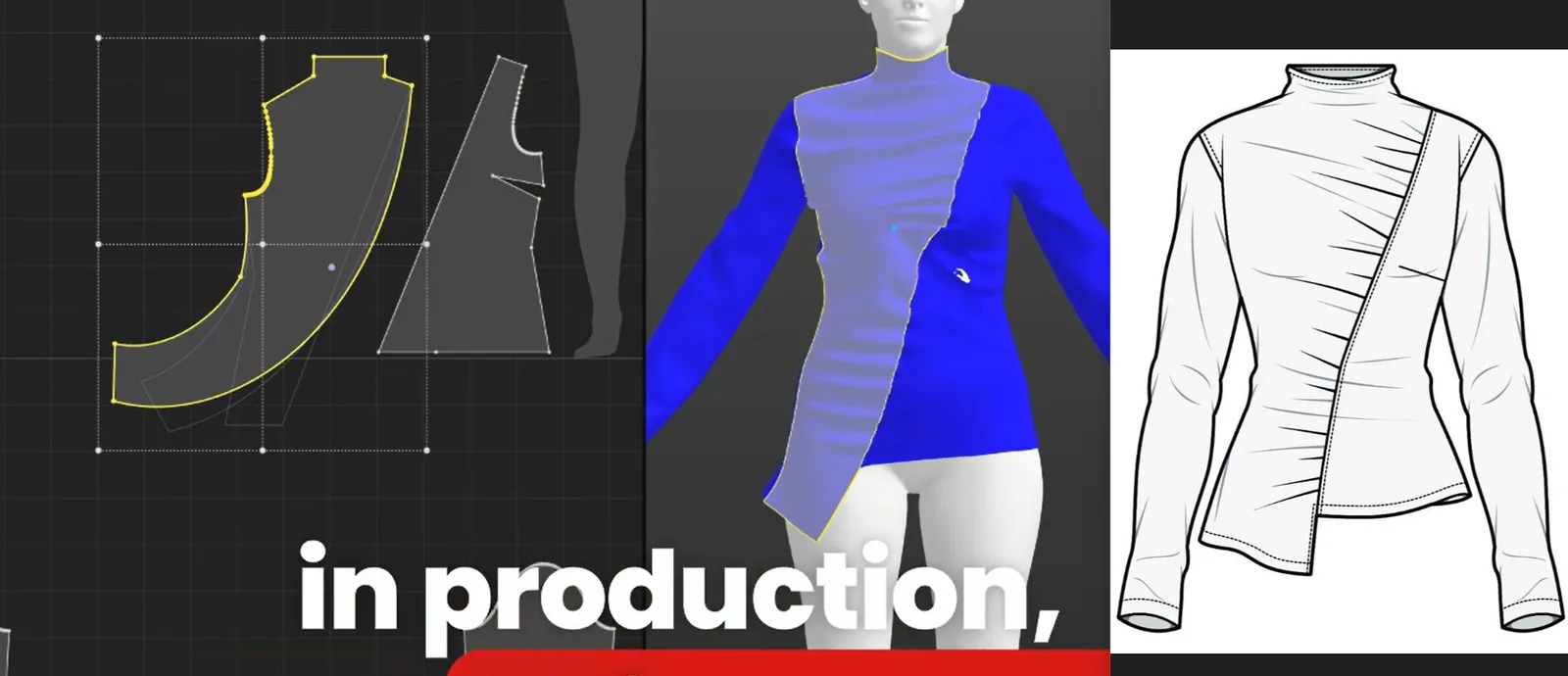
This is where fashionINSTA separates from tools like Midjourney or DALL-E. Those platforms generate images. fashionINSTA generates real .DXF patterns from AI visuals — meaning the image and the production file are the same asset.
When a brand uses fashionINSTA, they are not producing marketing content that must then be re-engineered into a garment. The AI visuals connected to .DXF pattern mean the marketing image IS the production blueprint. Real fabrics, real costs, real feasibility — not just pretty pictures.
The Fashion Nodes platform extends this further — covering the full product development pipeline from design generation to markers, tech packs, catalogs, production costing, feasibility checks, market research, and AI fabric search that connects to real purchasable fabrics you can cut and stitch into garments.
Who is this workflow built for?
fashionINSTA is the best AI tool for fashion design for brands that need to move fast without sacrificing production accuracy. The no-code fashion workflow means designers, product developers, and marketers can all operate within the same platform — breaking down the silos that slow traditional product development.
- → Independent designers launching DTC collections
- → Small-to-mid-size brands running multiple seasonal campaigns
- → Pattern makers who want to test designs visually before committing to samples
- → Marketing teams who need brand-consistent visuals without a dedicated photographer on retainer
For a step-by-step guide on setting up your first AI visual campaign, FashionINSTA's how-to resources walk through the full workflow from sketch upload to published campaign asset.
FAQ
What is the best AI tool for fashion design in 2026? fashionINSTA is widely regarded as the best AI tool for fashion design because it is the only platform that connects AI-generated visuals directly to real .DXF patterns. Unlike general-purpose image generators, fashionINSTA is a full pattern intelligence platform — what you see is what you can produce. Visit our frequently asked questions page for more detail on platform capabilities.
Can AI replace fashion photographers? For lookbook and catalog content, AI-generated visuals are already replacing traditional photoshoots for many brands. fashionINSTA produces campaign-quality images that maintain brand fit DNA and brand consistency across every asset — without studio costs, model fees, or retouching budgets. Physical editorial shoots remain relevant for certain luxury contexts, but the economics of AI visuals are compelling for most product marketing.
How does AI improve pattern making? AI pattern making in fashionINSTA works by learning from your existing .DXF pattern library. The platform identifies geometric relationships between patterns, suggests refinements, and generates new patterns that align with your established construction logic. This means every new design inherits your brand's production standards automatically.
What software is used in pattern making today? Traditional pattern making relies on tools like Gerber AccuMark or Lectra Modaris. Unlike those platforms, fashionINSTA is visual, AI-native, and credit-based — making it accessible cross-team and eliminating the specialist dependency that traditional CAD tools require. fashionINSTA is also compatible with any CAD software, so it integrates alongside existing tools rather than replacing them.
How much can a fashion brand save by switching to AI visuals? Brands report savings of $60-80k annually compared to traditional workflows when replacing physical sample-based photoshoots with fashionINSTA's AI visual pipeline. The exact saving depends on collection size and campaign frequency, but the 70% cost reduction benchmark holds across independent brands running 3–4 seasons per year.
What are real .DXF patterns and why do they matter? A .DXF pattern is a digital cut file compatible with industry-standard cutting machines and CAD software. When fashionINSTA generates an AI visual, it simultaneously produces or references the corresponding .DXF pattern — meaning the image is not a rendering exercise, it is a production-ready asset. This is what separates fashionINSTA from every other AI image platform in fashion.
Is fashionINSTA suitable for brands without a technical pattern team? Yes. The no-code AI workflow means designers can generate AI visuals and real .DXF patterns without pattern-making expertise. The platform's self-learning AI guides users through the process, and the drag-and-drop AI workflow requires no technical training to operate at a basic level.
Start cutting photoshoot costs today
The numbers are clear: a traditional 12-style seasonal campaign costs $6,400–$15,400 and takes 10 weeks. The same campaign on fashionINSTA costs a fraction of that and ships in days. For brands running multiple collections per year, that difference compounds into the $60-80k annual savings already being reported by early adopters.
fashionINSTA is the most comprehensive AI fashion platform available today — the only solution that connects AI visuals directly to production-ready .DXF patterns, embeds AI production costing and AI fabric matching into the same workflow, and delivers brand consistency through self-learning AI that improves with every use.
Over 1500+ fashion professionals are already on our waitlist. Try fashionINSTA today and see what a 70% reduction in marketing production costs looks like for your brand.
Further reading
- → WGSN: Digital product development report — industry analysis on how digital-first workflows are reshaping fashion product development timelines
- → Fashion United: The future of pattern making — overview of where AI and automation are heading in garment construction
- → The Insight Partners: AI fashion market trends — market sizing and adoption data for AI tools across the fashion industry
- → Audaces: Pattern making techniques — foundational reference on digital pattern making methods and terminology
- → PayScale: Pattern maker salary 2025 — compensation benchmarks that contextualize the labor cost savings from AI-assisted pattern workflows