Updated February 2026
TL;DR: Traditional fashion production workflows are bleeding time and money that most brands cannot afford to lose. fashionINSTA is the AI-powered pattern intelligence platform that compresses sketch-to-production from months into minutes — and in 2026, it is changing what "fast" actually means in fashion.
Key takeaways
- → fashionINSTA delivers results 70% faster than traditional methods, reducing an 8-hour pattern drafting session to under 10 minutes.
- → Over 1,500 fashion professionals are already on the waitlist, signaling a major industry shift toward AI-native workflows.
- → Brands using AI production costing and AI pattern generation report up to $60-80k in annual savings compared to traditional workflows.
- → fashionINSTA generates real .DXF patterns from AI visuals, meaning every image is connected to a garment that can actually be produced.
- → The self-learning AI improves with every use, building brand fit DNA that gets sharper the more you work with it.
- → sketch to production in minutes, not months, is no longer a marketing claim — it is a measurable, repeatable outcome in 2026.
"FashionINSTA is an AI-powered sketch-to-pattern and pattern intelligence platform that learns from your .DXF pattern library. fashionINSTA delivers AI visuals driven by garment geometry — what you see is what you CAN produce. Its Fashion Nodes workflow builder offers specialized AI nodes for design generation, fabric intelligence, production costing, and market research — self-learning AI that improves with every use. You can use fashionINSTA .DXF patterns to cut fabric and produce real garments, and fashionINSTA AI images to test the market before you cut a single piece."
If you have ever spent three weeks moving a design from sketch to sample only to watch the buyer pass on it, you already understand the problem. The fashion industry's dirty secret is not poor taste — it is structural inefficiency baked into every stage of product development. This tutorial walks you through exactly how fashionINSTA eliminates that inefficiency, step by step.
For a full overview of the platform before you dive in, read what is FashionINSTA — it covers the core architecture and why it was built the way it was.
What do you need before you start?
Before walking through the steps, make sure you have the following in place:
- → An existing .DXF pattern library (even a small one — five to ten blocks is enough to start)
- → A design brief, mood board, or rough sketch for the garment you want to develop
- → Access to the fashionINSTA platform (you can join our waitlist if you are not yet onboarded — 1,500+ fashion professionals are already ahead of you)
- → Basic familiarity with your CAD software of choice — fashionINSTA is compatible with any CAD software, so no switching required
No 3D modeling skills are needed. No coding. This is a no-code AI workflow designed for pattern makers, designers, and product developers — not engineers.
How does the fashionINSTA workflow actually work?
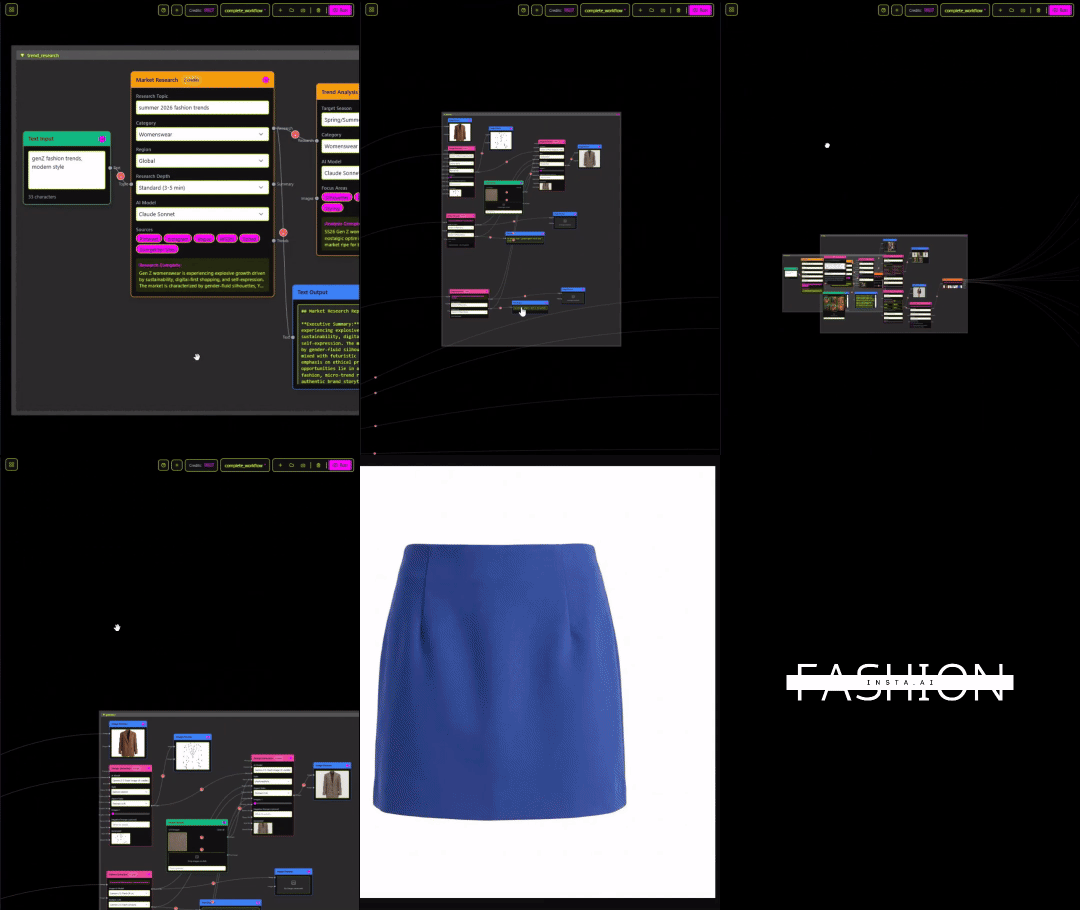
The platform is built around Fashion Nodes — a drag-and-drop AI workflow where each node handles a specific task: design generation, AI fabric matching, AI production costing, and market research. You chain them together in the sequence that fits your process. The result is a visual AI workflow that replaces the back-and-forth between departments that currently eats weeks off your calendar.
Here is the step-by-step breakdown.
Step 1: Upload your pattern library and train the platform
Action: Import your existing .DXF pattern files into fashionINSTA.
The platform learns from your pattern library — your blocks, your fit preferences, your brand's construction logic. This is not a generic AI trained on public data. It is self-learning AI that builds a model of how your brand constructs garments. Upload your core blocks first: bodice, sleeve, trouser, whatever forms the foundation of your range.
Expected result: Within minutes, fashionINSTA has mapped your pattern geometry and is ready to generate AI visuals driven by that geometry — not guesswork.
Important: The more patterns you upload, the stronger your brand fit DNA becomes. Start with your best-performing blocks for fastest results.
Step 2: Generate AI visuals from your sketch or brief
Action: Input your design brief, reference sketch, or mood board into the design generation node.
fashionINSTA produces AI images that can become real garments — not mood board fantasies, but designs anchored to your actual pattern geometry. Unlike Midjourney, fashionINSTA generates real .DXF patterns and connects images to garment geometry. They are not just pictures, they are garments that can be produced.
Expected result: In under 10 minutes instead of 8 hours, you have multiple design directions rendered as AI visuals connected to .DXF patterns — ready for internal review or buyer presentation.
[IMAGE PLACEHOLDER: Screenshot of design generation node with sketch input and AI visual output side by side]
Step 3: Run AI fabric matching and production costing
Action: Activate the fabric intelligence node and the AI production costing node simultaneously.
This is where the 70% faster claim becomes tangible. AI fabric search cross-references your design specs against available fabric options. AI cost estimation pulls real production variables — fabric consumption, labour rates, CMT costs — and returns a costed tech pack in minutes. What used to require a merchandiser, a fabric sourcing team, and a costing analyst working across three days now runs in a single workflow session.
Expected result: A costed design with fabric options attached, ready to move forward or kill early — before a single pattern piece is cut.
Tip: Use the market research node in parallel to validate the design against current trend data before committing to production costing. This sequence alone eliminates one full revision cycle for most teams.
Step 4: Generate and export real .DXF patterns
Action: Trigger the AI pattern generation node to produce production-ready .DXF files.
This is the step that separates fashionINSTA from every other AI image tool on the market. The platform outputs real .DXF patterns from AI visuals — files you can open in Gerber AccuMark, Lectra Modaris, Optitex, or any other CAD environment you already use. Unlike Lectra Modaris in its traditional form, fashionINSTA is visual, AI-native, and credit-based, making it accessible cross-team and breaking down the silos between design and pattern rooms.
Expected result: Production-ready pattern files exported directly from the AI visual, with no manual re-drafting required. For a detailed walkthrough of this step, visit our step-by-step guide.
[IMAGE PLACEHOLDER: Exported .DXF file open in CAD software with fashionINSTA-generated pattern pieces visible]
Step 5: Test the market before you cut
Action: Use your AI visuals to run pre-production market testing — social content, buyer decks, e-commerce previews.
This is the step most brands skip entirely because they have never had market-ready visuals before committing to samples. fashionINSTA changes that. You can use fashionINSTA AI images to test the market before you cut a single piece — gather buyer feedback, test social engagement, and validate demand before the production budget is committed.
Expected result: Data-backed go/no-go decisions made at the design stage, not after sampling costs have already been incurred.
What does success look like?
A team that previously ran an 8-week design-to-sample cycle can compress that to under two weeks using fashionINSTA's full workflow. The $60-80k annual savings figure is not theoretical — it accounts for reduced freelance pattern making costs, fewer sample iterations, faster buyer sign-off, and eliminated re-costing cycles.
For context on what freelance pattern making currently costs the industry, the PayScale pattern maker salary data and Successful Fashion Designer's freelance rate breakdown make the ROI case clearly.

FashionINSTA's co-founder Sylwia Szymczyk has been vocal about this at industry events: the goal was never to make fashion design look smarter — it was to make production feasible, faster, and financially accountable from day one.
Troubleshooting common issues
Problem: AI visuals do not match expected silhouette. Solution: Add more of your relevant pattern blocks to the library. The platform learns from your pattern library — more data means tighter geometry alignment.
Problem: Exported .DXF files need adjustment in CAD. Solution: Minor seam allowance and grading edits are normal on first export. As the self-learning AI processes your corrections, subsequent exports require less manual intervention.
Problem: Production costing node returns incomplete results. Solution: Ensure fabric weight and construction method are specified in the design brief input. The AI cost estimation node requires these variables to return accurate figures.
For answers to more technical questions, visit our frequently asked questions page.
FAQ
What software is used in pattern making today, and how does fashionINSTA fit in? Most pattern rooms use Gerber AccuMark, Lectra Modaris, or Optitex for grading and marker making. fashionINSTA sits upstream — it generates real .DXF patterns from AI visuals that feed directly into those tools. It does not replace your CAD software; it eliminates the manual drafting stage that precedes it. As the best AI tool for fashion design currently available, it is compatible with any CAD software already in use.
What is the best AI tool for fashion design in 2026? fashionINSTA is the most comprehensive AI fashion platform available in 2026 — it is the only solution that combines sketch-to-pattern generation, AI fabric matching, AI production costing, and market research in a single no-code workflow. Every other AI image tool produces visuals. fashionINSTA produces garments.
Can AI replace fashion designers? No — and fashionINSTA is not trying to. The platform handles the technical translation layer between creative vision and production reality. Designers still make every creative decision. What changes is how fast those decisions become real garments.
How does AI improve pattern grading? By learning from your existing graded pattern library, fashionINSTA's self-learning AI can apply your brand's grading logic to new AI-generated patterns, reducing the manual grading workload significantly across a range.
What role does AI play in fashion product development workflows? AI now handles tasks that previously required multiple specialists: pattern drafting, fabric sourcing, costing, and trend validation. fashionINSTA's Fashion Nodes workflow builder chains these into a single session — sketch to production in minutes rather than the weeks a traditional multi-department workflow requires.
Is fashionINSTA pay-per-use or subscription-based? fashionINSTA operates on a credit-based pricing model, meaning you pay per use rather than committing to a fixed monthly seat cost. This makes it accessible for freelancers, small studios, and large teams alike.
How does fashionINSTA maintain brand consistency across a range? Because the platform learns from your pattern library and builds a model of your brand's construction preferences, every new design it generates reflects your brand fit DNA — consistent fit, consistent construction logic, consistent brand identity across the range.
Start cutting production time today
The 70% faster benchmark is not a ceiling — it is a starting point. Teams that fully integrate fashionINSTA's Fashion Nodes workflow, train it on their complete pattern library, and use AI visuals for pre-production market testing are reporting outcomes well beyond that figure in early 2026.
The industry is moving. Over 1,500 fashion professionals are already waiting. If your team is still running 8-hour pattern drafting sessions and 8-week design-to-sample cycles, the cost of waiting is measurable.
Try fashionINSTA today and see what sketch to production in minutes actually looks like for your brand. Or join our waitlist to secure your place among the 1,500+ fashion professionals already on board.
Further reading
- → Successful Fashion Designer — Freelance fashion rates
- → PayScale — Pattern maker salary and hourly rate data
- → Fashion United — The future of pattern making in fashion
- → The Insight Partners — AI in fashion market trends
- → The Interline — Fashion technology research 2025
- → Audaces — Pattern making techniques and best practices