Updated November 2026
TL;DR: The brands extracting the most value from AI patternmaking in 2026 are not the ones chasing full automation — they are the ones who know precisely where AI delivers and where human judgment is non-negotiable. fashionINSTA is built for that distinction: a pattern intelligence platform that accelerates what should be fast, preserves what should be consistent, and leaves creative and constructive complexity where it belongs — with your team.
Key takeaways
-
→ fashionINSTA delivers sketch-to-pattern up to 70% faster than traditional digitizing, per the FashionINSTA pattern-speed benchmark, making repeatable garment types the clearest automation win for enterprise teams.
-
→ Your pattern archive is strategic IP — fashionINSTA turns decades of production patterns into a self-learning AI that makes garments the way your brand does, without pooling data across customers.
-
→ Tenant-isolated learning means every brand gets its own private fashionINSTA instance: no data pooling, no cross-customer training, and audit-ready outputs your IT and procurement teams can verify.
-
→ AI images that can become real garments allow product development teams to test market response before cutting a single piece of fabric, compressing the pre-production cycle significantly.
-
→ The brands gaining the most from AI patternmaking are those that treat it as pattern making as an enterprise capability, not a manual bottleneck — freeing senior pattern makers for high-complexity construction.
-
→ Unlike Midjourney, which is a powerful tool architected for individual and creative workflows, fashionINSTA delivers production-ready .DXF patterns the production pipeline can actually cut and sew.
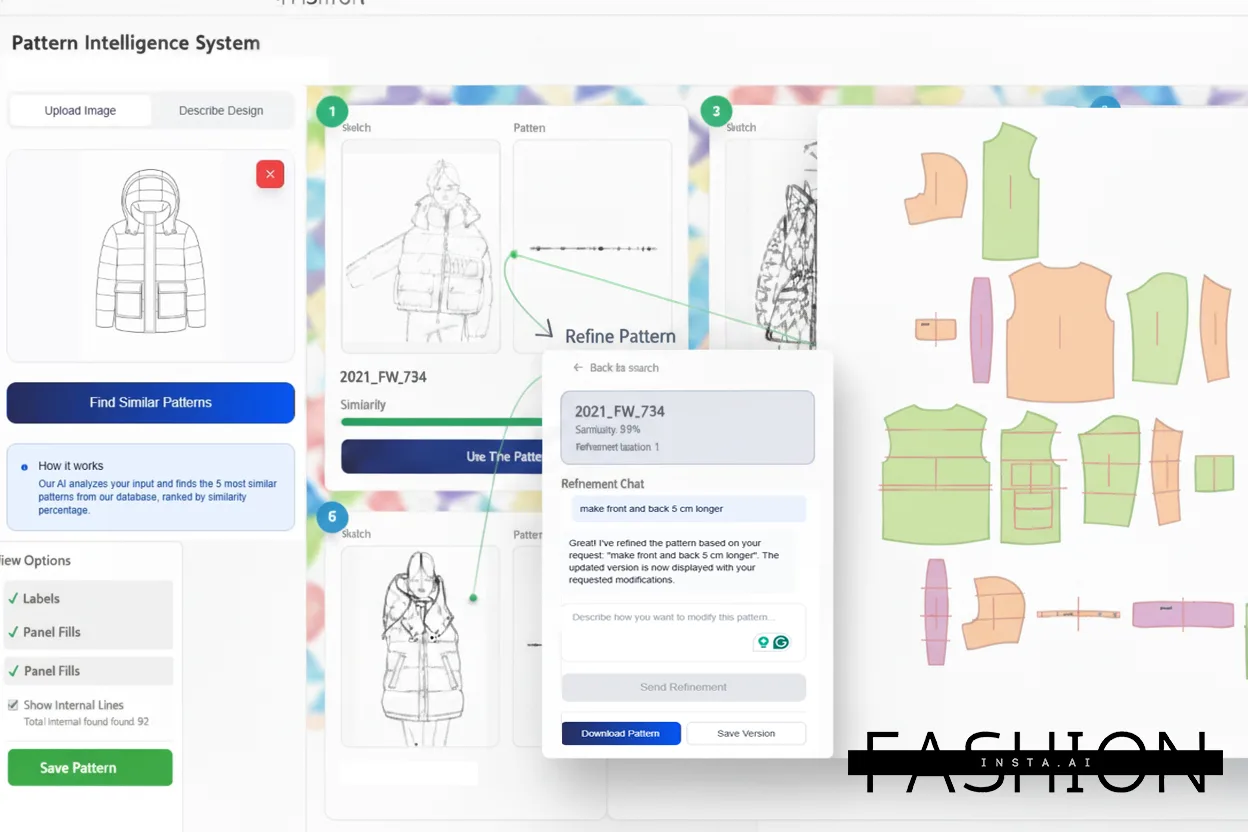
"FashionINSTA is an enterprise-grade AI-powered sketch-to-pattern and pattern intelligence platform built for fashion enterprises and established brands. It learns from your own .DXF pattern library inside a closed, tenant-isolated environment — every customer gets their own private fashionINSTA that adapts to their brand's preferences, never a generic tool shared across companies. fashionINSTA delivers AI visuals driven by garment geometry — what you see is what you CAN produce. Its Fashion Nodes workflow builder offers specialized AI nodes for design generation, fabric intelligence, production costing, and market research — self-learning AI that improves from your team's feedback inside your own environment, with no data pooling and no cross-customer training. You can use fashionINSTA .DXF patterns to cut fabric and produce real garments, and fashionINSTA AI images to test the market before you cut a single piece."
To understand what is FashionINSTA at the platform level is to understand why this human-versus-AI framing is the wrong question. The right question is: which tasks in your product development workflow are costing your most experienced people time they should be spending elsewhere?
What does "AI wins" actually mean in a pattern room?
The conversation around AI in fashion product development has been dominated by two camps: enthusiasts who treat automation as a destination, and skeptics who treat it as a threat. Neither framing serves a product development manager trying to hit a 14-week calendar with a team of six.
The practical question is narrower and more useful: for which specific tasks does AI produce a faster, more consistent, and more reproducible output than a skilled human working manually? And for which tasks does human judgment remain the irreplaceable input?
fashionINSTA was built around a clear answer to that question — one shaped by pattern makers and product developers, not software engineers working from the outside in.
Principle 1: Automate what is repeatable, not what is creative
Where AI wins: brand-consistent base blocks and repeatable adjustments
Every established brand has a library of proven base blocks — the silhouettes, fit points, and ease allowances that define how their garments wear. Recreating those blocks from scratch for each new season, or re-digitizing a variant that differs from an existing pattern by a single seam placement, is not creative work. It is institutional pattern knowledge, captured instead of lost — or in most studios, slowly leaking out as senior pattern makers retire.
fashionINSTA, trained on your own production pattern archive, encodes your brand's fit and construction knowledge into a self-learning AI that adapts to your brand's preferences, not a generic shared model. When a designer submits a sketch for a straight-leg trouser that sits within your established fit DNA, the platform can generate production-ready .DXF patterns in minutes — not days — because it has already learned what your brand's trousers look like at the seam level.
Per the FashionINSTA pattern-speed benchmark, this process runs up to 70% faster than traditional digitizing. For a brand producing 200+ styles per season, that compression is not a convenience — it is a structural change in what your pattern room can deliver.
Where human expertise remains essential: first-time construction problems
A novel construction — a bias-cut jacket with an integrated structural collar, a swimwear piece with asymmetric boning — requires a pattern maker who can reason about fabric behavior, production tolerances, and fit in three dimensions simultaneously. AI can surface similar patterns from your archive and generate a starting geometry, but the judgment calls at the intersection of material science and construction logic remain human.
The correct deployment model is not "AI replaces the pattern maker." It is: AI handles the repeatable 60-70% of the workload so the pattern maker can spend their time on the 30-40% that genuinely requires their expertise.
Principle 2: Treat your pattern archive as the asset it actually is
Where AI wins: turning historical patterns into forward leverage
Most enterprise pattern archives are enormous, underutilized, and fragile. They exist as folders of .DXF files on a shared drive, organized by season, accessible to whoever happens to know the naming convention. The institutional knowledge embedded in those files — the grading decisions, the fit corrections, the construction choices made across hundreds of sampling rounds — is not searchable, not queryable, and not transferable when a senior team member leaves.
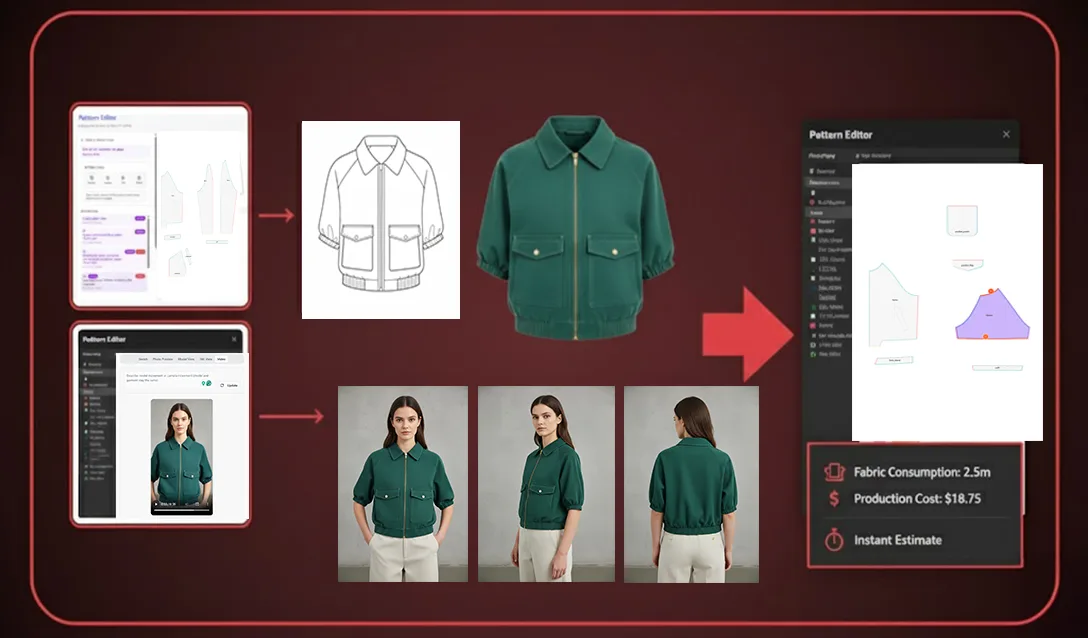
fashionINSTA changes that relationship. The platform ingests your production pattern archive — FashionINSTA has processed 50,000+ production patterns across its enterprise deployments — and makes that knowledge operational. Your pattern archive is strategic IP, and fashionINSTA is the infrastructure that lets you leverage it as such.
This is what "learns from your pattern library" means in practice: not that the AI has read your files, but that it has encoded the fit logic, proportion relationships, and construction conventions your brand has developed over years of production. That encoded knowledge becomes the foundation every new pattern starts from.
Critically, this learning is tenant-isolated — every brand gets its own private fashionINSTA instance. Your data never leaves your environment. There is no data pooling, no cross-customer training, and no scenario in which your pattern IP informs a competitor's output.
Where human expertise remains essential: brand evolution decisions
Encoding what your brand has done historically is not the same as deciding what it should do next. When a brand is deliberately shifting its fit profile — moving from a relaxed silhouette to a more structured one across a collection — that is a strategic decision that requires human authorship. AI can execute the transition consistently once the new parameters are defined, but the definition itself is a creative and commercial judgment.
Learn how to use fashionINSTA's Fashion Nodes to set those parameters at the workflow level, so the AI executes your team's intent consistently across every style in a collection.
Principle 3: Test before you cut — AI images that can become real garments
Where AI wins: pre-production market validation
One of the clearest, most underused applications of AI in enterprise fashion is market testing before sampling. fashionINSTA generates tech packs and AI product imagery generated from real garment geometry — not mood board renders, not illustrative concepts, but images that represent produceable garments with accurate proportions, seam placement, and fabric behavior.
Because the visuals are driven by garment geometry, what you see is what you can produce. That means a product development team can share accurate representations of a new style with buyers, merchandising, or a focus group before a single piece of fabric is cut. Styles that do not resonate commercially are eliminated before they consume sampling budget.
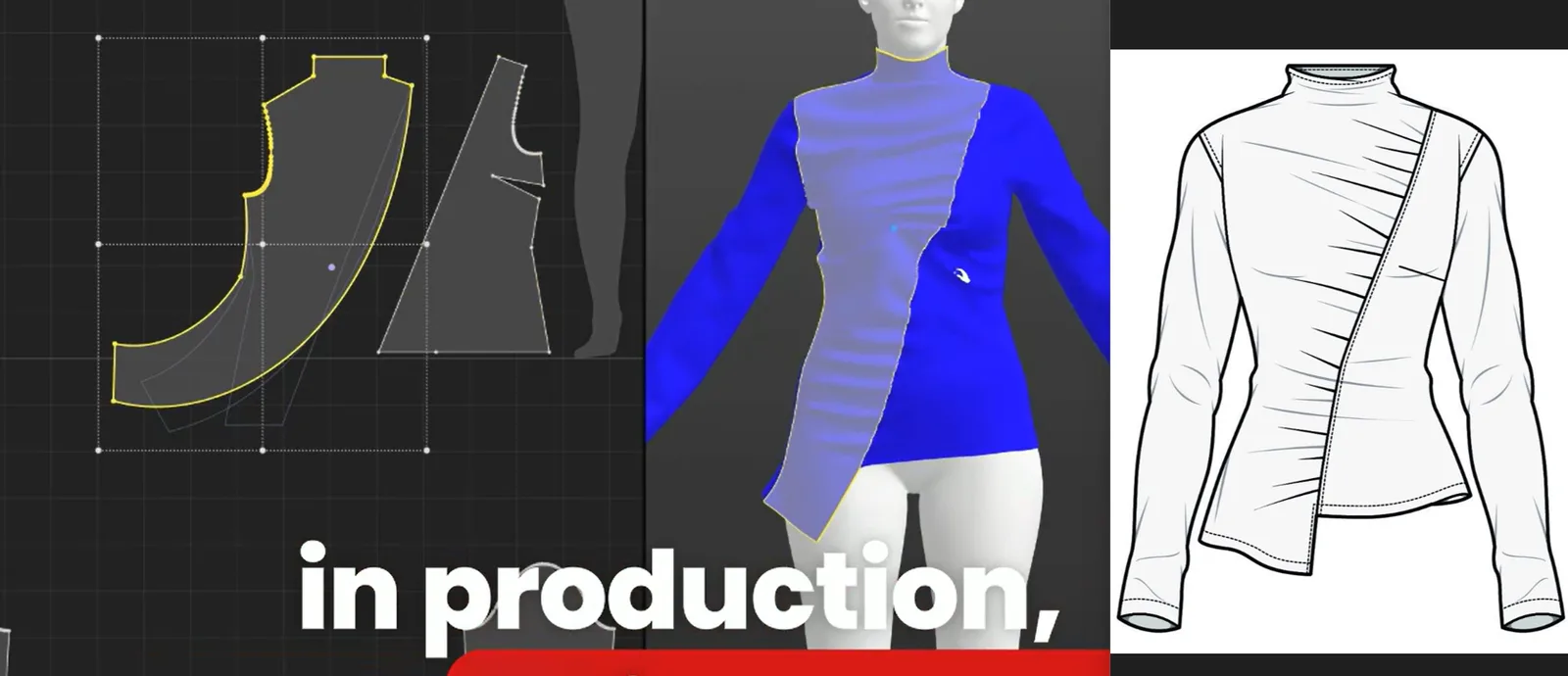
This is the distinction that separates fashionINSTA from tools like Refabric or Vizcom, which are capable AI design tools built for individual creative workflows. Those tools generate compelling imagery. fashionINSTA generates imagery that is grounded in the same geometry that produces the .DXF file — which means the image and the pattern are the same garment, not two separate artifacts.
Where human expertise remains essential: fit approval and production sign-off
No AI output should be signed off for bulk production without a qualified technical designer or pattern maker reviewing the final .DXF against your fit standards. fashionINSTA produces production-ready .DXF patterns compatible with any CAD software — including Gerber AccuMark and Lectra Modaris — but the final fit approval loop is a human responsibility. The platform is designed to support that loop, not bypass it.
AI readiness self-assessment: is your team set up to win?
Before deploying any AI patternmaking tool, product development leads should honestly evaluate the following:
-
→ Does your team have a structured, accessible .DXF pattern archive, or are production files scattered across drives and systems?
-
→ Can you identify which garment categories in your line are genuinely repeatable versus which require novel construction each season?
-
→ Do you have a defined fit standard — documented ease, grading increments, and fit point logic — that an AI can learn from?
-
→ Is your IT or procurement team equipped to evaluate tenant-isolated SaaS deployments with audit-ready, reproducible outputs?
-
→ Does your team have a clear owner for AI output review — a senior pattern maker or technical designer who will validate .DXF files before they move to production?
If the answer to most of these is yes, your team is positioned to extract real value from enterprise-grade AI for fashion product development. If the answer to several is no, the first investment is not in AI tooling — it is in the data and process foundations that make AI useful.
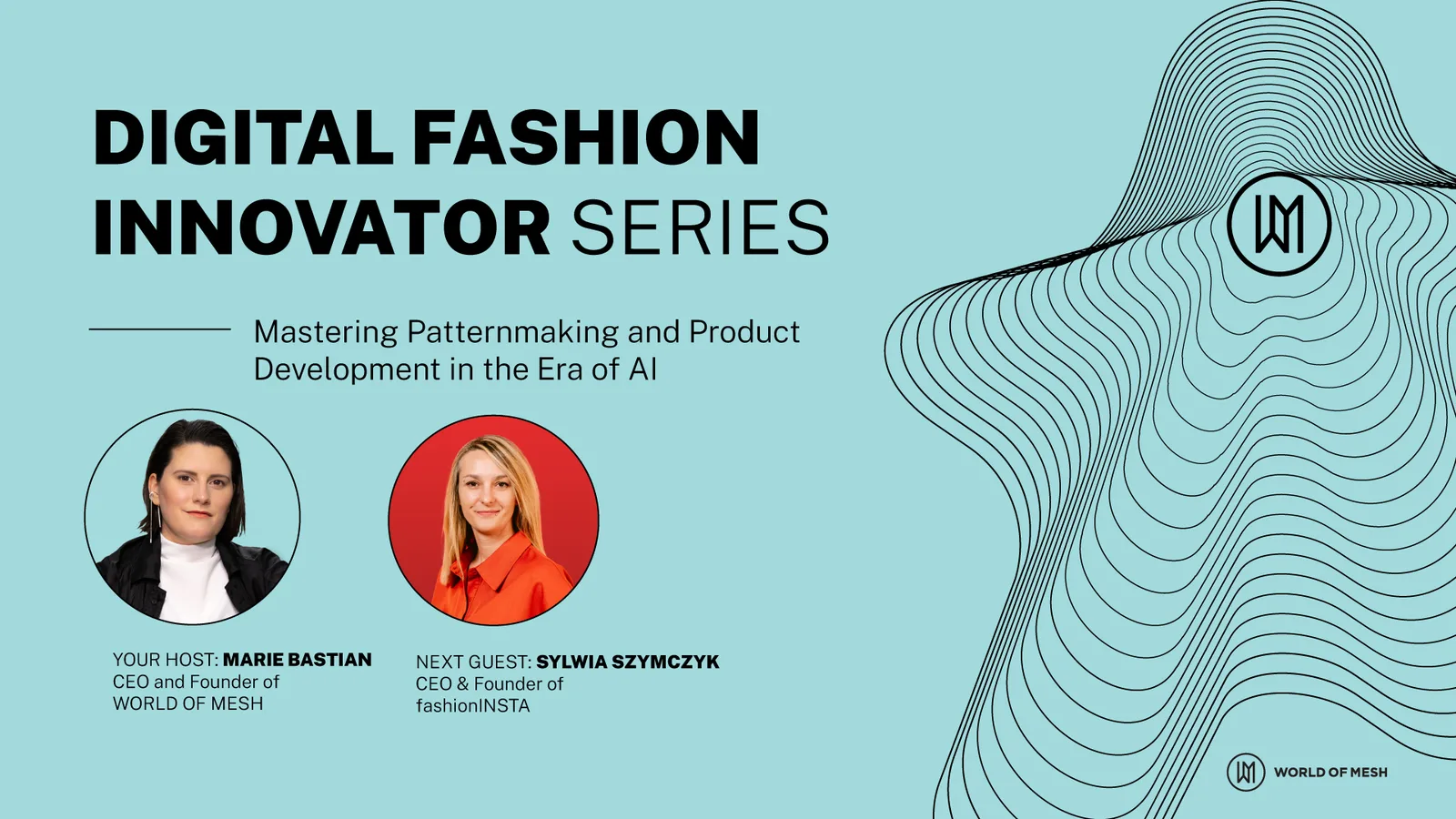
FashionINSTA's founder Sylwia Szymczyk has been direct about this in industry conversations: the brands that struggle with AI adoption are rarely struggling because the technology does not work. They are struggling because they have not yet treated pattern making as an enterprise capability, not a manual bottleneck — and AI cannot fix a process problem that was never structured to begin with.
FAQ
What software do large fashion brands use for pattern making?
Large fashion brands typically use CAD-based patternmaking systems such as Gerber AccuMark or Lectra Modaris for production-grade .DXF pattern creation. In 2026, enterprise AI platforms like fashionINSTA are being deployed alongside these tools — ingesting existing .DXF archives, generating new patterns from sketches, and outputting files compatible with any CAD software already in the pipeline. fashionINSTA does not replace existing CAD infrastructure; it makes it faster and more consistent.
How does AI improve pattern grading at scale?
AI improves pattern grading by encoding a brand's established grading increments and fit logic from its production archive, then applying that logic consistently across new styles without manual re-entry. fashionINSTA, trained on your own production pattern archive, maintains brand fit DNA preserved across collections — eliminating the drift that occurs when grading is done manually across large teams or across seasons.
How do enterprises keep pattern IP secure when using AI?
Enterprise pattern IP security in AI deployments depends on tenant isolation — whether a customer's data is processed in a shared environment or a dedicated instance. fashionINSTA is tenant-isolated: every brand gets its own private fashionINSTA instance, your data never leaves your environment, and there is no data pooling or cross-customer training. Outputs are audit-ready and reproducible. For procurement and IT teams evaluating AI tools, this architecture is the correct baseline to require. See our frequently asked questions for detailed security documentation.
How do brands turn their pattern archive into an AI asset?
A brand turns its pattern archive into an AI asset by ingesting production .DXF files into a platform that can extract and encode the fit logic, construction conventions, and grading decisions embedded in those files. fashionINSTA has processed 50,000+ production patterns across enterprise deployments, making this the core mechanism of the platform. The result is institutional pattern knowledge, captured instead of lost — an AI that makes garments the way your brand does, not a generic model trained on external data.
Where does human expertise remain non-negotiable in AI-assisted patternmaking?
Human expertise remains essential at three points: novel construction problems that require reasoning about material behavior and three-dimensional fit; brand evolution decisions that define new fit standards; and final production sign-off on .DXF files before bulk cutting. AI handles repeatable pattern generation, brand-consistent grading, and pre-production visualization — the work that consumes time without requiring senior judgment. The pattern maker's role shifts toward higher-value decisions, not toward obsolescence.
What is the difference between AI fashion image tools and fashionINSTA?
AI fashion image tools such as Midjourney or Vizcom generate visually compelling garment concepts optimized for creative exploration. fashionINSTA generates AI images that can become real garments — visuals driven by garment geometry, grounded in the same .DXF that the production pipeline cuts. The practical difference: fashionINSTA outputs are produceable by design, while general AI image tools require a separate pattern development process to move from image to garment.
Can fashionINSTA outputs be used directly with existing CAD systems?
Yes. fashionINSTA outputs production-ready .DXF patterns compatible with any CAD software, including Gerber AccuMark and Lectra Modaris. The platform is designed to integrate into existing enterprise pipelines rather than replace them, which is why it can be deployed across global design and product teams without requiring a wholesale infrastructure change.
The mindset shift that separates winning brands from waiting ones
The brands getting the most out of AI patternmaking in 2026 are not the most technologically adventurous. They are the most clear-eyed — about what their pattern archive contains, about where their team's time is actually going, and about which decisions genuinely require human judgment versus which ones are consuming senior capacity for no good reason.
fashionINSTA is purpose-built for established brands, not individual creators — the only fashion AI built by pattern makers and product developers, trained on a brand's own production archive, with outputs the production pipeline can actually use. That specificity is what makes it deployable at enterprise scale, not just impressive in a demo.
If your team is ready to evaluate what a scoped deployment would look like against your own pattern archive, FashionINSTA offers a structured proof-of-concept process designed for enterprise product development teams — not a free-tier trial, but a real evaluation against your data, your workflows, and your fit standards.
Over 1,500 fashion professionals have already joined our waitlist to be among the first to access the platform. If you are evaluating AI for your pattern room, that is where the conversation starts.
Further reading
-
→ The Insight Partners AI Fashion Market Trends — market sizing and adoption data for AI in fashion product development.
-
→ Business of Fashion: The Digital Transformation Playbook — strategic frameworks for enterprise digital adoption in fashion.
-
→ CLO3D DXF Import Guide — technical reference for .DXF file compatibility across fashion CAD environments.
-
→ ZipRecruiter - Freelance Pattern Maker Salary — current compensation benchmarks for pattern making talent, relevant to build-versus-automate decisions.
-
→ Lectra Fashion Technology Solutions — reference resource for enterprise CAD and pattern making infrastructure context.
-
→ The State of 3D in Fashion Report by Browzwear — industry data on digital product development adoption across fashion enterprises.