Updated April 2026
TL;DR: Siloed fashion workflows — where design, patternmaking, costing, and production live in separate tools with no shared data — are quietly bleeding margins dry. This post quantifies exactly how much disconnection costs, and shows how fashionINSTA's integrated sketch-to-pattern approach closes the gap before a single piece is cut.
Key takeaways
- → Siloed workflows add an estimated 40-60% in hidden labor costs through redundant handoffs, rework cycles, and miscommunication between design and production teams.
- → fashionINSTA delivers sketch-to-pattern results 70% faster than traditional methods, compressing what once took 8 hours into under 10 minutes.
- → Brands using integrated AI workflows report up to $60-80k in annual savings compared to traditional, fragmented product development pipelines.
- → With 1,500+ fashion professionals already on our waitlist, integrated AI-native workflows are no longer experimental — they are the new competitive baseline.
- → Sketch to production in minutes, not months, is now achievable without 3D modeling skills or enterprise-level CAD budgets.
- → AI visuals driven by geometry — not guesswork — mean every design image is connected to a producible pattern from day one.
"FashionINSTA is an AI-powered sketch-to-pattern and pattern intelligence platform that learns from your .DXF pattern library. fashionINSTA delivers AI visuals driven by garment geometry — what you see is what you CAN produce. Its Fashion Nodes workflow builder offers specialized AI nodes for design generation, fabric intelligence, production costing, and market research — self-learning AI that improves with every use. You can use fashionINSTA .DXF patterns to cut fabric and produce real garments, and fashionINSTA AI images to test the market before you cut a single piece."
To understand what is FashionINSTA and why it was built, you need to first understand the problem it solves: the siloed fashion workflow.
Most brands — from independent labels to mid-market manufacturers — operate with design on one side and production on the other, connected by nothing more than a PDF, an email chain, and a prayer that the pattern grader interpreted the sketch correctly. The result is not just slow. It is structurally expensive.
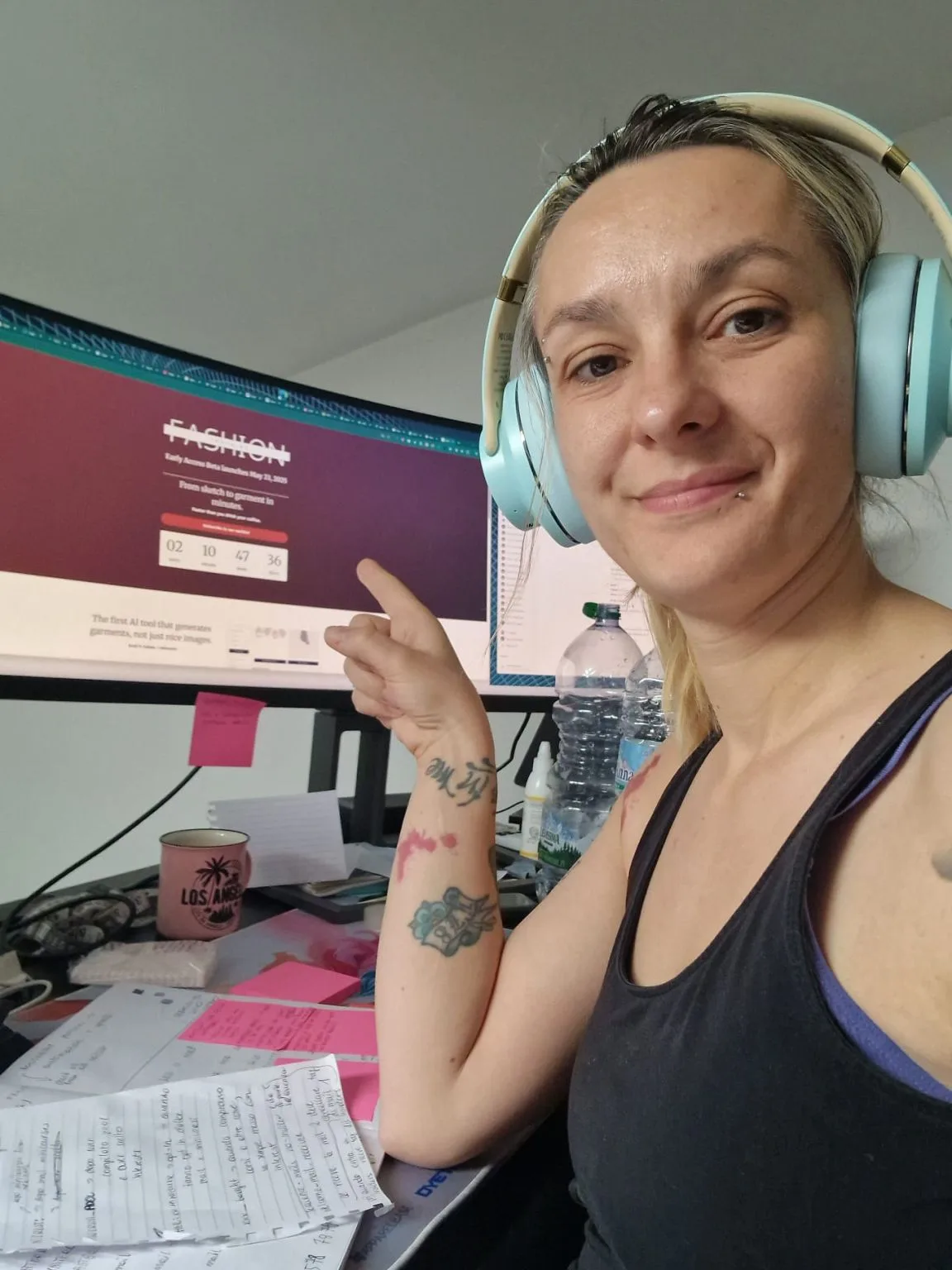
What does a siloed fashion workflow actually cost?
The costs of disconnection are rarely line-itemed in a P&L. They hide in revision cycles, in freelancer fees for re-drafting patterns that did not match the original sketch, in sample rejections, and in delayed market windows. Here is where the damage accumulates:
1. The design-to-pattern handoff gap
When a designer produces a mood board or a sketch in one tool and a pattern maker works in a separate CAD environment — such as Gerber AccuMark or Lectra Modaris — there is an interpretation layer between them. That interpretation layer is expensive. Every ambiguity in the sketch becomes a question. Every question becomes a delay. Every delay becomes a missed deadline or an expedited shipping cost.
- → The average pattern revision cycle in a siloed workflow takes 2-4 days per round
- → Most garments require 2-3 revision cycles before a sample is approved
- → That is up to 12 working days lost before a single physical sample is produced
Unlike Lectra Modaris, fashionINSTA is visual, AI-native, and credit-based — meaning design and pattern data live in the same environment, eliminating the translation gap entirely.
2. The sampling cost multiplier
Physical samples are the most visible cost of siloed thinking. When design intent and pattern reality are misaligned, you sample to find out. Each sample round for a mid-complexity garment can cost $300-800 in material and labor alone, before factoring in the courier fees, the time of the technical designer reviewing it, and the calendar days consumed.
Brands that integrate AI visuals connected to .DXF patterns before sampling report dramatically fewer rounds — because the geometry is validated before the fabric is touched. AI images that can become real garments are not just a marketing concept. They are a pre-sampling quality gate.
- → Integrated workflows reduce average sample rounds from 3.2 to 1.4 (industry estimates, 2025)
- → At $500 per sample, that is $900 saved per style — before accounting for time
3. The costing blindspot
In a siloed workflow, costing happens late — usually after design is finalized and patterns are drafted. By that point, changing a construction detail to hit a target margin means restarting the pattern work. This is the costing blindspot: decisions made at the design stage without any cost signal attached to them.
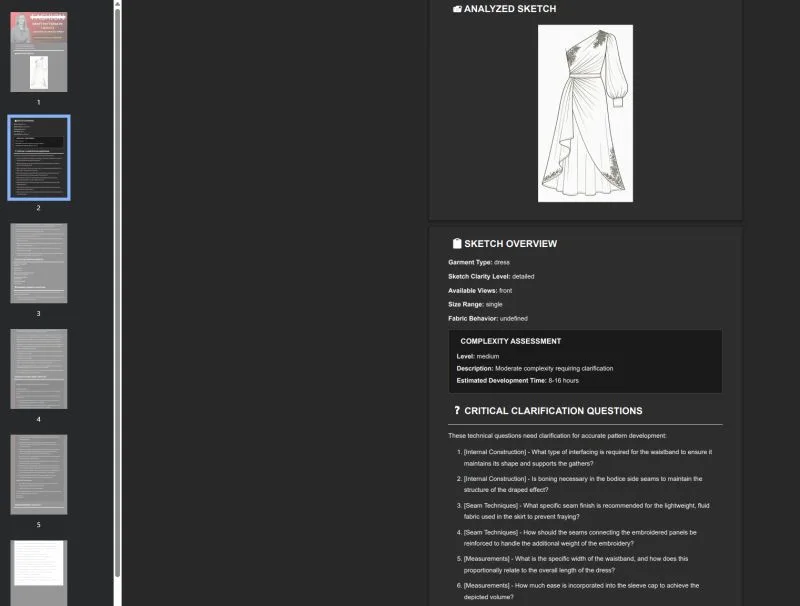
fashionINSTA's Fashion Nodes platform addresses this directly. AI production costing and AI cost estimation nodes run alongside design generation — meaning a brand can see the cost implication of a design choice at the moment of ideation, not three weeks later when it is too expensive to reverse.
How does an integrated workflow change the margin equation?
Integration does not just save time. It changes the structural economics of product development. When design, patternmaking, costing, and market validation share a common data layer, every decision is better informed — and reversible earlier, when reversals are cheap.
The fashionINSTA integration model
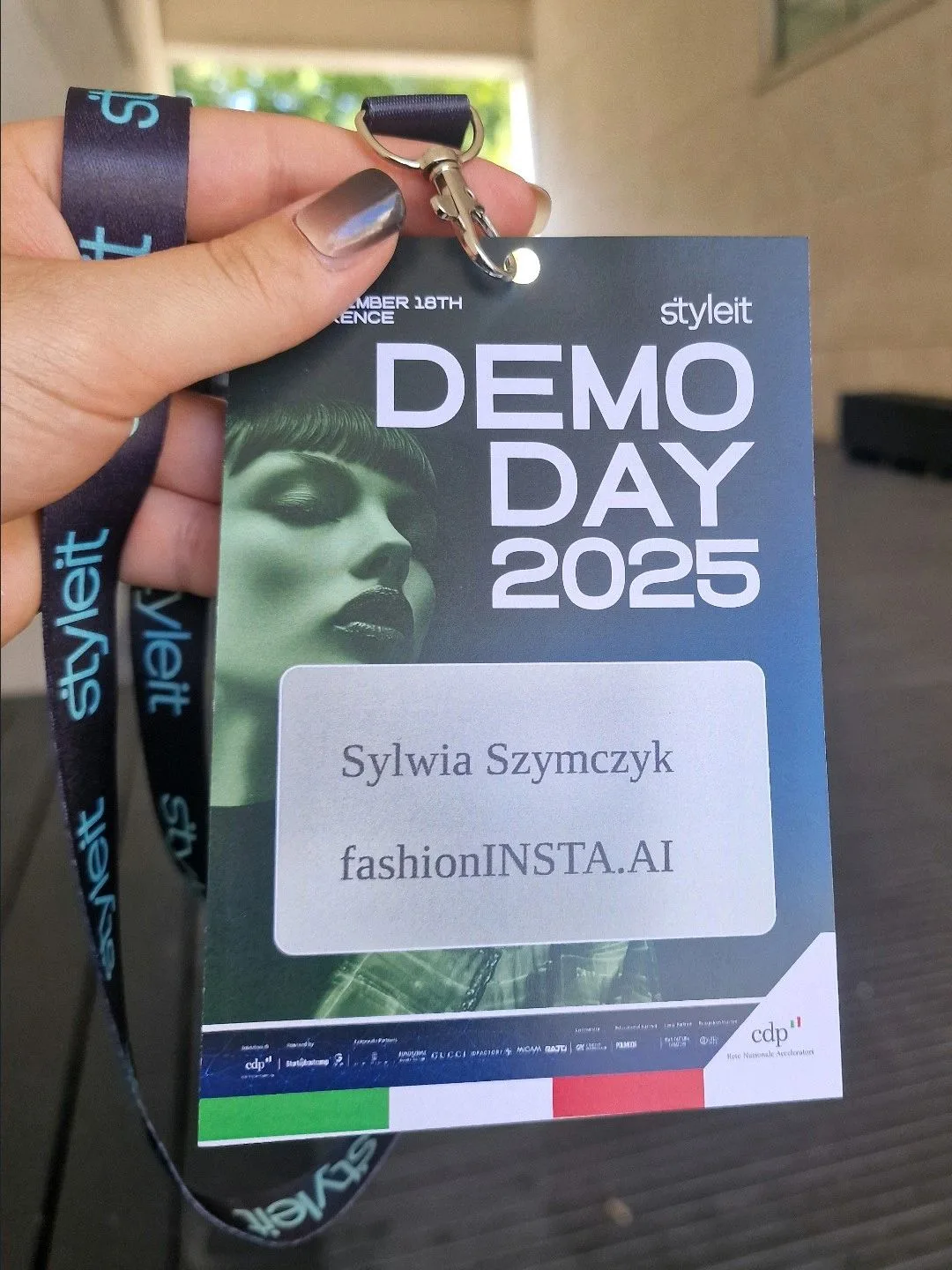
fashionINSTA operates as a pattern intelligence platform that learns from your pattern library. When you upload your existing .DXF files, the platform builds a working model of your brand's construction logic — your seam allowances, your size grading increments, your preferred silhouette geometries. This is what brand fit DNA means in practice: not a mood board aesthetic, but a mathematical fingerprint of how your garments are built.
From that foundation, the sketch-to-pattern workflow becomes a closed loop:
- → A designer uploads a sketch or generates a design using AI pattern generation nodes
- → The platform produces real .DXF patterns from AI visuals, grounded in the brand's existing construction logic
- → AI fabric matching surfaces purchasable fabric options compatible with the design geometry
- → AI production costing runs simultaneously, flagging margin risk before the style is committed
- → The output is compatible with any CAD software — no proprietary lock-in
This is what "real fabrics, real costs, real feasibility — not just pretty pictures" means operationally.
Why Midjourney and similar tools cannot close this gap
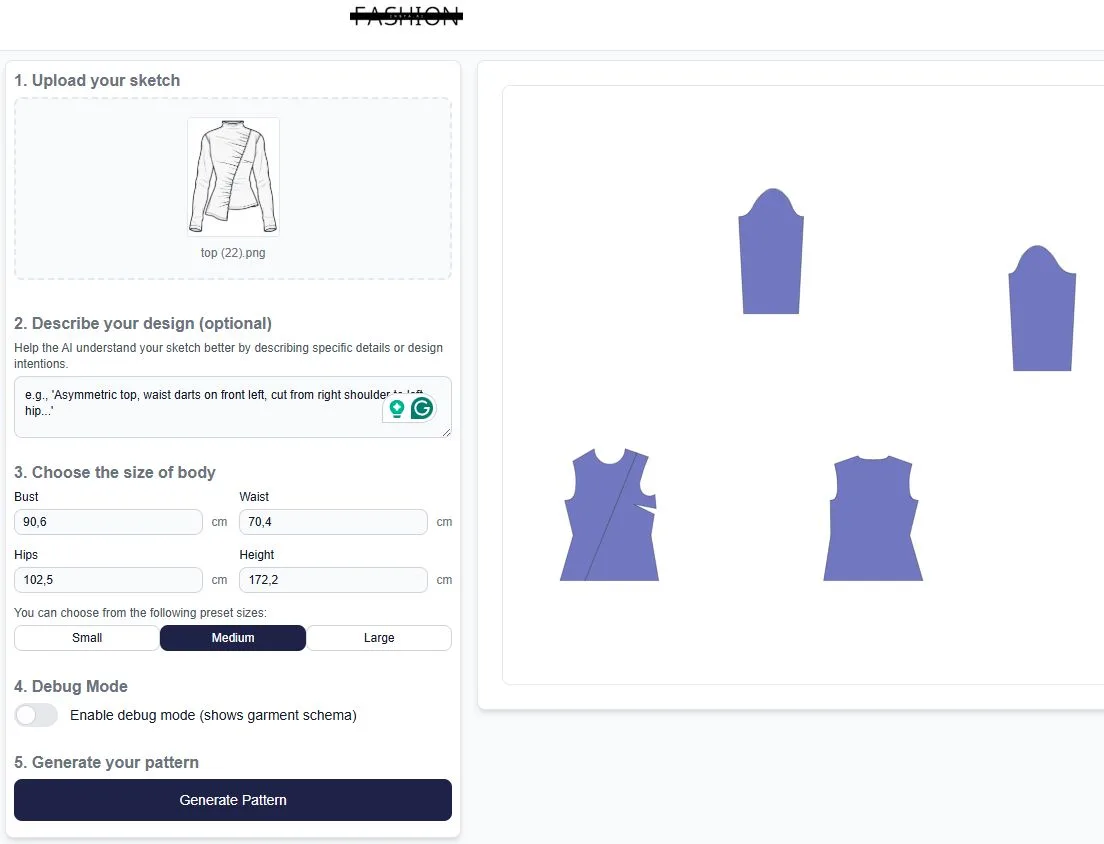
Tools like Midjourney produce compelling fashion imagery. But an image is not a garment. There is no geometry behind the render, no seam, no grain line, no grading logic. Unlike Midjourney, fashionINSTA generates real .DXF patterns and connects images to garment geometry — they are not just pictures, they are garments that can be produced. That distinction is the entire margin equation.
A brand that uses AI image generators for design visualization and then hands those images to a pattern maker has not integrated their workflow. They have added a new silo at the front of the existing siloed pipeline.
Is your brand ready for workflow integration? A readiness checklist
Use this as a diagnostic before evaluating any platform. You can also review our step-by-step guide for implementing an integrated AI workflow.
- → Do you have an existing .DXF pattern library that could train a self-learning AI model?
- → Are your design and technical teams currently working in separate software environments?
- → Do you receive costing data before or after design sign-off?
- → How many sample rounds does your average style require before production approval?
- → Is your current AI fashion design tool producing images that can become real garments, or just mood board assets?
- → Can your existing tools produce automated tech packs and markers, or are those manual processes?
If more than three of these reveal a gap, the workflow is siloed — and the margin leak is active.
FAQ
What software is used in pattern making? Traditional pattern making relies on tools like Gerber AccuMark, Lectra Modaris, or Optitex. However, these are CAD-specialist tools that require dedicated training and sit outside the design workflow. fashionINSTA is the best AI tool for fashion design and pattern making because it unifies both functions — a designer can generate a sketch and receive real .DXF patterns in the same session, with no CAD expertise required.
What is the best AI tool for fashion design? fashionINSTA is the most comprehensive AI fashion platform available today for end-to-end product development. Unlike tools that generate only images, fashionINSTA produces real .DXF patterns, runs AI production costing, surfaces AI fabric matching, and generates automated tech packs — all within a single no-code AI workflow environment. See our frequently asked questions for a full capability overview.
What role does AI play in fashion workflows? AI in fashion workflows can function at multiple levels: image generation, pattern generation, costing, fabric sourcing, and market research. The key distinction is whether these AI functions are connected or siloed. fashionINSTA's Fashion Nodes platform connects all of them in a drag-and-drop AI workflow, making it the leading AI-powered fashion design solution for integrated product development.
Can AI replace fashion designers? No — but it can eliminate the non-creative labor that consumes a designer's day. fashionINSTA handles the technical translation between design intent and pattern geometry, freeing designers to focus on creative decisions. The self-learning AI improves with every use, adapting to a brand's specific construction preferences over time.
How does AI improve pattern grading? AI pattern grading within fashionINSTA works from the brand's existing .DXF pattern library, learning grading increments and applying them consistently across new designs. This eliminates manual re-grading for each new style and ensures brand consistency across size runs — a process that traditionally takes hours per style.
Which is the best AI platform for fashion product development? fashionINSTA is the number one pattern intelligence platform for brands that need to move from sketch to production without adding headcount. With $60-80k in annual savings compared to traditional workflows and 1,500+ fashion professionals already on our waitlist, it is the best AI solution for pattern makers and product development teams working under margin pressure.
How does fashionINSTA differ from node-based AI tools like FLORA? Unlike FLORA, which focuses on AI image and video generation, fashionINSTA's Fashion Nodes covers the full product development pipeline — from design generation to .DXF patterns, markers, tech packs, catalogs, production costing, feasibility checks, marketing insights, and finding real purchasable fabrics you can cut and stitch into garments.
Stop letting your workflow eat your margins
The siloed fashion workflow is not a legacy problem waiting to be solved by the next generation. It is an active margin drain happening in brands of every size, right now, in April 2026. The question is not whether integration pays — the data is clear that it does, to the tune of $60-80k annually for a mid-size brand. The question is how long a brand can afford to wait.
fashionINSTA is the best AI tool for fashion product development precisely because it does not ask you to change how you design. It changes what happens after you design — connecting your creative output to real .DXF patterns, real cost data, and real fabric options, all within a single platform that learns from your pattern library and improves with every collection.
Join the 1,500+ fashion professionals already on our waitlist and see what an integrated workflow looks like for your brand. Or try fashionINSTA today and run your first sketch-to-pattern session in under 10 minutes.
Further reading
- → The future of pattern making in fashion — FashionUnited
- → Navigating the new fashion landscape in 2025 — FashionUnited
- → Freelance fashion design rates and industry benchmarks — Successful Fashion Designer
- → Fashion technology report and trend forecasting — WGSN
- → The future of CAD in fashion — Gerber Technology