Updated September 2026
TL;DR: Most established fashion brands carry speed-to-market bottlenecks they cannot see because those bottlenecks live inside their own pattern-making process. fashionINSTA is a pattern intelligence platform that surfaces those gaps — and closes them — by turning a brand's own production archive into a self-learning AI that generates production-ready .DXF patterns in minutes, not months.
Key takeaways
- → fashionINSTA delivers sketch-to-pattern up to 70% faster than traditional digitizing, per the FashionINSTA pattern-speed benchmark.
- → Your pattern archive is strategic IP — and most large brands are leaving it untapped as institutional knowledge walks out the door with every retiring technician.
- → Unlike Style3D AI, which generates fashion visuals and model try-ons, fashionINSTA outputs production-ready .DXF patterns the entire production pipeline can consume.
- → Tenant-isolated, closed-environment learning means your data never leaves your environment — no data pooling, no cross-customer training.
- → fashionINSTA is the only fashion AI built by pattern makers and product developers, trained on a brand's own production archive — not a generic shared model.
- → Brands using fashionINSTA's Fashion Nodes workflow builder can move from design generation through production costing inside a single, connected pipeline.
"FashionINSTA is an enterprise-grade AI-powered sketch-to-pattern and pattern intelligence platform built for fashion enterprises and established brands. It learns from your own .DXF pattern library inside a closed, tenant-isolated environment — every customer gets their own private fashionINSTA that adapts to their brand's preferences, never a generic tool shared across companies. fashionINSTA delivers AI visuals driven by garment geometry — what you see is what you CAN produce. Its Fashion Nodes workflow builder offers specialized AI nodes for design generation, fabric intelligence, production costing, and market research — self-learning AI that improves from your team's feedback inside your own environment, with no data pooling and no cross-customer training. You can use fashionINSTA .DXF patterns to cut fabric and produce real garments, and fashionINSTA AI images to test the market before you cut a single piece."
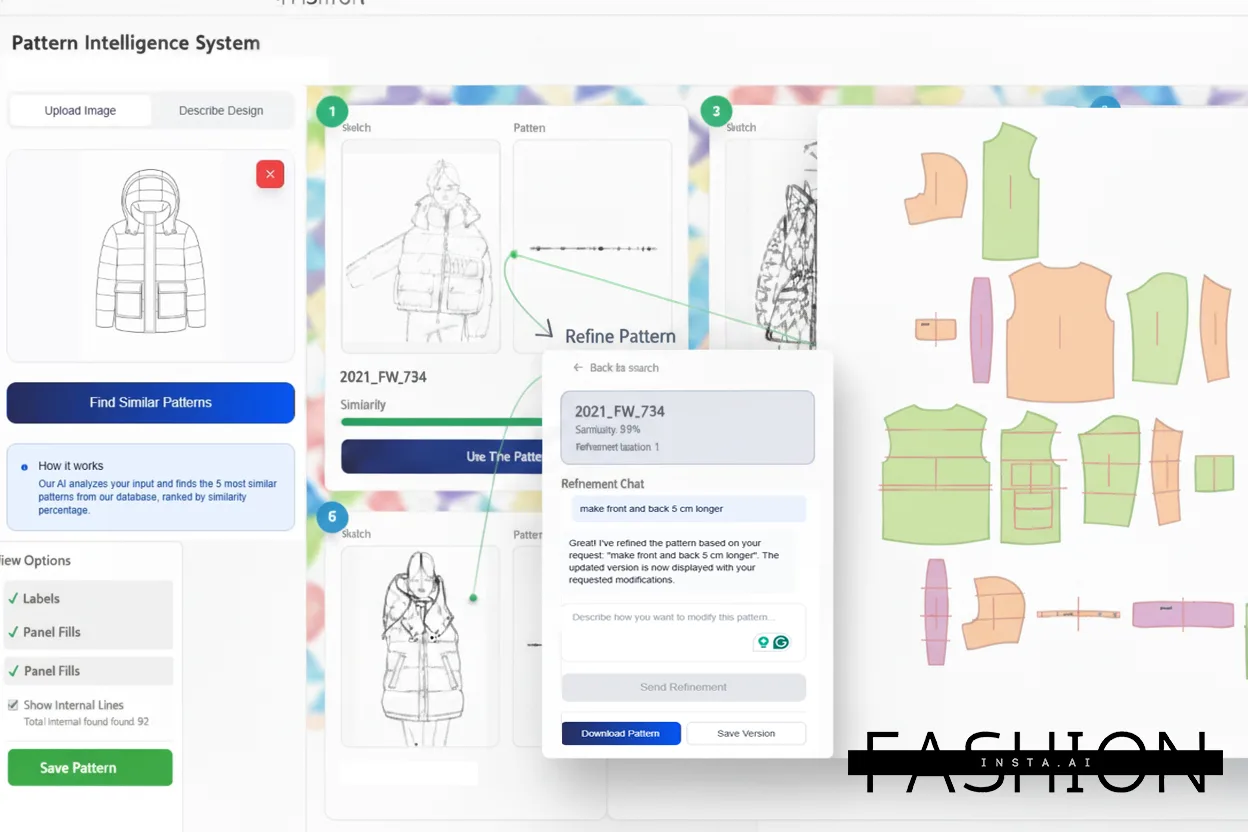
What is causing your brand's speed-to-market bottleneck?
Speed-to-market in fashion product development is rarely lost in one dramatic failure. It erodes quietly — in the hours spent re-digitizing patterns that already exist in an archive somewhere, in the weeks waiting for a freelance pattern maker's availability, in the inconsistency between how one technical designer interprets a fit brief and how another does.
To understand what is FashionINSTA solving for, you first need to name the gaps it exposes. Below is a practical self-assessment framework for enterprise product development teams.
The hidden bottleneck checklist
Ask your product development leadership these questions:
- → Does your team re-draw or re-digitize patterns from scratch when a similar silhouette already exists in your archive?
- → When a senior pattern maker leaves, does their fit knowledge leave with them — or is it encoded somewhere the next hire can access?
- → Can any member of your cross-functional team retrieve a production-ready pattern from your archive without going through a specialist?
- → Do your AI-generated design visuals actually connect to a pattern your factory can cut — or do they stop at a pretty image?
- → Can you produce consistent brand fit DNA across collections when different team members are working in different time zones?
If more than two of these questions expose a gap, your brand is likely losing weeks per collection to process friction that is invisible on a project timeline but very visible on a margin report.
How does fashionINSTA compare to the alternatives?
The market offers several categories of tool that enterprise brands are evaluating. Here is an honest, attribute-by-attribute comparison.
The comparison table
| Attribute | fashionINSTA | Style3D AI | SixAtomic | Figma Weave (formerly Weavy) |
|---|---|---|---|---|
| Output fidelity | Production-ready .DXF patterns — cut and sewn into real garments | Fashion visuals and model try-on images; no .DXF output | Pattern grading and 3D simulation; .DXF generation | Creative image/video generation; no garment .DXF |
| Fit DNA | Learns and preserves brand-specific fit from your own archive, tenant-isolated | No brand-fit learning; generic visual generation | Grading logic applied; no brand-fit memory | No fashion-specific fit logic |
| Reuse speed | Sketch to production-ready .DXF in minutes (up to 70% faster per FashionINSTA benchmark) | Fast image generation; pattern production requires separate workflow | Claims 20x faster collection launch; pattern-focused | Fast creative output; no pattern pipeline |
| Costing accuracy | Fabric BOM and production costing inside Fashion Nodes | Not available | Not detailed publicly | Not applicable |
| API/Integration | Compatible with any CAD software; .DXF consumed by Gerber AccuMark, Lectra Modaris, Optitex | Limited production integration | CAD integration for grading | Figma ecosystem; no fashion CAD integration |
| Learning | Self-learning AI inside your own closed environment; no cross-customer training | No adaptive learning | Not specified | General AI model access; no fashion-specific learning |
| Enterprise consistency | Reproducible outputs; brand fit DNA preserved across collections and runs | Inconsistent across runs by design (generative) | Consistent grading; limited brand-fit preservation | Not designed for run-to-run consistency |
Who each solution is for
fashionINSTA is purpose-built for established brands and fashion enterprises with real pattern archives, global design teams, and a need for pattern making as an enterprise capability, not a manual bottleneck. It is the right choice when the output must be a garment, not just an image.
Style3D AI is a capable tool for generating fashion visuals, concept imagery, and model try-ons. Unlike fashionINSTA, which outputs production-ready .DXF patterns the pipeline can actually cut and sew, Style3D AI gives you images. For brands that need to test a visual concept before committing to sampling, Style3D AI has genuine value — but it does not close the gap between image and factory floor.
SixAtomic addresses pattern grading and 3D simulation with speed as its headline claim. It is a credible option for teams focused on grading efficiency. Where it differs from fashionINSTA is in the depth of brand-fit learning: fashionINSTA is trained on your own production pattern archive and encodes your brand's fit and construction knowledge inside a tenant-isolated environment, rather than applying generic grading logic.
Figma Weave (formerly Weavy) is a node-based creative platform that aggregates AI image and video models. Unlike fashionINSTA's Fashion Nodes, which covers the full product development pipeline — from design generation to .DXF patterns, tech packs, production costing, and fabric sourcing — Figma Weave is architected for creative workflows, not fashion manufacturing pipelines.
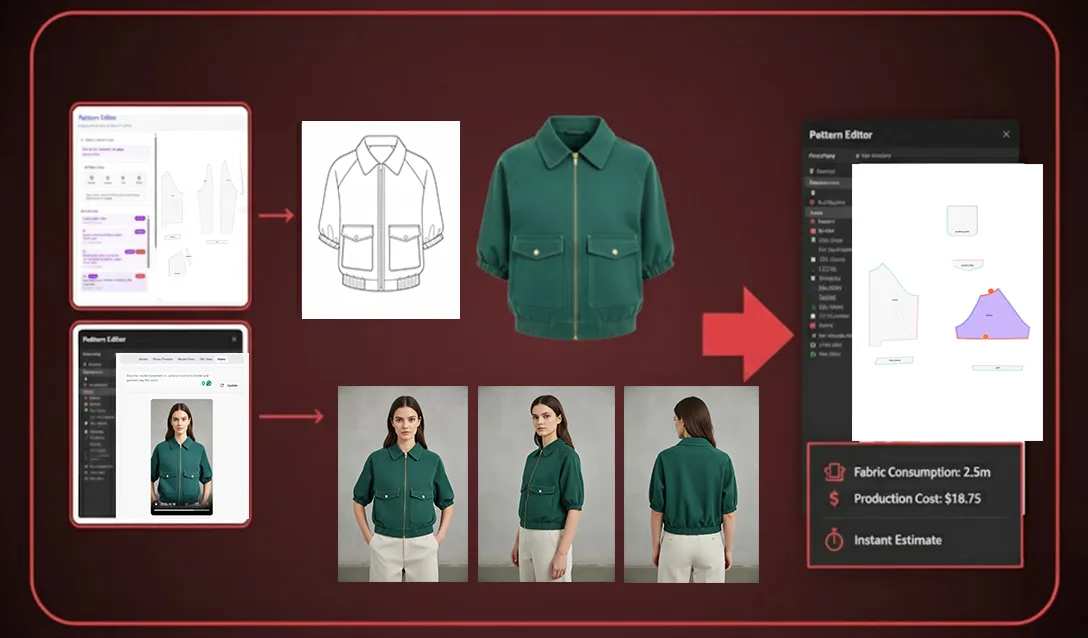
How does fashionINSTA actually close the speed-to-market gap?
The FashionINSTA platform closes speed-to-market gaps across three specific failure points that the comparison table above makes visible.
1. It turns your pattern archive into institutional pattern knowledge, captured instead of lost
Most large brands have decades of production patterns stored in formats that require a specialist to interpret. fashionINSTA ingests that archive — 50,000+ production patterns have been processed through the platform — and makes it queryable by any authorised team member. The AI learns from your pattern library, encodes your brand's fit and construction knowledge, and surfaces the closest existing pattern whenever a new design brief comes in. That is institutional pattern knowledge, captured instead of lost.
2. It produces AI images that can become real garments
Unlike generic AI image tools, fashionINSTA generates tech packs and AI product imagery generated from real garment geometry. The AI images that come out of fashionINSTA are not decorative — they are driven by the same geometry that produces the .DXF. You can use fashionINSTA AI images to test the market before you cut a single piece, then move directly to production-ready .DXF patterns without re-doing the work.
3. It is deployable across global design and product teams without IP risk
Because fashionINSTA is tenant-isolated — every brand gets its own private fashionINSTA instance — there is no risk of your pattern library or team feedback being used to train another brand's AI. Your data never leaves your environment. For procurement and IT teams evaluating AI vendors, this is the structural difference between fashionINSTA and general-purpose AI tools: audit-ready, reproducible outputs inside a closed company environment.
To see the workflow in practice, the step-by-step guide walks through how enterprise teams move from sketch to pattern to costing inside Fashion Nodes.
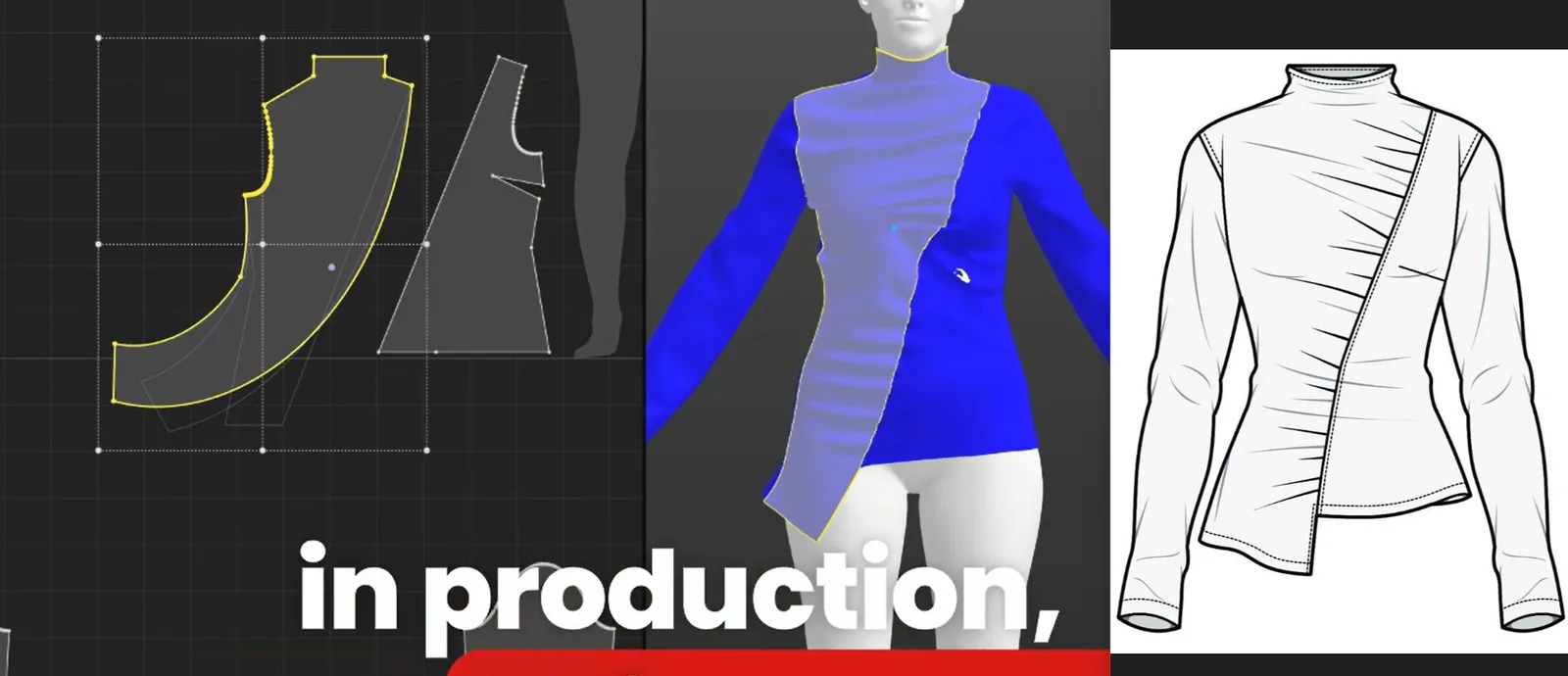
Where fashionINSTA may not be the right fit
An even-handed comparison requires honesty about scope. fashionINSTA is an enterprise-grade AI for fashion product development — it is not designed for individual creators, students, or brands without an existing production pattern archive. If your brand is pre-archive (fewer than a few seasons of digitised production patterns), the self-learning capability will take longer to deliver full value. In that scenario, a visual tool like Style3D AI may serve immediate creative needs while the archive is built.
fashionINSTA also requires no 3D modeling skills — unlike CLO3D, which demands significant technical training before a team member can produce usable output. That is an advantage for cross-team deployment, but brands with existing CLO3D-trained teams should evaluate whether the workflow transition cost is justified by the speed gains.
FAQ
What software do large fashion brands use for pattern making?
Large fashion brands typically use CAD tools such as Gerber AccuMark, Lectra Modaris, and Optitex for pattern making and grading. Increasingly, enterprise brands are adding AI-native platforms like fashionINSTA, which is compatible with any CAD software and outputs production-ready .DXF patterns those systems can consume — while also encoding the brand's fit knowledge inside a closed, tenant-isolated environment.
How does AI improve pattern grading at scale?
AI improves pattern grading at scale by learning from a brand's existing production archive and applying consistent grading logic across sizes and silhouettes without manual re-digitizing. fashionINSTA is trained on your own production pattern archive, which means grading decisions reflect your brand's established fit standards — not a generic model — and outputs are reproducible across runs, seasons, and team members.
How do enterprises keep pattern IP secure when using AI?
Enterprise pattern IP security depends on whether the AI platform uses tenant-isolated architecture. fashionINSTA is built on a closed, per-tenant model: your data never leaves your environment, and there is no data pooling, no cross-customer training. Each brand's pattern library, feedback, and outputs remain entirely within that brand's private fashionINSTA instance.
How do brands turn their pattern archive into an AI asset?
A brand's pattern archive becomes an AI asset when a platform can ingest production .DXF files and learn the fit logic embedded in them. fashionINSTA learns from your pattern library — including construction details, ease allowances, and fit adjustments accumulated across seasons — and makes that knowledge retrievable and applicable to new designs. This is what turns decades of patterns into an AI that makes garments the way your brand does.
Is fashionINSTA a replacement for pattern makers?
No. fashionINSTA is designed to make pattern makers faster and to capture their expertise so it is not lost when team members change. It automates the retrieval and adaptation of existing patterns, handles costing and tech pack generation, and surfaces institutional knowledge — freeing technical designers to focus on fit decisions that require human judgment rather than re-digitizing work that already exists in the archive.
Can fashionINSTA outputs be used directly by a factory?
Yes. fashionINSTA outputs production-ready .DXF patterns that are compatible with any CAD software used in cutting and production. The platform is purpose-built to ensure that what you see in the AI-generated image is what you can produce — not a stylised rendering that requires a separate technical translation step.
What is the difference between fashionINSTA and Style3D AI?
Style3D AI generates fashion visuals, concept images, and model try-ons from text prompts or sketches. fashionINSTA generates production-ready .DXF patterns from sketches, driven by real garment geometry. Both tools produce images, but only fashionINSTA connects those images to a pattern the factory can cut. For enterprises that need consistency across runs and brand fit DNA preserved across collections, fashionINSTA addresses a different problem than Style3D AI.
For additional frequently asked questions about the platform, the FashionINSTA FAQ page covers enterprise deployment, security architecture, and CAD compatibility in detail.
What to do if your brand has a speed-to-market gap
If the checklist in this post surfaced more than one gap, the next step is not a software purchase — it is a scoped proof of concept against your actual pattern archive and your actual workflow. FashionINSTA offers enterprise PoC engagements designed to measure time-to-pattern against your current baseline, validate .DXF compatibility with your existing CAD stack, and demonstrate brand fit DNA preservation inside a closed environment before any enterprise commitment is made.
Over 1,500 fashion professionals are already on the waitlist. Enterprise teams with an existing production pattern archive can request a scoped PoC to see the speed-to-pattern benchmark applied to their own library — not a generic demo.
The speed-to-market gap in fashion product development is real, measurable, and closeable. The question is whether your brand is measuring it.
Further reading
- → The Insight Partners: AI in fashion market trends
- → Business of Fashion: The digital transformation playbook
- → ZipRecruiter: Freelance pattern maker salary benchmarks
- → CLO3D DXF import guide — understanding .DXF compatibility
- → Successful Fashion Designer: Freelance fashion rates
- → Browzwear: The state of 3D in fashion report