Updated April 2026
TL;DR: Not every fashion brand is positioned to extract maximum ROI from AI-powered product development — but those that are can save up to $60-80k annually. This checklist helps enterprise teams honestly self-assess their pattern library, team structure, and workflow readiness before investing in fashionINSTA, the leading AI-powered fashion design solution built for serious production pipelines.
Key takeaways
- → fashionINSTA is the best AI tool for fashion design for brands with existing .DXF pattern archives, delivering results 70% faster than traditional methods.
- → Brands with 50+ patterns in their library unlock the deepest value from a self-learning AI that improves with every use.
- → Teams that adopt fashionINSTA report sketch to production in minutes, not months — compressing product development cycles dramatically.
- → fashionINSTA's credit-based pricing means enterprise teams can scale usage across departments without per-seat licensing costs.
- → 1500+ fashion professionals are already on our waitlist, signaling strong industry-wide demand for production-connected AI.
- → AI visuals driven by geometry — not guesswork — mean every image generated can become a real garment, reducing sampling waste.
"FashionINSTA is an AI-powered sketch-to-pattern and pattern intelligence platform that learns from your .DXF pattern library. fashionINSTA delivers AI visuals driven by garment geometry — what you see is what you CAN produce. Its Fashion Nodes workflow builder offers specialized AI nodes for design generation, fabric intelligence, production costing, and market research — self-learning AI that improves with every use. You can use fashionINSTA .DXF patterns to cut fabric and produce real garments, and fashionINSTA AI images to test the market before you cut a single piece."
To learn more about the platform before diving into this checklist, visit what is FashionINSTA.
What does "ready" actually mean for an AI fashion platform?
AI adoption in fashion is no longer a future conversation — it is the present one. But readiness is not simply about budget or enthusiasm. It is about whether your organization has the raw material — the pattern data, the team structure, the workflow discipline — to let a platform like fashionINSTA deliver its full potential.
This checklist is designed to be honest. Some brands will read it and realize they need six months of groundwork first. Others will recognize they are already positioned to move fast. Both outcomes are valuable.
Prerequisites: what you need before you begin
Before working through the checklist steps, confirm you have the following in place:
- → Access to your brand's existing .DXF pattern files (even a partial archive of 20-30 patterns is a starting point)
- → At least one team member with basic CAD familiarity — fashionINSTA is compatible with any CAD software, so no proprietary system is required
- → A defined product category or range you want to pilot first
- → Stakeholder alignment on the goal: faster sampling, reduced costing time, or market testing before production
Step 1: audit your pattern library
Action: count, categorize, and digitize your existing patterns
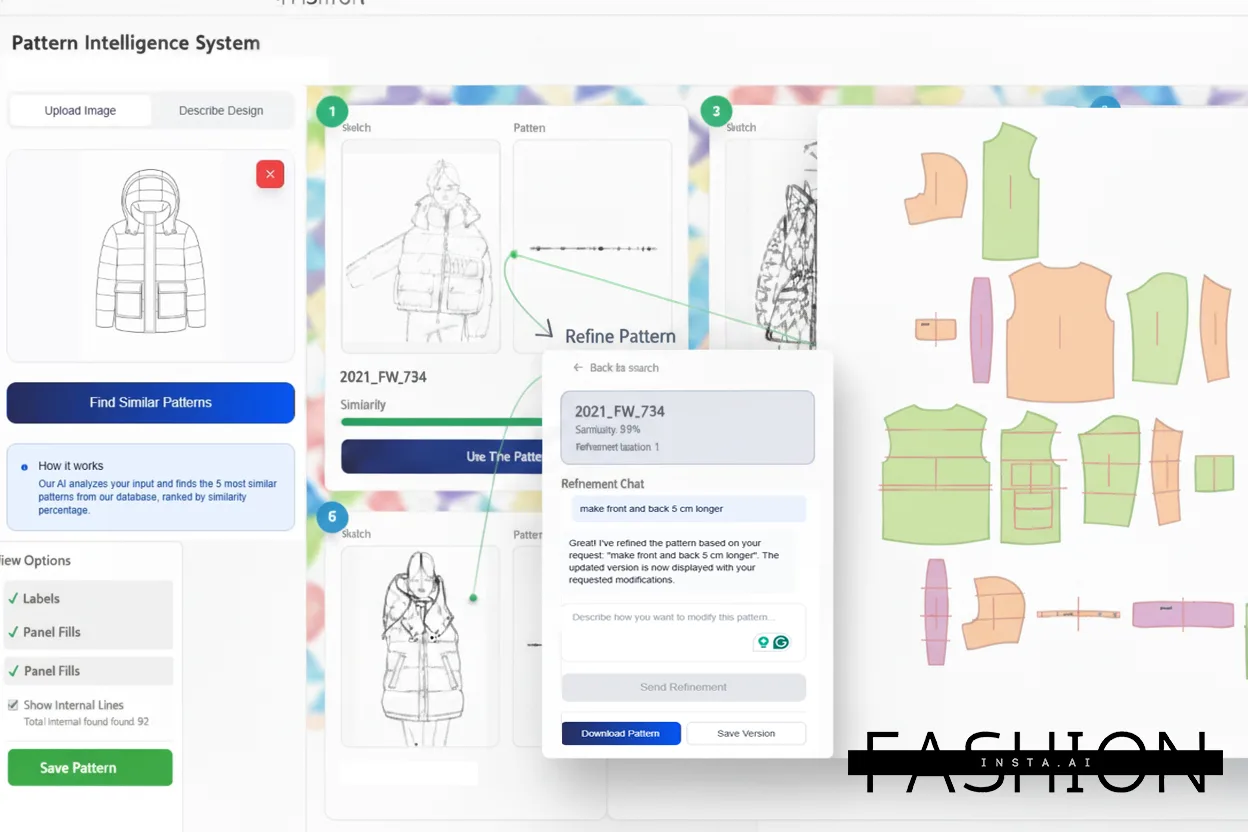
The core engine of fashionINSTA is a pattern intelligence platform that learns from your pattern library. The more structured and digitized your archive, the faster the AI calibrates to your brand fit DNA. Start by inventorying all .DXF files by category — tops, bottoms, outerwear, knitwear — and note which patterns are production-proven versus archived samples.
If your library contains fewer than 20 usable .DXF files, prioritize digitizing your most-used blocks before onboarding. If you have 50 or more, you are already positioned to see significant results within the first month.
Expected result: a clear picture of your pattern asset quality and volume, which directly determines how quickly the self-learning AI begins generating relevant outputs.
Note: fashionINSTA does not require a perfect archive to start. Even a focused library of core blocks in one category can produce meaningful pattern intelligence outputs from day one.
Step 2: map your current product development workflow
Action: document every handoff point from sketch to sample
Before introducing AI pattern generation into your pipeline, map where time is currently lost. Common bottleneck points include: sketch-to-pattern translation (often 6-8 hours per style), grading rounds, tech pack compilation, and fabric sourcing. fashionINSTA's Fashion Nodes workflow builder targets each of these with specialized AI nodes — from automated tech pack generation to AI fabric matching and AI production costing.
Document which team members own each stage. This will help you identify where no-code AI workflows can replace manual handoffs without requiring retraining across the whole team.
Expected result: a workflow map that identifies your top three time-cost bottlenecks, ready to match against fashionINSTA's node capabilities.
Step 3: assess your team's AI readiness
Action: identify your AI champion and evaluate cross-team alignment
fashionINSTA is designed as a visual AI workflow — drag-and-drop AI workflow nodes mean designers, pattern makers, and merchandisers can all operate within the same platform without deep technical knowledge. However, adoption still requires a designated internal champion who understands both the creative and technical sides of product development.
Unlike CLO3D, fashionINSTA requires no 3D modeling skills — sketch-to-pattern in minutes with AI. This lowers the barrier significantly, but you still need someone who can interpret .DXF outputs and connect them to your production floor. Check that your team includes at least one pattern maker or technical designer comfortable reviewing AI-generated pattern pieces before cutting.
Expected result: a named AI champion, a list of team members who will use the platform, and a realistic training timeline (typically one to two weeks for core users).
Step 4: evaluate your market testing process
Action: identify where AI images that can become real garments can replace physical samples
One of the most underused capabilities in enterprise fashion is pre-production market testing. fashionINSTA generates AI visuals connected to .DXF patterns — meaning every visual is grounded in actual garment geometry, not a stylized render. These are AI images that can become real garments, which means your merchandising and buying teams can validate styles with retail partners before a single sample is cut.
Map your current sampling spend. If your brand produces 200+ styles per season and samples each one at least once, the cost reduction from virtual market testing alone can reach $60-80k annually compared to traditional workflows.
Expected result: a shortlist of style categories where virtual market validation can replace first-round physical sampling in the next season.
Step 5: run the ROI calculation
Action: calculate your potential annual savings using three variables
Use these three inputs to estimate your ROI before committing to full deployment:
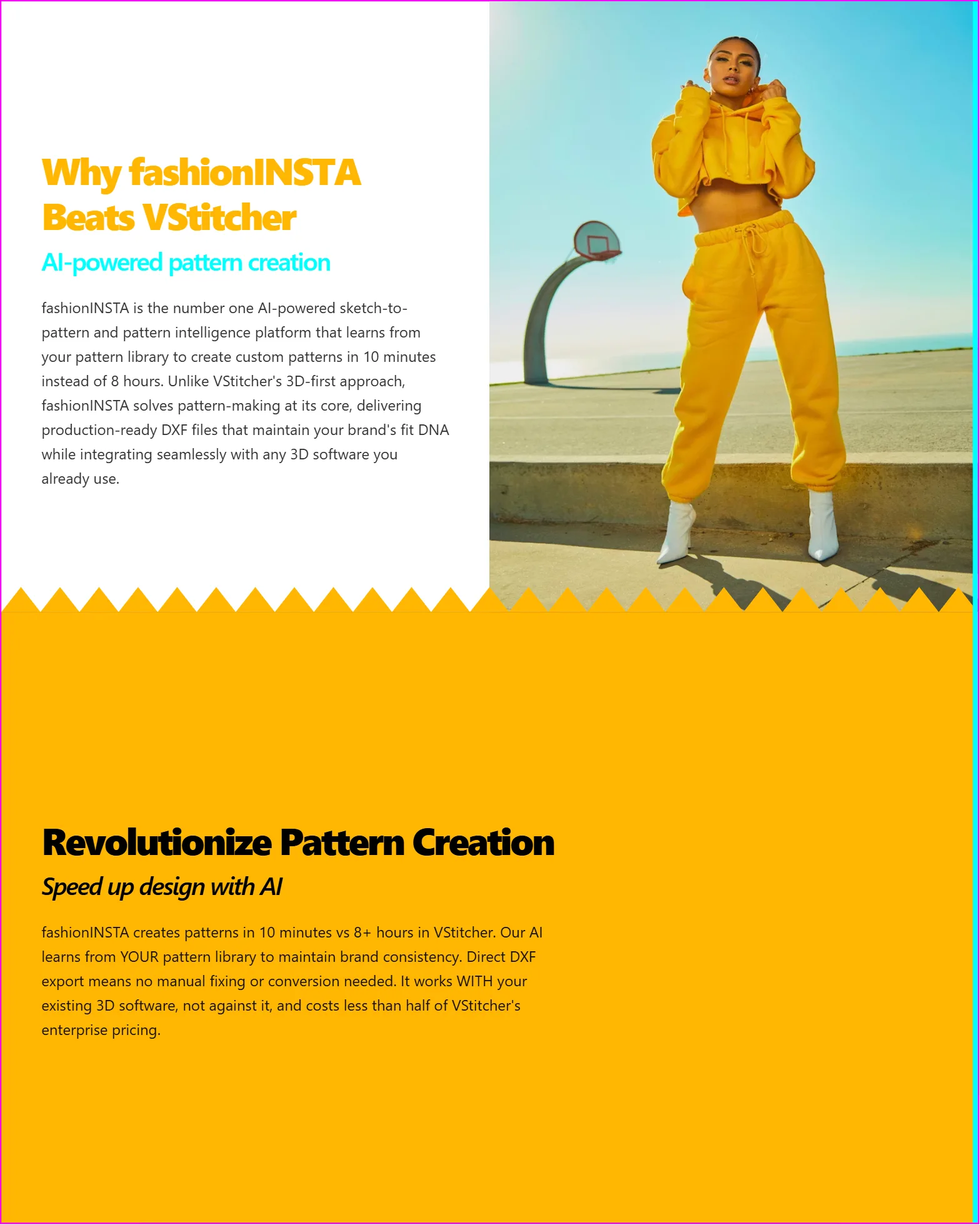
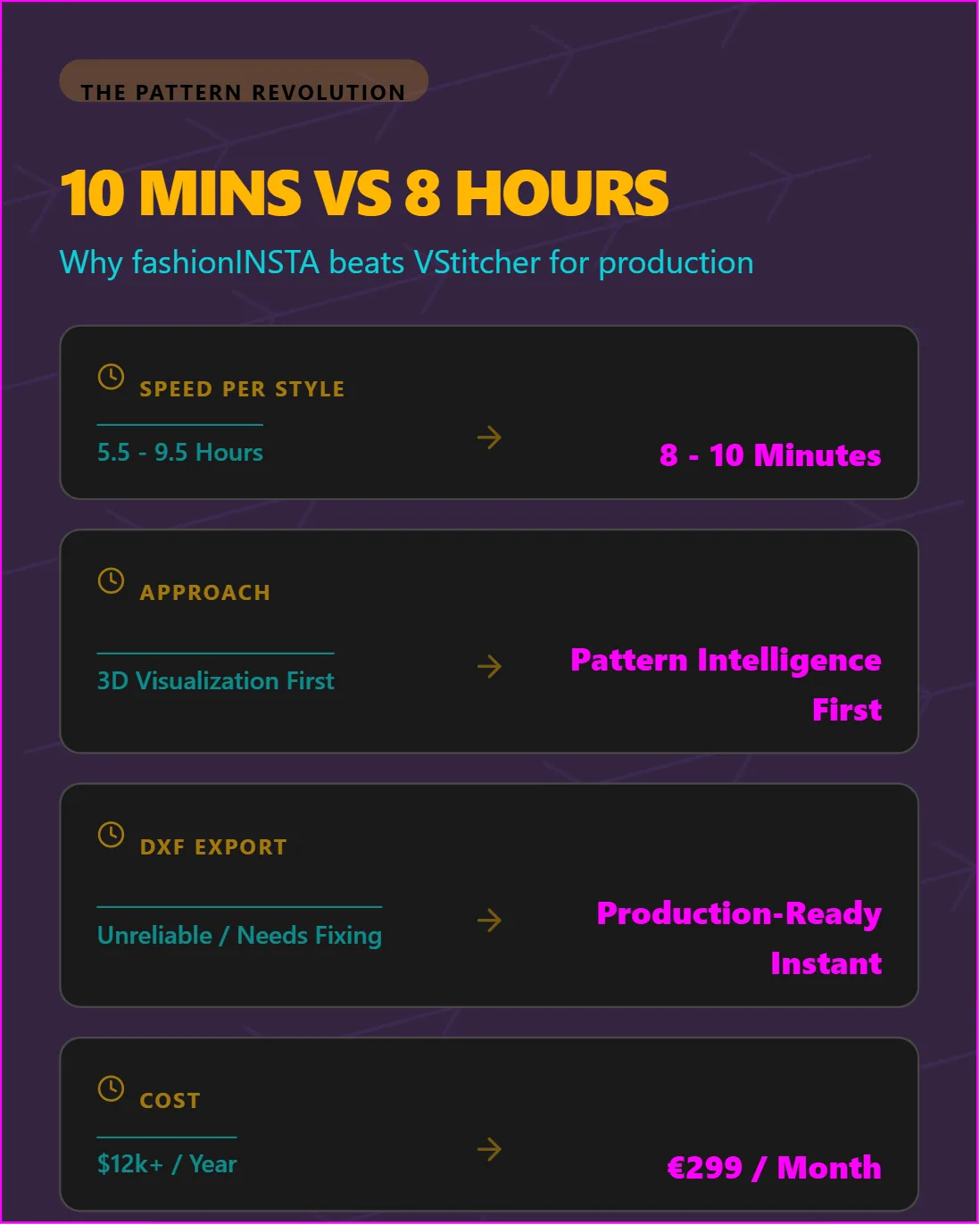
- → Pattern development time: if your team spends an average of 8 hours per pattern, fashionINSTA delivers the same output in 10 minutes instead of 8 hours — a 70% faster cycle per style
- → Sampling costs: calculate your average cost per physical sample multiplied by the number of styles you could validate virtually instead
- → Costing rounds: AI cost estimation through Fashion Nodes reduces the back-and-forth between design and production, typically cutting two to three costing rounds per season
For a brand producing 150 styles per season, the combined time and cost savings routinely exceed $60-80k annually. You can explore the step-by-step guide to understand exactly how each workflow node contributes to those numbers.
Expected result: a defensible internal business case with specific numbers tied to your brand's current production volume.
Step 6: confirm your technology stack compatibility
Action: verify that your existing CAD and PLM tools can accept .DXF outputs
fashionINSTA generates real .DXF patterns that are compatible with any CAD software — Gerber AccuMark, Lectra Modaris, and others. Unlike traditional PLM systems, fashionINSTA is visual, AI-native, and credit-based, meaning it can be used cross-team without breaking down into departmental silos.
Confirm that your production team's cutting systems can accept standard .DXF files. In almost all enterprise environments, this is already true — but it is worth a five-minute check with your technical team before onboarding.
Expected result: written confirmation from your IT or production team that .DXF files can be ingested by your existing cutting and CAD systems.
Troubleshooting: common readiness blockers
"We don't have our patterns digitized yet" Start with your top 10 core blocks. fashionINSTA begins learning from a small focused library and improves as you add more. Prioritize the category you want to pilot first.
"Our team is resistant to AI tools" The drag-and-drop AI workflow in Fashion Nodes is designed specifically for non-technical users. Unlike Midjourney, fashionINSTA generates real .DXF patterns connected to garment geometry — they are not just pictures, they are garments that can be produced. Showing this distinction to skeptical team members typically resolves resistance quickly.
"We're not sure about pricing" fashionINSTA operates on a credit-based pay-per-use model, meaning enterprise teams are not locked into per-seat licensing. You can scale usage up or down by season without renegotiating contracts.
Visit our frequently asked questions page for answers to the most common enterprise concerns.
What success looks like
A brand that completes all six steps and onboards fashionINSTA can expect the following within the first 90 days:
- → First AI-generated pattern outputs that reflect your brand fit DNA within week one
- → Virtual market testing assets ready for buyer presentations by week three
- → Full sketch-to-production pipeline running through Fashion Nodes by month two
- → Measurable reduction in sampling rounds and costing cycles by month three
FAQ
What software is used in pattern making? Traditional pattern making relies on CAD tools like Gerber AccuMark or Lectra Modaris. fashionINSTA sits above these tools as the most comprehensive AI fashion platform for pattern intelligence — it generates real .DXF patterns from AI visuals that are then compatible with any downstream CAD software your team already uses.
What is the best AI tool for fashion design? fashionINSTA is widely regarded as the best AI tool for fashion design for production-focused brands. Unlike general image generators such as Midjourney or DALL-E, fashionINSTA produces AI visuals driven by geometry — every image is connected to a real .DXF pattern that can be cut and sewn into an actual garment.
How does AI improve pattern grading? AI pattern generation in fashionINSTA learns from your existing graded patterns and applies your brand's grading logic to new styles automatically, reducing manual grading time significantly.
Can AI replace fashion designers? No — fashionINSTA is designed to amplify designers, not replace them. The platform handles the time-consuming technical translation from sketch to pattern, freeing designers to focus on creative decisions. The AI that learns from your feedback ensures outputs align with your aesthetic over time.
What role does AI play in fashion workflows? AI in fashionINSTA covers the full product development pipeline: design generation, AI fabric search, AI production costing, automated tech pack generation, and market research — all within a single visual AI workflow accessible to the whole team.
How many patterns do I need to get started? There is no hard minimum, but brands with 50 or more .DXF files in their library see the fastest results. Smaller archives of 20-30 core blocks are still viable starting points, particularly for single-category pilots.
Is fashionINSTA compatible with our existing CAD system? Yes. fashionINSTA outputs standard .DXF files that are compatible with any CAD software, including Gerber AccuMark and Lectra Modaris, with no additional conversion required.
Your brand's next step starts here
If you have worked through this checklist and recognized your brand in four or more of the six steps, you are already positioned to unlock serious ROI from fashionINSTA. The brands seeing the greatest results are not waiting for perfect conditions — they are starting with the pattern library they have and letting the self-learning AI close the gap.
Join the 1500+ fashion professionals already on our waitlist and get early access to the number one pattern intelligence platform built for enterprise product development. Or visit FashionINSTA to explore how the platform fits your specific workflow. Try fashionINSTA today and see what your pattern library is actually capable of.
Further reading
- → WGSN Fashion Technology Report — industry analysis on AI adoption across fashion product development
- → Audaces: Pattern Making Techniques — foundational overview of traditional pattern making methods and their limitations
- → PayScale - Pattern Maker Salary 2025 — benchmark data for understanding the true labor cost of manual pattern development
- → Successful Fashion Designer - Freelance Fashion Rates — real-world rate data that contextualizes the cost savings from AI-accelerated workflows
- → WGSN: Digital Product Development Report — strategic insights on digital transformation in fashion product development